Korean Face Yoga, Honestly: Does 중안부 운동 Actually Work?
Your Korean feed is full of it right now — five-minute 'midface lifting' routines that promise to take ten years off, with dermatologists themselves doing them on camera. Here's what the science actually shows, what it quietly can't do, and the one mistake that makes it backfire.

If you follow even a few Korean beauty accounts, you've seen it by now: someone in their forties, pressing two fingers into their cheeks, lifting, and explaining — with total conviction — that this five-minute routine is why they "still get carded." The hashtag is #중안부운동 (jung-an-bu undong, "midface exercise"), and right now it is everywhere — Threads, Instagram reels, YouTube. Even Harper's Bazaar Korea ran a piece on a five-minute daily lifting routine that, it claims, dermatologists themselves do.
It's free, it requires no products, and the before-and-afters are genuinely tempting. So we did what we always do: went looking for what's actually proven, what's overstated, and whether it's worth your five minutes. Here's the honest version.
First, what "중안부 운동" actually means
중안부 (jung-an-bu) is the midface — the middle third of your face, roughly from under the eyes down across the cheeks and around the nose. It matters because it's one of the first areas to show age: the cheek fat that sits high and full when you're young gradually descends, the 광대 (gwang-dae, cheekbone) area loses its lift, and the face starts to read "tired" before it reads "old."
중안부 운동, then, is a set of exercises aimed specifically at that zone — lifting and engaging the muscles under the cheekbones, on the theory that a stronger, more toned midface holds its shape better. It's the Korean, hyper-targeted cousin of what the West calls "face yoga." The Korean framing is very consistent: lift the 광대, and the whole face lifts with it.
That's the pitch. Now the evidence.
What the science actually shows (and it's not nothing)
Here's the part that surprises skeptics: there is real research, and it's cautiously positive.
The headline study is from Northwestern University, published in JAMA Dermatology in 2018 (Alam et al.). Researchers had middle-aged women do a structured 30-minute facial-exercise routine — daily for eight weeks, then every other day through 20 weeks. Dermatologists who rated before-and-after photos found a significant improvement in upper and lower cheek fullness, and the raters' average estimated age of the participants dropped from 50.8 to 48.1 — roughly three years younger.
That's a genuine, measured result. The honest caveats matter just as much, though:
- It was small: 27 women enrolled, and only 16 finished.
- The gains were specifically in cheek fullness — not wrinkles, not jawline, not the whole face.
- It took 20 weeks of near-daily, 30-minute commitment. This is not a "do it twice and glow" situation.
Newer work points the same modest direction. Smaller 2024-era studies on intensive face-yoga programs have measured improvements in facial-muscle tone and skin elasticity, and a research review found facial exercise can increase muscle thickness over time. As Medical News Today summarizes the field: small studies show "some positive effects… but larger studies are needed."
So the fair read is: face yoga produces a real but modest improvement in midface fullness and muscle tone — if you're genuinely consistent for months. The "ten years younger in two weeks" reels are not that.
What it quietly cannot do
This is where the honest line lives, and where most of the hype quietly skips past the truth. Dermatologists are broadly in agreement on the ceiling:
- It can't change your bone structure. The youthful "lift" you see in some before-and-afters is muscle and posture — your underlying skeleton isn't moving.
- It can't tighten genuinely loose skin. Once skin laxity is established, exercise won't re-tighten it (UCLA Health, which calls the overall evidence "slim," and dermatology groups like Westlake are explicit on this).
- It won't reverse true sagging caused by collagen and fat loss — the deeper structural changes of aging. Stronger muscle underneath a deflating, thinning envelope only does so much.
In plain terms: face yoga works on the muscle layer. Aging happens across skin, fat, muscle, and bone. So it can meaningfully help one of four layers — which is real, but partial.
The one mistake that makes it backfire
Here's the part the trend almost never mentions, and the reason to take technique seriously.
Repeatedly creasing your skin in the same spot is, mechanically, how dynamic wrinkles form. So a face-yoga routine done carelessly — scrunching, furrowing, dragging the skin — can, over time, deepen the very lines you're trying to prevent. Dermatologists who are wary of the trend flag exactly this: done wrong, it risks wrinkle-worsening, plus tension headaches and muscle imbalance from overdoing it.
The fix isn't to skip it; it's to do it clean:
- Lift and support, don't crease. Use your fingers to anchor the skin so the muscle works without folding the surface.
- Gentle, not grimacing. You're toning, not straining. If your forehead is bunching, you're recruiting the wrong muscles.
- Always on slip, never on dry drag. A little oil or moisturizer so you're not tugging skin.
- Five to ten minutes is plenty. More is not better here; consistency beats intensity.
So — honestly — is it worth it?
Here's our actual verdict, with no thumb on the scale either way.
Face yoga is real, modest, free, and low-risk when done gently — and the best available evidence says months of consistency buy you a small, genuine improvement in midface fullness and muscle tone. For something that costs nothing and replaces zero steps in your routine, that's a perfectly reasonable "why not."
What it is not is a substitute for the things that actually move the needle on aging: daily sunscreen (the single highest-ROI anti-aging habit there is), a retinoid, good sleep, and — if you want structural change — the procedures the exercises are quietly standing in for. The Korean trend's smartest framing treats 중안부 운동 as a daily maintenance habit, like brushing your teeth — not as a facelift you do with your hands.
If you go in expecting a free, slow, modest toning effect layered on top of real skincare, you'll likely be happy. If you go in expecting the reel, you'll be disappointed — and you might crease a few lines in on the way.
Five minutes, gentle, consistent, and on a layer of moisturizer. That's the honest sweet spot. Everything past that is marketing.
This article is general information, not medical or dermatological advice. The research cited (JAMA Dermatology, 2018; UCLA Health; and subsequent facial-exercise studies) reflects small trials; individual results vary. If you have a skin condition or concern, talk to a dermatologist.
Keep Reading
More Stories
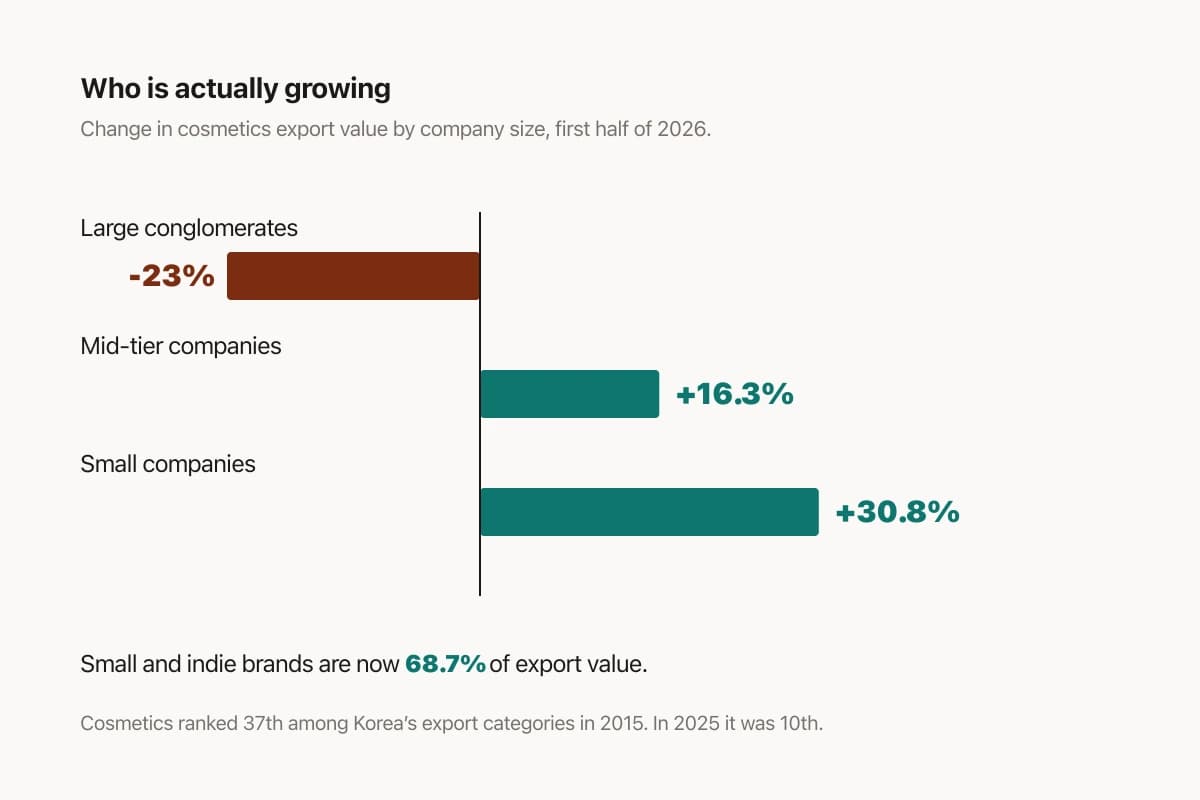
K-Beauty Just Had Its Biggest August on Record. Its Two Largest Companies Went Backwards.
Korean cosmetics exports hit $1.31 billion in August, up 52 per cent — the fastest monthly growth in nearly three years. Almost none of it belongs to AmorePacific or LG Household & Health Care, whose export value fell 23 per cent in the first half. Small brands are now 68.7 per cent of what Korea ships. And China, which took more than half of it five years ago, now takes one seventh.

Is Korea the Plastic Surgery Capital of the World? The Numbers, Honestly
The claim rests on a 2011 survey. ISAPS hasn't published a Korean procedure count since. The figure Korean media reported as an ISAPS finding in 2024 is the one row in its own source table that can't be reproduced — and the standard calculation counts a million foreign patients as if they were Korean.
Glass Skin, Honestly: How Much of K-Beauty's Most Famous Look Is Real?
It's the most screenshotted goal in all of K-beauty — poreless, lit-from-within, smooth as a pane of glass. Here's where the term actually comes from, the richer Korean vocabulary it flattens, and the honest breakdown of how much is skincare, how much is makeup and a ring light, how much is a dermatologist's needle — and how much is just genetics.
The Weekly Dispatch
Korea, curated. Every week.
The best of K-culture, straight from Seoul. Written by people who actually live here.
Free, no spam, unsubscribe whenever.