Korean Webtoons, Explained: The Engine Behind Your Favorite K-Dramas
That show you just binged? It probably started as a comic you scroll on your phone. Itaewon Class, Sweet Home, Hellbound, D.P., All of Us Are Dead, 참교육 — all webtoons first. Here's what webtoons are, why Korea invented them, how they quietly became Hollywood's favorite story farm, and where to start reading.
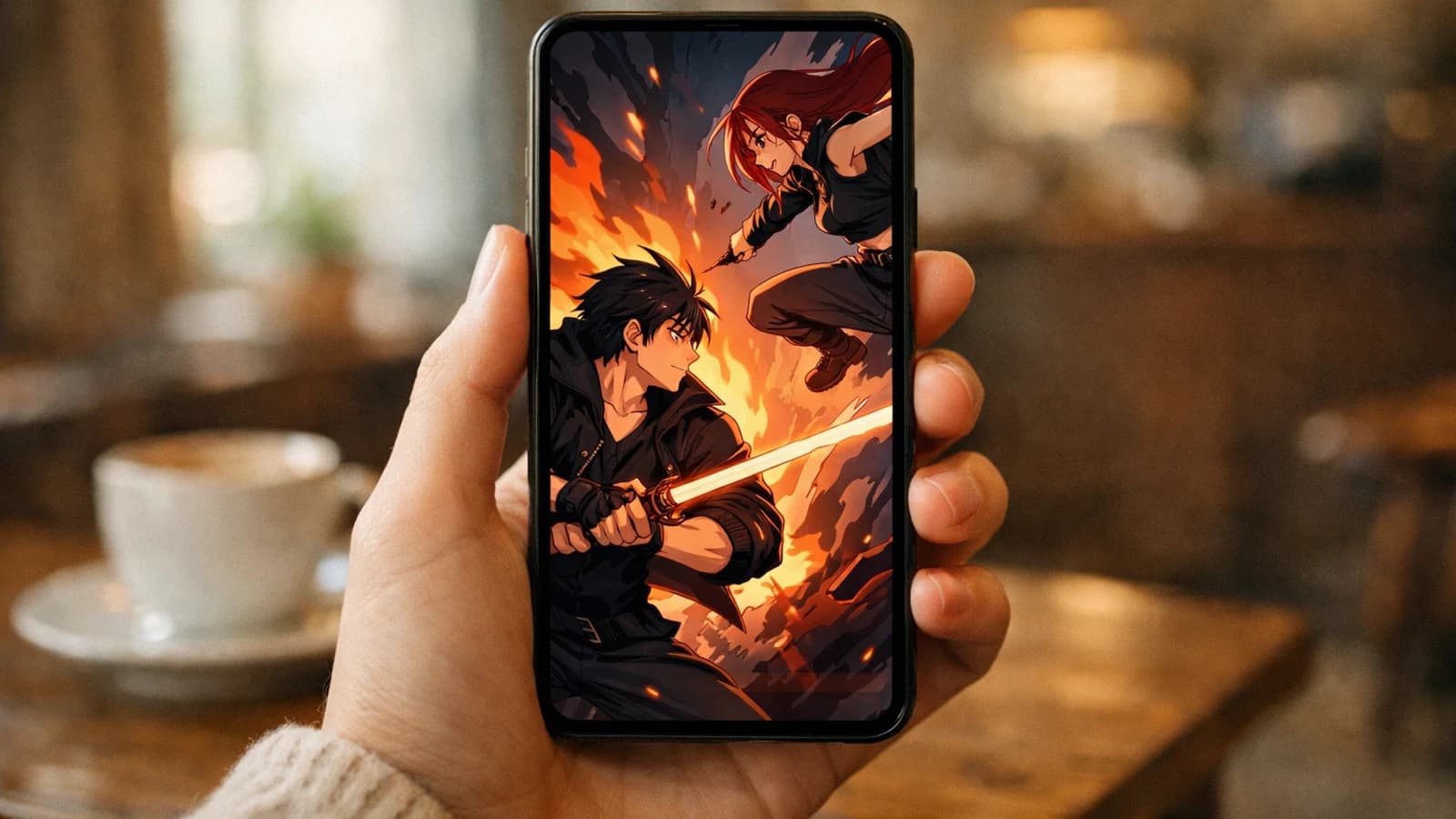
Here's a game you'll lose more often than you'd expect: name a recent Korean hit, and check whether it started as a comic on someone's phone.
Itaewon Class. Webtoon. Sweet Home. Webtoon. Hellbound, D.P., All of Us Are Dead, True Beauty, Moving, The Uncanny Counter. Webtoon, webtoon, webtoon. The Netflix #1 we just broke down — 참교육 (Teach You a Lesson)? Adapted from a webtoon. There is a machine humming underneath the Korean entertainment wave, and most of the world never sees it — because it lives on a vertical scroll, on a phone, one episode at a time.
This is that machine. Here's what a webtoon actually is, why Korea built the format, how it became the most valuable story farm in global entertainment, and where to start if you want to read the next Itaewon Class before it's a show.
So what is a webtoon?
The word is exactly what it looks like: 웹툰 (webtoon) = web + cartoon. But the format is the interesting part.
A webtoon is a digital comic built for a phone. Three things make it different from the manga or American comics you might know:
- You scroll, you don't flip. Instead of laying out panels across a page, a webtoon runs as one long vertical strip you thumb straight down — an "infinite canvas." Artists use that downward motion deliberately: a long empty gap before a jump scare, a slow scroll down a tall building. It's a format designed for the way your thumb already moves.
- It's in full color. Almost all of it, almost always — unlike the black-and-white default of Japanese manga.
- It's serialized and (mostly) free to start. New episodes drop on a schedule, usually weekly, and you can begin reading most series for nothing.
Korea invented this in the early 2000s. As the country wired itself with some of the world's fastest broadband, portals like Daum and then Naver started hosting comics built for the screen rather than the page — and a national habit was born. Today, reading a few webtoon episodes on the subway is as ordinary as scrolling Instagram.
Where you read them — and how they make money
Three names cover most of it:
- Naver Webtoon (네이버 웹툰) — the giant. It runs the dominant Korean service and the global WEBTOON app you may have seen in app stores.
- Kakao — its big rival, through Kakao Webtoon and Kakao Page, with particular strength in genre fiction and novel-to-webtoon adaptations.
- Lezhin (레진코믹스) and others — smaller platforms, often leaning into mature and niche content.
The money model is the genuinely clever bit, and it explains a lot about why webtoons spread the way they did. Most series use "wait or pay" — on Naver it's literally called 기다리면 무료 ("wait and it's free"). You can read up to the latest episode for nothing if you're patient; or you spend a little in-app currency (쿠키, "cookies," on Naver; 캐시 on Kakao) to unlock the next chapters early through 미리보기 ("preview ahead"). Free entry for everyone, tiny micro-payments harvested from impatience. It turns out a lot of people will pay 100 won not to wait three days to find out what happens.
Why the format won
It's tempting to think webtoons succeeded just because phones did. But the deeper reason is that the format solved problems print comics never could:
- It fits the thumb. Vertical scroll is effortless on a phone in a way that pinch-zooming a manga page never is. Comics stopped being something you sat down with and became something you did in a two-minute gap.
- Free removed the gatekeeper. No bookstore, no $4 single issue, no commitment. You sample ten series on a Tuesday and get hooked on one.
- The algorithm does the discovery. Like any good app, the platforms surface what's rising, so a nobody artist with a great first episode can go national in a week.
The result is that Korea did something the West spent decades failing to do: it made comics a mainstream, daily, all-ages habit again. Naver's platform alone has reported topping 85 million monthly readers across more than 100 countries, and in June 2024 its parent company, Webtoon Entertainment, listed on the Nasdaq (ticker WBTN) at roughly a $2.7 billion valuation — a Korean comics format, IPO'd on Wall Street.
The part you actually came for: the K-drama engine
Here's why this matters even if you never read a single webtoon. Korea's screen industry treats webtoons as a pre-tested IP farm, and it is the not-so-secret reason the hit rate feels so high.
Think about what a popular webtoon hands a producer:
- A proven story. It already survived the harshest focus group there is — millions of readers voting weekly with their attention.
- A built-in audience. The fanbase exists before the show airs, primed to watch and to argue about the casting.
- A storyboard, basically. The art direction, the character designs, the big set-piece moments — already drawn.
So the adaptations keep coming, and they keep landing. A partial roll-call, all webtoons first:
- Itaewon Class (이태원 클라쓰) — the revenge-and-redemption restaurant saga.
- Sweet Home (스위트홈) — apartment-block monster horror.
- Hellbound (지옥) — supernatural dread from director Yeon Sang-ho.
- D.P. — the military-deserter-hunting drama that started a national conversation.
- All of Us Are Dead (지금 우리 학교는) — the high-school zombie smash.
- Moving (무빙) — the superpowered Disney+ epic, written for the screen by the webtoon's own creator, Kang Full.
- True Beauty, The Uncanny Counter, Weak Hero, Extraordinary You, My ID Is Gangnam Beauty — and a long tail beyond them.
And it isn't only television. 신과함께 (Along with the Gods), a Naver webtoon by Joo Ho-min, became two films that each drew more than 10 million moviegoers in Korea — a "쌍천만" double-record, and among the highest-grossing Korean films ever made.
This is the loop, and it feeds itself: a webtoon proves a story, the drama makes it global, the show sends new readers back to the source, and the platform's next hit is already climbing the charts. When we explained 참교육 — a webtoon about a teachers'-rights strike force that became Netflix's #1 show worldwide — that whole arc happened in a matter of months. If you want the wider view of what's hitting right now, our June 2026 K-drama watchlist is the map; a striking share of it traces back to a scroll.
Where to start reading
You don't need Korean, and you don't need to spend anything. Download the WEBTOON app (Naver's global edition) or browse it in a browser, and start with the Originals and the top-ranked charts. A few globally famous gateways:
- Tower of God (신의 탑) — the sprawling fantasy that helped define the platform abroad.
- Lore Olympus — a wildly popular Western-made original, proof the format travelled.
- Then just follow the rankings — the beauty of "wait or pay" is that browsing costs nothing.
If you're newer to Korean storytelling generally and want the screen version first, our K-dramas for beginners guide is the gentler on-ramp — and now you'll know that a good number of those shows were comics before they were anything else.
The quiet engine
The flashy part of the Korean wave is the part you can see — the idols, the red carpets, the Netflix Top 10. The webtoon is the part you can't: a vast, churning library of stories being drafted, tested, and proven by millions of readers every single week, years before a camera ever turns on.
So the next time a Korean show comes out of nowhere to eat the global charts, do the small satisfying thing. Open the app, search the title, and watch the little label appear: 원작 웹툰 — "based on the original webtoon." It was scrolling on a phone long before it was on your screen.
—The Editors
Sources: webtoon-to-screen adaptations cross-checked against TIME, Netflix, Den of Geek, and Comics Beat reporting (Itaewon Class, Sweet Home, Hellbound, D.P., All of Us Are Dead, True Beauty, Moving, The Uncanny Counter, and others), with 참교육's webtoon origin verified in our own explainer; 신과함께 confirmed as Joo Ho-min's Naver webtoon and its two 10-million-admission films via Naver Webtoon and Korean box-office records. Platform scale and the June 2024 Nasdaq IPO of Webtoon Entertainment (ticker WBTN, ~$2.7B valuation, $315M raised) verified against Reuters, CNBC, and the company's SEC filings. Korean terms verified against primary Korean-language sources.
Keep Reading
More Stories

Korea's 《야구여왕》 Built a Women's Baseball Team Out of Olympians, Lost 36–0, and Now Has to Win 60 Per Cent or Be Disbanded
채널A's sports-variety series is managed by Choo Shin-soo on his days off, captained by an Olympic handball medallist, and has a catcher who kept goal for the unified Korean ice hockey team at PyeongChang. On 17 September a 22-year-old golfer — drafted 115th by New York in America's new women's professional league, and never signed — caught for the first time, hit her first home run and closed out the game. The team is 5–2. The sport it plays has thirty elite women registered in the entire country.

Netflix's 《스캔들》 Is Officially a Remake of the 2003 Film. Its Director Says He Went Back to the 1782 Novel Instead.
All eight episodes drop at 17:00 KST on 18 September, with Son Ye-jin as the widow who runs the game, Ji Chang-wook as the rake she runs it with, and Nana as the woman they wager on. Netflix's own announcement credits Lee Jae-yong's 《스캔들-조선남녀상열지사》 as the source. Jung Ji-woo told the press conference he didn't start from that film at all, but from Laclos — and rewrote the relationships until, he says, 'a great deal changed.' Here is what is known the day before, and what has been said about it that isn't quite true.
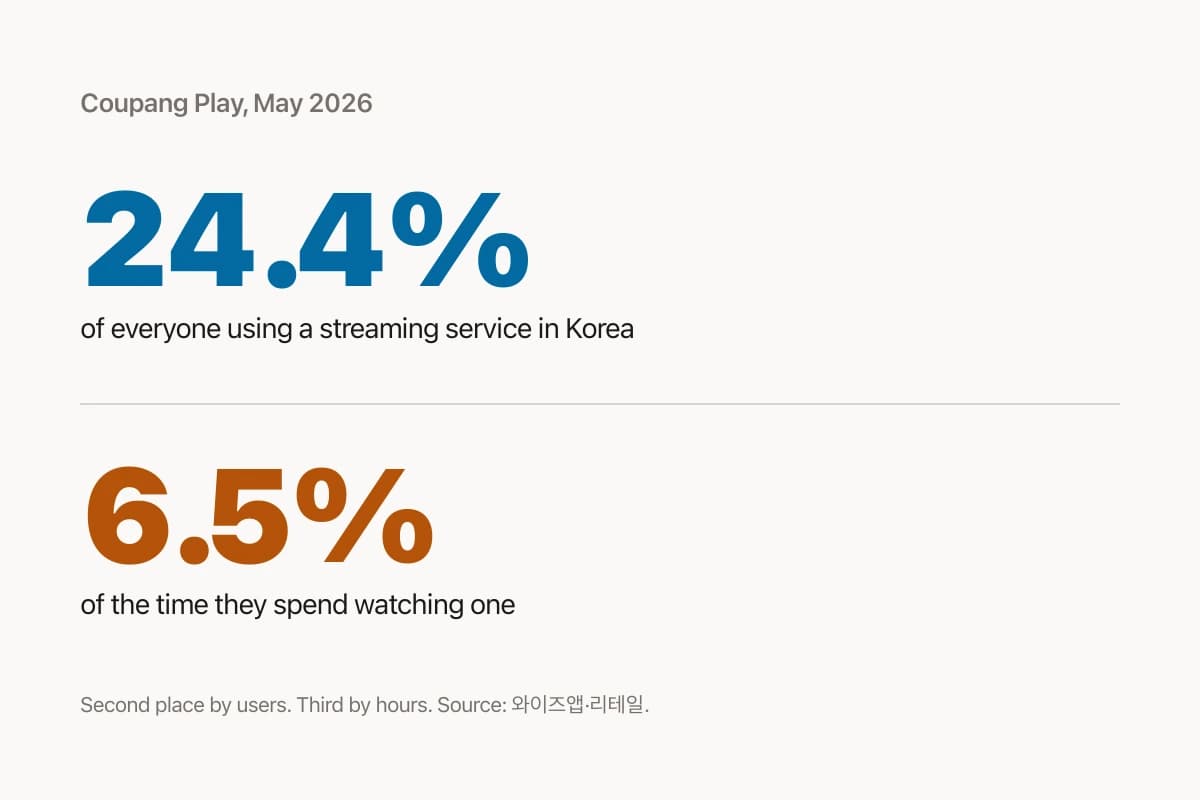
Korea's No. 2 Streaming Service Is One Almost Nobody Watches. It Just Made the Biggest Show on Korean Television.
Coupang Play has a quarter of Korea's streaming users and six and a half per cent of its viewing time — the signature of a service people are subscribed to rather than watching. Then Kim Hye-soo and Cho Yeo-jeong turned up in a black comedy produced by the Squid Game director's studio, and it became the most-watched thing the platform has ever made. It is free to watch in Korea, licensed to Viu everywhere else, and the Western press that decides which Korean shows go global still hasn't looked at it.
The Weekly Dispatch
Korea, curated. Every week.
The best of K-culture, straight from Seoul. Written by people who actually live here.
Free, no spam, unsubscribe whenever.