Teach You a Lesson, Explained — The Netflix Hit That a Real Politician Wants to Build (June 2026)
It's a pulpy revenge fantasy about a government bureau that disciplines out-of-line students by force — and within a week of premiering it was the most-watched non-English show on Netflix in the world. Then a newly elected superintendent proposed building its fictional agency for real. Here's what 참교육 actually is, why it hit such a nerve in Korea, and where the fantasy stops.

In the first week of June 2026, the most-watched non-English series on Netflix in the world was a Korean show about teachers. Not a cozy classroom drama — a bruising, deliberately provocative revenge fantasy in which a special government bureau is given the legal power to discipline out-of-line students, parents, and even teachers, by force. It is called 참교육 (Teach You a Lesson), and it went to #1 in Korea within a day and to the top of Netflix's global non-English chart within the week.
Then something stranger happened. A newly elected provincial superintendent of education looked at the fictional agency at the center of the show — the 교권보호국, a "Teachers' Authority Protection Bureau" — and proposed building a real one.
Here's what the show is, who's in it, why it struck the nerve it did, and where the fantasy quietly parts ways with reality.
Quick orientation. Teach You a Lesson (Korean title: 참교육 / Chamgyoyuk, literally "true education") premiered on Netflix worldwide on June 5, 2026. It runs 10 episodes, is rated 19+ (청소년 관람불가), and is directed by Hong Jong-chan — the director of Juvenile Justice. It's adapted from the hit Naver webtoon 《참교육》 (English title Get Schooled) by Chae Yong-taek and Han Ga-ram.
The premise — and the pun in the title
The setup is pure comic-book wish-fulfillment. After years of headlines about collapsing discipline in Korean schools, the government stands up a new agency, the 교권보호국 (Teachers' Authority Protection Bureau), and gives its agents extraordinary powers: they answer to no ordinary law — not even the Child Welfare Act that, in real life, governs how adults may treat children — and they show up at schools to deal out hard, physical, frequently violent justice to anyone "crossing the line." Bullies, abusive parents, predatory teachers: the Bureau handles them all, on-screen, satisfyingly, and without paperwork.
The title is the key to the whole thing. 참교육 literally means "true education." But in everyday Korean internet slang, 참교육 has come to mean something closer to teaching someone a hard lesson — putting a smug, line-crossing person firmly in their place. The show lives entirely in that second meaning, which is exactly why the English title is Teach You a Lesson rather than a literal translation. The joke, and the bait, is that the "real education" on offer is a beating.
That conceit is provocative on purpose. The Netflix logline sells it as "유쾌, 상쾌, 통쾌" — fun, refreshing, cathartic. Critics and a fair number of teachers have used a sharper word: alarming. Both readings are correct, and the gap between them is the most interesting thing about the show.
The cast
The pedigree is heavier than the premise might suggest.
- 김무열 (Kim Mu-yeol) plays 나화진 (Na Hwa-jin), the Bureau's lead inspector and the show's blunt instrument. (The role was reportedly first offered to Kim Nam-gil, who passed; Kim Mu-yeol — of The Outlaws franchise — makes it his own.)
- 이성민 (Lee Sung-min) — one of Korea's most reliable heavyweights, from Reborn Rich and Misaeng — plays 최강성 (Choi Kang-seong), the Minister of Education who dreams up the Bureau and turns it loose.
- 진기주 (Jin Ki-joo) plays the agent 임한림 (Im Han-rim), and 표지훈 (Pyo Ji-hoon) — better known as P.O of Block B — plays fellow agent 봉근대 (Bong Geun-dae).
Behind the camera, Hong Jong-chan is the draw. He directed Juvenile Justice, Netflix's chilly, serious 2022 drama about the juvenile court system — which makes him a pointed choice for a show that takes the opposite tack on the same subject: where Juvenile Justice was sober and procedural, Teach You a Lesson is loud, pulpy, and unapologetically cathartic. The screenplay is by Lee Nam-gyu and collaborators, adapting a webtoon that was itself a long-running, sometimes controversial sensation.
Why it became a phenomenon
The numbers came fast. Teach You a Lesson hit #1 on Netflix Korea's daily Top 10 the day after it dropped, and by the following week Netflix's official global ranking listed it as the most-watched non-English TV show in the world. For a 10-episode, 19-rated swing at a single national grievance, that's a remarkable reach.
The mechanics of the appeal are simple, and worth being honest about. This is catharsis television. Korea has spent three years watching the question of teacher authority curdle into something genuinely painful (more on that below), with no satisfying resolution in sight. Teach You a Lesson offers the resolution that real life refuses to: a swift, physical, no-consequences reckoning, delivered weekly. It is the same engine that powered another of June's big hits, the Joseon-villainess fantasy My Royal Nemesis — a wronged figure getting to even the score on their own terms. Teach You a Lesson just points that engine at a real and raw social wound.
That's also why, for all the global numbers, the show's center of gravity is unmistakably domestic. The fantasy only fully lands if you know the reality it's answering.
The real nerve it hits
To understand why a show like this exists — and why a politician would respond to it the way one did — you have to understand what "교권" (gyogwon, roughly "teachers' authority/rights") has come to mean in Korea.
In July 2023, a young first-year teacher at Seoi Elementary School (서이초) in Seoul died — widely reported as a suicide, after what colleagues described as relentless complaints from parents. Her death became a national touchstone. Through the second half of 2023, tens of thousands of teachers rallied in central Seoul, week after week, in the largest teacher movement in modern Korean history. Their core grievance was specific and, to outsiders, surprising: teachers said that when they tried to discipline a disruptive student, they risked being reported for child abuse (아동학대) under the Child Welfare Act — and that the mere accusation could end a career, regardless of merit.
The protests produced real legislation — a package of teacher-protection laws often called the 교권회복 4법 — passed in September 2023. But a year on, surveys of teachers found most saw little change on the ground; in one poll, 77.4% said the classroom hadn't improved. The malicious-complaint problem persisted, and the wound stayed open. The grievance itself — the relentless 민원 complaints, the absurd parental demands, and the toll they take on teachers — is the subject of our deep dive on Korea's monster-parent problem.
This is the soil Teach You a Lesson grows in. Its fictional Bureau is, quite literally, a power fantasy about the one thing the real reforms couldn't deliver: an authority that can act, immediately and without fear of being sued back. When the show's agents stride into a school and the rules simply do not apply to them, the catharsis isn't abstract. It's aimed squarely at the helplessness real teachers have spent three years describing.
Which is also why the reaction among teachers has been the most telling — and the most divided. Many have called it 통쾌 (cathartic), a rare sight of their reality dramatized and avenged. Others have found it almost unwatchable for the same reason. Teacher-press outlets reported educators skipping certain episodes because they hit too close to home, and pointedly noting that a bureau operating above the law — corporal punishment tolerated, child-welfare protections suspended — is not, whatever else it is, "educational." The show knows this. It just isn't very interested in slowing down to dwell on it.
When the fantasy walked into a press conference
Here is where June 2026 got genuinely unusual.
On June 12, 안민석 (Ahn Min-seok) — newly elected as Superintendent of Education for Gyeonggi Province, the country's most populous — posted on social media that he had watched the entire series, and proposed something concrete: a public debate on whether to create a real "Gyeonggi-style 교권보호국" within the provincial education office. He framed it as a way to "restore the school community" so that "students look forward to coming to school and teachers can teach," and said he'd wait for arguments for and against.
Within a day it was national news, carried by Munhwa Ilbo, Hankyung, Herald Economy, Money Today, Edaily, and others: the drama's revenge fantasy, proposed as policy. It's a striking measure of how hard the show landed — a piece of pulp fiction becoming the reference point for an actual education official's first major proposal.
It's worth being clear-eyed about what that proposal is and isn't. A real "교권보호국" would not be the show's above-the-law strike force; no provincial office can suspend the Child Welfare Act or sanction the violence the drama treats as a feature. What a real bureau could plausibly be is administrative — a dedicated support body to handle teacher-rights complaints, shield educators from frivolous abuse accusations, and centralize the protections the 2023 laws left scattered and toothless. That's a real and arguably overdue idea. It's also, notably, the unglamorous bureaucratic version of the thing audiences are cheering. The fantasy is the fist; the policy is a filing system. Whether the public debate Ahn proposed can hold that distinction — or whether the show's catharsis quietly sets the expectations — is the part worth watching.
The honest take
Teach You a Lesson is not subtle, and it isn't trying to be. It's a loud, violent, expertly made wish-fulfillment machine, and on the terms it sets for itself it works — which is precisely why it raced to the top of Netflix worldwide. If you want a tight, propulsive binge with a real argument buried inside it, queue it. Just go in knowing the show is selling a fantasy, and that the people closest to its subject — Korea's actual teachers — are the ones most visibly torn about whether the fantasy helps.
What makes it more than a guilty pleasure is the conversation it dragged into daylight. A drama doesn't usually become a policy proposal in its first week. This one did, because it's plugged into a grievance the country never resolved. The show gives that grievance a fist to root for. The harder, slower question — what real protection for teachers, and real safety for students, actually looks like — is the one the public debate will have to answer without a script.
If you're newer to the genre and wondering where a show this intense fits, our K-dramas for beginners guide is the gentler on-ramp, and our June 2026 watchlist rounds up everything else worth streaming this month.
Where and how to watch
- Platform: Netflix, worldwide, with English subtitles. All 10 episodes are streaming.
- Rating: 19+ (청소년 관람불가) — it earns the rating; expect sustained violence.
- Best for: viewers who like Juvenile Justice or The Glory but want the catharsis those shows withhold. If you'd rather have the moral complexity than the payoff, watch Hong Jong-chan's Juvenile Justice instead — and notice how differently the same director handles the same subject.
A revenge fantasy about teachers became the most-watched show in the world and then a real political proposal, all in the span of a week. That's not an accident of the algorithm. It's what happens when a piece of pulp finds a wound a whole country has been waiting to see someone, anyone, do something about.
—The Editors
Sources: title, platform, premiere date, episode count, rating, director, screenwriter, source webtoon, and principal cast and roles (Kim Mu-yeol as Na Hwa-jin, Lee Sung-min as Education Minister Choi Kang-seong, Jin Ki-joo as Im Han-rim, Pyo Ji-hoon as Bong Geun-dae) verified against Netflix's official listing, English Wikipedia, Namu Wiki, IMDb, and MyDramaList. Netflix ranking via Netflix's official Top 10 and Korean press (Daum/Yonhap). Superintendent-elect Ahn Min-seok's June 12 proposal of a "Gyeonggi-style 교권보호국" verified across Munhwa Ilbo, Hankyung, Herald Economy, Money Today, and Edaily (June 13–14, 2026). Teacher-rights backdrop — the July 2023 Seoi Elementary teacher's death, the 2023 teacher protests, the 교권회복 4법, and the persistence of malicious child-abuse complaints — verified against Yonhap, Asia Today, and Korean education-press reporting. Korean terms and names verified against primary Korean-language sources.
Cover and card images: Teach You a Lesson (참교육) promotional artwork © Netflix, used here for editorial coverage.
Keep Reading
More Stories

Korea's 《야구여왕》 Built a Women's Baseball Team Out of Olympians, Lost 36–0, and Now Has to Win 60 Per Cent or Be Disbanded
채널A's sports-variety series is managed by Choo Shin-soo on his days off, captained by an Olympic handball medallist, and has a catcher who kept goal for the unified Korean ice hockey team at PyeongChang. On 17 September a 22-year-old golfer — drafted 115th by New York in America's new women's professional league, and never signed — caught for the first time, hit her first home run and closed out the game. The team is 5–2. The sport it plays has thirty elite women registered in the entire country.

Netflix's 《스캔들》 Is Officially a Remake of the 2003 Film. Its Director Says He Went Back to the 1782 Novel Instead.
All eight episodes drop at 17:00 KST on 18 September, with Son Ye-jin as the widow who runs the game, Ji Chang-wook as the rake she runs it with, and Nana as the woman they wager on. Netflix's own announcement credits Lee Jae-yong's 《스캔들-조선남녀상열지사》 as the source. Jung Ji-woo told the press conference he didn't start from that film at all, but from Laclos — and rewrote the relationships until, he says, 'a great deal changed.' Here is what is known the day before, and what has been said about it that isn't quite true.
Korea's No. 2 Streaming Service Is One Almost Nobody Watches. It Just Made the Biggest Show on Korean Television.
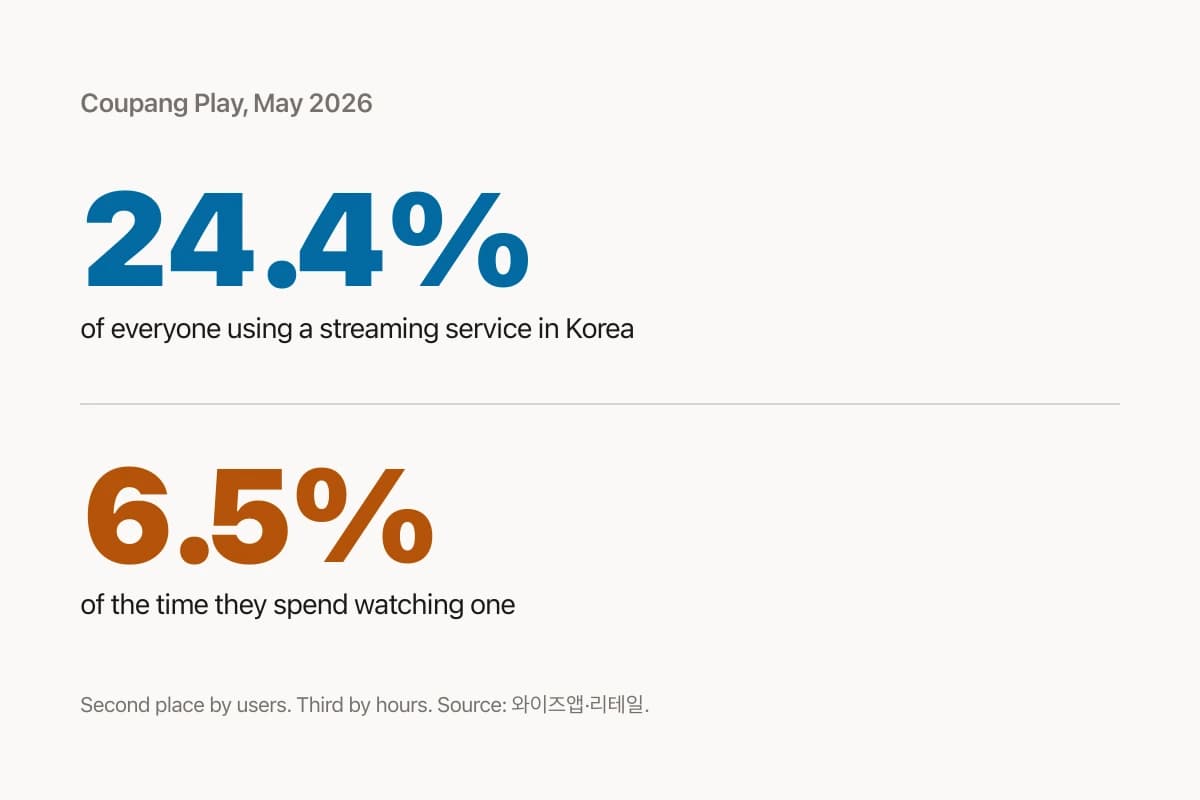
Coupang Play has a quarter of Korea's streaming users and six and a half per cent of its viewing time — the signature of a service people are subscribed to rather than watching. Then Kim Hye-soo and Cho Yeo-jeong turned up in a black comedy produced by the Squid Game director's studio, and it became the most-watched thing the platform has ever made. It is free to watch in Korea, licensed to Viu everywhere else, and the Western press that decides which Korean shows go global still hasn't looked at it.
The Weekly Dispatch
Korea, curated. Every week.
The best of K-culture, straight from Seoul. Written by people who actually live here.
Free, no spam, unsubscribe whenever.