Call 119 for a Paper Cut: How Korea's 'Monster Parents' Broke the Classroom
A parent wrote the teacher's exam for her. Another demanded she kneel for refusing to fetch coffee. Sixty percent of Seoul's elementary schools quietly killed the sports-day podium. Behind the absurd is something far darker — a complaint culture that has hounded Korean teachers out of the profession, and in the worst cases to their deaths. Here's how the classroom broke.
A mother wrote her child's teacher a complete exam paper and instructed her to use it in class — the boy had "recently seemed intimidated" by the real material. When the teacher declined, the mother accused her of "not being flexible."
Another mother phoned her child's teacher after a fight with her husband and asked the teacher to "talk some sense into him." It was the school's responsibility, she explained, since her child attended there. She berated the teacher for twenty minutes.
A parent demanded that a principal force a teacher to kneel and apologize — for refusing to bring coffee. Parents told a newlywed teacher not to get pregnant "this year." One filed a complaint because the school lunch used store-bought dumplings instead of handmade.
None of these are jokes, and none are invented. They come from a database of 2,070 such cases that worn-out Korean elementary teachers compiled themselves on an online community called Indi School. It is funny, in the way a thing can be funny right up until you follow it to the end of the line — which, in Korea, has run through a string of teachers' graves.
This is the story of how the most education-obsessed country on earth handed its parents a weapon, watched them turn it on the people teaching their children, and is only now reckoning with the wreckage.
The word for it: 민원
To understand the phenomenon you have to understand 민원 (minwon) — a civil complaint or petition lodged with a public body. It is a perfectly ordinary, even healthy, instrument of Korean civic life: a citizen's formal channel to flag a pothole, a rude clerk, a bus that never comes. Korea runs on it. Government offices are measured by how fast they resolve their 민원s.
Point that machinery at a classroom and something breaks. A teacher is a public servant, and a parent is, in effect, a citizen-customer — so the same channel that fixes potholes can be aimed, again and again, at the woman trying to teach forty first-graders to line up. And because the complaint is a formal act with formal consequences, it carries a threat the playground spat never did. Survey data tells the scale: in a May poll of 4,068 teachers by the Korean Federation of Teachers' Unions, 46.8% said their rights had been violated by inappropriate parental complaints in the past year, and 84% said parents reached them on their personal mobile phones or messaging apps — not the school line, the personal one, evenings and weekends included. (Korea Herald)
The mental model underneath it is the same one we've written about as gapjil — Korea's power-trip problem. In the 갑(gap)–을(eul) hierarchy of Korean life, the one who pays is the 갑 and the one who serves is the 을. A parent who has come to see the school as a service and themselves as the paying customer has, without quite deciding to, cast the teacher as staff. And staff, as anyone who has worked a Korean service counter knows, can be summoned, scolded, and made to apologize.
The handcuffs: how discipline became "abuse"
Here is the part that turned an irritation into a crisis. The complaint isn't just annoying; for a Korean teacher, it is genuinely dangerous — because of a single clause in the Child Welfare Act.
Article 17 of that act bans "emotional abuse that may harm a child's mental health or development." It sounds unimpeachable. The problem is the wording: it requires no physical evidence and rests on subjective claim. In a school, almost any act of discipline can be re-described to fit it. Telling a misbehaving student to apologize becomes "coercion." Calling a child's name sharply, or taking a student firmly by the arm to break up a fight, becomes "emotional abuse." (Korea Times)
And the mere report detonates. A teacher accused of child abuse is, in practice, immediately paralyzed — most are pushed onto leave regardless of whether the claim has any merit, while they absorb the investigation, the legal costs, the isolation, and the professional stigma. The accusation alone is the punishment. By May 2026, 80% of Korean teachers said they feared being accused of child abuse simply for giving routine classroom guidance. (Korea Times)
What do those reports actually turn up? Almost nothing. Of the 1,870 child-abuse reports filed against teachers between September 2023 and February 2026, education offices classified 72% (1,352 cases) as lawful classroom management, and 90.4% of concluded cases ended in no charges at all. (Korea Times) The reports were overwhelmingly baseless — and it didn't matter, because the goal was never a conviction. The goal was leverage.
So teachers adapted the only way they could: they stopped. Stopped disciplining, stopped correcting, stopped intervening. The unofficial pedagogy that filled the vacuum is the one every Korean teacher will describe to you in the same flat voice — no punishment, only praise. You compliment, you placate, you document everything, and you do not, under any circumstances, give a parent a reason to file. A teacher with thirty children and no authority is not running a classroom. She is managing a liability.
Why the playground went quiet
Follow that logic outward from the individual teacher to the institution, and you arrive at the strange, muffled state of the Korean elementary school today, where the safest activity is no activity.
If a child can be hurt, a parent can complain, and if a parent can complain, a teacher can be destroyed — so the rational institutional response is to remove the things children can be hurt by. That is why some schools have banned students from playing any sport on the playground, why field trips are quietly being canceled across the country, and why, on one survey, roughly 60% of Seoul's elementary schools either stopped honoring winners at their annual sports day or scrapped the event entirely. (Korea Herald, Asia News Network) No race means no loser, no loser means no wounded child, no wounded child means no 민원.
This is the quiet cost that doesn't make headlines: not the lurid demands, but the slow subtraction of childhood's ordinary friction — the scraped knee, the lost match, the teacher who tells you that you were wrong — from a generation of kids, because the adults around them have made those things legally radioactive. An entire class is deprived of a life lesson so that one child is never disappointed.
The graves
It would be a darkly comic story if it stopped at dumplings and sports days. It does not.
On July 18, 2023, a second-year teacher at Seoi Elementary School (서이초) in Seoul — she was 24 — was found dead inside the school, in an apparent suicide. Days earlier, a first-grade student in her class had cut a classmate's forehead with a pencil — exactly the kind of incident Korea's school bullying (학폭) system exists to handle. After she handled the incident, she was, by her colleagues' and the union's account, subjected to a barrage of complaints and phone calls from parents, including repeated calls to her personal phone, a fact the Ministry of Education later confirmed.
Her death became a national rupture. Through the autumn of 2023, teachers rallied in central Seoul week after week — as many as 200,000 at the largest gathering — in the biggest teacher movement in modern Korean history, and on September 4 they staged a mass walkout they called "a day to pause public education." (CNN, NPR) What made the grief curdle into fury was the recognition that she was not an outlier. As teachers came forward, the figures surfaced: roughly 100 public-school teachers — most of them elementary teachers — had died by suicide between 2018 and mid-2023. Her name simply became the one the country could no longer look away from.
The protests worked, to a point. In September 2023 the National Assembly passed the 교권회복 4법 — four "teacher's-rights restoration" bills that, among other things, barred schools from suspending a teacher over a child-abuse report without just cause and declared that a teacher's legitimate guidance should not be treated as abuse. (Korea Herald) For a while the numbers moved: once regional education offices were required to vet parental reports before they reached police, child-abuse accusations against teachers fell sharply.
And then the wound stayed open anyway. A year on, 77.4% of teachers said the classroom hadn't improved. The reports kept coming, now merely filtered rather than stopped; teachers who appealed found that even a confirmed rights violation could end with "no measures, not a single word of apology." By 2026, malicious parental complaints had become the single most-cited reason teachers gave for wanting to quit — 62.8%, well ahead of pay — and in one Korean Federation of Teachers' Unions survey, 55.5% of respondents said they had considered resigning in the past year. (Korea Times) The law had changed. The culture had not.
Where it's worse: 사교육
Everything above is the public school, where teachers at least have a union, civil-servant status, and — now — a law with their name on it. Step into the 사교육 (private education) world and even those thin protections fall away.
Korea's private-education industry is a parallel economy worth roughly 27.5 trillion won — about $20 billion a year — and it is not a fringe. By the standard surveys, around three in four Korean students are enrolled in some form of hagwon or tutoring, rising past 80% among elementary schoolers. In that world the gap–eul math isn't a mindset; it's the contract. The parent is not a citizen lodging a 민원 with the state — the parent is a customer who can cancel, and the 강사 (instructor) is an at-will employee whose continued paycheck depends on that customer's mood.
So the demands escalate accordingly, and the instructor has no Article-17 reform and no union to absorb them. Hagwons wire their classrooms with CCTV that parents can effectively monitor; instructors describe being pressured over a single bad test score, a single complaint, a single child who didn't make the cut for the advanced class. The whole system runs on what the industry itself calls anxiety marketing — "if not now, then when?" — and an anxious paying parent is a demanding one. The public-school teacher fears the report that ends her career. The hagwon instructor fears the parent who simply stops paying, and takes three friends' children with her.
Why it keeps getting worse
The honest question is why a culture this self-evidently broken keeps tightening rather than easing. A few forces compound.
The children are fewer and more precious. Korea has the lowest birth rate in the world, and a household pouring its entire hope into a single child guards that child differently than a family of five once did. The 귀한 자식 — the precious only child — cannot be allowed to lose, to struggle, or to be corrected by a stranger.
The parents are younger — and were raised in the same machine. The mothers and fathers filing today's complaints came up through the same pressure cooker of rankings and hagwons, and have arrived at parenthood fluent in the customer's posture toward the school and short on any memory of the teacher as an authority to be deferred to. Each cohort, teachers say, is a little more so than the last.
The customer mindset has hardened everywhere. The same Korea that made "the customer is king" a national reflex in its cafés and department stores has carried that reflex into the school gate, where it does not belong, because a teacher is not a barista and a child's education is not a latte to be sent back.
The fantasy this reality built
There is a reason all of this should feel familiar even to readers who have never set foot in a Korean school: you may have already watched the revenge fantasy it produced.
In June 2026, the most-watched non-English show on Netflix on earth was 참교육 (Teach You a Lesson) — a pulpy, violent drama about a government bureau with the legal power to march into schools and physically discipline anyone "crossing the line," parents very much included. It went to No. 1 in Korea in a day, and within a week a newly elected provincial superintendent watched the whole thing and proposed building its fictional bureau for real.
It is not a coincidence that this particular fantasy, in this particular country, hit that hard. Teach You a Lesson offers, weekly, the one thing the real reforms could not deliver: an authority that can simply act — immediately, without being sued back into oblivion. Its agents stride into a school and the Child Welfare Act does not apply to them, and a country of exhausted teachers cheered. The fist is fiction. The wound is real, and it is the one we've just described: a profession that lost the authority to say no to a child, and then to that child's parent, and is still counting the cost.
The hard part — the part no drama resolves in ten episodes — is that the original instinct wasn't wrong. Children do need protecting; that's what the Child Welfare Act was for. The catastrophe was building a shield so broad that it could be picked up and swung, and handing it to whoever shouted loudest. Korea is still looking for the version of that law that guards a child without disarming the only adult in the room. Until it finds one, the safest thing a Korean teacher can do is exactly what too many are now choosing instead: leave.
—The Editors
Sourcing: the catalogue of unreasonable parental demands (the custom exam, the marital-mediation call, the kneeling-over-coffee demand, the "don't get pregnant" remark, the dumpling complaint) and the 2,070-case Indi School compilation, plus the KFTU survey figures (46.8% rights-violated, 84% contacted on personal devices), are reported by the Korea Herald. The Child Welfare Act Article 17 mechanism, the 1,870 child-abuse reports (72% ruled lawful management, 90.4% no charges), the 80% who fear accusations, the 62.8%/55.5% resignation figures, and the "no measures, no apology" appeal are from the Korea Times. The July 2023 Seoi Elementary teacher's death, the "pencil incident," the personal-phone calls (Ministry-confirmed), the ~200,000-strong protests and Sept. 4 walkout, the ~100 teacher suicides (2018–mid-2023), and the 교권회복 4법 are reported by the Korea Herald, CNN, and NPR; the persistence-of-complaints figure (77.4% saw no improvement) and the post-reform decline in accusations are from Korean education-press reporting. Private-education scale (≈₩27.5 trillion; ~three in four students enrolled) draws on standard Korean education statistics. Suicide figures are reported aggregates; this article does not name or detail individual deaths beyond what was publicly and widely reported. Korean terms and the sequence of the 2023 reforms verified against primary Korean-language sources.
Cover: a sunlit empty classroom — photo by Oliver Hung via Pexels (free to use); illustrative, not a specific school. Listing card: the exterior of a Korean elementary school (중대초등학교) — photo by InSapphoWeTrust, Wikimedia Commons, CC BY-SA 2.0.
.jpg)
Keep Reading
More Stories
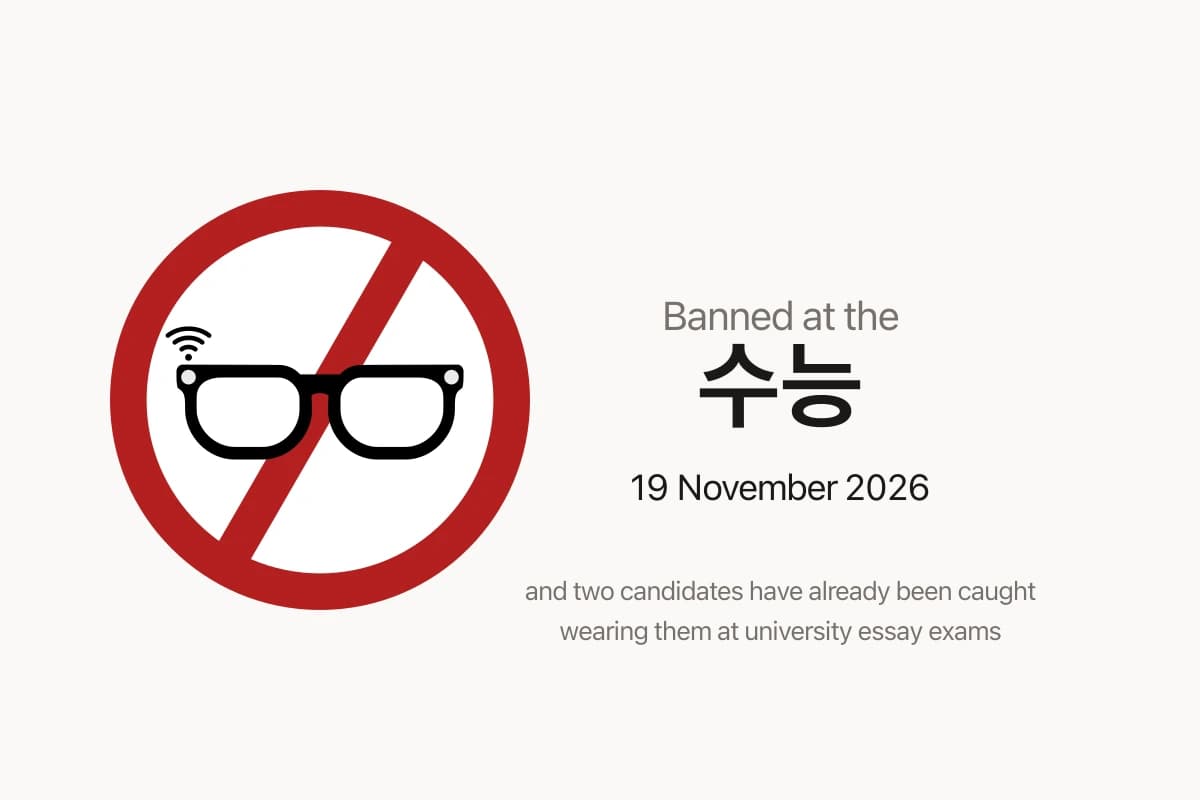
Two Candidates Wore AI Glasses Into Korean University Exams This Month. Five Weeks Later, 550,000 People Sit the 수능
At the University of Seoul on 3 October and at Yonsei a week later, proctors spotted AI smart glasses on candidates sitting essay exams for admission. Both had passed the glasses check in ordinary frames and switched once the exam began. The 수능 on 19 November already bans the devices; the question is whether anyone can see them.

The Fisherman Hid It Under His Floorboards. The Reward He Eventually Got Set Off a Decade of Looting.
Korea marked fifty years of underwater archaeology in Mokpo in September 2026. The official story starts with a net and a report. The documented one starts with six pieces of Chinese porcelain given away as presents, a schoolteacher brother who had to get them all back, and officials who did not want the paperwork. Then the state paid a reward, a diver worked out how much of it went in tax, and for the next ten years people stole the wreck faster than the government could raise it — until the navy's own divers could not find the ship, and the excavation hired the looters.
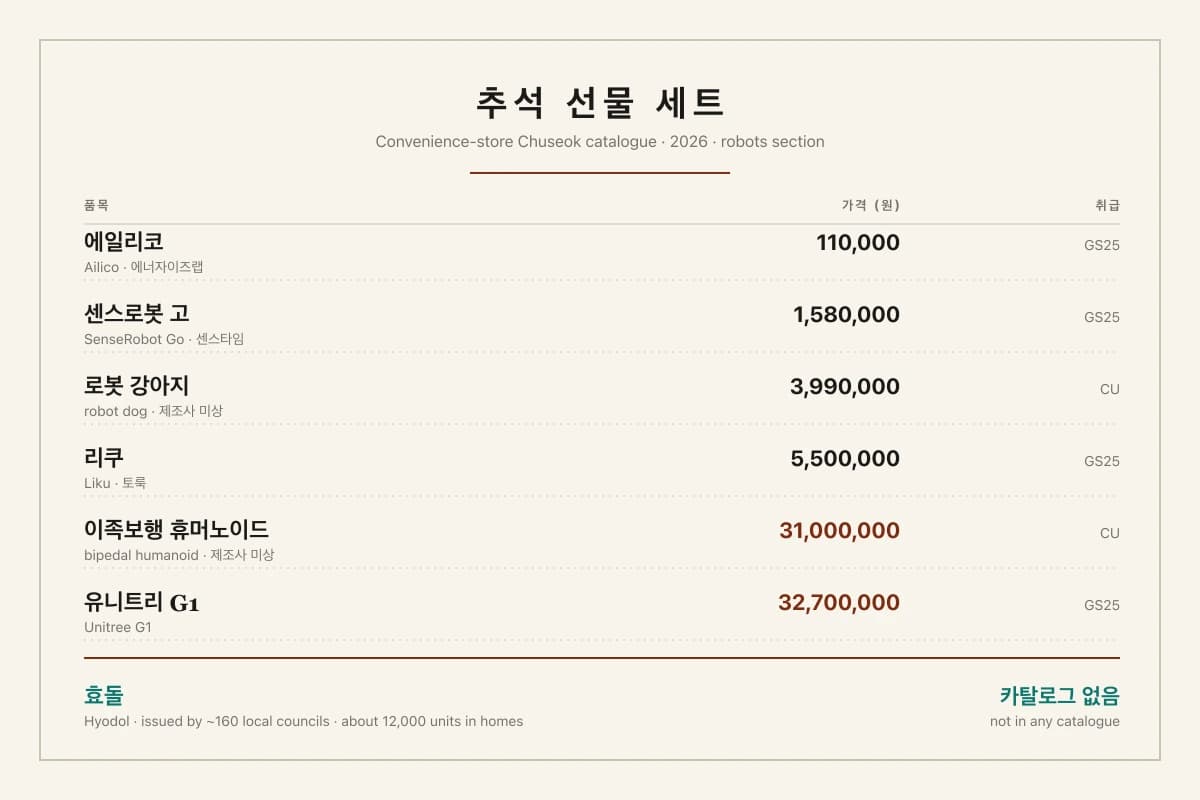
Korea's Convenience Stores Are Selling Humanoid Robots for Chuseok. Neither Chain Expects to Sell One, and Both Have Said So.
CU's holiday catalogue has a bipedal humanoid at ₩31 million, next to the beef and the gold bars. GS25 has an AI companion robot at ₩5.5 million and a keyring that talks back at ₩110,000. We assumed the pitch was companionship for parents you won't be visiting. It isn't — the retailers say plainly these are there to be noticed, not bought. Meanwhile about twelve thousand robots are already in Korean homes, asking elderly residents whether they've taken their medicine, and nobody put those in a catalogue.
The Weekly Dispatch
Korea, curated. Every week.
The best of K-culture, straight from Seoul. Written by people who actually live here.
Free, no spam, unsubscribe whenever.