Why Korea Loses Its Mind for the World Cup
Every four years, the most buttoned-up country you know turns its streets into a roaring sea of red. Here's the story of the Red Devils, the 2002 miracle that started it all, the chant you'll never get out of your head — and how to join in while the 2026 World Cup is on.
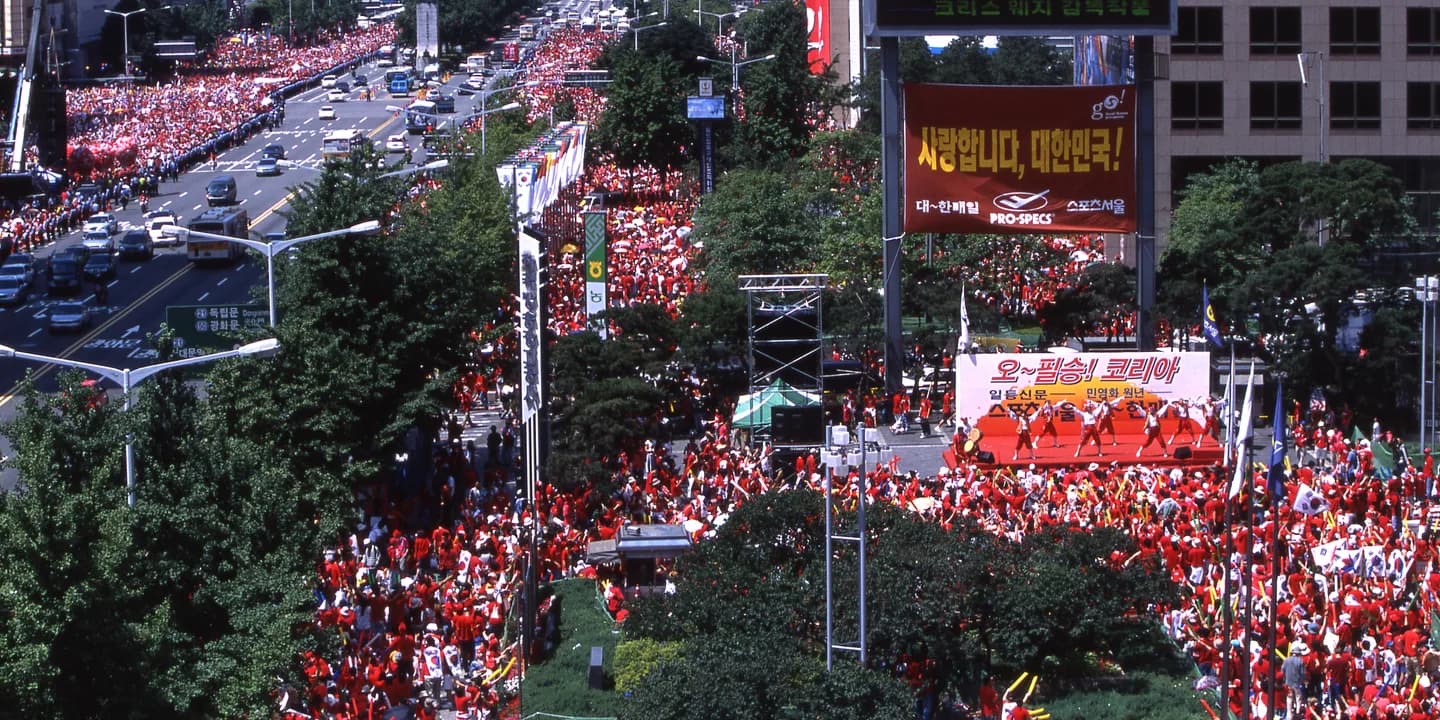
Walk through Gwanghwamun Square in Seoul on the right summer night this month and you will hear it before you see it: a drumbeat, then tens of thousands of voices snapping into the same four syllables — "대~한민국!" (Dae-han-min-guk — "Republic of Korea") — followed by five sharp claps. The square is a single, heaving field of red T-shirts. Strangers have their arms around each other. A grandmother and a toddler are doing the same chant. There is a screen the size of a building, and every face in the crowd is pointed at it.
This is Korea during a World Cup, and it is one of the strangest, most wonderful sights in the country — strange because, the other 1,460 days of the cycle, Korea is famously the opposite of this. Quiet on the subway. Careful about volume. Acutely conscious of not bothering strangers. And then, every four years, the whole nation walks outside, puts on the same red shirt, and screams at a television together until it's hoarse.
Right now, in June 2026, it's happening again. So here's the field guide: who the Red Devils are, the 2002 summer that turned this into a national ritual, what the chants and the red shirts actually mean — and, if you're in Korea while the tournament is on, exactly how to go stand in the middle of it.
Who the Red Devils are
Start with the name, because it confuses people. The Red Devils (붉은악마, Bulgeun Angma) are not the players — they're the supporters. The national team's official fan club, and the loudest organized cheering section on earth.
They began in December 1995 as a scrappy outfit called the "Great Hankuk Supporters Club," put together to organize support during qualifying for the 1998 World Cup, and renamed themselves the Red Devils in 1997. The name has a real origin story: back at the 1983 FIFA World Youth Championship in Mexico, Korea's under-20 team stunned everyone by finishing third while playing in red, and the foreign press nicknamed them the "Red Furies." Korean reporters rendered that into Korean as "붉은 악마" — Red Devils — and it stuck, first to the youth team and eventually to the whole footballing identity. Red became the color. (The team's nickname, the Taegeuk Warriors, never caught on with fans the way "Red Devils" did.)
Then came 2002, and the slogan that turned a fan club into a phenomenon: two English words printed on millions of cheap red T-shirts — "Be the Reds!" You still see that shirt everywhere in Korea. It is, functionally, a national uniform that comes out of the drawer every two years for a World Cup or an Asian Cup.
2002: the summer the streets turned red
You cannot understand Korean street-cheering without 2002, because that's the summer it was invented.
Korea co-hosted that World Cup with Japan, hired the Dutch coach Guus Hiddink, and proceeded to go on a run nobody — least of all Koreans — saw coming. They won their group. Then, in the round of 16, Ahn Jung-hwan headed in a golden goal in the 116th minute to knock out Italy. In the quarterfinal, they beat Spain on penalties, 5–3. They lost to Germany in the semifinal and finished fourth — still, two decades later, the best result by any Asian nation, and the first time a team from outside Europe or the Americas had ever reached a World Cup semifinal.
And as the team climbed, the country poured into the streets to watch together on giant screens — a thing that simply had not been done at scale in Korea before. The numbers, drawn from the archives of the National Institute of Korean History, tell the story of a snowball: roughly 500,000 people gathered for the opening match against Poland; by the semifinal against Germany, that single-day figure had swelled to over two million, packed into Gwanghwamun and the plaza in front of Seoul City Hall and squares in every other city. (Korea Herald)
That's the founding myth of 거리응원 (geori-eungwon), "street cheering." It wasn't organized from the top down. It was a country discovering, more or less by accident, that it loved being loud together — and deciding to keep doing it.
The ritual, decoded
If you wander into a cheering crowd, here's what you're actually hearing and seeing.
The chant. The core one is dead simple: "대~한민국" — the country's own name, stretched across four beats — answered by a five-beat clap (clap-clap, clap-clap-clap). That's it. It's designed so that anyone, of any age, can join on the first try, and so that a hundred thousand people can stay perfectly in sync. There are call-and-response versions too ("Who are we so proud of? — South Korea!"), but the name-plus-clap is the heartbeat.
The song. The unofficial anthem is "오 필승 코리아" (Oh! Pilseung Korea — "Oh, Victory Korea"), a stadium chant adapted by a Korean rock band for 2002 that has never left. When the crowd sings it, grown adults cry.
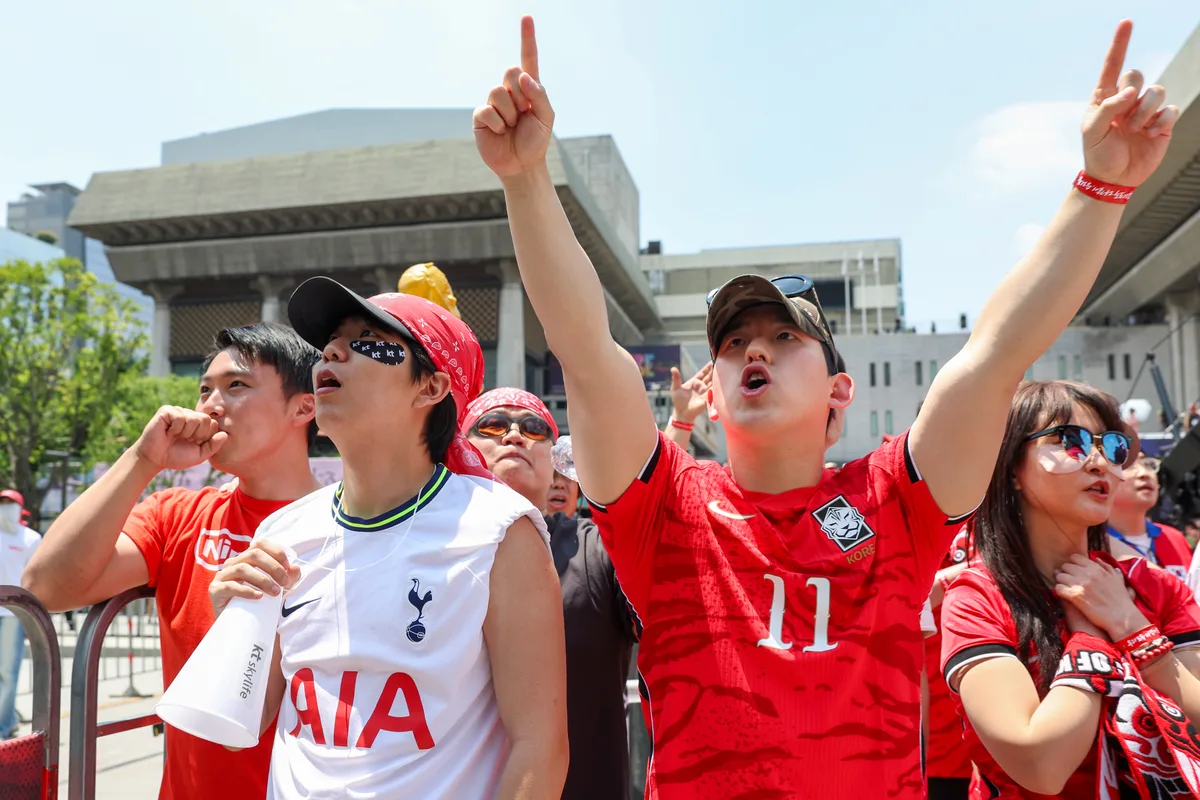
The look. Red, head to toe — the "Be the Reds" shirt, face paint, scarves, and the only-slightly-tongue-in-cheek devil horns that give the supporters their name. The drums. The Red Devils bring proper percussion, which is what keeps a crowd of thousands locked to the same tempo.
The whole package is engineered, intentionally or not, for maximum participation and zero skill. You don't have to know a song. You don't have to know football. You learn the entire repertoire in about ninety seconds, and then you belong.
Why a reserved country does this
Here's the part that's actually interesting, and it's not really about football.
Korea is a society with a strong sense of public decorum and hierarchy. There's a reason we've written about 방 culture — the whole industry of rentable private rooms exists partly because Korean cities are dense, homes are small, and there are very few places you're allowed to be loud and uninhibited. Day to day, the social rule is: don't make a scene, don't bother anyone, read the room.
Street cheering is the great exception — the one time the rule flips completely. For a few weeks every four years, being loud in public isn't rude; it's patriotic. The reserve that governs the subway car dissolves into a plaza where it's not just permitted but expected to scream, hug strangers, and cry. It's a national pressure valve. (Plenty of that energy then moves to the bars and barbecue tables afterward, win or lose.)
There's national pride in it, obviously. But there's also a specific story Koreans are telling themselves when they put on that shirt — the 2002 story, the underdog-from-nowhere-shocks-the-giants story. It maps neatly onto how a country that rebuilt itself from postwar poverty into a cultural superpower likes to see itself. The red crowd isn't only cheering a team. It's cheering a version of itself.
It also quietly corrects one of the biggest myths tourists arrive with — that Koreans are uniformly stiff and emotionally buttoned-down. Spend ten minutes in a cheering square and that idea evaporates.
2026: the tradition, live right now
The Red Devils are back out this month for the 2026 World Cup — Korea's 11th in a row (they've qualified for every single tournament since 1986). It's the biggest World Cup ever, with 48 teams across the United States, Canada and Mexico, and Korea drew Group A alongside co-host Mexico, South Africa, and Czechia.
The group stage has been a rollercoaster. Korea opened with a 2–1 win over Czechia (goals from Hwang In-beom and Oh Hyeon-gyu), then lost 1–0 to Mexico — which sets up a genuine knife-edge: their fate comes down to the final group match against South Africa on June 25 (KST), in Monterrey. Win, and they're almost certainly through to the knockouts; slip up, and they're out. As you read this, that match may be hours away or just finished. (standings & schedule)
And Gwanghwamun Square is once again the country's living room. For each Korea match, the Korea Football Association, telecom giant KT, the Red Devils and the Seoul city government have set up an official fan zone with giant screens. It's more managed than the joyous chaos of 2002 — the cheering area is split into six sections with a designated-zone cap of around 6,000, with 190-plus safety staff and 115 police on hand for crowds that swell to 12,000–14,000 across the wider square. (Korea Herald, Korea Times) Smaller than the two-million-strong tide of 2002, but the soul of it — the drums, the red, the "대~한민국" — is exactly the same.
How to join in (if you're in Korea for it)
If the tournament is on and you're anywhere near Seoul, this is one of the great free experiences in the country. A quick how-to:
- Go to Gwanghwamun Square (Line 5, Gwanghwamun Station) for the official fan zone, or Seoul Plaza in front of City Hall, the other historic cheering ground. Both are central, free, and built for exactly this.
- Wear red. Anything red works, but the "Be the Reds" shirt is sold cheaply all over during a tournament and is the full experience. You will feel out of place in any other color, in the best way.
- Learn the two things that matter: the "대~한민국" chant and its five-beat clap. That's your entire entry requirement. Everyone around you will carry the rest.
- Mind the clock. Because the 2026 host cities are in the Americas, kickoffs land at odd hours in Korea — Korea's matches this tournament have started in the late morning KST, so the squares fill up before lunch rather than at midnight. Check the local kickoff time before you go.
- Expect to make friends. Strangers will high-five you, share snacks, and absolutely lose it with you when Korea scores. Going along, win or lose, is the point.
For a country that spends most of its life being careful and quiet, the World Cup is the great exhale — the few weeks when the whole place agrees to be loud, together, in the street, in red. Whatever happens against South Africa, the drums will be out at Gwanghwamun. Go stand in the middle of it.
대한민국! 👏👏 👏👏👏
—The Editors
Red Devils history (founded December 1995 as the "Great Hankuk Supporters Club," renamed 1997; the "Red Furies" → "Red Devils" naming from the 1983 FIFA World Youth Championship; the "Be the Reds!" slogan) verified against Wikipedia and Korean reference sources. 2002 results — co-hosting with Japan, coach Guus Hiddink, Ahn Jung-hwan's 116th-minute golden goal vs. Italy, the 5–3 penalty win over Spain, and the fourth-place finish — and the street-cheering crowd figures (≈500,000 for the Poland opener rising to over 2 million by the Germany semifinal, per the National Institute of Korean History) are from the Korea Herald. 2026 tournament details (Group A; the 2–1 win over Czechia, 1–0 loss to Mexico, and June 25 KST match vs. South Africa) and the Gwanghwamun fan-zone figures are from current reporting by the Korea Herald, the Korea Times, ESPN and others. Match results after publication may have changed the standings.
Cover: the 2002 World Cup street-cheering crowd filling central Seoul near City Hall — photo donated by Jeong Chang-ik, Wikimedia Commons, KOGL Type 1. In-article photo: South Korean fans at Seoul's Gwanghwamun fan zone during the 2026 World Cup — photo by Republic of Korea / Korea.net, Wikimedia Commons, CC BY-SA 4.0.


Keep Reading
More Stories
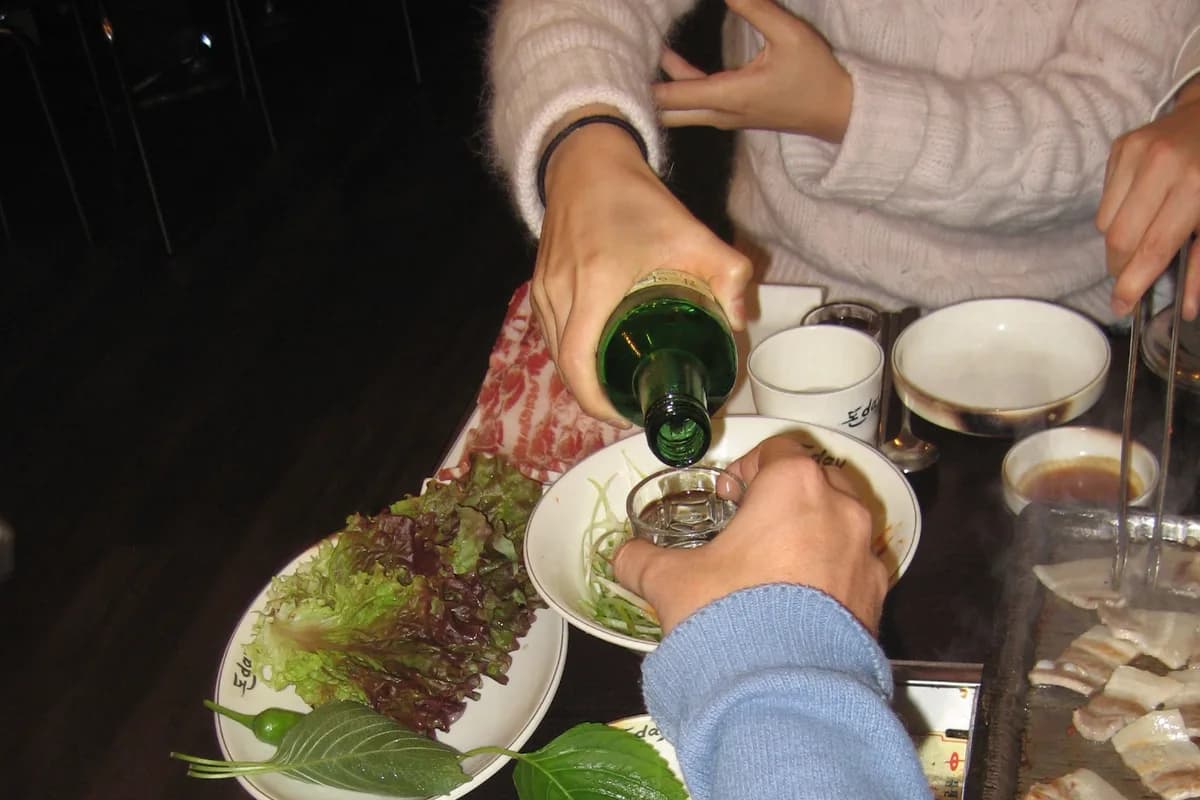
Why Koreans Are Drinking Less — and What's Replacing 회식
For decades Korea drank like almost nowhere else on earth, and the all-night company dinner — 회식 — was the engine that fueled it. Now the numbers are falling fast, a whole generation barely drinks, and the after-work hours are filling up with gyms, cafés, and running crews instead. Here's what's actually changing, why, and what it means if you visit or work here.
Korea's 방 Culture, Explained: Why There's a Private Room for Everything
Sing, game, sweat, sleep, study, or break out of a locked room — in Korea you rent the space by the hour. Walk any city street and the neon is stacked with 방 (bang, 'room') signs. Here's the tour, the prices, and the genuinely interesting reason a whole country built its leisure around renting rooms.
Korean Summer, Explained: 장마 Season, the August Heat, and What Comes After (2026)
The 31-day rainy season is just the warmup. Here's when 장마 arrives this year, why August is worse, and how Koreans actually get through it.
The Weekly Dispatch
Korea, curated. Every week.
The best of K-culture, straight from Seoul. Written by people who actually live here.
Free, no spam, unsubscribe whenever.