The Opposition Leader, the Park Chung-hee Foundation and a Police Complaint Want Chuseok's Number-One Film Off the Screens. The Director Says the Line They Object To Isn't In It
《암살자(들)》 passed 1.6 million admissions over the holiday. On the Monday after it, the foundation that keeps Park Chung-hee's memory demanded an apology and a halt to screenings, the leader of the opposition asked why insulting Park is 'freedom of expression' when touching Roh Moo-hyun gets you sued, and by Tuesday morning a former city councillor had filed a criminal complaint against the producer, the director and both writers. Hur Jin-ho's answer is that the film nowhere says Park ordered his wife shot, and that he now wishes he had drawn that line in dialogue. The audience score is 8.3. The netizen score is 2.2.
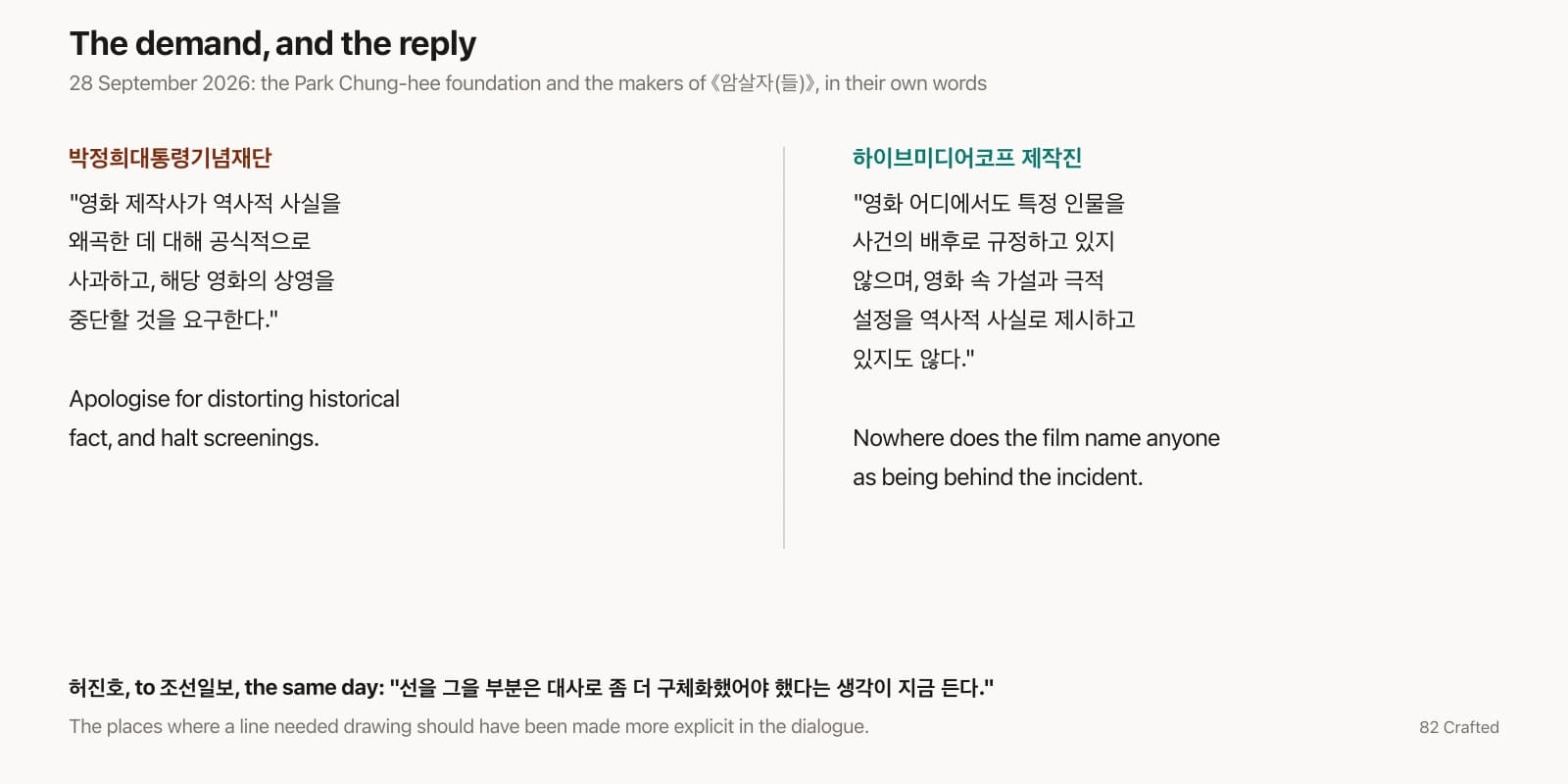
On Monday 28 September, the day the Chuseok holiday ended, 《암살자(들)》 stood at 1,633,618 admissions after six days, the most-watched film in Korea on every one of them. That afternoon the 박정희대통령기념재단 — the foundation that maintains the late president's memorial and his memory — issued a statement headed "영화 암살자(들)의 허구성에 대한 박정희대통령기념재단의 입장", the foundation's position on the film's fictitiousness. It ended like this:
"이에 박정희대통령기념재단은 영화 제작사가 역사적 사실을 왜곡한 데 대해 공식적으로 사과하고, 해당 영화의 상영을 중단할 것을 요구한다."
"The foundation therefore demands that the production company officially apologise for distorting historical fact, and that screenings of the film be halted."
By Tuesday morning there was a police complaint. In between, the leader of the opposition, a former prosecutor-turned-lawmaker, a culture minister who declined to answer questions in a committee room, and a governing party that has decided the whole thing is a gift had all had their say. This is the argument, as it stands, about who gets to tell 15 August 1974.
What the foundation says
Its case rests on a count. Citing investigation records held at the diplomatic archives, the statement says six shots were fired in the National Theatre that day: five trigger-pulls by the gunman 문세광, one of which misfired, and one shot by a guard, which killed the schoolgirl 장봉화 in the choir. The film, it says, is built on "6발의 총성 가운데 탄피가 4개만 발견" — six shots and only four cartridge cases found — which it calls fabrication. It cites no document number, volume or page.
We should say plainly that this touched our own reporting. Our explainer on the film, published on 17 September, gave the record as seven shots, four by 문세광 and three by security, with six bullets recovered — a 2005 newspaper's restatement of the investigation, which we presented as the investigation itself. The file, as broadcasters read it in 2005, lists seven numbered shots including the misfire; that is six rounds fired, and "six bullets recovered" has no source we can find. The explainer has been rewritten to set out each count and where it comes from, with a dated correction at the foot. The short version: seven and six are both readings of the same list, depending on whether a round that failed to fire counts as a shot, and none of the records anyone has produced accounts for the bullet that killed Yuk Young-soo. That gap is the film's subject. It is also, it turns out, the foundation's.
What the film says
The production company's statement, issued in the production team's name on the afternoon of the 28th, has one sentence that matters:
"영화 어디에서도 특정 인물을 사건의 배후로 규정하고 있지 않으며, 영화 속 가설과 극적 설정을 역사적 사실로 제시하고 있지도 않다."
"Nowhere in the film is any particular person identified as being behind the incident, and the film's hypotheses and dramatic devices are not presented as historical fact."
It asked that the film be seen "창작의 산물로만" — only as a work of creation — and said it was not made to establish new historical conclusions or to deny or distort existing facts.
허진호 himself spoke to 조선일보 the same day, and it is his only on-record answer to the row:
"박 대통령이 육 여사 피격을 지시했다는 내용은 영화 어디에도 나오지 않는다… 합리적으로 불가능한 주장이다."
"There is nothing anywhere in the film saying President Park ordered the shooting of the First Lady… it is not a claim that could reasonably be made."
He said the suspicions in the film were not his invention but had been raised for years by MBC's 《이제는 말할 수 있다》, SBS's 《그것이 알고 싶다》 and 《꼬리에 꼬리를 무는 그날 이야기》; he denied, flatly, a claim circulating online that the film remakes a North Korean propaganda picture — "사실이 아니다". And he conceded something:
"선을 그을 부분은 대사로 좀 더 구체화했어야 했다는 생각이 지금 든다."
"I now think the places where a line needed to be drawn should have been made more explicit in the dialogue."
That is a director saying his film's ambiguity was a choice, and that he is no longer sure it was the right one.
The politics, in order
주진우, the 국민의힘 lawmaker and former prosecutor, went first, on Saturday the 27th, on Facebook: the film was "영화적 상상력이 아니라 유족의 가슴을 미어지게 하는 패륜적 범죄" — not cinematic imagination but a depraved crime that tears at the bereaved family's hearts — which could not be justified by freedom of expression and should be "엄정히 처벌", punished strictly, as defamation of the dead. By Tuesday he was demanding a search of the production company's offices.
장동혁, the party's leader, posted on Sunday the 28th:
"노무현 대통령을 건드리면 줄줄이 고소·고발 당한다. 박정희 대통령 모욕은 '표현의 자유'다."
"Touch President Roh Moo-hyun and the lawsuits come one after another. Insulting President Park Chung-hee is 'freedom of expression'."
And: "'표현의 자유'는 좌파의 전유물이냐" — is freedom of expression the left's private property? The same post ranged across the May 1980 uprising, the "북침" theory of the Korean War and the 천안함 sinking, and recommended the film 《아수라》 to the President. On Tuesday he shared a boycott poster — "보지 않습니다. 예매하지 않습니다", we won't watch, we won't book — and said the boycott was young people's own, "'스타벅스 불매'처럼 대통령과 정부가 나선 것이 아니다", not something the President and the government had organised the way the Starbucks boycott had been.
Also on record from that side: a request to call 허진호 and the producer as witnesses at next month's parliamentary audit; and, from 나경원, a proposed "육영수여사서거 역사왜곡처벌법" — a law against distorting the history of the First Lady's death — offered, one assumes, to make a point. From 개혁신당's 이기인, the one line in the week that neither side has answered: "확인된 과오를 비판하는 일과 확인되지 않은 범죄를 덧씌우는 일은 다르다" — criticising a confirmed wrong and pinning an unconfirmed crime on someone are different things.
The governing party has decided the row sells tickets. 최민희: "암살자들은 픽션이다. 긁어 부스럼 만들어 좋을 게 뭐 있을까?" — it's fiction; what good does scratching a sore do? — followed, later, by a post noting the film had passed 1.5 million. 박지원: "논픽션 영화도 아니고 픽션 영화", and "대박 터진다" — it's going to blow up. The party's chief spokesman, 박성준, said the opposition had "공작의 DNA" — the DNA of political manoeuvre.
The government has said nothing. Asked about the film at the legislation committee on Monday — including whether 문세광 was the man who killed Yuk Young-soo — the culture minister, 최휘영, declined: "답을 못하는 게 아니라, 답을 안 하고 있는 겁니다". It isn't that I can't answer; I am choosing not to.
The family has said nothing publicly either. There are reports that the foundation and the 육영재단 are considering an injunction to stop screenings, and a second-hand claim, through a former aide, about what a family member has asked for. We do not print second-hand claims about a family's wishes.
The complaint
On Tuesday morning 이종배, a former 국민의힘 member of the Seoul city council, filed a complaint with the Seoul Metropolitan Police against 김원국, the chief executive of the producer 하이브미디어코프, against 허진호, and against the film's two writers, 권기준 and 이지민. Most outlets report the charge as defamation by false statement of fact; he himself argues defamation of the dead, and the two are consistent, since the offence under the criminal code requires a false statement of fact about a dead person. It is a complaint, not a charge. Whether the police open a case is now a decision someone in the Seoul force will have to take about a film.
The audience, split in two
On CGV's own audience meter the film sits at 91 per cent; among verified viewers on Naver, 8.3 out of 10. The portal's open netizen score is 2.2, after what MBC and 헤럴드경제 describe as organised low-scoring, with posts sharing how to give the minimum. Hostile comments have been left for the cast, including on 이민호's accounts, and for three actors who wrote endorsements — 이영애, 김고은 and 박병은. A review video by the critic 이동진 drew more than 6,500 comments. The YouTuber 지무비, with over four million subscribers, took his video on the film down. And 유해진 has been told by strangers that they were disappointed in him — "믿고 봤는데" — for saying in an interview, as our explainer reported, that the script he was first sent was more direct than the film he made.
On the other side, 박찬욱 came to a special screening at CGV 왕십리 on the 26th with the director and 박해일 and said he had marvelled several times at how "정말 영리하고 스마트하다" it was, and compared it to Brian De Palma. 김성수, who made 《서울의 봄》, had done a screening three days earlier.
The numbers, and what they don't prove
The row landed on the same day the film lost first place. On Monday the 28th, 《타짜: 벨제붑의 노래》 drew 68,913 to 《암살자(들)》's 67,406, from 943 screens against 1,302. 조선일보 attributed the drop to the controversy — "박정희 대통령을 악마화했다는 논란 탓으로 분석된다". KOBIS's table says something simpler: the holiday ended, and the whole market fell from 676,260 admissions on Sunday to 228,546 on Monday; 《암살자(들)》 fell 74 per cent and 《타짜》 59. Both things can be true. By nine on Tuesday morning the film had 11.3 per cent of advance bookings, second only to a Japanese cartoon that opens on Wednesday, and ahead of 《타짜》.
Update, 1 October
The audit summons failed. On 29 September 국민의힘 asked the culture committee to call 허진호 to next month's parliamentary audit as a 참고인, a reference witness; without agreement between the parties, it was not adopted. The governing party's objection, as 노컷뉴스 reported it, was that summoning a director to the Assembly to interrogate a film's content could chill creative freedom. On 30 September conservative groups including the society that preserves Park's birthplace held a rally outside it in 구미, demanding the film be pulled. The first editorial against the film in a national daily ran on 1 October, in 파이낸셜뉴스, under the headline "표현의 자유도 진실의 벽은 넘지 못한다" — freedom of expression cannot climb the wall of truth. We have not seen an injunction filed. And the film kept selling: 1,766,946 admissions by 30 September, second only to the Japanese animated film that opened that day.
What it says
A film that declines to name a culprit has been accused of naming one, by people who can say what it shows because they have seen it, and by many who have not. The foundation's strongest argument is a count of shots, and the count is a fair reading of the record — but so is the film's, because the record is a list that can be read either way, which is what our own correction this week had to acknowledge. The director's strongest concession is that he should have drawn his line in words. The opposition's strongest line is a comparison to how the other side polices its own dead, and it is not a bad one. The government has chosen silence, the governing party has chosen to enjoy it, and the police now hold a complaint against four people for a film about a day in 1974 that the state's own file never closed.
Images. The lead photograph is the National Assembly building in Yeouido, by the Commons user Cjb8293, CC BY-SA 4.0, licence verified on the file page. The cover is ours: the foundation's demand and the production company's reply, set side by side. There is no licence-clean photograph of 장동혁 — every image of him on Wikimedia Commons is a frame taken from his party's video channel, which we do not use — and none of the foundation's statement, the complaint or the screening; stills from the film are 하이브미디어코프's, which we have asked for and not received.
Sources. The foundation's statement of 28 September as reported by 뉴데일리, 헤럴드경제 (via 연합뉴스) and 서울신문, and read in full; the production company's statement in full from 스타뉴스 (29 September); 허진호's remarks from 조선일보's interview of 28 September and 경향신문 (28 September). 주진우 from 세계일보 and 서울신문 (28 September) and 뉴데일리 (29 September); 장동혁 from 세계일보, 머니투데이 and 한국일보 (28 September) and 서울경제 and 서울신문 (29 September); 나경원, 조은희 and 이기인 from 서울신문 (29 September); 최민희 from 매일신문 (28 September); 박지원 from 서울경제 (29 September); 박성준 from 동아일보 (28 September); 최휘영 from 오마이뉴스 and 위키트리 (28 September). The complaint from 국민일보, 서울신문 and 헤럴드경제 (29 September). Audience figures from 헤럴드경제, MBC and 서울신문 (28–29 September); 박찬욱 from 주간경향 (27 September). Box office from KOBIS's daily table, read directly; bookings from 서울신문 (29 September); 조선일보's attribution from its report of 29 September.
Stated rather than smoothed. Two quotations that have circulated as the opposition leader's and the lawmaker's words are newspaper compressions, and we have used the Facebook posts as the papers themselves render them. The director's line about conclusions not being a director's job appears in 경향신문 attributed only to a pre-release interview we could not identify, so we have used his 조선일보 interview instead. The foundation's own website could not be reached; its statement is quoted from a full reproduction that matches every fragment the newspapers carry. We searched 조선, 중앙 and 동아 for an editorial on the film and found none by Tuesday afternoon; the only editorial we found was in the regional 경북일보, which asked whether the film was "예술의 탈을 쓴 역사 모독" — historical insult in art's mask. We have not reported what the family is said to want, because the only account of it is a former aide's. And we note, because it has been confused in some coverage, that the President's remark this week about "baseless conspiracy theories" was about a mine in the DMZ, not this film.
Keep Reading
More Stories
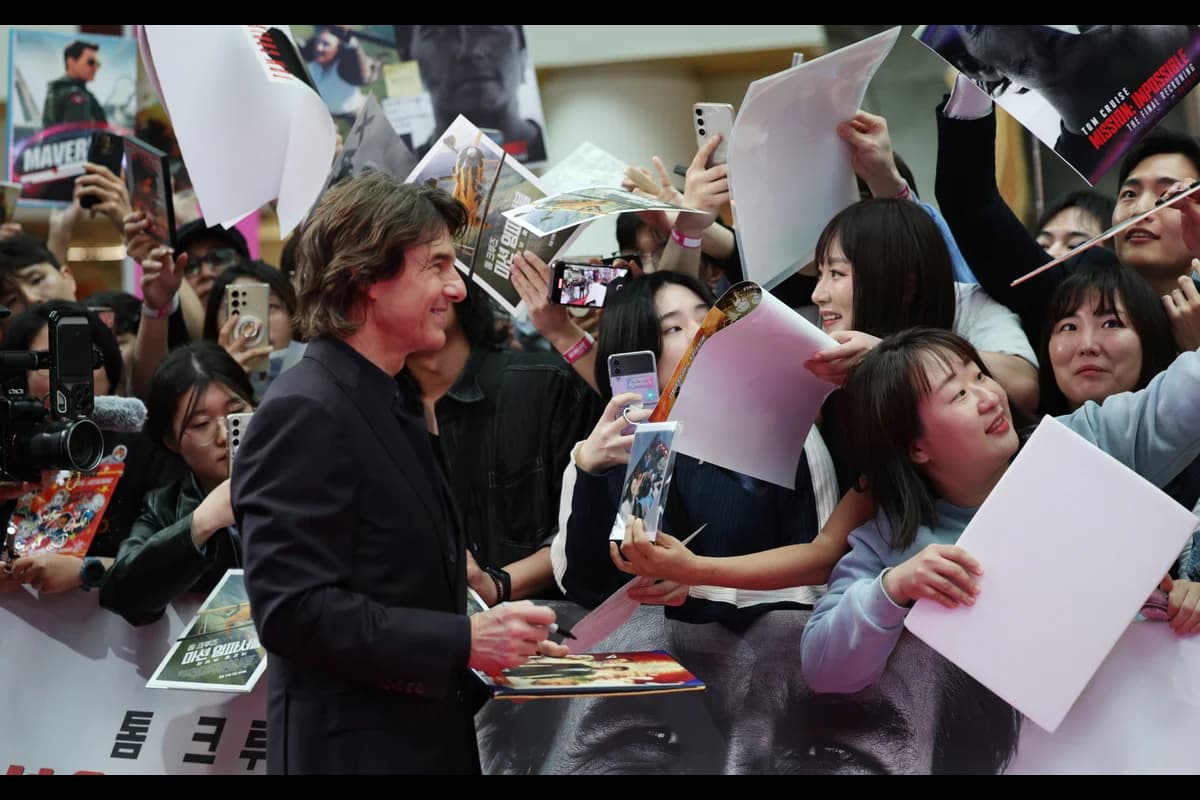
A Japanese Cartoon About Small Cute Creatures Opened at Number One in Korea. Tom Cruise's New Film Is Seventh on the Booking Board, With Cruise in Seoul to Sell It
《극장판 치이카와》 took 122,293 admissions on its opening day, the biggest start for any animated film released in Korea this year, and by the next morning held 39 per cent of every advance ticket in the country. 《디거》, Alejandro G. Iñárritu's black comedy with Tom Cruise as an oil baron, opens on 3 October with 2.6 per cent — behind a Venice prize-winner in its second week — while Cruise makes his thirteenth visit to Korea, more than any other Hollywood actor. Iñárritu was meant to come too. He cancelled the night before.

Seven Shots or Six? The 1974 Record Can Be Read Both Ways. Hur Jin-ho's Film Took Six, and Built a Newsroom Around the Bullet Nobody Examined.
Hur Jin-ho's 《암살자(들)》 opens on 23 September as the most pre-booked Korean film of the Chuseok season, ahead of 《인턴》, with a bracketed plural in its title that is the whole argument. The 1974 file on the shooting of First Lady Yuk Young-soo lists seven shots, one of them a misfire; the Park Chung-hee foundation now counts six; the film counts six and finds four bullets. What none of them can show is the bullet that killed her — and the director says he is offering a hypothesis, not a verdict.
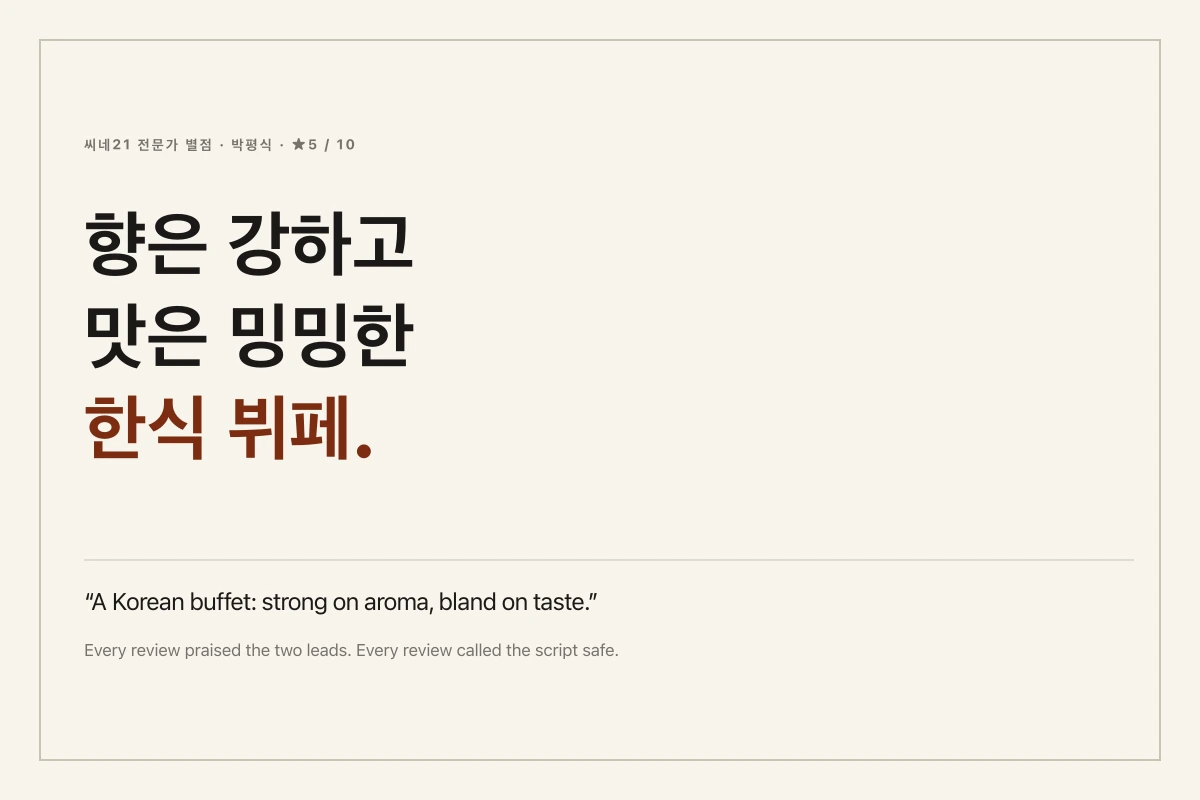
《인턴》 Opens on 16 September Behind a Film From August and a Film From the Following Week
Two days before Korea's warmest film of the autumn opens, it is the third most-booked film in the country. Above it: a Christopher Nolan film that has been number one for forty consecutive days, and a Korean thriller that does not open until the 23rd. The critics have praised the two leads in every review and called the script safe in every review. And the whole thing exists because a studio that quit Korea six years ago came back for it.
The Weekly Dispatch
Korea, curated. Every week.
The best of K-culture, straight from Seoul. Written by people who actually live here.
Free, no spam, unsubscribe whenever.