Three Korean Films Open the Day Before Chuseok. One of Them Isn't Competing — It's Meeting a Deadline.
On 23 September, a card-gambling franchise finale, a true-crime thriller about a 1974 assassination attempt, and Lee Chang-dong's Oscar entry all open in Korean cinemas. Two of them are fighting over the biggest holiday audience of the year. The third is there because the Academy requires a seven-day theatrical run by the 30th — the film no Korean investor would fund is using Chuseok as a compliance window.
Wednesday 23 September is the day before the Chuseok holiday begins. In Korea that makes it the most valuable release date of the autumn: Wednesday is the conventional opening day, and a film that opens on the 23rd walks straight into a three-day national holiday with the whole country off work.
Three Korean films are opening on it.
- 《타짜: 벨제붑의 노래》 — the fourth and final film in the 타짜 card-gambling series, directed by 최국희, distributed by CJ ENM.
- 《암살자(들)》 — 허진호's true-crime thriller about the 1974 attempt on the life of the president's wife 육영수, starring 유해진, 박해일 and 이민호, and an official Gala selection at Toronto.
- 《가능한 사랑》 — Lee Chang-dong's first feature in years, in Competition at Venice, and as of 25 August Korea's official submission for the Academy Award for Best International Feature.
Two of those films are in a fight. The third one isn't, and the reason it is standing on the same date is the interesting part.
The Academy's calendar, not Korea's
To be eligible for the International Feature award, a film has to have played theatrically in its submitting country — a run of at least seven consecutive days, completed by 30 September.
Count back from that. A film opening on 23 September clears seven days on the 29th, with a day in hand.
Possible Love is not on Chuseok weekend because Chuseok weekend sells tickets. It is there because it is the last Wednesday that satisfies the Academy. The most commercially contested date in the Korean autumn is being used, by one of the three films standing on it, as a compliance window.
This is the same film we wrote about in the movie no Korean investor would fund — an ₩8 billion picture that went to Netflix because domestic money would not touch it. That piece went out while the Oscar submission was still an open question. It is now settled: KOFIC named it on 25 August.
At a press event in Mapo-gu on the same day, Lee was asked about the theatrical release, given that the film's home is a streaming service. His answer was flatter than the headlines around it suggest:
"넷플릭스와 처음부터 약속한 부분이다… 어떤 간섭이나 별도의 요구사항도 없었다"
"It was agreed with Netflix from the very beginning… there was no interference and no additional demands."
Some coverage has framed that as Lee extracting a promise, laying down a condition. His actual words describe a mutual arrangement made at the outset, and we are not going to upgrade "agreed from the beginning" into "insisted upon" because the second version is a better story.
The franchise that has shrunk every time out
Now the film that genuinely is fighting for the holiday.
타짜 is one of the durable properties in Korean commercial cinema — a card-sharp series that began in 2006 with 최동훈's original and has produced a sequel roughly every five to eight years since. It is the kind of film Korean investors do fund: a known title, a known genre, a known audience.
What is less often said is that it has got smaller every single time.
| Year | Admissions | |
|---|---|---|
| 타짜 | 2006 | 5.68m |
| 타짜: 신의 손 | 2014 | 4.01m |
| 타짜: 원 아이드 잭 | 2019 | 2.23m |
That last one matters. One Eyed Jack needed roughly 2.6 million admissions to break even and finished at 2.23 million. The most recent entry in Korea's reliable gambling franchise lost money.
So the fourth film arrives as a finale, distributed by CJ ENM — which last handled a 타짜 picture in 2006, the second and third having gone through Lotte — carrying a title that has declined by 60 per cent across three instalments, onto the busiest date of the season, against two other Korean films.
There is a symmetry here worth naming plainly, and it cuts against an easy reading. The safe commercial bet has been steadily losing its audience. The unfundable art film is the country's Oscar entry. Neither of those facts proves anything about the other, but they are both true on the same Wednesday.
What happened the last time Korea did this
Korean distributors have crowded a single window before, and the industry still talks about the results.
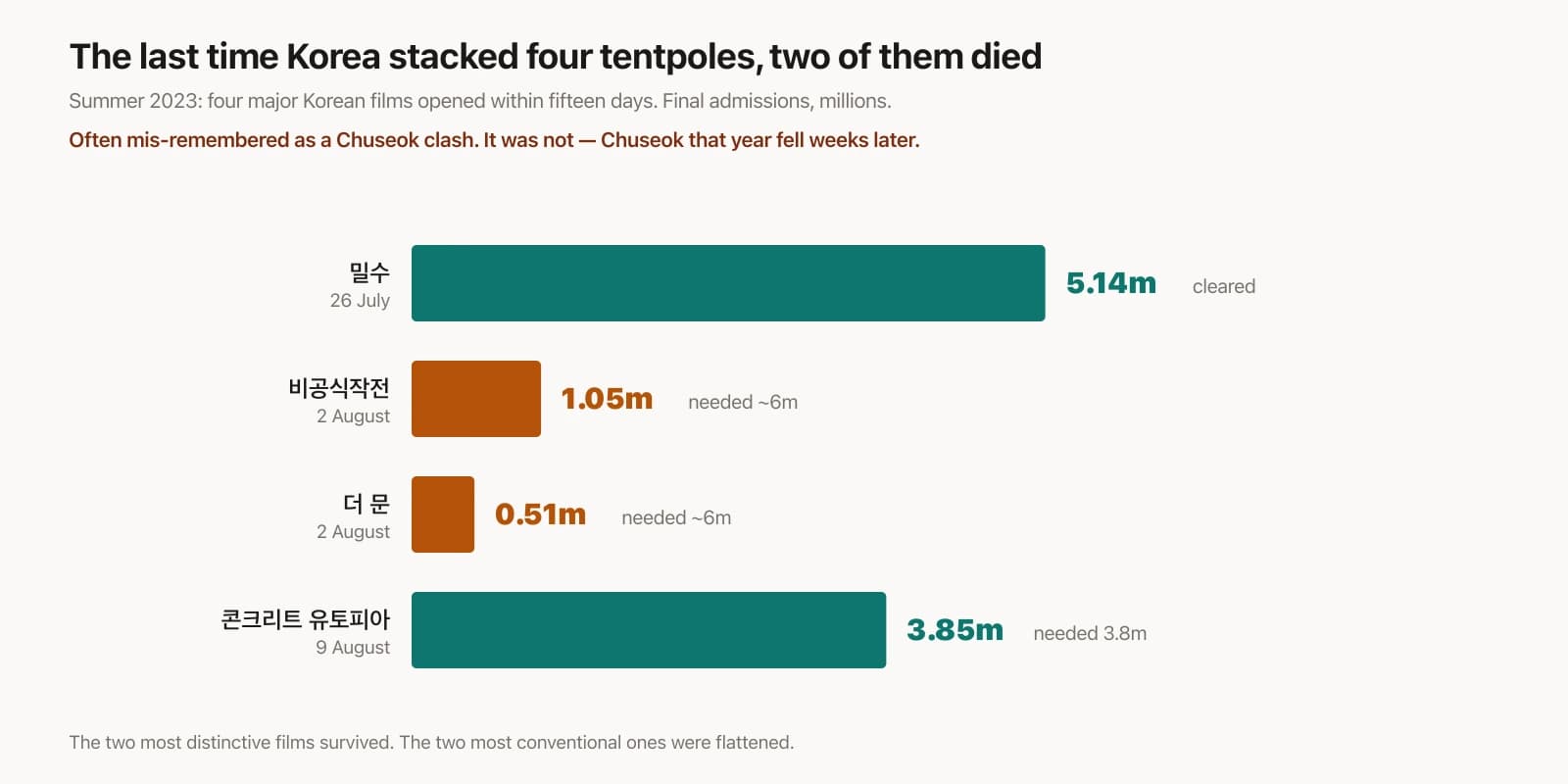
In the summer of 2023, four major Korean films opened within fifteen days of each other:
| Film | Opened | Final admissions | Outcome |
|---|---|---|---|
| 밀수 | 26 July | 5.14m | cleared break-even |
| 비공식작전 | 2 August | ~1.05m | needed ~6m |
| 더 문 | 2 August | 510,000 | needed ~6m, budget ~₩28bn |
| 콘크리트 유토피아 | 9 August | 3.85m | needed 3.8m — cleared, barely |
Two survived. Two were destroyed — The Moon in particular, a ₩28 billion science-fiction production that finished on half a million admissions.
One correction to how this precedent usually gets told, including in our own working notes: this was a summer pile-up, not a Chuseok one. Chuseok 2023 fell on 28 September to 1 October, weeks after all four had already opened. If you want a genuine same-holiday precedent, this is not it — what it is, is the clearest recent evidence of what happens when Korean tentpoles are stacked too close together, which is that the two most differentiated films survive and the two most conventional ones are flattened.
Why September looks like this
Because the summer was not available.
Korean films had an extraordinary first half of 2026. Revenue from Korean films alone reached ₩370.2 billion, up 81.7 per cent year on year, on 37.37 million admissions, up 74.9 per cent. (That figure is Korean-films-only. Total industry revenue was ₩579 billion, up 41.9 per cent — two different numbers that are easy to confuse and often are.)
Then Hollywood took the summer. By early August, The Odyssey and Spider-Man: Brand New Day were between them accounting for more than eight of every ten tickets sold in Korean cinemas. We wrote about the Odyssey end of that in Korea's single IMAX screen, where the queueing got so intense that a law taking effect this week — one that bans ticket scalping for concerts and sport — pointedly does not cover cinema seats.
Korean distributors did what you would expect: they waited. The result is six Korean releases stacked into a single month.
| Film | Date | Distributor |
|---|---|---|
| 비광 | 2 September | — |
| 인턴 | 16 September | Warner Bros. Korea |
| 가능한 사랑 | 23 September | Netflix |
| 타짜: 벨제붑의 노래 | 23 September | CJ ENM |
| 암살자(들) | 23 September | Hive Media Corp |
| 부활남: 더 레드 | 30 September | Lotte Entertainment |
The one that opens a week early is doing so on purpose. 《인턴》, Warner Bros. Korea's Korean-language remake of The Intern, takes 16 September and gets a clear week before the pile-up — and it arrives with a director who is introduced as two different people depending on the language you read.
Korean trade coverage has already noticed the shape of it, and has drawn the same line we are drawing: a piece in 한국경제 this week explicitly sets Possible Love aside from what it calls the commercial contest, and says that fight is between the others.
What it says
The interesting thing about 23 September is not that three films are competing. It is that only two of them are.
Korean cinema in 2026 is running two economies at once. One is the commercial system — franchises, holiday dating, break-even thresholds, distributors who will back a fourth 타짜 but would not back Lee Chang-dong. That system had a spectacular first half, lost the summer to two American films, and has now crowded itself into one September because there was nowhere else to go.
The other is a single film that the first system declined to finance, which was made with foreign streaming money, which is going to Venice and to the Oscars, and which is in cinemas for seven days in September because a rule in Los Angeles says it has to be.
They will share a Wednesday. One of them is chasing an audience and the other is satisfying a clause, and from the outside — three Korean films, one date, one holiday — you would never be able to tell which was which.
Update, 23 September: opening day, by the booking board
Read from KOBIS's real-time reservation board at 02:02 on the morning the three films open:
| Film | Share of advance sales | Tickets sold in advance |
|---|---|---|
| 《암살자(들)》 | 30.5% | 235,853 |
| 《오디세이》 (week 8) | 17.2% | 132,579 |
| 《타짜: 벨제붑의 노래》 | 15.4% | 118,692 |
| 《인턴》 (week 2) | 7.0% | 53,984 |
| 《가능한 사랑》 | 5.6% | 43,166 |
Three things the board says before a single regular screening has run. The collision is not a three-way fight: 《암살자(들)》 goes in with twice 《타짜》's advance and five and a half times Lee Chang-dong's, which is the ordering the reservation board has shown since the Toronto premiere and not the one the summer's coverage assumed. The film in second place is not one of the three — it is 《오디세이》, in its eighth week, which took the daily top spot back from 《인턴》 on Tuesday. And the paid previews already count: 《암살자(들)》 opens with 24,126 admissions on the books, 《타짜》 with 19,183, 《가능한 사랑》 with 3,128, from the preview screenings of the past week.
Chuseok falls on Friday the 25th, with the public holiday running Thursday to Saturday. The first full weekend for all three films is therefore the holiday weekend itself; those numbers post on Monday the 28th, and we will read them.
Update, 28 September: 《암살자(들)》 won Chuseok, 《타짜》 won the Monday, and the Venice winner drew 130,000
The holiday is over and the collision has a result. Admissions from KOBIS's daily table, read directly:
| Wed 23 | Thu 24 | Fri 25 | Sat 26 | Sun 27 | Mon 28 | Cumulative | |
|---|---|---|---|---|---|---|---|
| 《암살자(들)》 | 134,460 | 288,480 | 426,257 | 432,348 | 260,541 | 67,406 | 1,633,618 |
| 《타짜: 벨제붑의 노래》 | 103,361 | 143,957 | 181,736 | 214,885 | 169,894 | 68,913 | 901,929 |
| 《오디세이》 (wk 8) | 41,208 | 90,556 | 131,074 | 142,222 | 91,463 | 31,359 | 11,814,652 |
| 《인턴》 (wk 2) | 23,373 | 55,125 | 77,900 | 78,653 | 49,793 | 12,537 | 768,591 |
| 《가능한 사랑》 | 19,032 | 21,756 | 21,204 | 26,551 | 24,264 | 14,418 | 130,353 |
| 《어벤져스: 엔드게임 앙코르》 | 21,502 | 23,175 | 18,801 | 24,415 | 20,057 | 6,256 | 114,206 |
Four things.
《암살자(들)》 took the holiday outright. It was the most-watched film in the country every day from Wednesday to Sunday, did over 426,000 on both Friday and Saturday, took 44 per cent of Friday's box office on 1,462 screens, and passed one million admissions on Saturday, its fourth day. Six days after opening, it has 1.63 million.
《타짜》 is the second film, and on Monday it was the first. With the holiday over and audiences down two-thirds across the board, 《타짜》 did 68,913 on Monday to 《암살자(들)》's 67,406 — a first day at number one, by 1,500 admissions, at the end of a week it spent in second. It closes the holiday at 901,929, with a million a few weekdays away.
《오디세이》 did not go away. Third every day, 364,759 across the weekend in its eighth week, and past 11.8 million.
And the Venice winner did what Venice winners do here. 《가능한 사랑》 has 130,353 after six days, on fewer than 200 screens. On its first two days it was out-drawn by a seven-year-old Marvel film's re-release; it edged the Endgame encore over the weekend, and finishes the holiday ahead of it by sixteen thousand. The Silver Lion did not move the Korean box office, which is the outcome the earlier piece said the precedents predicted.
For the funding story behind Possible Love — the ₩8 billion nobody in Korea would put up — see the film no Korean investor would fund. For the summer that pushed all of this into September, see Korea's one IMAX screen. And for the festival that has just made itself an Oscar gatekeeper, BIFF, explained.
Images. All three are charts we built ourselves: the September release calendar with the three-film stack and the Chuseok holiday marked; the 2023 summer pile-up set against each film's break-even; and 타짜's admissions across three films. There are no stills. We could not locate published terms of use for press images from either CJ ENM or Hive Media Corp — Korean distributors generally issue stills to outlets on an implicit editorial basis rather than through a public licence — and publication is not permission. Wikimedia Commons also treats South Korea as a no-freedom-of-panorama country, which rules out its photographs of cinemas or venues. So: charts. (Corrected 11 September: we had written that Korea has no freedom of panorama at all. It has one — 저작권법 제35조②, which lets works permanently displayed in streets, parks and on building exteriors be reproduced "by any method whatsoever" — but it carves out reproduction for the purpose of sale, and that carve-out is why Wikimedia Commons, which requires commercial reuse, treats Korea as a no-FoP country and will not host such photographs. Our sourcing decision is unchanged; the reason we gave for it was wrong.)
Reported from Korean trade and entertainment coverage published between 4 and 27 August 2026 — 텐아시아, TV리포트, 한국경제, 데일리안, OSEN — together with KOFIC's first-half 2026 report and KOBIS admissions records. Corrections we made to our own brief before writing: we had this as a two-film collision, and it is three — 《암살자(들)》 was confirmed for the same date on 20 August. We had also carried the 2023 pile-up as a Chuseok event; it was a summer one, and Chuseok that year fell weeks later. And the 81.7 per cent growth figure is Korean-films-only revenue, not the whole market. Flagged rather than asserted: 타짜 4's budget, which has not been disclosed; whether Lee Chang-dong asked Netflix for the theatrical window or agreed it mutually, where the verified quotes support the second reading and some headlines imply the first; and a month-by-month domestic-versus-foreign box-office series, which would need a direct pull from KOBIS's own tables rather than the two published data points we have. On originality: the observation that Possible Love sits outside the commercial fight is not ours — Korean press got there first, and we say so. What does not appear to exist in English is any piece placing these three films on the same date at all; the trades have covered 23 September purely as Oscar logistics, and the one English outlet that wrote about the commercial clash left Possible Love out of its list entirely.
Keep Reading
More Stories
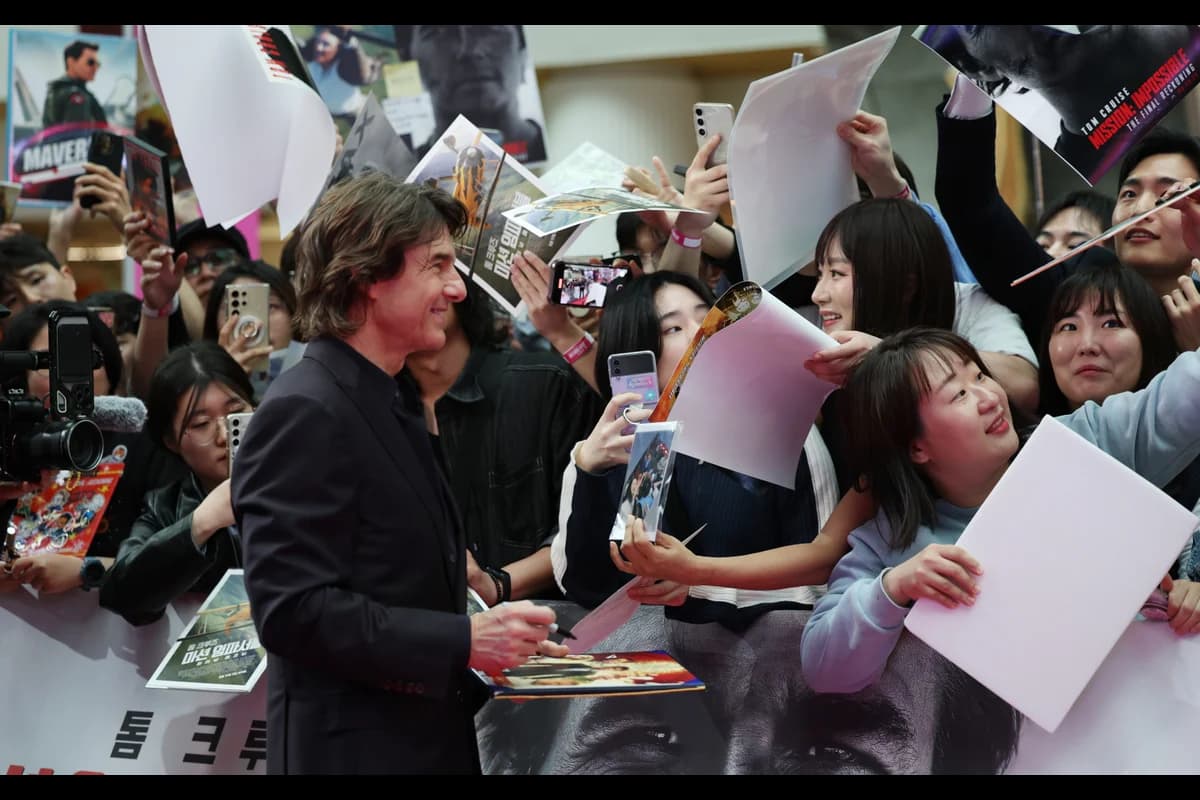
A Japanese Cartoon About Small Cute Creatures Opened at Number One in Korea. Tom Cruise's New Film Is Seventh on the Booking Board, With Cruise in Seoul to Sell It
《극장판 치이카와》 took 122,291 admissions on its opening day, the biggest start for any animated film released in Korea this year, and by the next morning held 39 per cent of every advance ticket in the country. 《디거》, Alejandro G. Iñárritu's black comedy with Tom Cruise as an oil baron, opens on 3 October with 2.6 per cent — behind a Venice prize-winner in its second week — while Cruise makes his thirteenth visit to Korea, more than any other Hollywood actor. Iñárritu was meant to come too. He cancelled the night before.
The Opposition Leader, the Park Chung-hee Foundation and a Police Complaint Want Chuseok's Number-One Film Off the Screens. The Director Says the Line They Object To Isn't In It
《암살자(들)》 passed 1.6 million admissions over the holiday. On the Monday after it, the foundation that keeps Park Chung-hee's memory demanded an apology and a halt to screenings, the leader of the opposition asked why insulting Park is 'freedom of expression' when touching Roh Moo-hyun gets you sued, and by Tuesday morning a former city councillor had filed a criminal complaint against the producer, the director and both writers. Hur Jin-ho's answer is that the film nowhere says Park ordered his wife shot, and that he now wishes he had drawn that line in dialogue. The audience score is 8.3. The netizen score is 2.2.

Seven Shots or Six? The 1974 Record Can Be Read Both Ways. Hur Jin-ho's Film Took Six, and Built a Newsroom Around the Bullet Nobody Examined.
Hur Jin-ho's 《암살자(들)》 opens on 23 September as the most pre-booked Korean film of the Chuseok season, ahead of 《인턴》, with a bracketed plural in its title that is the whole argument. The 1974 file on the shooting of First Lady Yuk Young-soo lists seven shots, one of them a misfire; the Park Chung-hee foundation now counts six; the film counts six and finds four bullets. What none of them can show is the bullet that killed her — and the director says he is offering a hypothesis, not a verdict.
The Weekly Dispatch
Korea, curated. Every week.
The best of K-culture, straight from Seoul. Written by people who actually live here.
Free, no spam, unsubscribe whenever.