Busan Spent Thirty Years Becoming a Gatekeeper. This Year the Key Doesn't Fit.
In 1997 the Busan film festival's programmers were arguing with police on an outdoor stage about whether protesting censorship counted as a festival event. In May 2026 the Academy made Busan's top prize a direct route to an Oscar submission — the only Asian festival on that list. The prize is announced on 15 October. The submission deadline is 30 September.
On the afternoon of 14 October 1997, about sixty people marched from a cinema in Busan's 남포동 district to the festival's outdoor stage and sat down.
They were documentary filmmakers, and they were there because five films at that year's Busan International Film Festival had been ordered to submit to state censorship. The police told them this was an illegal assembly and warned them they would be dispersed by force.
이용관 — one of the festival's three founders, then a professor at 경성대 — went to argue with the commanding officer. His line, as recorded in Korean accounts of that day:
"이거 시위 아니고 야외무대에서 벌어지는 것과 똑같은 영화제 행사입니다. 왜 영화제 행사에 경찰이 개입하려 합니까?" This isn't a demonstration. It's a festival event, exactly like everything else that happens on this stage. Why are the police trying to intervene in a festival event?
They stayed sitting. They kept shouting for the abolition of censorship. And then the Taiwanese director 차이밍량 (Tsai Ming-liang) turned up with his lead actor 이강생 (Lee Kang-sheng), and the protest simply dissolved into the crowd that formed around them.
That afternoon is the whole festival in miniature: a genuine political confrontation, resolved by the arrival of a film director. Twenty-nine years later, in May 2026, the Academy of Motion Picture Arts and Sciences made Busan's top prize one of six in the world that can put a film into the Oscars without its own government's involvement.
This is the story of how a festival got from the first thing to the second, and what it gave up on the way.
It Was Censored Because It Was New
Korea's system of film pre-censorship was still standing when Busan held its first festival, 13–21 September 1996: thirty-one countries, 169 films, and — against organisers' expectations of thirty or forty thousand — 184,071 admissions.
The 1995 영화진흥법 did exempt films screened at festivals from pre-release review by the 공연윤리위원회, the state body that vetted films before they could be shown. But the exemption came with a condition that reads like a joke and wasn't one: it applied only to festivals with three or more participating countries and three or more previous editions.
A brand-new festival had to be censored twice in order to earn the right not to be.
So the censors reviewed the first Busan programme. And the process was, procedurally, absurd. The festival's general manager 오석근 described the problem plainly: submissions and verdicts travelled by official letter, which took two or three days, by which point the film had already been screened and the verdict was meaningless.
The festival's countermeasure was pure attrition. According to the film journalist 성하훈's account of the period, organisers invited the censors down to Busan and piled the submissions up in front of them — a 교란작전, a disruption operation, designed "산더미처럼 쌓아서 기를 죽이는": to heap them into a mountain and break their spirit.
Then, on 4 October 1996 — thirteen days after the first festival closed — the Constitutional Court struck the whole apparatus down. In 93헌가13, decided unanimously by all nine justices, it held that requiring films to be vetted before exhibition, by a body with the power to forbid exhibition, was prior censorship of the kind the Constitution forbids. On the committee's nominal independence, the Court was blunt: 공연윤리위원회는 검열기관으로 볼 수 밖에 없다 — it cannot be seen as anything but a censorship organ.
Here is the detail that makes this more than a chronology. The founding executive director of the Busan International Film Festival was 김동호. From March 1993 to March 1995, he had been the chairman of the 공연윤리위원회.
Eleven months after leaving the censorship board, he took over the festival. Thirteen days after his festival's first edition closed, the Constitutional Court ruled that the body he had chaired was a censorship organ and that what it had been doing was unconstitutional.
The Second Year Was Worse
The exemption still didn't apply in 1997, and this time the films were pointed.
Five titles were caught: 변영주's 《낮은 목소리 2》, on the wartime sexual slavery survivors; 김동원's 《명성, 6일간의 기록》; 홍형숙's 《변방에서 중심으로》; 조성봉's 《레드헌트》, on the 제주 4·3 uprising; and Wong Kar-wai's 《부에노스 아이레스》 — Happy Together — which was ruled unimportable on the grounds of its homosexual content.
On 《레드헌트》, 조성봉 has said the producer proposed a way through: insert a subtitle reading "이 다큐멘터리는 사실과 다를 수 있습니다" — this documentary may differ from the facts. He refused and pulled the film.
That is what the sixty people on the outdoor stage were shouting about.
And the most useful thing anyone said that season came from inside the festival, from 김동원, who was serving on its jury:
"감옥에는 독립영화감독들이 있고, 인권영화제가 중단됐다. 퀴어영화제는 개막조차 못했다. 부산영화제는 훌륭하지만 영화 악법이 표현의 자유를 제한하는 우리 상황을 잊게 만들고 있다." There are independent directors in prison. The Human Rights Film Festival was shut down. The Queer Film Festival never even opened. Busan is excellent — and it is making us forget the situation we are in.
Both halves were true in the same autumn. Busan was a genuine free space, and its existence was making the surrounding unfreedom easier to overlook. The festival has been negotiating that trade ever since.
2014: The Documentary
On 16 April 2014 the ferry 세월호 sank, killing 304 people, most of them schoolchildren from 단원고. That October, the nineteenth Busan festival programmed 《다이빙벨》, a documentary by 이상호 and 안해룡 about the first two weeks of the rescue operation.
서병수 had become mayor of Busan on 1 July that year, and the mayoralty came with a seat: the mayor was, automatically, chairman of the festival's organising committee. About a week before the festival opened, he said he would prefer the film not be screened.
The festival screened it. On 6 October 2014, at CGV 센텀시티, all hundred and fifty-odd seats were full.
What followed took four years to work through, and the order matters:
The city audited the festival that November, and alleged a false sponsorship-brokerage arrangement worth 27.5 million won. In May 2015 the Korean Film Council cut its grant to the festival from 1.46 billion won to 800 million — a 45% reduction — on the stated reasoning that a festival of Busan's international standing ought to strengthen its self-sufficiency. 529 professors at fifteen Busan-area universities publicly refused that explanation. The city pressed for 이용관's departure, and sought an injunction against the festival's appointment of sixty-eight new advisers.
In April 2016, nine film-industry bodies — the producers', directors', producers-guild, industry-union, independent-film, cinematographers', screenwriters', women-in-film and marketing associations — resolved to boycott the festival, with over 90% support among those polled.
They mostly kept to it. The twenty-first edition went ahead in October 2016, and 《아가씨》 (The Handmaiden), 《곡성》 (The Wailing) and 《밀정》 (The Age of Shadows) all screened in Busan while their directors and stars stayed away. Attendance fell from 227,377 to 165,149 — a drop of 62,228, or 27.4%. A typhoon hit the city on opening day and a new anti-graft law had just taken effect, so the boycott is not the sole cause. It is not a small share of it either.
And 이용관 was convicted. Not of anything to do with the film — of embezzlement, on the brokerage arrangement. Six months' imprisonment, suspended for two years, in October 2016; reduced on appeal in July 2017 to a five-million-won fine; the fine confirmed by the Supreme Court in January 2018. He maintained throughout that he was innocent — "난 무죄다" — and the Korean film industry read the prosecution as retaliation. Both of those things are true at once, and the tidy version of this story, in which he was vindicated, is not what happened.
What did change was structural. At an extraordinary general meeting on 22 July 2016, the festival rewrote its own articles: the clauses making Busan city officials automatic office-holders were deleted, the organising committee became a board, and provisions guaranteeing the festival's independence and autonomy were written in. The mayor's seat was gone. 서병수 lost the 2018 mayoral election.
The blacklist inquiry that examined the Park Geun-hye administration's cultural interference later reported that the mayor and the city had discussed the screening with the presidential office on several occasions, and prosecutors alleged in a separate indictment that the culture minister had asked the mayor to stop it. We flag those as findings and allegations on the record rather than as established fact — we have not read the underlying report or indictment text.
2025: The Festival Becomes a Competition, and Sends the Bill
For twenty-nine years Busan had no main competition. Korean writing described it precisely as 부산 경쟁이 포함된 비경쟁영화제 — a non-competitive festival containing partial competitions. There were two of those, split by career stage: 뉴 커런츠, for Asian directors on their first or second feature, and from 2017 the 지석상, for Asian and Korean directors with three or more.
At the thirtieth edition, in September 2025, both were merged into a single section called simply 경쟁, with a prize family called the 부산 어워드. Fourteen Asian films, no distinction by career stage, judged by a seven-person jury chaired by the director 나홍진. The top prize, the 대상, went unanimously to 장률's 《루오무의 황혼》.
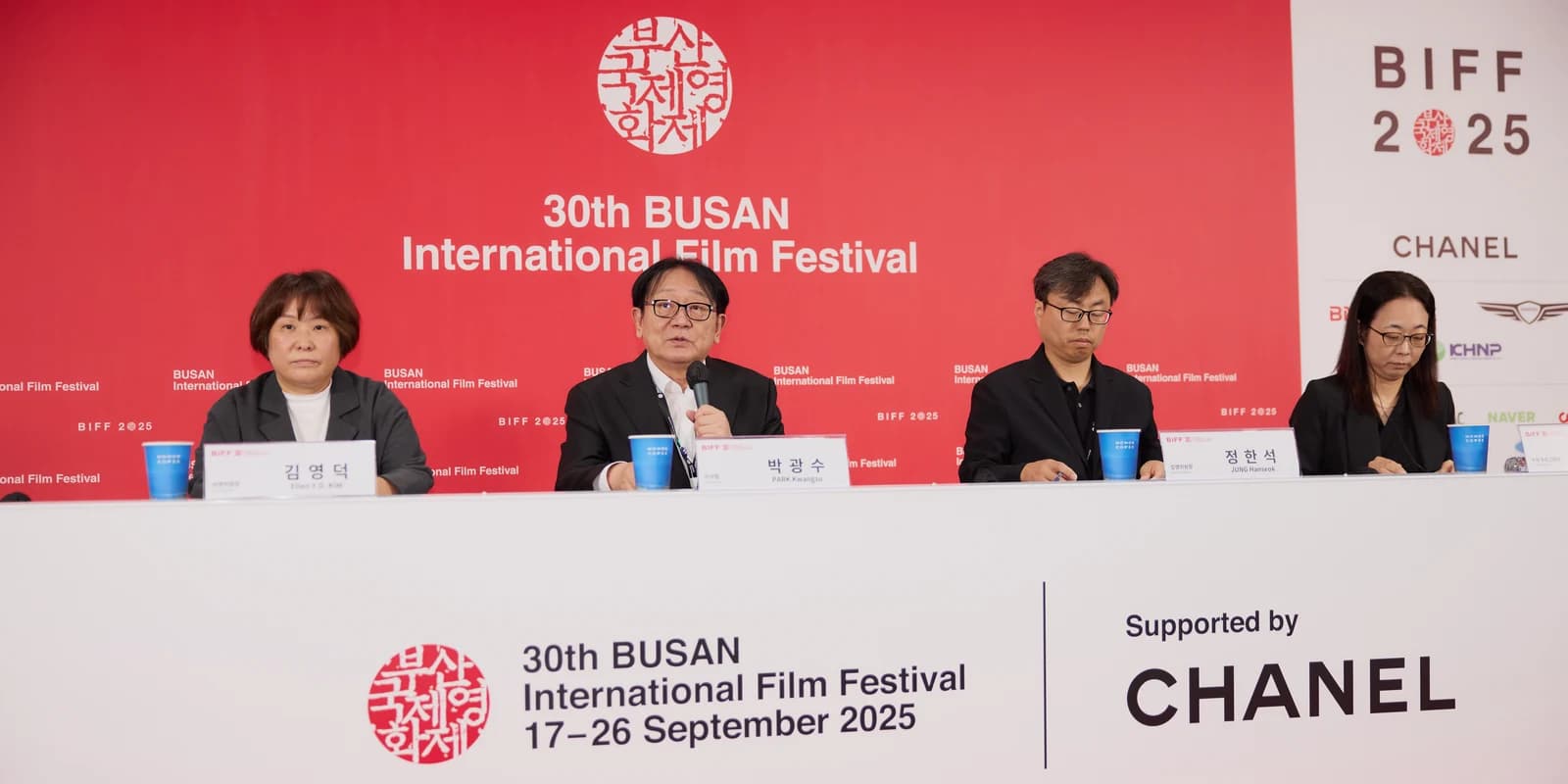
The executive director 정한석 explained the change as a need for reach: "파급력 있고, 영향력 있는 섹션이 필요하겠다는 판단에서."
Here is what it cost.
뉴 커런츠 survived as a reduced prize. The 지석상 was abolished outright. The name persists only as a ten-million-won sponsor award inside another section, funded by a group called 김지석의 친구들 — Friends of Kim Jiseok.
김지석 co-founded this festival in 1996, as a professor at 부산예술문화대, and programmed it for two decades. He died of a heart attack on 18 May 2017, on a work trip to Cannes, aged 58. In 2019 his death became the first death of a Korean film programmer to be formally recognised as an industrial accident. The award created in his name was understood to carry a specific meaning beyond commemoration — a refusal to yield to the forces that had used the cultural blacklist to threaten the freedom to make and show films.
The critic 이수원, on its removal: "지석상을 없앤 것은 몹시 서운하고 속상하다." The festival had the option of expanding the 지석상 into the competition. It deleted it instead.
2026: What It Bought
Two things arrived seven weeks apart, and the temptation is to treat them as one event. They are not.
In March 2026, FIAPF — the international federation that accredits film festivals — scrapped the four-category system it had used since 2007 and published a single A-List of seventeen festivals, judged on two years of data across programming, industry activity, press and audience. Busan is on it, and is the only Korean festival on it.
Do not read that as a reward for the competition. FIAPF went deliberately agnostic about curation model, and the proof is that Toronto, which has no competition at all, was classified A-List in the same round. Tokyo and Shanghai are also on the list. So the FIAPF instrument does not make Busan pre-eminent in Asia; it puts it in the same tier as the two festivals it is usually measured against.
What it does do is retire a piece of shorthand. Under the old system Busan sat in the specialised competitive category while Tokyo and Shanghai sat in the general one — so the familiar Korean phrase A급 영화제, applied to Cannes, Berlin, Venice, Tokyo and Shanghai, described a ladder Busan was not actually on. That ladder no longer exists.
Then, in May 2026, the Academy published the International Feature Film rules for the 99th Academy Awards, and added something genuinely new: a second, parallel eligibility path. A non-English-language film that wins a designated top prize at one of six festivals becomes eligible to be submitted without going through its country's official selection committee.
The six are the Golden Bear at Berlin, the Palme d'Or at Cannes, the Golden Lion at Venice, the World Cinema Grand Jury Prize at Sundance, the Platform Prize at Toronto — and the Busan Award – Best Film Award.
Busan is the only Asian festival on that list. Tokyo is not on it. Shanghai is not on it. This, and not the FIAPF badge, is the thing Busan now has that nobody else in Asia does.
Two cautions, because Korean coverage got this wrong in exactly the way we have had to correct ourselves for before. The committees have not been abolished — each country still submits one film, and official submissions remain eligible; the festival route runs alongside national selection, which is how the festival itself phrases it. And what the prize confers is eligibility to be submitted, not a nomination. Headlines reading "win at Busan and go straight to the Oscars" are not describing the rule.
The Key Doesn't Fit the Lock
Now put two dates next to each other.
The submission deadline for the 99th Academy Awards International Feature Film category is 30 September 2026.
The 31st Busan International Film Festival runs 6–15 October 2026. The Busan Award is announced at the closing ceremony, on the fifteenth.
The 2026 Busan Award winner cannot be submitted for the 99th Academy Awards. The prize that unlocks the door is handed out fifteen days after the door closes.
The irony is sharper than it first looks. The thirtieth edition, in 2025, ran from 17 to 26 September — pushed early that year by 추석 and the national sports festival — and would have cleared a 30 September deadline comfortably. But the rule did not exist in 2025. In 2026 the rule exists and the festival has moved back to October.
The rule and the calendar have not yet lined up once. Which Oscar year the October winner does feed into is a question the Academy's own qualifying-window definitions should answer, and we would rather say we have not established it than guess.
What's Actually Happening in October
The thirty-first edition opens on 6 October at 영화의전당, the Coop Himmelb(l)au building in 센텀시티 that has held the Guinness record for the world's longest cantilever roof since it opened in 2011 — eighty-five metres of it, reaching out from a single cone-shaped column.
양자경 (Michelle Yeoh) receives this year's Asian Filmmaker of the Year award. 허안화 (Ann Hui) receives the Camellia Award, and said something about it worth quoting in full:
"과거에는 앞으로도 계속 영화를 만들고 싶다는 마음에 제 영화 인생을 되돌아보는 의미의 상을 받는 것이 내키지 않았다. 하지만 어느덧 여든을 바라보는 나이가 되었고, 영화를 만드는 일이 점점 쉽지 않아진 지금 이 상을 받게 되어 더욱 뜻깊다." I used to be reluctant to accept an award that meant looking back over my life in film, because I wanted to keep making them. But I am approaching eighty now, and making films has become harder, and so receiving this means more.
Update, 24 August. The opening film was announced on 19 August: 김종관's 「낮과 밤은 서로에게」, an omnibus of four love stories set in a quiet alley café as one summer turns to autumn. Which is a notably gentle choice for the edition that has just made this festival a gatekeeper — the first Busan Award under the Academy's new rule opens with four couples in a coffee shop. The competition lineup and the jury still had not been announced at the time of that update. The festival's own poster has: it is built from photographs of last year's audience, by 최순대, who has been its art director since the second edition. His stated idea was that what has completed this festival has always been the people in the seats.
Update, 3 September. The rest of it was announced at press conferences in Busan and Seoul on 1 September, and it is a big programme: 315 films screening in total, 246 of them officially invited, from 59 countries — the largest slate since 2019. The competition is 14 films, among them two first-time directors and four women directors, and it includes both Lee Chang-dong's Venice competition entry and a new Hong Sang-soo. The Icon section is a record 35 films, with Almodóvar, Nanni Moretti and Cristian Mungiu's Palme d'Or winner in it. There is a new Japanese-animation strand of 13 films.
The guest list is the most international the festival has assembled: Isabelle Huppert, Maggie Gyllenhaal — her first visit to Korea — Fan Bingbing, Hou Hsiao-hsien, Tsai Ming-liang, Hirokazu Koreeda, and the animator Rintaro.
And one structural change worth noticing: the opening night moves from a Wednesday to Tuesday 6 October, and the daily screening count goes from four to five between Thursday and Sunday. A festival that has just been handed a role in the Oscar calendar has quietly given itself a longer weekend.
We are not naming the jury. Several outlets carry a 2026 jury list that, on checking, appears to describe last year's panel — the same wrong-year trap this article's own sourcing note warns about. Until we see it confirmed for the 31st edition, we would rather leave a gap than repeat it.
There is one more thing in that building worth knowing about. The 부산 어워드 trophy was designed by the Thai director 아피찻퐁 위라세타쿤 (Apichatpong Weerasethakul), mirror-finished, so that it reflects the room and the people in it back at whoever is holding it.
Which is a reasonable object for this festival to hand out. Busan has spent thirty years being argued over by mayors, ministries, censors and its own film industry, and what it kept was an audience — 184,071 of them in a city everyone said was the wrong city, in a year when the censors were still reading the programme.
Correction and update, 5 October. Two things in the 3 September update above were wrong. 《가능한 사랑》, Lee Chang-dong's Venice film, and Hong Sang-soo's 《눈 둘 데가 없네》 are not in the competition: both screen in the Icon section, as 연합뉴스 reported on 1 September. And the competition now has 13 films, not 14 — the Chinese film 《디센던트》 has been withdrawn, for what the festival is reported to have called the production's own internal reasons, in a single report we could not reopen. The breakdown of first-time and women directors we gave was counted on the original fourteen. Busan city's latest totals are 316 films and 247 officially invited, one more of each than we said; reports of the Icon section's size disagree between 35 and 36.
The jury is now confirmed, announced by the festival on 17 September: 장이머우 (Zhang Yimou) presides, with 비간 (Bi Gan), 사말 예슬랴모바 (Samal Yeslyamova), 이시카와 게이 (Kei Ishikawa), 정주리, 쩐 티 빅 응옥 and 최희서.
The festival runs from 6 to 15 October. 김종관's 《낮과 밤은 서로에게》 opens it as a world premiere on Tuesday night at 영화의전당, where 양자경 (Michelle Yeoh) receives the festival's 올해의 아시아영화인상, its Asian filmmaker of the year award. There is no closing film this year by design: the winner of the 대상 is screened last instead.
Sources for this update: biff.kr's competition list, counted on 5 October; 연합뉴스 (1 September) on the Icon section; 경향신문 (17 September) on the jury; 뉴스핌 (30 September) on the opening film; 머니투데이 and 경향신문 (6 August) on Michelle Yeoh's award; 아시아투데이 (5 October) on the closing; 부산시 (30 September) on the totals; 서울신문 (5 October) on the competition count.
If you want the other end of this story — a Korean film currently in Competition at Venice, whose director's 《오아시스》 was pitched at Busan's own project market in 2001 — see Lee Chang-dong's 'Possible Love'. And Na Hong-jin's 'Hope' is the film he made the year before he chaired Busan's first competition jury.
Images, cropped by us — all three via Wikimedia Commons, all three CC BY-SA, so these crops are offered under the same terms. Hero — the opening ceremony of the 14th festival, 8 October 2009, on a temporary open-air stage; the screen in shot reads "14th PUSAN International Film Festival," and the photograph's own camera data matches that date. It is two years before 영화의전당 opened, which is why we can use it at all. By Injeongwon, CC BY-SA 3.0. We do not name the venue, because we could not confirm where the ceremony itself was staged. Cover — the closing press conference of the 30th festival, 25 September 2025, the edition that created the 부산 어워드; the backdrop dates itself, and the nameplates read 김영덕, 박광수 and 정한석, the executive director quoted above. By Outhere505 for WikiPortraits, CC BY-SA 4.0. The sponsor branding is the event's official backdrop, not ours. Listing card — BIFF광장 in 남포동 at night, September 2018, GPS-confirmed to the plaza; the district the festival grew out of and where the 1997 march ended. The stall umbrellas are the festival's own, printed for its 22nd edition. By Christophe95, CC BY-SA 4.0.
Three things about those images are worth saying out loud. We rejected every available photograph of 영화의전당, the festival's own building. Korea's freedom-of-panorama provision excludes reproduction for the purpose of sale, so Wikimedia Commons treats the country as a no-FoP jurisdiction and will not host photographs of its buildings — which leaves a 2011 Coop Himmelb(l)au building unavailable to us under any free licence. (Corrected 11 September: we had written that Korea has no freedom of panorama at all. It has one — 저작권법 제35조②, which lets works permanently displayed in streets, parks and on building exteriors be reproduced "by any method whatsoever" — but it carves out reproduction for the purpose of sale, and that carve-out is why Wikimedia Commons, which requires commercial reuse, treats Korea as a no-FoP country and will not host such photographs. Our sourcing decision is unchanged; the reason we gave for it was wrong.) Several candidates carried no warning tag at all; absence of a tag is not permission. No free imagery of 1996 or 1997 exists. The earliest Busan festival photograph we could find under any acceptable licence is from 2006, so the founding era, the censored programmes and the protest this article opens on are unillustrated here, and that is a real gap rather than an editing choice. And we sourced nothing touching the 세월호 disaster — not the ferry, not the victims, not their families. The 2014 section has no image, deliberately.
Verified against primary and Korean-language sources. The Constitutional Court holding is quoted from 헌재 1996. 10. 4. 93헌가13·91헌바10(병합) via 국가법령정보센터; the ruling was unanimous and postdates the first festival's close by thirteen days. 김동호's tenure as chairman of the 공연윤리위원회 (March 1993 – March 1995) and as the festival's founding executive director (from February 1996) are from Korean reference records. The 1996 and 1997 censorship episodes, the 14 October 1997 protest, and the quotations from 이용관, 오석근, 조성봉 and 김동원 are from 성하훈's 오마이스타 history of the Korean film movement. The 1996 attendance figure (184,071) is BIFF's own archive; note that at least three incompatible figures circulate for that edition, and that BIFF publishes screening admissions separately from an all-inclusive total — we use the archive series and do not mix them. The 2014–18 chronology, the 45% Film Council cut, the 529 professors, the nine boycotting organisations and the 2016 articles amendment are from contemporaneous Korean reporting. 이용관 was convicted of embezzlement on a financial charge and the five-million-won fine was confirmed by the Supreme Court in January 2018; we state that plainly rather than the widespread implication that he was cleared. The FIAPF A-List and the Academy's 99th International Feature rules are as reported by Screen Daily, Cineuropa and Korean coverage of the festival's own announcement; we have not read the Academy's rule PDF directly, so the exact rule wording and the qualifying-award window remain unconfirmed, and the deadline/announcement clash is arithmetic from two independently sourced dates. Deliberately omitted: the festival's total annual budget, where sources conflict irreconcilably and one summary corrupted the unit; a "record attendance" claim for 2025, which holds only on one of two series BIFF publishes in the same document and which BIFF itself does not make; the blacklist inquiry's findings and the related indictment, reported here as findings and allegations because we have not read the underlying documents; and, at first publication, any 2026 opening film or closing film — an AI-generated site was asserting both, and neither then existed in any festival announcement (the real opening film was announced on 19 August, and there is no closing film this year).
Keep Reading
More Stories
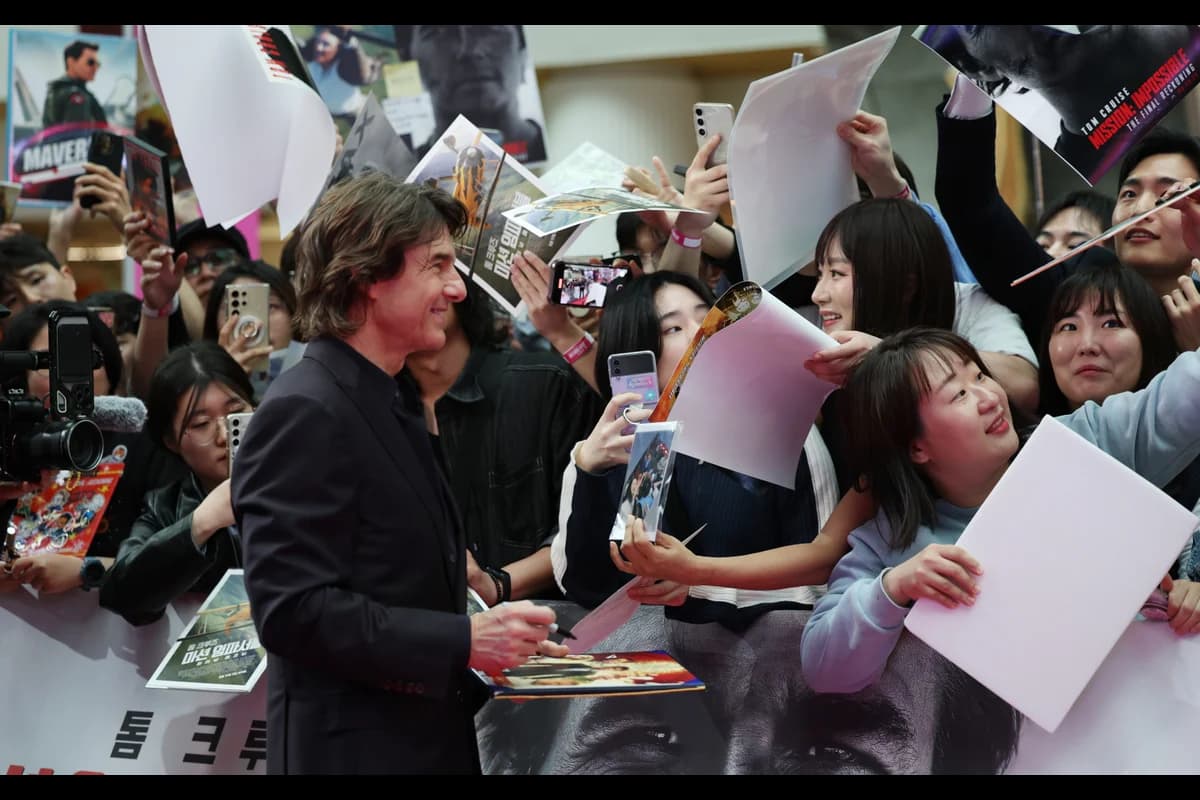
A Japanese Cartoon About Small Cute Creatures Opened at Number One in Korea. Tom Cruise's New Film Is Seventh on the Booking Board, With Cruise in Seoul to Sell It
《극장판 치이카와》 took 122,291 admissions on its opening day, the biggest start for any animated film released in Korea this year, and by the next morning held 39 per cent of every advance ticket in the country. 《디거》, Alejandro G. Iñárritu's black comedy with Tom Cruise as an oil baron, opens on 3 October with 2.6 per cent — behind a Venice prize-winner in its second week — while Cruise makes his thirteenth visit to Korea, more than any other Hollywood actor. Iñárritu was meant to come too. He cancelled the night before.
The Opposition Leader, the Park Chung-hee Foundation and a Police Complaint Want Chuseok's Number-One Film Off the Screens. The Director Says the Line They Object To Isn't In It
《암살자(들)》 passed 1.6 million admissions over the holiday. On the Monday after it, the foundation that keeps Park Chung-hee's memory demanded an apology and a halt to screenings, the leader of the opposition asked why insulting Park is 'freedom of expression' when touching Roh Moo-hyun gets you sued, and by Tuesday morning a former city councillor had filed a criminal complaint against the producer, the director and both writers. Hur Jin-ho's answer is that the film nowhere says Park ordered his wife shot, and that he now wishes he had drawn that line in dialogue. The audience score is 8.3. The netizen score is 2.2.

Seven Shots or Six? The 1974 Record Can Be Read Both Ways. Hur Jin-ho's Film Took Six, and Built a Newsroom Around the Bullet Nobody Examined.
Hur Jin-ho's 《암살자(들)》 opens on 23 September as the most pre-booked Korean film of the Chuseok season, ahead of 《인턴》, with a bracketed plural in its title that is the whole argument. The 1974 file on the shooting of First Lady Yuk Young-soo lists seven shots, one of them a misfire; the Park Chung-hee foundation now counts six; the film counts six and finds four bullets. What none of them can show is the bullet that killed her — and the director says he is offering a hypothesis, not a verdict.
The Weekly Dispatch
Korea, curated. Every week.
The best of K-culture, straight from Seoul. Written by people who actually live here.
Free, no spam, unsubscribe whenever.