Seven Shots or Six? The 1974 Record Can Be Read Both Ways. Hur Jin-ho's Film Took Six, and Built a Newsroom Around the Bullet Nobody Examined.
Hur Jin-ho's 《암살자(들)》 opens on 23 September as the most pre-booked Korean film of the Chuseok season, ahead of 《인턴》, with a bracketed plural in its title that is the whole argument. The 1974 file on the shooting of First Lady Yuk Young-soo lists seven shots, one of them a misfire; the Park Chung-hee foundation now counts six; the film counts six and finds four bullets. What none of them can show is the bullet that killed her — and the director says he is offering a hypothesis, not a verdict.
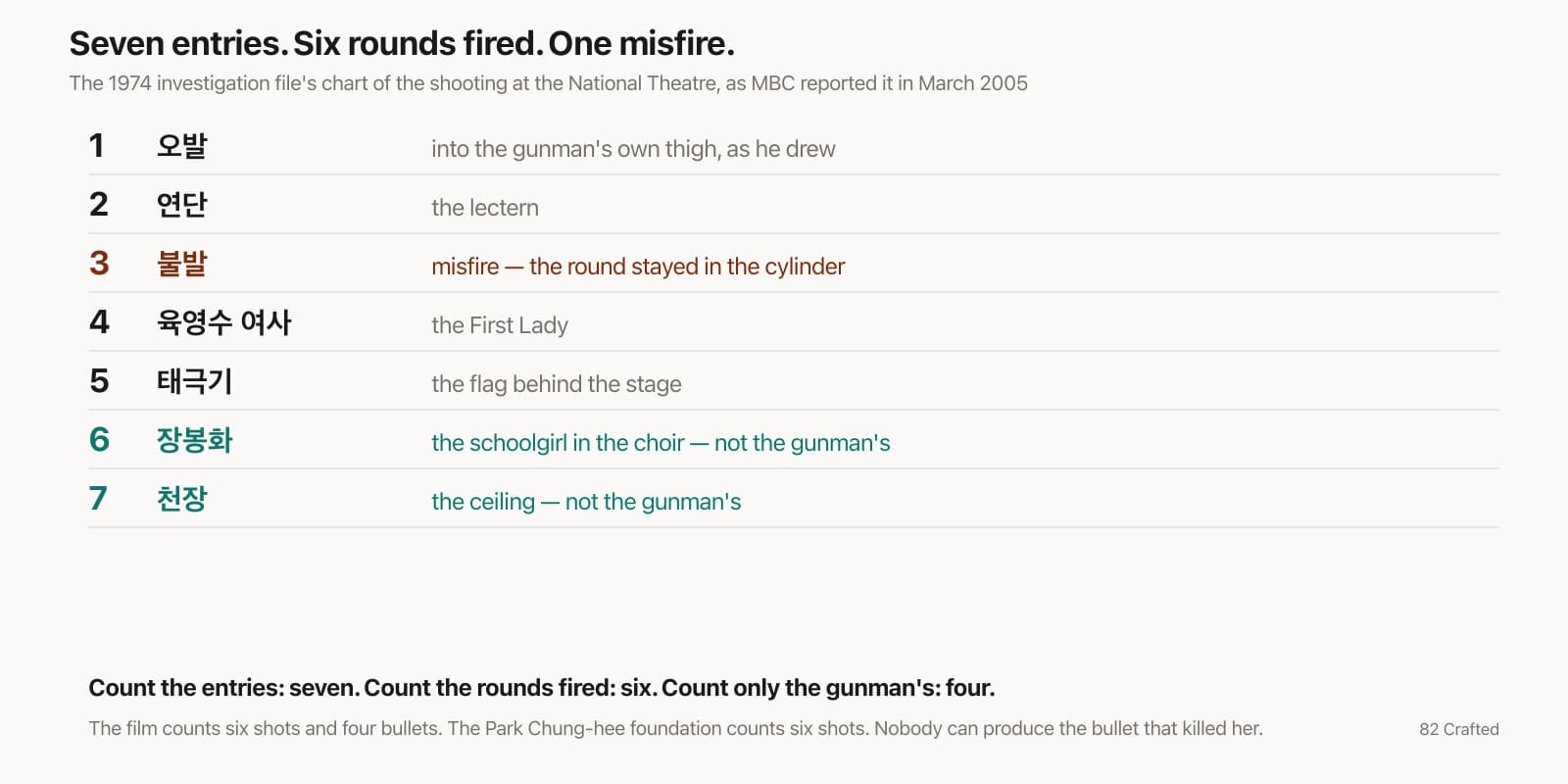
On 15 August 1974, at the National Theatre in Seoul, during the Liberation Day ceremony, a man in the audience stood up and fired at the stage. President Park Chung-hee ducked behind the lectern and was unhurt. His wife, Yuk Young-soo — 육영수, seated behind him, was hit in the head and died that evening at Seoul National University Hospital. A second-year student from a girls' vocational school, 장봉화, singing in the choir on stage, was also hit and also died.
The gunman was 문세광, a Korean resident of Japan. He was tried, convicted and executed within the year.
Fifty-two years later, Hur Jin-ho — the director of Christmas in August and One Fine Spring Day — has made a film about that afternoon, and put a bracket in its title. 《암살자(들)》: The Assassin(s). Asked about it at the press conference, he said the bracket was there so that audiences would feel "호기심과 긴장감" — curiosity and tension.
That is polite. The bracket is a claim. And to understand what it is claiming, you need to know what the record actually says, because the film has changed it.
What the records say: seven, or six, depending on a misfire
There is no single count. There are at least four, and most of the difference comes down to one question: does a round that failed to fire count as a shot?
The court. The 1974 judgment against 문세광 accounts only for his revolver. It held five rounds, and he pulled the trigger five times. The first went into his own thigh as he drew. The second hit the left of the lectern. The third misfired. The fourth hit Yuk Young-soo. The fifth, fired as he was tripped, struck the flag behind the stage. The misfired round was still in the cylinder when the gun was recovered. That makes four rounds actually fired.
The investigation file. In 2005 prosecutors released parts of the file to broadcasters. Its chart of the shooting, as MBC reported it that March, numbers seven: the five above, then a sixth that killed the choir girl 장봉화, then a seventh into the ceiling. The third of the seven is the misfire. Read that way, the file lists six rounds fired: four from 문세광's gun and two from somewhere else.
The 2005 newspapers. On the day the diplomatic file was declassified, 동아일보 restated the investigation as seven shots, four by 문세광 and three by security. One of the guards' shots killed 장봉화; the whereabouts of the other two were unknown. 한국일보 gave the same seven and four, and said the remaining three "can be presumed" to be the guards' or someone else's. That is the count the first version of this article used. It treats the seven as seven shots actually fired, when the file's seven already includes the misfire — a doubt 서울경제 raised on the same day in 2005.
The foundation. On 28 September 2026 the 박정희대통령기념재단 counted six, citing investigation records held at the 외교사료관: 문세광's five, misfire included, and one guard's shot, which killed 장봉화. It does not mention the ceiling.
Then there are the challenges to all of these. In 1989 이건우, the Seoul police forensic identification chief who examined the hall the day after, told the monthly 《다리》 that he found four bullet marks and not a single bullet; the presidential security service, he was told, had swept them all up the night before. By his notes, 문세광's rounds went into his own leg, the lectern, the flag and the ceiling, with the fifth still in the gun. None went into the First Lady. In February 2005 숭실대's 배명진 analysed the broadcast sound for SBS. He counted seven reports, gave four to 문세광 and put the guards' shots at the fourth, sixth and seventh, and argued that the fourth — a guard's — was the one that hit her.
So "seven shots" and "six shots" can both be read out of the same file. What none of the records we opened settles is the question the film is built on: which bullet killed Yuk Young-soo, and where it went. MBC reported in 2005 that, according to the file, the round said to have passed through her head reached the KCIA two days later and was never examined.
What the film says: six shots, four bullets
The film's own premise, in the words of its Korean press materials:
"6발의 총성, 발견된 4개의 탄환, 공식 기록에서 사라진 두 발의 행방."
"Six gunshots, four bullets recovered, and the whereabouts of two rounds that vanished from the official record."
The Toronto festival's programme note puts it another way: "There were six shots fired, but Mun's pistol only carried five bullets."
The film's six is not a departure from the record; it matches the foundation's reading of it. Its four bullets matches no count in the record at all — the nearest thing is 이건우's four bullet marks, and he said he found no bullets. We point this out not to catch the film in an error, because it is not making a documentary claim; we point it out because English-language coverage has been repeating the film's arithmetic as though it were the record's. It is one reading of it.
What the film does with the gap is the plot. Its characters are analogues, and the Korean reference sites map them openly: 박정민 plays 문태광, the gunman; 박성훈 plays 김학수, a prosecutor modelled on 김기춘, who led the 1974 investigation; 박지환 plays 이현도, a forensics chief modelled on the 이건우 who spoke out in 1989; 최유리 plays the choir girl. The leads are a newsroom: 박해일 as 김재환, a city editor at a fictional daily, and 이민호 as 한영일, a rookie reporter who happens to be the youngest son of a conglomerate family — with 유해진 as 박철구, a police officer attached to the security detail. 정우성, 심은경 and around twenty others appear in cameos. The film closes with the actual footage of the shooting.
What Hur says he is doing
The director has been unusually careful in interviews, and the care is the story.
"어느 하나가 맞는다고 생각하지 않고 일종의 가설로 생각하며 균형을 잡았다."
"I didn't take any one account as correct. I treated it as a kind of hypothesis and tried to keep a balance."
He said the subject took him more than ten years to work out how to approach, "비극적인 실화이자 실존 인물들이 살아계신 사건이라" — because it is a real tragedy, and the people involved are still alive. On the conspiracy question directly: "음모, 현실 은폐 등 여기에 대한 결론 이야기하는 건 내가 가지고 갈 수 있는 부분은 아닌 거 같다. 관객의 판단이지 않을까" — reaching a conclusion about conspiracy or cover-up isn't something he can carry; that is the audience's judgement.
And on the era:
"1970년대는 지금은 상상이 안 가는 거대한 국가 폭력이 있던 시기였다."
"The 1970s was a period of enormous state violence that is hard to imagine now."
He was in the fifth year of primary school in 1974. His parents and his sisters, he said, all cried.
The argument it opens into
The film will be argued about, and the arguments have already started.
중앙일보's critic, after the press screening, wrote that the film "leans toward the possibility that the bullet through the First Lady's head was not the gunman's," and that because it "points toward the conspiracy theory of a Blue House set-up, controversy is to be expected." The Korea Herald, which called it "Korea's best newsroom thriller yet," added in the same breath that "the conspiracy at the core may have no basis in the record, but the world around it rings true in spirit."
The pushback has come from where you would expect. A conservative outlet, 펜앤마이크, filed it under "progressive-camp conspiracy theories," alongside 12.12: The Day, and insisted that the number and placement of every bullet was established in 1974 by the prosecutor 김기춘's investigation — which is, of course, the investigation the film's prosecutor character is modelled on.
The most revealing comment came from 유해진, on the script he was first sent:
"처음 저한테 던져졌던 시나리오로 하자고 했으면 저는 아마 못했을 거다. 많이 수정을 거치면서 지금의 영화가 됐다."
"If we'd gone with the screenplay I was first handed, I probably couldn't have done it. It went through a lot of revision to become the film it is now."
He described the finished version as "직접적이진 않고 열려있는 얘기" — not direct; an open story. Which tells you the first draft was more direct, and someone decided that was not the film to make.
We report all of this as the film's hypothesis and the debate around it. We are not adjudicating a 1974 forensic question, and neither, by his own account, is the director.
What the critics who have seen it say
Screen Daily, from Toronto: the film "reveals itself to be an impassioned salute to a free press and a condemnation of a corrupt government that knowingly deceived its citizens." That is the film's second subject — the fictional newsroom's fight to report — and it is the one every reviewer has warmed to. 뉴스엔's headline: "총 대신 펜을 든 '서울의 봄'" — 12.12 with a pen instead of a gun. 스포츠조선 called it "the taste of the genuine article." Next Best Picture gave it 6 out of 10; Toronto's NEXT magazine four N's out of five.
The Korean press-screening reviews are, to a piece, positive and, to a piece, unstarred. Only 파이낸셜뉴스 raised the note of caution that matters commercially: "how reactions differ by generation remains to be seen." Which is a way of saying that the people who remember 1974 and the people who do not may be watching different films.
The numbers, and why the date matters
On the KOBIS reservation board at 18:19 on 17 September:
| # | Film | Opens | Share | Tickets |
|---|---|---|---|---|
| 1 | 《오디세이》 | 5 Aug | 22.9% | 124,996 |
| 2 | 《암살자(들)》 | 23 Sept | 17.1% | 93,321 |
| 3 | 《인턴》 | 16 Sept | 13.7% | 74,730 |
| 4 | 《타짜: 벨제붑의 노래》 | 23 Sept | 10.2% | 55,638 |
The most pre-booked Korean film of the season is one that has not opened yet, and it is ahead of the one that took number one last Wednesday. It opens on the 23rd against 《타짜》 and Lee Chang-dong's 《가능한 사랑》 — the three-film collision — and it has one structural edge over 《타짜》 that a Chuseok release cares about: it is rated 12+, and 《타짜》 is 19+.
It runs 131 minutes. Hive Media Corp produces and distributes it in-house, having had no distributor attached as late as January; the shoot ran to 68 sessions and, the director says, was done entirely on location with no built sets. Its Toronto gala on 16 September at Roy Thomson Hall — Hur's third Gala presentation there, after Dangerous Liaisons in 2012 and A Normal Family in 2023 — sold out, and 이민호 was given his own "In Conversation" session the following evening.
Update, 29 September: the foundation, the opposition and a police complaint
The film is now the subject of a political fight — a demand from the 박정희대통령기념재단 that screenings stop, a boycott shared by the leader of the opposition, and a criminal complaint against the producer, the director and the writers — and of a correction to this article, below. We have written the fight up separately.
Update, 28 September: one million on day four
It opened as the board said it would. 134,460 on Wednesday 23 September — the day's most-watched film, ahead of 《타짜》 on 103,361 — then 288,480 on the holiday Thursday, 426,257 on Chuseok itself, 432,348 on Saturday, and past one million admissions on its fourth day. By Monday 28 September, when the holiday ended and the whole market fell by two-thirds, it stood at 1,633,618 from KOBIS's daily table, having been number one every day but that Monday, when 《타짜》 edged it by fifteen hundred tickets. The full holiday table is in the collision piece.
What it says
A film has taken the gaps in the state's own record — a misfire counted as a shot, a bullet nobody examined — built a newsroom around them, and asked the audience to decide. The director calls it a hypothesis and has spent ten years making sure it stays one. The right is calling it a conspiracy theory. The critics are calling it the best newsroom thriller Korea has made. And it is the most-booked Korean film going into the holiday.
Whatever you think happened at the National Theatre in 1974, the bracket is doing exactly what he said it would.
Images. The lead photograph shows President Park Chung-hee and Yuk Young-soo together at the groundbreaking ceremony for Seoul's first subway line on 12 April 1971, three years before the shooting — from the Seoul Museum of History, released under 공공누리 제1유형 (attribution), licence verified on the file page. It is the only image of her we would run: a public event, with her husband, alive. We have not used, and would not use, any frame of the shooting or its aftermath, including the footage the film itself ends on. The second photograph is 이민호 at a public event in Malaysia in 2015, CC BY-SA 2.0 via Flickr, a genuine camera photograph and the only one of the three leads on Wikimedia Commons that is not a video frame — 유해진's and 박해일's are all frame-grabs, which we do not use. The third image is ours: the investigation file's seven numbered shots, as MBC reported them in 2005, with the misfire marked. Stills from the film are Hive Media Corp's; we have asked for them.
Sources. The counts are from the 1974 judgment as quoted by 문화일보 and Pressian; 동아일보, 한겨레, 서울경제 and 문화일보 of 20 January 2005 and 한국일보 of 21 January 2005 on the declassified diplomatic file; MBC's reading of the file's shot chart as reported by 한국일보 and 부산일보 on 18 March 2005; 이건우's 1989 interview with 《다리》, reprinted by Pressian on 14 February 2005; 배명진's sound analysis from 한겨레 of 11 February 2005; and the 박정희대통령기념재단's statement of 28 September 2026 as reported by 뉴데일리 and 헤럴드경제. The film's own arithmetic is from its Korean press materials as reproduced by JTBC and 서울신문, and from the Toronto festival's programme. The director's words are from 경향신문 (15 September), the press screening at Megabox COEX on 8 September as reported by 시사위크 and iMBC, the 10 August production report via YTN, and round-table interviews in 일간스포츠 and 중앙일보. 유해진 is quoted from OSEN. Runtime, rating, release date and the company's roles are from KOBIS's film and company records; reservation figures from KOBIS's real-time board, read directly. Reviews are Screen Daily, the Korea Herald, Next Best Picture, NEXT, 스포츠조선, 뉴스엔, 파이낸셜뉴스, 미디어오늘 and 경향, 8–16 September. Cast and character analogues from 씨네21 and 나무위키.
Stated rather than smoothed. The first version of this article gave one 2005 newspaper's restatement of the investigation as the record itself; the section above now sets out each count and where it comes from, and the correction note at the foot says what changed. 장봉화 was a choir member from a girls' vocational school, not an accordionist, as an early draft had it. Toronto billed the gala as a world premiere; the Korean press had seen it on 8 September, so it was the first public screening rather than the first. No Korean review we found carries a star rating, and 씨네21's critics' scores had not been published at the time of writing. We searched for a review in the main conservative dailies and found none, which is not the same as there being none. KT StudioGenie handles international sales; we have not found a Korean source describing any other role for it, so we say nothing further. And we have not reported anything said by the family of the victim about the film, because in every page we opened there was nothing.
Correction, 29 September 2026. An earlier version of this article said the 1974 investigation "counted seven gunshots and recovered six bullets", four of the shots by 문세광 and three by security. That four-and-three split is how 동아일보 and 한국일보 restated the investigation when the diplomatic file was declassified in January 2005, and we presented it as the record itself. The investigation file, as MBC reported it in March 2005, lists seven numbered shots including a misfire, which means six rounds fired, two of them not 문세광's. On 28 September 2026 the 박정희대통령기념재단 counted six, one of them a guard's. We found no source for "six bullets recovered" and have removed it. We also said 이건우 described a bullet being collected before the forensic examination; he said all of them had been. The headline, the standfirst, the section on the record, the closing line and the cover image have been rewritten to set out each count and where it comes from.
Keep Reading
More Stories
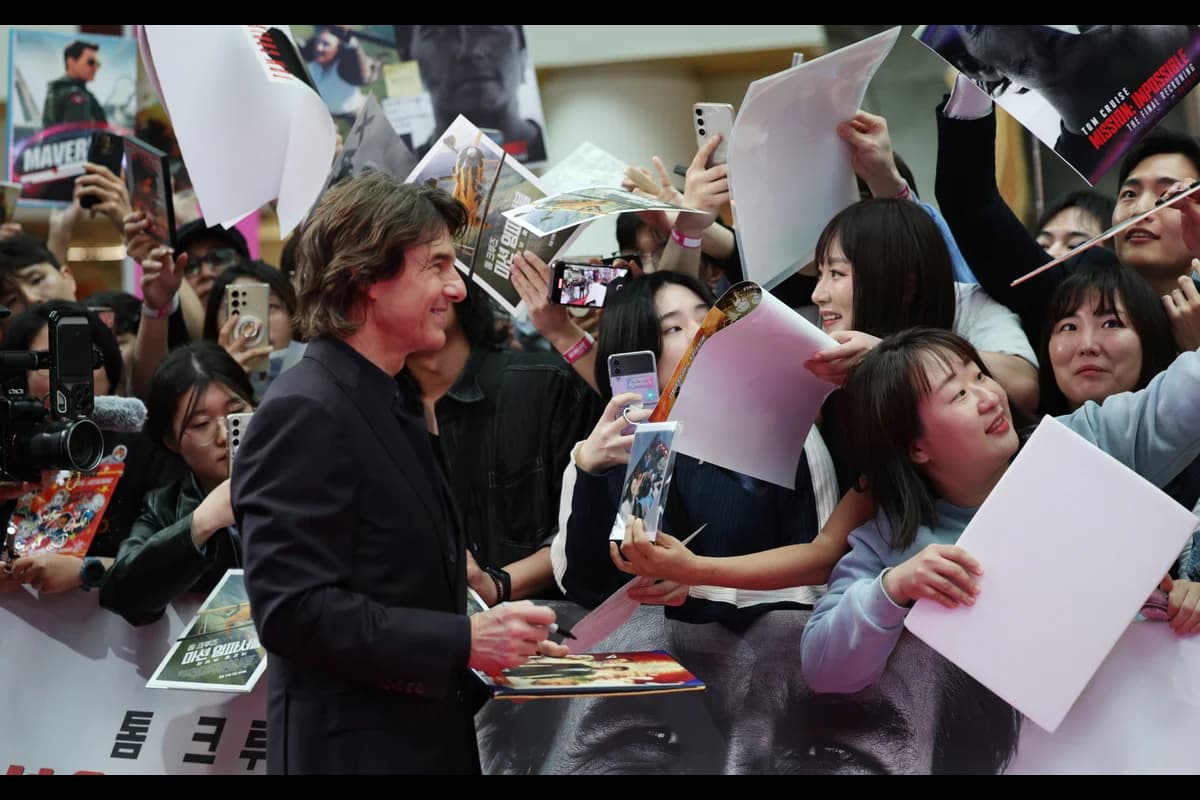
A Japanese Cartoon About Small Cute Creatures Opened at Number One in Korea. Tom Cruise's New Film Is Seventh on the Booking Board, With Cruise in Seoul to Sell It
《극장판 치이카와》 took 122,293 admissions on its opening day, the biggest start for any animated film released in Korea this year, and by the next morning held 39 per cent of every advance ticket in the country. 《디거》, Alejandro G. Iñárritu's black comedy with Tom Cruise as an oil baron, opens on 3 October with 2.6 per cent — behind a Venice prize-winner in its second week — while Cruise makes his thirteenth visit to Korea, more than any other Hollywood actor. Iñárritu was meant to come too. He cancelled the night before.
The Opposition Leader, the Park Chung-hee Foundation and a Police Complaint Want Chuseok's Number-One Film Off the Screens. The Director Says the Line They Object To Isn't In It
《암살자(들)》 passed 1.6 million admissions over the holiday. On the Monday after it, the foundation that keeps Park Chung-hee's memory demanded an apology and a halt to screenings, the leader of the opposition asked why insulting Park is 'freedom of expression' when touching Roh Moo-hyun gets you sued, and by Tuesday morning a former city councillor had filed a criminal complaint against the producer, the director and both writers. Hur Jin-ho's answer is that the film nowhere says Park ordered his wife shot, and that he now wishes he had drawn that line in dialogue. The audience score is 8.3. The netizen score is 2.2.
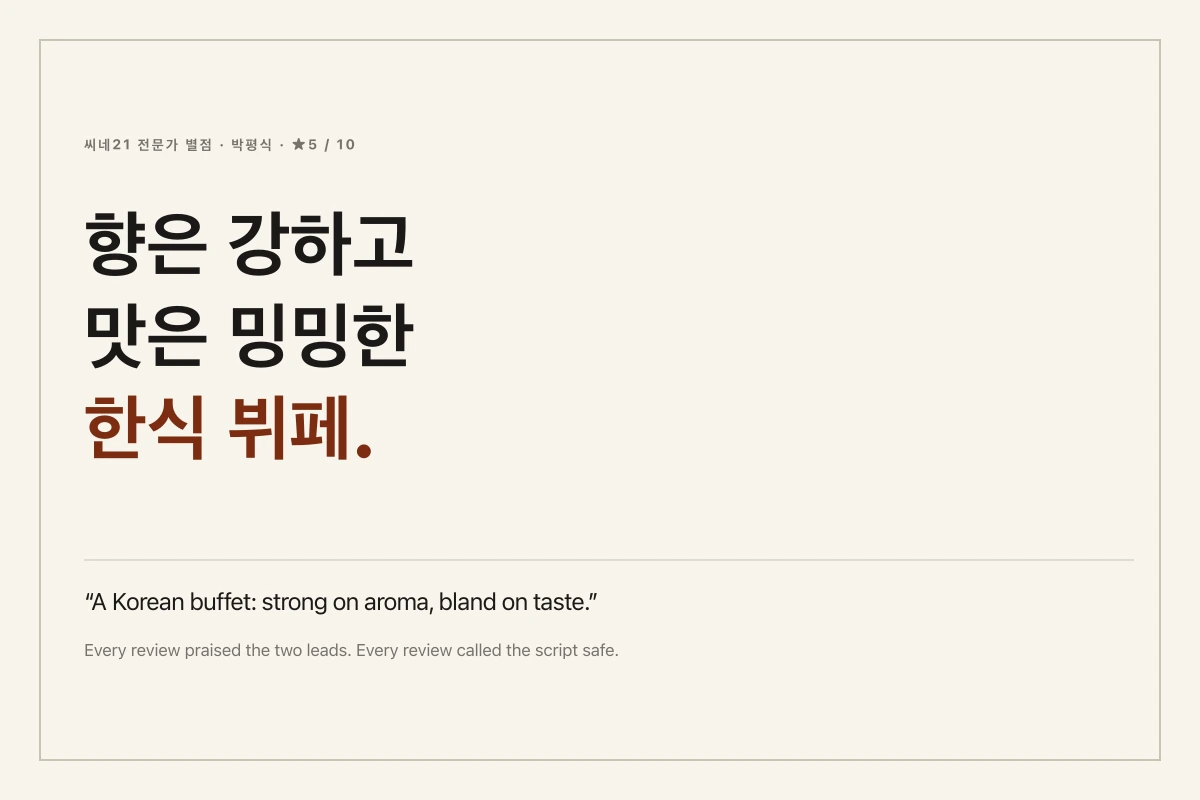
《인턴》 Opens on 16 September Behind a Film From August and a Film From the Following Week
Two days before Korea's warmest film of the autumn opens, it is the third most-booked film in the country. Above it: a Christopher Nolan film that has been number one for forty consecutive days, and a Korean thriller that does not open until the 23rd. The critics have praised the two leads in every review and called the script safe in every review. And the whole thing exists because a studio that quit Korea six years ago came back for it.
The Weekly Dispatch
Korea, curated. Every week.
The best of K-culture, straight from Seoul. Written by people who actually live here.
Free, no spam, unsubscribe whenever.