In English She Is the Director of 'Kim Ji-young, Born 1982.' In Korean She Is a Remake Specialist.
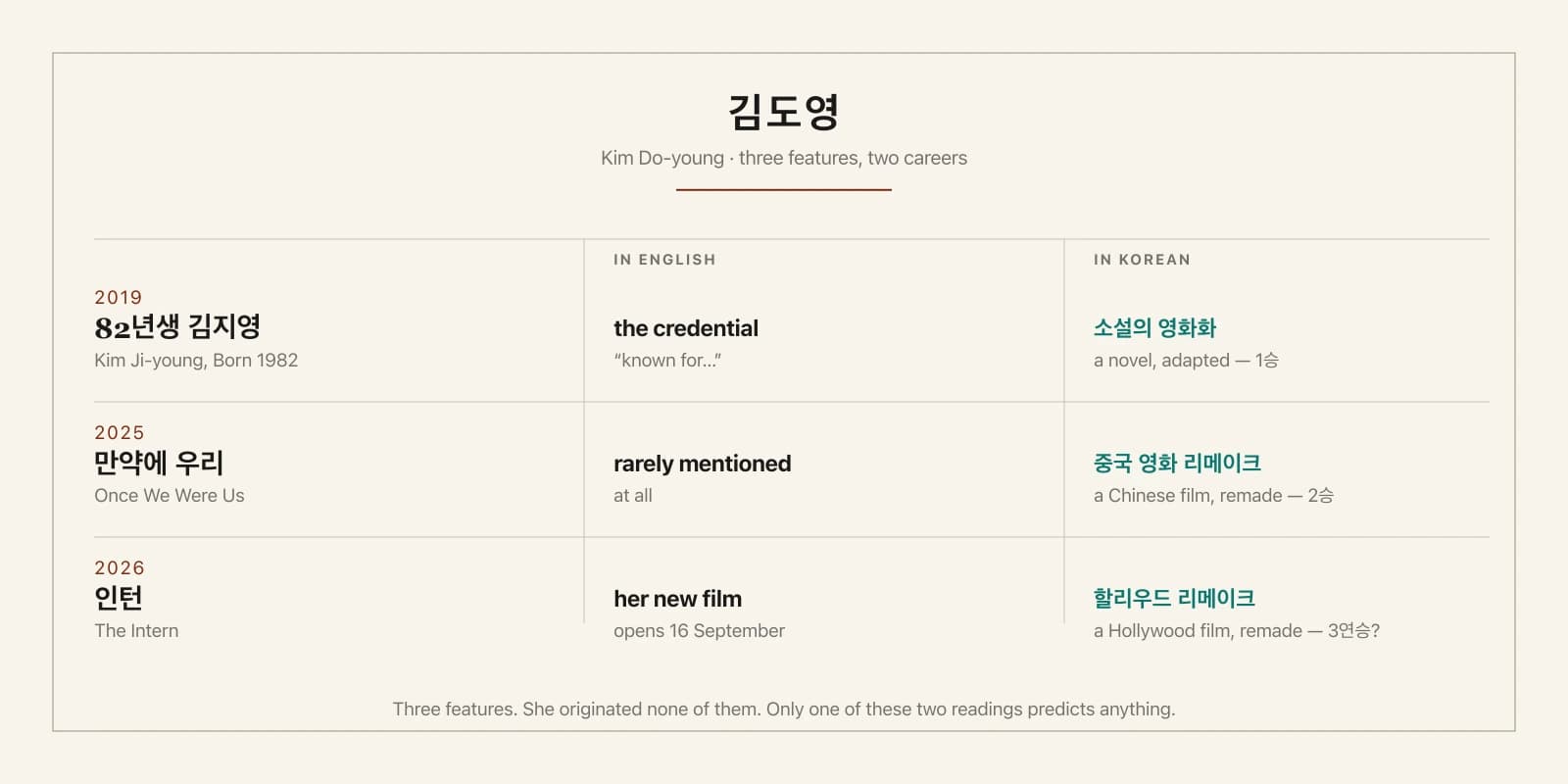
Kim Do-young's Korean 'The Intern' opens 16 September with Choi Min-sik and Han So-hee. Every English write-up introduces her by the film that started a national argument about feminism. Korean film writers introduce her as someone on a two-for-two run at adapting other people's material, going for three. Same director, same three films, two completely different careers — and which one you get depends on which language you read.
On 16 September, a Wednesday, Warner Bros. Korea releases 《인턴》 — a Korean remake of Nancy Meyers' 2015 comedy The Intern. Choi Min-sik takes the Robert De Niro role as 김기호 (Kim Ki-ho), a man with thirty-seven years of career behind him who joins a fashion company as its most junior hire. Han So-hee takes Anne Hathaway's as 이선우 (Lee Seon-woo), the founder of a brand called WOO22 (우투투), which the official synopsis says hit ₩10 billion in sales within three years of launch. The supporting cast includes Kim Jun-han, Ryu Hye-young and Kim Geum-soon.
The director is 김도영 (Kim Do-young). And the interesting thing about this film, before anyone has seen it, is that she is a different person depending on which language you read about her in.
Two introductions
Here is how the English-language press introduced her in August and September. Korea Herald: known for Kim Ji-young, Born 1982. Korea Times: same. Korea JoongAng Daily reached instead for her most recent film, Once We Were Us. Philstar gave no director background at all.
Where Kim Ji-young, Born 1982 appears, it appears as a credential — the shorthand that tells an English-reading audience this is a serious director. It is doing the same work as "the director of Parasite."
Now here is how a Korean critic introduced her, in a review published 4 September at iMBC연예:
"'82년생 김지영', '만약에 우리' 등 영화 리메이크, 소설의 영화화 등 자신만의 감각으로 원작을 재해석하며 영화로도 성공한 이력이 있기 때문이다. 김도영 감독이 3연승의 신화를 쓸 수 있을지 기대가 된다."
"Because she has a track record of reinterpreting source material with her own sensibility and succeeding at it — film remakes, novel adaptations, works like Kim Ji-young, Born 1982 and Once We Were Us. The question is whether Kim Do-young can write a three-in-a-row legend."
Read that again, because it is a genuinely different sentence about a genuinely different career.
In this telling, Kim Do-young is not "the feminist director." She is a 리메이크 장인 — a remake craftsman. Her subject is not gender. Her subject is other people's material, and her skill is making it land in Korean. And on that reading she is not one-for-one with a famous political film. She is two-for-two, going for three.
The three films, counted the second way
The Korean framing is not a stretch. It is arithmetic.
- 《82년생 김지영》 (2019) — an adaptation of Cho Nam-joo's 2016 novel.
- 《만약에 우리》 / Once We Were Us (31 December 2025) — a remake of the 2018 Chinese film 《먼 훗날 우리》 (Us and Them), starring Koo Kyo-hwan and Moon Ga-young.
- 《인턴》 (2026) — a remake of a 2015 American film.
She has directed three features. She originated none of them. That is not a criticism; adaptation is a craft, and a hard one. But it does mean that a filmography which reads in English as "landmark feminist statement, then two other things" reads in Korean as "three consecutive jobs of the same kind, getting progressively harder to localise."
Both readings are true. Only one of them predicts anything about the film opening on 16 September.
What we came here to write, and why we are not writing it
The pitch, honestly stated: the director who made the film that set off a national argument about how Korean women are treated at work has now made a warm intergenerational office comedy in which a veteran man mentors a young woman CEO. Isn't that something?
We spent the research on that and it does not hold, so we are not running it as one.
Kim Do-young has not drawn that line herself. Across every interview we could retrieve from the 24 August press event at CGV Yongsan I'Park Mall and the coverage around it — Korea Times, Korea Herald, Herald Muse, Cineplay — she discusses this film in terms of generational labelling, of grounding the characters, and of departing from the American original. She never connects it to Kim Ji-young's subject matter. Not once that we found. Any irony here is our observation, not her statement, and an observation that a director has not made about her own work is a thin thing to build a piece on.
What she did say is about realism:
"원작보다는 훨씬 더 땅에 붙인 인물들이면 좋겠다는 생각을 했다." — "I wanted characters more firmly on the ground than the original's."
"원작보다 훨씬 더 현실적인 내면의 불안과 외로움을 가진 인물들." — "Characters carrying far more realistic inner anxiety and loneliness than their counterparts in the original."
And Choi Min-sik said the thing everyone quoted:
"우리도 훌륭한 원작을 잠시 접어두고 우리만의 방식으로 표현하자는 마음으로 의기투합했다." — "We agreed to set the fine original aside for a moment and do it our own way."
He also, on being told who his co-star was, apparently said: "그 한소희?" — "That Han So-hee?" Han So-hee's version was that a chance like that does not come twice in a lifetime, and that she worked to "원작의 잔상을 지우고" — erase the original's afterimage — rather than play Anne Hathaway.
The word the film had to invent, and the budget line that already existed
The synopsis calls Choi Min-sik's character a 실버 인턴 — a "silver intern." That phrase is doing translation work, and it is worth pulling on.
Korea has an actual, named, funded version of this. The 현장실습 훈련(시니어인턴십) 지원사업 — literally the on-site training internship support programme — is run by the Ministry of Health and Welfare through the 한국노인인력개발원. It pays companies to hire people aged 60 and over: half a month's wage for three months, capped at ₩400,000 a month, up to ₩2.7 million per hire, with more if the hire is kept on, and up to ₩2.8 million more for keeping them past eighteen, twenty-four and thirty-six months.
And then there is a category called 세대통합형 — the "generation-integration type." It pays a company ₩3 million, in a lump sum, for hiring a retiree with skilled expertise as a mentor to its young staff, for at least six months.
That is the plot of The Intern, sitting in a Korean government budget as a line item, with a subsidy attached.
We would love to tell you the film knows this. We cannot. One English-language piece — Korea JoongAng Daily — states that the character joins through "a government-backed 'silver intern' program that offers companies tax incentives for hiring older workers," and no Korean source we read says anything of the kind. The same paragraph also gives Ki-ho a thirty-seven-year career in publishing, where every Korean source we found gives thirty-seven years and no industry at all — and publishing looks suspiciously like a memory of the American original, where Ben Whittaker came from a phone-directory company. So we are reporting the policy because the policy is real and genuinely funny, and flagging that we could not confirm the script invokes it.
There is also a smaller, sharper irony available for free. The real programme's generation-integration tier pays for a veteran hired as a mentor. The film makes him the 막내 — the most junior person in the room. The policy would have given him rank. The movie takes it away, because that is where the comedy is.
The first review is in, and it says the translation failed
《인턴》 has been screened. The 4 September iMBC연예 review, by 김경희, gives it two stars, and the headline is not gentle: "the K-startup playhouse produced by remake craftsman Kim Do-young's complacency."
The core charge:
"리메이크 작품으로 2연승의 기록을 세운 김도영 감독인데 이번에는 좀 안일했던 것 같다."
"Kim Do-young set a two-in-a-row record with her remakes, but this time she seems to have gotten a bit complacent."
Note what that argument is and is not. It is not "the feminist director sold out." It is "the localiser did not localise." The reviewer's specific complaint is that the film markets itself as a K-오피스물 — a K-office picture — and is really an 오피스로망물, an office-fantasy: a startup that does not behave like a startup, a corporate crisis too silly to credit, and a Choi Min-sik reduced to a retiree gamely trying to communicate with young people rather than a man whose thirty-seven years of experience are actually worth something. What should have been experience plus passion, the review says, came out as 오지랖과 예민함의 만남 — a meeting of meddling and touchiness.
It grants the film its sets, its art direction, its supporting characters, and the view of Namsan through the office windows.
One review is one review, and it is a pre-release review of a film that opens to the public on 16 September. But it is a useful data point precisely because it is arguing on the Korean terms, not the English ones: the question it asks is not is this politically consistent with her earlier work, it is is this as well-adapted as her earlier work.
The part that is actually funny
Here is the fact that makes the whole enterprise a little bit of a joke on itself.
The Intern (2015) did not need localising for Koreans. It already worked. It grossed about $194 million worldwide against a budget it beat roughly fivefold, and — per the same Korean review's before-screening notes — Korea was its single strongest international market. Ten years on it still turns up in Korean lists of 인생작, films people count as one of their life's films.
So Korea took an American fantasy about a courteous old man in a well-lit office, loved it more than any other country outside the United States, kept loving it for a decade, and is now being sold it back with the accents corrected. And the first person to review the Korean version says the American one felt more grounded.
There is one more coincidence in there, which the Korean review supplies without comment. It introduces Anne Hathaway — the actress whose part Han So-hee is taking — as the star of The Devil Wears Prada, Interstellar, and 《오디세이》. Which is the film that, as of the end of August, had become the most-watched IMAX release in Korean history. She is not going anywhere.
The date is not an accident
16 September is a Wednesday, which is the standard Korean opening day, and it sits in a very deliberate gap.
23 September is a three-film pile-up — 《타짜: 벨제붑의 노래》, 《암살자(들)》 and 《가능한 사랑》 all opening the same day. And Chuseok falls on Friday 25 September, with the holiday running 24–26 September.
Opening on the 16th buys 《인턴》 a full week alone before the collision, and puts it in cinemas with word of mouth already built when the holiday audience arrives. Nobody at Warner Bros. Korea has said this out loud in anything we read, so treat it as inference from a calendar rather than stated strategy — but it is a very legible calendar.
It matters to Warner because this is its first Korean theatrical release in about five years, produced and distributed directly. The production company is 앤솔로지스튜디오 (Anthology Studios), founded in 2020 by producer Choi Jae-won with director Kim Jee-woon and actor Song Kang-ho, in partnership with Warner Bros. Korea. The film runs about 132 minutes and carries a 12+ rating.
The pre-release signals are good and are only signals: the teasers passed 10 million YouTube views inside about a week, combined views passed 20 million by early September, and Edaily reported the film sitting first in advance-booking share among Korean films about two weeks out. Advance bookings are not admissions.
The record on remakes is genuinely mixed
For scale, three recent Korean remakes of Western films, and they go three different ways.
《미쓰GO》 (2012), from My Best Friend's Girl, drew about 610,000 admissions and is remembered as a flop. 《자백》 (2022), from the Spanish The Invisible Guest, opened at number one and then underperformed against expectations. 《핸섬가이즈》 (2024), from Tucker and Dale vs. Evil, was a real surprise hit at over 1.7 million admissions, one of the year's top Korean comedies, and won its director a new-directors award.
So: one flop, one disappointment, one hit. Anyone telling you Korean remakes of Western films always fail, or always work, is choosing their example.
Which career is she having?
Probably both, and that is the honest answer.
Kim Ji-young, Born 1982 was a national event — it topped the box office on its opening day, passed two million admissions inside eleven days, and its rating pages became a proxy battlefield in an argument that was already running before the film existed. That happened, and it is reasonable that English-language coverage still leads with it.
But the film that made it a national event was, mechanically, an adaptation of a novel that had already caused the argument. Kim Do-young's job on it was to translate a book people were already fighting about into a film that worked. Which is, structurally, exactly the job she took on Once We Were Us, and exactly the job she has taken on 《인턴》.
The English-language version of her career treats one of those three as the real one. The Korean version treats all three as the same one. On 16 September, Korean audiences get to decide whether the third attempt landed — and they will be judging her against the second one, not the first.
Also on this desk: what happens on 23 September, and why Yongsan's IMAX screen became the biggest story in Korean cinema this year.
A necessary aside on names. The director 김도영 and the KIA Tigers third baseman 김도영 are two different people with the identical Korean name and the identical standard romanisation, Kim Do-young. Korean reference sites keep a disambiguation page for exactly this reason. If you have been reading us this week you have met the other one, stuck on thirty-nine home runs while it rains in Gwangju. No relation, no connection, and we mention it only because we nearly built a cross-link that would have been very embarrassing.
Images. There are none, and here is why. Warner Bros. Discovery's Korean press portal returned HTTP 403 to us, so we could neither see what it holds nor read any terms attached to it. The stills circulating on Korean entertainment sites carry the credit 워너브러더스코리아㈜, and the review page we quote carries an explicit notice that 무단 전재·복제·배포를 금합니다 — unauthorised reproduction, copying and distribution are prohibited. Publication is not permission. There is no Creative Commons or KOGL material for a commercial studio production, and freedom of panorama opens no route either, because Wikimedia Commons treats South Korea as a no-FoP country and will not host photographs of its buildings. (Corrected 11 September: we had written that Korea has no freedom of panorama at all. It has one — 저작권법 제35조②, which lets works permanently displayed in streets, parks and on building exteriors be reproduced "by any method whatsoever" — but it carves out reproduction for the purpose of sale, and that carve-out is why Wikimedia Commons, which requires commercial reuse, treats Korea as a no-FoP country and will not host such photographs. Our sourcing decision is unchanged; the reason we gave for it was wrong.) So the artwork here is typographic: the two ways this director gets introduced, set side by side, which is the actual subject of the piece.
Sources: the 4 September iMBC연예/파이낸셜포스트 review by 김경희, including the official synopsis it reproduces; Korea Times, Korea Herald, Herald Muse and Cineplay on the 24 August 제작보고회; Korea JoongAng Daily; Korean Wikipedia, Namuwiki and KMDb on the filmography; KOBIS on Anthology Studios; and 한국노인인력개발원's own programme page for the 시니어인턴십 support figures.
What we could not confirm, stated plainly. The full supporting cast — sources disagree on several smaller roles and we name only the five that reconcile across three or more. The screenplay credit; no source we found states one separately from the director. The 132-minute runtime and 12+ rating, which three secondary sources agree on but which we could not pull from a primary record. The Korea JoongAng Daily claims about a government scheme in the plot and a publishing background, both single-source and both contradicted by the Korean coverage. And the exact Korean admissions figure for the 2015 original, which we have seen given as 3.61 million and have therefore not printed — we say only that Korea was its strongest international market, which its Korean distributor's own materials assert.
One correction to our own working notes. We began this with her second feature recorded as 《우리들의 블루스》. That is wrong, and not marginally: that title belongs to an unrelated 2022 tvN television drama directed by Kim Kyu-tae. Her second feature is 《만약에 우리》.
Keep Reading
More Stories
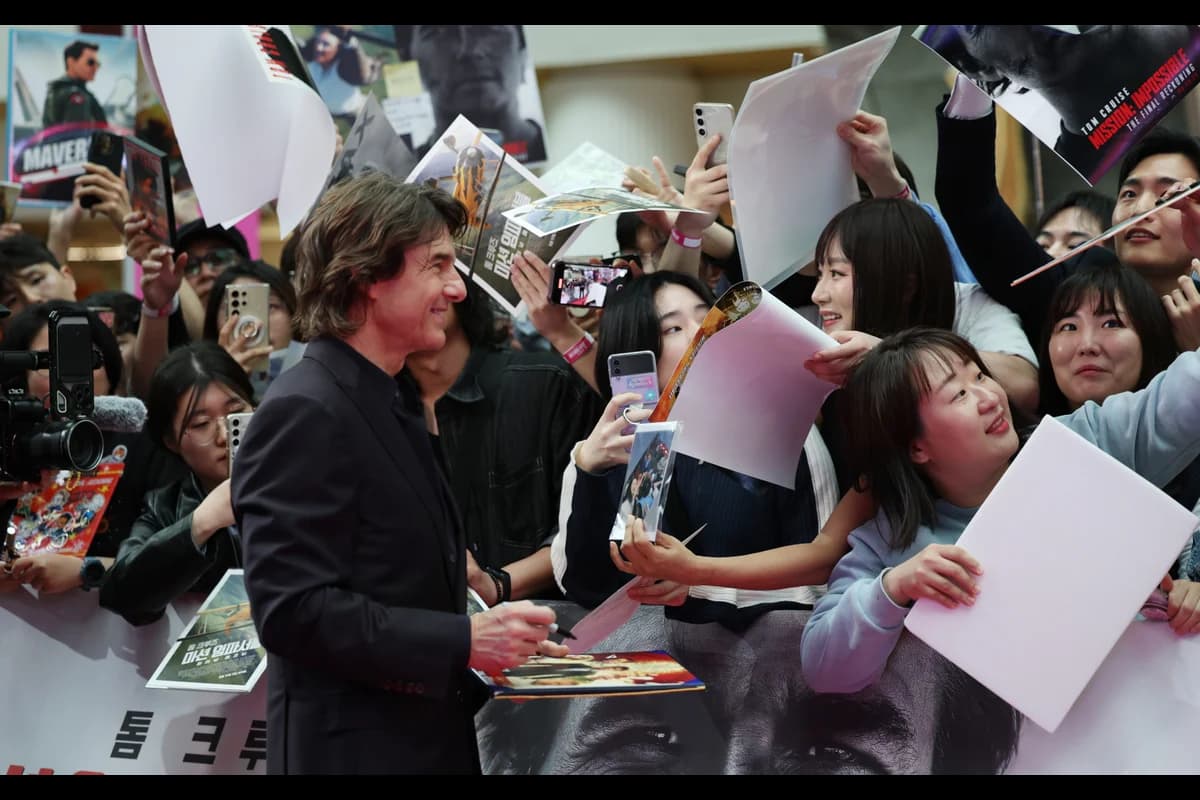
A Japanese Cartoon About Small Cute Creatures Opened at Number One in Korea. Tom Cruise's New Film Is Seventh on the Booking Board, With Cruise in Seoul to Sell It
《극장판 치이카와》 took 122,291 admissions on its opening day, the biggest start for any animated film released in Korea this year, and by the next morning held 39 per cent of every advance ticket in the country. 《디거》, Alejandro G. Iñárritu's black comedy with Tom Cruise as an oil baron, opens on 3 October with 2.6 per cent — behind a Venice prize-winner in its second week — while Cruise makes his thirteenth visit to Korea, more than any other Hollywood actor. Iñárritu was meant to come too. He cancelled the night before.
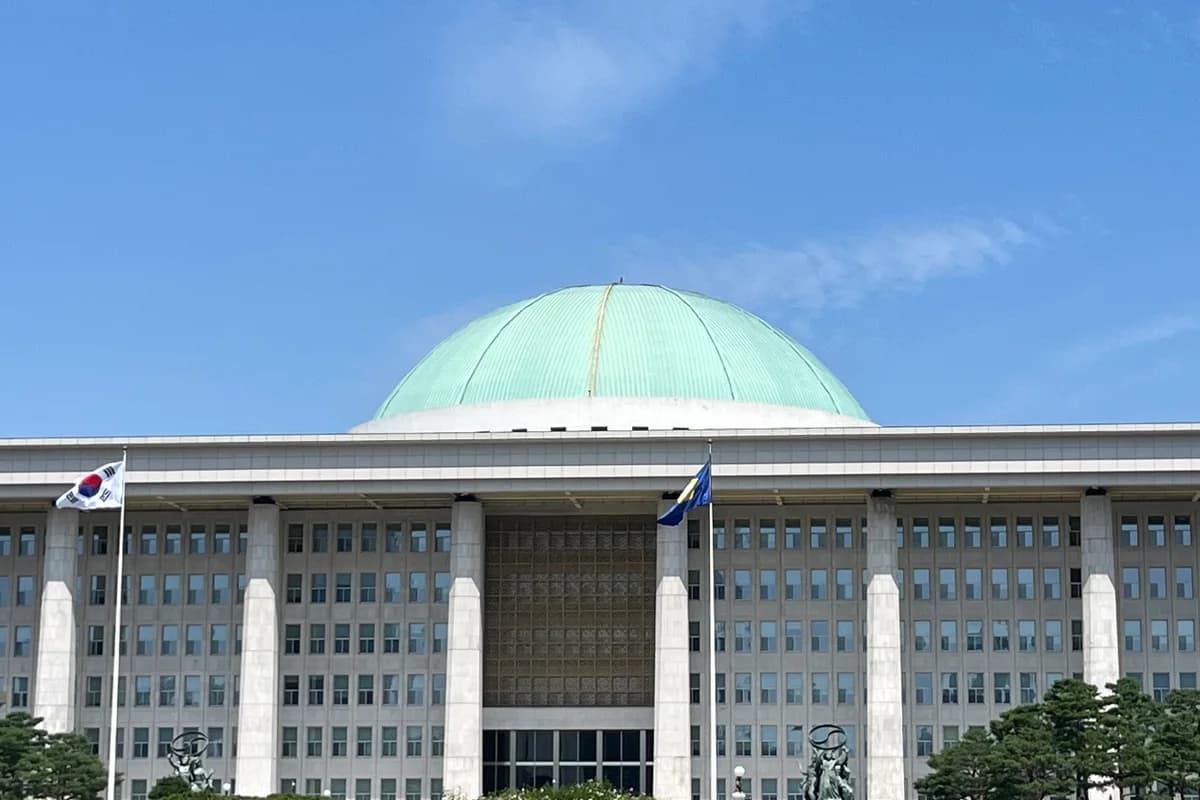
The Opposition Leader, the Park Chung-hee Foundation and a Police Complaint Want Chuseok's Number-One Film Off the Screens. The Director Says the Line They Object To Isn't In It
《암살자(들)》 passed 1.6 million admissions over the holiday. On the Monday after it, the foundation that keeps Park Chung-hee's memory demanded an apology and a halt to screenings, the leader of the opposition asked why insulting Park is 'freedom of expression' when touching Roh Moo-hyun gets you sued, and by Tuesday morning a former city councillor had filed a criminal complaint against the producer, the director and both writers. Hur Jin-ho's answer is that the film nowhere says Park ordered his wife shot, and that he now wishes he had drawn that line in dialogue. The audience score is 8.3. The netizen score is 2.2.

Seven Shots or Six? The 1974 Record Can Be Read Both Ways. Hur Jin-ho's Film Took Six, and Built a Newsroom Around the Bullet Nobody Examined.
Hur Jin-ho's 《암살자(들)》 opens on 23 September as the most pre-booked Korean film of the Chuseok season, ahead of 《인턴》, with a bracketed plural in its title that is the whole argument. The 1974 file on the shooting of First Lady Yuk Young-soo lists seven shots, one of them a misfire; the Park Chung-hee foundation now counts six; the film counts six and finds four bullets. What none of them can show is the bullet that killed her — and the director says he is offering a hypothesis, not a verdict.
The Weekly Dispatch
Korea, curated. Every week.
The best of K-culture, straight from Seoul. Written by people who actually live here.
Free, no spam, unsubscribe whenever.