Forty Thousand People Queued for 624 Seats. On 28 August a New Law Bans Ticket Scalping — But Not This Kind.
Nolan shot The Odyssey entirely on IMAX cameras, for a 70mm format that exists in 41 cinemas worldwide and none of them in Korea. What Korea has is one digital screen in Yongsan that shows the full frame uncropped. Seats resell at five times face value, the resale ban taking effect this week specifically does not cover cinema tickets, and the thing that will actually end the run is a law written to protect Korean film.
On the evening of 19 August, CGV opened bookings for screenings through the end of the month. More than forty thousand people were on the site at once. The wait to get through the queue ran to about fifty minutes, and by the time it cleared, every IMAX seat at CGV Yongsan through 30 August was gone except the accessibility seats.
That was a Wednesday, and it was one of the quietest nights the film has had in Korean cinemas — 207,841 admissions, its second-lowest day of the run, with the actual low coming the following evening. Nobody was queueing to watch a film that night. They were queueing for the right to watch it later, on one specific screen, out of the roughly 27 IMAX screens in the country.
There are 624 seats on that screen.
The format the film was made for does not exist here
Christopher Nolan shot The Odyssey entirely with IMAX cameras — the first feature ever shot that way start to finish — and the format he shot it for is IMAX 70mm film. Worldwide, 41 cinemas can project a 70mm IMAX print. Twenty-five of them are in the United States. After the North American opening, seats at those 41 were reselling for as much as a thousand dollars.
Korea has none. Not one.
It used to have one. The country's first IMAX opened in the 63 Building in Yeouido in 1985, and it could run film. It closed in August 2015. The space is a duty-free shop.
What Korea has instead is CGV Yongsan I'Park Mall, and what makes Yongsan the object of all this is narrower than "it's big," although it is: 31 metres by 22.4, the largest IMAX screen in Asia and the third-largest of its kind anywhere. The point is the shape. Yongsan is the only screen in Korea that shows the full 1.43:1 IMAX frame without cropping. Every other IMAX screen in the country is 1.9:1, which means that on all of them you are watching a version of this film with the top and bottom taken off.
It is worth being precise about what Yongsan actually is, because the enthusiasm around it tends to blur into something it isn't. It is a digital system — dual 4K laser projection. There is no film running through it. So the closest thing in Korea to Nolan's intended presentation is a digital approximation of a photochemical format, on a screen whose great virtue is that it is the right shape. That is genuinely the best available, and it is also not the thing itself, and Korean audiences know this perfectly well. It has not cooled anybody down.
The screen has a nickname, which is how you can tell this matters to people: 용아맥 — Yong-a-maek, a compression of Yongsan I'Park Mall IMAX.
What the run actually looks like
Here is the part nobody has drawn, so we drew it.
The Odyssey opened in Korea on 5 August. It had been scheduled for 15 July and was pushed back three weeks, partly to secure an IMAX-exclusive window and partly to stay out of the way of the Korean release 「호프」 (Hope), which opened on that exact day.
By the end of 23 August, day 19, it had taken 7,109,371 admissions and about ₩78.4 billion. It reached eight million on its 24th day and nine million on 31 August, its 27th — three days for the last million. It is the second foreign film since the pandemic to pass nine million in Korea, after Avatar: The Way of Water, and it has now overtaken Spider-Man: Brand New Day, the film it trailed in pre-sales before release. It has been top of the integrated advance-booking chart for seventeen consecutive days. Its weekend seat-occupancy rate has run above 70 per cent.
The daily curve is a clean sawtooth — weekdays between roughly 190,000 and 330,000, weekends between 500,000 and 720,000 — and there is a reason to look at it rather than just the total. The peak was the Liberation Day weekend of 15–17 August, topping out at 720,584 on the Sunday. The floor came four days later: 188,668 on 20 August, with 19 August, the night forty thousand people fought over tickets, only marginally above it. Demand for the seats and demand for the film are not the same curve. That week they ran in opposite directions.
It is now within touching distance of ten million, which in Korea is the number that means a film has become an event. Thirty-four films have done it. Twenty-five of them are Korean; nine are foreign. The Odyssey would be the tenth foreign film ever to manage it. It has already taken Universal's Korean record off Les Misérables, which finished its 2012 run on 5,920,977.
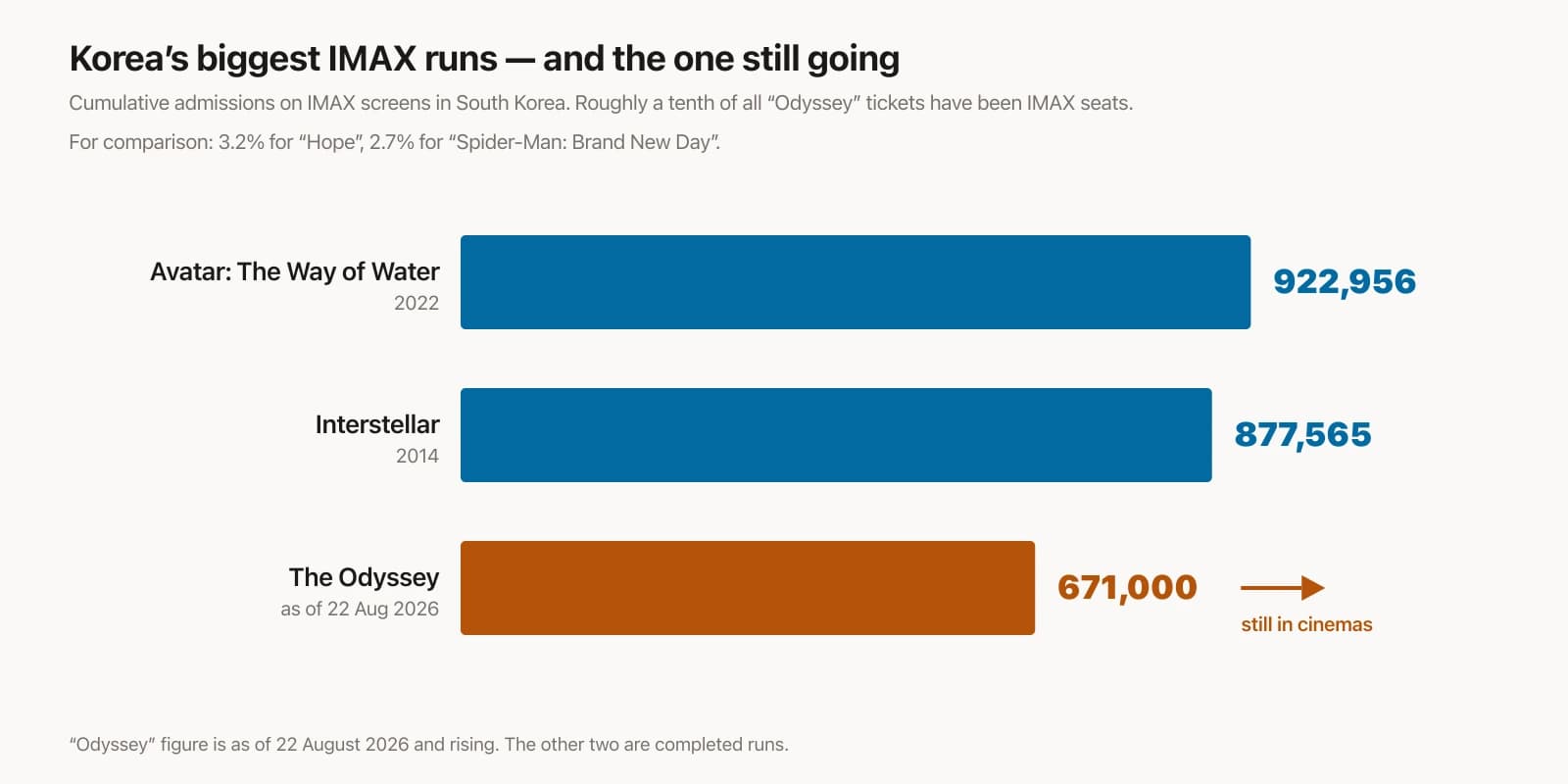
Of that total, more than 671,000 admissions were on IMAX screens as of 22 August — around a tenth of everything, against 3.2 per cent for Hope and 2.7 per cent for Spider-Man: Brand New Day. When we first published this, that put it third all-time in Korea, behind Avatar: The Way of Water and Interstellar, and we said both were within reach.
Update, 1 September. Both have gone. By 30 August the film had drawn about 941,000 IMAX admissions, past the roughly 929,000 that Avatar: The Way of Water had held the record with. The Odyssey is now the most-watched IMAX release in Korean history — on a digital screen, in a country with no IMAX film projector at all, for a film shot on cameras whose native format cannot be shown here.
The scalping, and the law that does not apply to it
Face value for a Yongsan IMAX seat is ₩17,000 to ₩21,000, depending on the day and the time.
Before the film had even opened, seats were on Korea's resale marketplaces at ₩50,000 to ₩100,000. By the middle of August, with the 11 August booking window producing queue numbers in the nine thousands, listings were reported at ₩110,000, and the worst of them have been reported far above that. Some sellers posted upwards of ten tickets for a single screening, which is not a person who changed their plans. That is a bot.
Here is the part that makes this a Korean story rather than a Nolan story.
In January 2026, Korean lawmakers passed a genuinely tough anti-scalping law. Fines of up to fifty times the ticket price. It was written in response to years of macro-driven resale, and it takes effect on 28 August 2026 — four days from now.
It covers concerts and sporting events. It does not cover cinema tickets.
So on Friday, Korea acquires one of the more aggressive ticket-resale bans anywhere, and the single most conspicuous ticket-resale market in the country at that exact moment — a market running at five times face value, on one screen, in Yongsan — sits outside it. Reselling a Yongsan IMAX seat falls under the 경범죄처벌법, the Minor Offences Act, where the maximum penalty is a fine of ₩200,000. Buying one carries no penalty at all. The film council, 영화진흥위원회, is collecting reports. It has nothing to enforce.
None of this is an oversight, exactly. In its review of the bill last year the Culture Ministry backed the intent but recommended narrowing any ban to online sales. And the pattern being legislated against — Hollywood tentpole, premium screen, five-times markup — has recurred in Korea for years without ever quite becoming the thing lawmakers were angriest about. IMAX 3D seats for Avengers: Infinity War went for ₩110,000 in 2018, about five times face. The same thing happened around Avatar: The Way of Water in 2022 and Dune: Part Two in 2024.
CGV's own position is that it monitors booking traffic and cancels or suspends accounts it believes are abusing the system. It has not, for the record, called the 19 August queue a record — that framing is the press's, repeated widely enough to have hardened, and we are not going to put it in the company's mouth.
If you want to understand why an ordinary Korean booking window turns into this, the mechanics are the same ones we walked through in how to actually buy a K-pop concert ticket in Korea: a 대기열, a sequential virtual queue, a fixed instant when it opens, and a lot of people who have done this before.
The thing that will actually end it
Not the scalpers. Not demand. A quota.
Korea's 스크린쿼터 requires every cinema screen to give at least a fifth of its operating days to Korean films — 73 days a year for a screen running year-round. Crucially, the quota applies per screen, not per building. The IMAX screen at CGV Yongsan is a screen. It owes its 73 days like any other.
As of 21 August it had banked 35 of them. It still owes 38.
Dune: Part Three and Avengers: Doomsday are both due before the year is out, and both will want that screen. Korean industry reporting suggests The Odyssey has perhaps two more months on it at the outside — and the binding constraint is not the audience, which is plainly nowhere near finished. It is a piece of cultural-protection law from a different era, doing exactly what it was designed to do, to a film nobody had in mind when it was written.
There is now an active argument in the Korean industry about reforming precisely this: counting Korean-film days across a whole multiplex rather than screen by screen, which would let a chain park its quota on a small auditorium and keep the premium screen running whatever sells. The counter-argument, which is not a weak one, is that the per-screen rule is the only thing that gets Korean films onto the good screens at all. Relax it and 「호프」 plays in cinema 11 for ever.
That is a real fight about what a screen quota is for, and it is being had, right now, because of a Christopher Nolan film.
What it says about Korea
A country with no IMAX film projector at all has produced the highest IMAX admissions total in its own history, on a digital screen, for a film shot on cameras whose native format cannot be shown here.
The gap between what the format promises and what is actually available is the whole engine. Korean commentary on this has a phrase for it — the scarcity is 휘발성, volatile: when the theatrical run ends, the 1.43:1 frame does not move to a streaming service in a smaller version, it simply stops existing as an option. So you go now, and you go to Yongsan, and if you can't get in you pay a stranger ₩110,000, and the cinemas hand out a different 특전 — a bonus card, a poster, a variant ticket stub — every week specifically to get you to come back a second and third time.
It would be easy to write this as fan mania, and Korean cinemas are certainly not discouraging it. But underneath the queueing there is something fairly rigorous going on: an audience that has decided the aspect ratio is not a detail, and that watching the cropped version is watching a different film. They are not wrong about that. They have simply drawn a harder line about it than most audiences bother to.
Then, in about two months, the screen goes back to owing Korean cinema 38 days, and that will be that.
For the other Korean film story running this month — a festival that has just turned itself into an Oscar gatekeeper — see BIFF, explained.
Update, 17 September: the run ends at forty-two days
《오디세이》 was the number-one film in Korea every day from its opening on 5 August to 15 September — forty-two consecutive days — until 《인턴》, the Korean remake of The Intern, opened above it on Wednesday the 16th. On its last day at the top it still took 45.5 per cent of the box office.
The same Wednesday it reached 10,921,483 admissions, passing Avatar: The Way of Water (10,824,614) to become the sixth most-watched foreign film ever released in Korea, on KOBIS's all-time table. Above it now: Avengers: Endgame, Frozen 2, Avatar, Aladdin and Avengers: Infinity War. Both figures are from KOBIS's daily table for 16 September, read directly.
Images. All three are charts we built ourselves from the Korean Film Council's public box-office record and from published IMAX admission figures: the daily admissions curve from 5 to 23 August with the 19 August booking night marked on the trough where it actually falls; Korea's all-time IMAX top three; and the three numbers that describe the squeeze — one screen, 624 seats, forty thousand people in a queue. We have not used a film still. Universal Pictures Korea distributes press stills and Korean outlets run them credited, which is ordinary practice for covering a film, but we could not locate published terms of use for them and chose not to assume. Wikimedia Commons has nothing usable here, and Wikimedia Commons treats South Korea as a no-freedom-of-panorama country, so a photograph of the Yongsan auditorium or the building is not a route either. (Corrected 11 September: we had written that Korea has no freedom of panorama at all. It has one — 저작권법 제35조②, which lets works permanently displayed in streets, parks and on building exteriors be reproduced "by any method whatsoever" — but it carves out reproduction for the purpose of sale, and that carve-out is why Wikimedia Commons, which requires commercial reuse, treats Korea as a no-FoP country and will not host such photographs. Our sourcing decision is unchanged; the reason we gave for it was wrong.)
Reported from Korean and Korean-English coverage published between 2 and 23 August 2026 — principally 코리아헤럴드, 코리아중앙데일리, 경향신문, 세계일보 and 파이낸셜뉴스 — together with the Korean Film Council's own figures. The daily admissions series is KOBIS data as compiled publicly; its 23 August cumulative matches the 7,109,371 figure reported independently elsewhere, which is our cross-check. Figures date fast: admissions were as of 23 August at first publication and have been updated twice since, most recently on 1 September. The ten-million crossing still had not happened at the latest update. One discrepancy we could not resolve: our original source gave Avatar: The Way of Water's Korean IMAX total as 922,956, while the Korean press reporting the record being broken gives it as about 929,000. We have used the reported figure for the comparison because it is the one the record was declared against, and flag the roughly six-thousand-admission gap rather than quietly picking one. Corrections we made to our own working notes before publishing, because they were wrong in ways worth naming: an earlier draft placed a nine-thousand-person queue on 19 July, three weeks before the film opened — both queue events were in August, on the 11th and the 19th. We had also written that Yongsan projects 70mm; it does not, and neither does anywhere else in Korea. Deliberately hedged: we say "roughly 27" IMAX screens because sources give 27 and 31 and we could not resolve it; we do not describe non-Yongsan IMAX screens as "fake IMAX," a common online framing that IMAX's own 1.9:1 certification contradicts; we do not state how CGV's queue allocates positions, because CGV has not published it and sequential-looking queues are often randomised specifically to defeat bots; and we do not call 19 August a CGV record, because CGV never said so. Peak resale figures above ₩110,000 circulate widely and we have referred to them only in general terms, since we could not verify a specific top price.
Keep Reading
More Stories
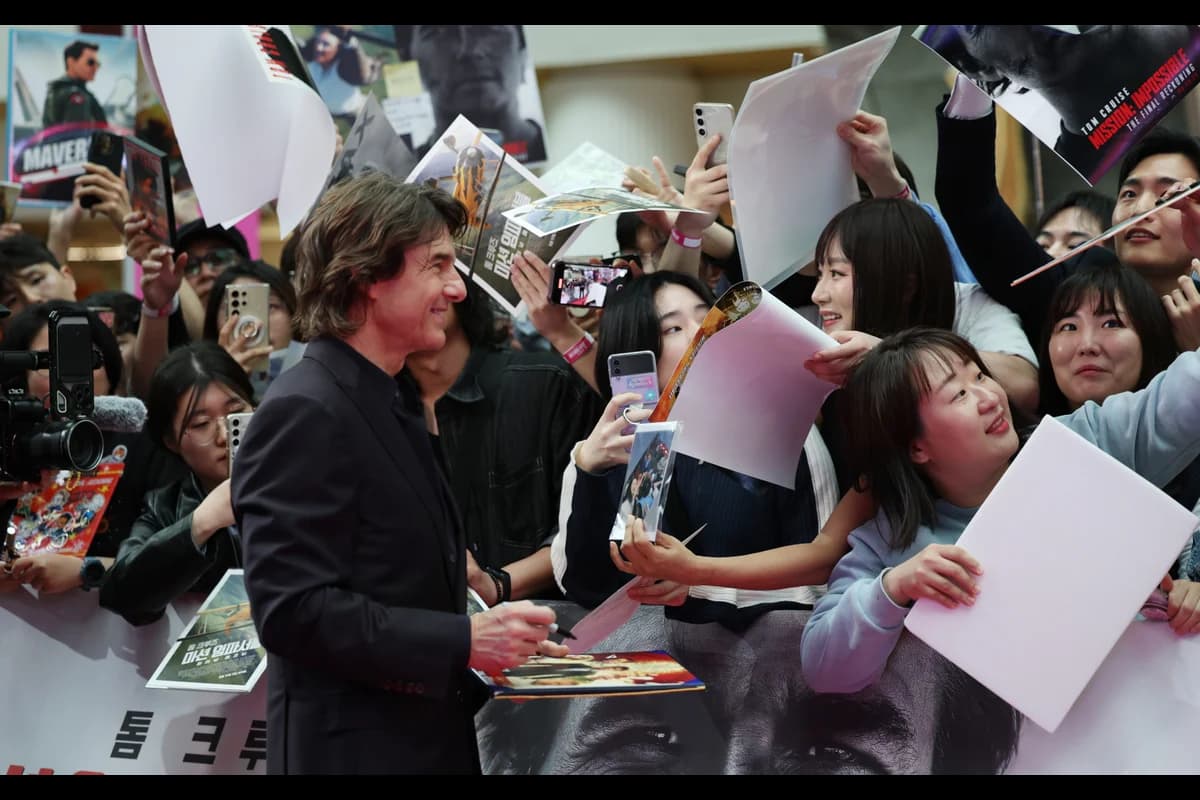
A Japanese Cartoon About Small Cute Creatures Opened at Number One in Korea. Tom Cruise's New Film Is Seventh on the Booking Board, With Cruise in Seoul to Sell It
《극장판 치이카와》 took 122,291 admissions on its opening day, the biggest start for any animated film released in Korea this year, and by the next morning held 39 per cent of every advance ticket in the country. 《디거》, Alejandro G. Iñárritu's black comedy with Tom Cruise as an oil baron, opens on 3 October with 2.6 per cent — behind a Venice prize-winner in its second week — while Cruise makes his thirteenth visit to Korea, more than any other Hollywood actor. Iñárritu was meant to come too. He cancelled the night before.
The Opposition Leader, the Park Chung-hee Foundation and a Police Complaint Want Chuseok's Number-One Film Off the Screens. The Director Says the Line They Object To Isn't In It
《암살자(들)》 passed 1.6 million admissions over the holiday. On the Monday after it, the foundation that keeps Park Chung-hee's memory demanded an apology and a halt to screenings, the leader of the opposition asked why insulting Park is 'freedom of expression' when touching Roh Moo-hyun gets you sued, and by Tuesday morning a former city councillor had filed a criminal complaint against the producer, the director and both writers. Hur Jin-ho's answer is that the film nowhere says Park ordered his wife shot, and that he now wishes he had drawn that line in dialogue. The audience score is 8.3. The netizen score is 2.2.

Seven Shots or Six? The 1974 Record Can Be Read Both Ways. Hur Jin-ho's Film Took Six, and Built a Newsroom Around the Bullet Nobody Examined.
Hur Jin-ho's 《암살자(들)》 opens on 23 September as the most pre-booked Korean film of the Chuseok season, ahead of 《인턴》, with a bracketed plural in its title that is the whole argument. The 1974 file on the shooting of First Lady Yuk Young-soo lists seven shots, one of them a misfire; the Park Chung-hee foundation now counts six; the film counts six and finds four bullets. What none of them can show is the bullet that killed her — and the director says he is offering a hypothesis, not a verdict.
The Weekly Dispatch
Korea, curated. Every week.
The best of K-culture, straight from Seoul. Written by people who actually live here.
Free, no spam, unsubscribe whenever.