A Governor Called the Fire Service a Budget Straw. The Row Is Really About Who Pays for Korea's Firefighters
On 13 October Gyeonggi's governor, 추미애, told a National Assembly audit that firefighting was draining the province's finances. Three apologies later, the argument underneath has not gone away: firefighters became national civil servants in 2020, but provinces still pay almost nine-tenths of the bill. On 8 November the ruling party and the government said they would review about ₩2 trillion. Nobody has said over how long, or where it comes from.
The question at the National Assembly's audit of Gyeonggi Province, on 13 October, was about tobacco. 권영진 of the People Power Party was pressing the governor, 추미애, on a plan to turn a tobacco-linked local education tax into a regional resource tax for the fire service, and arguing that the province should be demanding more from central government instead.
The governor's reply has outlasted the audit by a month. "소방이 가장 큰 골치 아픈 재정 빨대 같다", 추미애 said: the fire service seems to be the biggest, most troublesome straw sucking at the budget. The governor went on to the numbers. Gyeonggi's firefighters would cost ₩1.1 trillion in pay alone in 2027, plus about ₩500 billion in programme costs.
The province said afterwards that no disparagement had been meant, and that the point was about provinces carrying costs while central support shrinks. Over the next two days the two confederation-affiliated firefighters' unions condemned the remark, first the KCTU branch and then the one under the FKTU.
16 October
At 08:38 on 16 October, a fire broke out at a factory in 부천. It was out in two hours and twenty-eight minutes. Firefighter 김진석, in the first crew sent to the third floor, was trapped when the fire spread suddenly and was brought out in cardiac arrest. 김진석 died at 00:55 the next morning, and was promoted posthumously. Seven others were hurt, five of them firefighters. It was the fourth death at a fire ground this year.
The two events have been set side by side ever since, so it needs saying plainly: nothing connects them but the calendar. No official, police or inquiry statement ties the death to the budget. The questions being asked are about fire-ground command, entry decisions, and the dozens of cans of thinner and hundreds of cans of paint found on site. The National Fire Agency began a 22-member joint inquiry on 20 October, due to run for thirty days, and has asked the public to avoid unverified claims until it reports. The police have booked the factory's head on suspicion of professional negligence and accidental fire. Neither has concluded. The unions' own accusation about the fire concerned the judgement of those in command.
Three apologies
추미애 visited the scene on 16 October without apologising, and the Democratic Party apologised on the governor's behalf. The first personal apology came on the 17th, at the funeral hall, and was criticised for its opening, which noted that people had wanted one. The second came on the 19th, the day of the funeral, at another Assembly audit. MBC reported that the President had by then criticised the remark indirectly, and that the party leader, 김민석, had urged a sincere apology. One union demanded the governor's resignation.
The third came on 20 October, in person to union officials in Suwon, with a rally going on outside. 추미애 called the remark a momentary slip of wording, and said the underlying problem of who bears the cost still needed fixing. So the apology covers the word and not the argument.
Who actually pays
The argument is about something real.
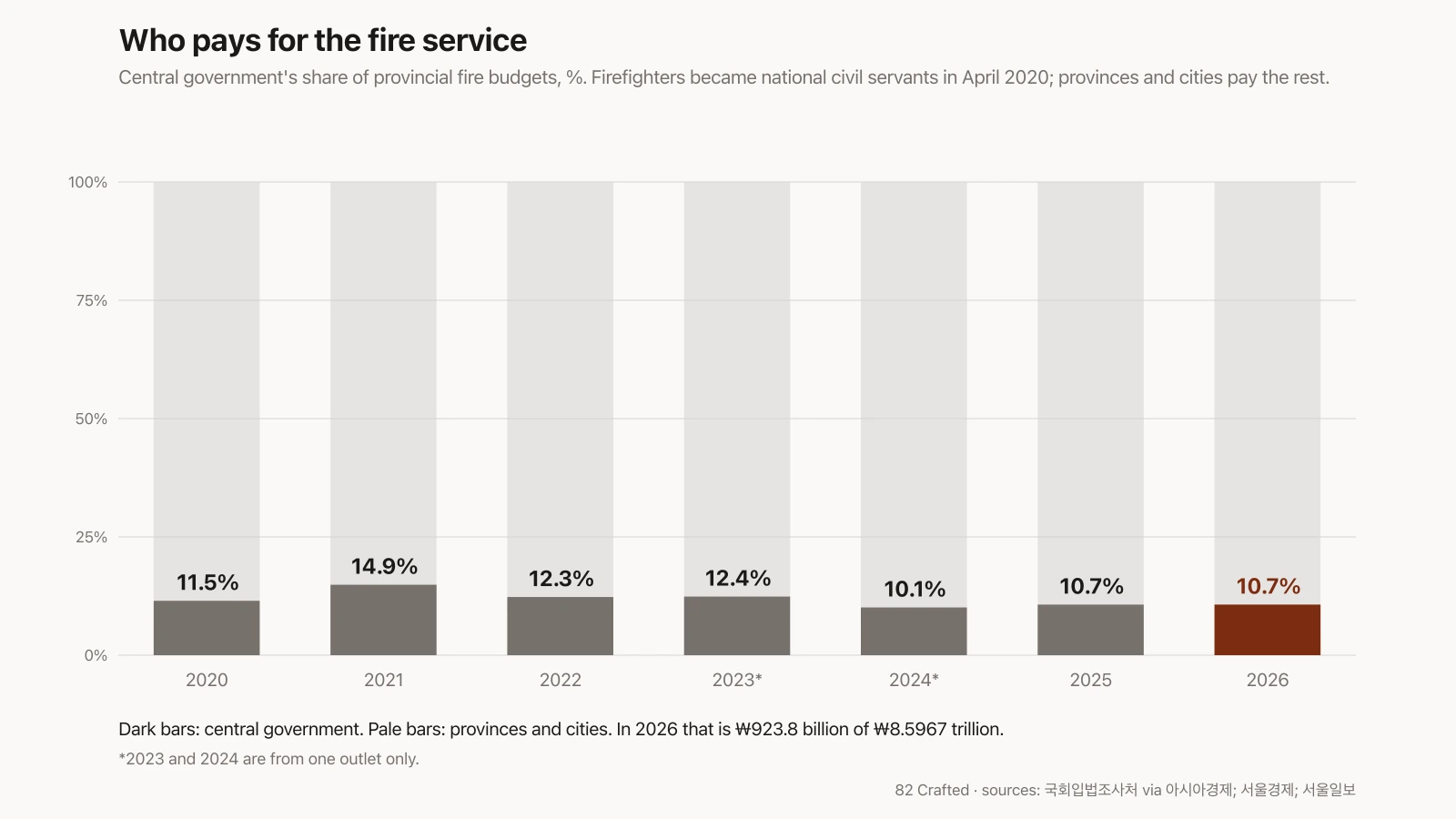
Firefighters became national civil servants in April 2020. But firefighting remains, in law, a local-government function, so the provinces go on paying most of the cost. In 2026 the seventeen provincial fire headquarters have a combined budget of ₩8.5967 trillion, of which central government provides ₩923.8 billion, or 10.7%. Of a pay bill of ₩6.5129 trillion, the centre covers 8.4%. Between 2021 and 2026 the total rose by ₩1.9 trillion while central money fell by ₩70.9 billion. The National Assembly's research service set out the structural problem in a paper in January.
And the main central grant, the 소방안전교부세, is about to shrink. It is funded by 45% of the excise on tobacco, and the 2027 budget proposal sets it at ₩760.5 billion, down from ₩1.0502 trillion: a fall of 27.6%. The interior ministry says that is a statutory calculation reflecting falling cigarette sales, not a decision to cut. It means that a national service is partly paid for by how many people still smoke.
The sums at the bottom are smaller. A retired firefighter, 김상철, told 연합뉴스 that the allowance for fire suppression is ₩80,000 a month, unchanged since 2001, or ₩3,200 a working day. That is one person's account, though a specific one. And on 24 October, Gyeonggi's annual memorial day for its fallen firefighters went ahead on about ₩7.5 million, with some 60 people, against about 5,500 last year, after ₩100 million was cut in a reduced supplementary budget. The province, which declared a fiscal emergency in August, cites its finances.
₩2 trillion, perhaps
On 8 November a high-level meeting of the party and the government, at the Prime Minister's residence, agreed to review about ₩2 trillion from central to local governments for urgent essential fire investment, with further unspecified funds. That is the whole of what has been fixed. No period was stated. Asked whether it would go into next year's budget, the Democrats' chief spokesman, 박성준, replied tentatively that this seemed to be the meaning. The source is undecided, between a new fund built on excess tax revenue and the general account. Whether it can be used for pay is unsettled.
Separately, the tobacco-linked education tax that started all this, worth about ₩1.5 trillion last year, lapses on 31 December. The Democrats want all of it for firefighting, and the government disagrees.
The People Power Party's 배준영 and 유상범 called the ₩2 trillion a cover for the governor's remark and a patch job, and 유상범 wants hazard pay raised by ₩500,000 a month first. For a union response to the figure, see the update below. Before Fire Day, by one report, the KCTU branch was asking for central government to pay salaries in full, and for an independent reform committee.
On 9 November President 이재명 spoke at the 64th Fire Day in Sejong, the President's first since taking office, and promised stable funding, more people, stronger command and better conditions, along with AI, robots and drones. The published text gave no figure, and mentioned neither the ₩2 trillion nor the governor. The same day the budget minister, 박홍근, told the Assembly that the new fund's local account could be considered for fire costs, since falling tobacco revenue threatens even pay.
Update, 11 November: a plaque, and the opposition's own number
One union has now responded, warmly. At Gyeonggi's Fire Day ceremony in Suwon on 9 November, 미래소방연합노동조합, an independent firefighters' union founded this year and outside both confederations, presented 추미애 with a plaque for work on fire-service finances. 경인일보 linked it to the ₩2 trillion review. SBS reports that the same union had said in October that the remark was badly put but not meant to disparage.
The People Power Party has a figure of its own. On 3 November, before the party and government announced their ₩2 trillion, the opposition leader 장동혁 proposed ₩2.41 trillion for fire safety, within a ₩11.6 trillion package of budget increases, including the ₩500,000-a-month rise in hazard pay. So both sides now say the money is needed; the argument is over whose number, over what period, and from where. As of 11 November the ₩2 trillion still had no stated period or source.
The joint inquiry has not reported. The fire agency's head, 최용철, said on 9 November that cause and response would be judged on its findings. Its 30-day window from 20 October closes around 19 November.
Sources for this update: SBS, 수원일보 and 경인일보 (9–10 November); 쿠키뉴스, 이데일리 and 오마이뉴스 (3 November); YTN and KBS (11 November); 세계일보 and 이데일리 (9 November).
Update, 19 November: the inquiry window passes
The joint inquiry's 30-day window from 20 October ran out around 19 November with no published findings. The National Fire Agency's press releases from 9 to 19 November contain none, and we found no news report of them. Whether the window was extended is not known. On 16 November 서울경제 reported that the ₩2 trillion would come from a regional fund; the government replied the same day, on korea.kr, that the size and method had not been decided.
Sources for this update: the National Fire Agency's press releases, 서울경제 and korea.kr.
What it says
추미애 chose a bad word, and has said so. The reason it landed so hard is that firefighters have heard versions of it for years, from a state that made them national employees and went on sending the bill to the provinces. The reform of 2020 changed the title on the payslip. It left the money where it was.
So a governor with a real fiscal emergency and a real point made it in the one way guaranteed to lose it, and a fire service that wanted the point made was insulted by it. The reckoning that followed has produced a promise to review a large number. The constitutional deadline for next year's budget is 2 December. By then ₩2 trillion will either have a period, a source and line items, or it will have been a figure announced on a Sunday in the middle of a row.
Images. The cover, listing and homepage images are AI illustrations (generated with Higgsfield, GPT Image 2.6): an empty engine bay at dawn, a helmet and coat on a bench beside a closed ledger, and air cylinders beside budget binders. They depict no real person, station or fire. The chart in the text is ours. We found no recent, freely licensed photograph of these events.
Sources. The remark and the audit are from 경향신문, 한국일보, the JoongAng Daily and the Korea Herald. The fire and the death are from 경향신문, 아이뉴스24 and the National Fire Agency's release; the inquiry and the police case from 경향신문, 뉴스1 and 파이낸셜뉴스. The apologies are from the JoongAng Daily, 경향신문, YTN and 헤럴드경제; the President and 김민석 from MBC. The funding figures are from 서울경제, 서울일보, 한국경제 and the National Assembly Research Service as reported by 아시아경제; the allowance from 연합뉴스; the memorial from 서울경제. The 8 November meeting is from 연합뉴스, 이투데이, 국민일보, 경향신문 and 파이낸셜뉴스; Fire Day from 연합뉴스 and 서울경제; 박홍근 from MTN.
Stated rather than smoothed. The joint inquiry and the police case had not concluded as we published, and nothing here should be read as a finding on the cause of the fire or on the decisions made at it. Reports differ on whether the factory was a metal-injection printing plant or a paint shop, and on whether the building had four or five storeys, so we have said neither. The central share for 2025 is 10.7% in the Assembly's research paper and 11.5% in one newspaper; we have used 10.7%, and the figures for 2023 and 2024 come from one outlet. Other reports frame the ₩2 trillion as a minimum or as money to be spent; the announced wording is that it will be reviewed. The allowance figure is one retired firefighter's. An independent union's October view of the remark rests on SBS alone.
Keep Reading
More Stories

김건희's Four-Year Sentence Is Final, and So Is the Acquittal Over 명태균's Polls
On 19 November the Supreme Court's full bench upheld 김건희's convictions over Deutsche Motors shares and Unification Church gifts, making four years in prison and a ₩50 million fine final. It also upheld the acquittal over 명태균's polls, by 10 votes to 2. Many Korean headlines carried that acquittal. 연합뉴스's English headline left it out.
A Forged Tally Sheet Is an Alleged Crime. It Is Not a Stolen Election
On 10 November Korea's election special counsel raided two election commissions over a tally sheet for one polling station. The counsel itself says the result and the winner were unchanged. The opposition leader 장동혁 says the count was stolen. The record supports a serious investigation, and not that claim.
Supreme Court Sets Aside 한덕수's 15-Year Term but Finds Insurrection After Martial Law Was Declared
On 19 November the full bench sent 한덕수's case back to the Seoul High Court, which will set a new sentence. Urging a cabinet meeting before martial law was declared could not be proven to be insurrection, it held; what 한덕수 did after the declaration was, and the false-document and perjury convictions stand. Detention was renewed, so there was no release. The ruling, the dissent, and how the case got there.
The Weekly Dispatch
Korea, curated. Every week.
The best of K-culture, straight from Seoul. Written by people who actually live here.
Free, no spam, unsubscribe whenever.