Supreme Court Sets Aside 한덕수's 15-Year Term but Finds Insurrection After Martial Law Was Declared
On 19 November the full bench sent 한덕수's case back to the Seoul High Court, which will set a new sentence. Urging a cabinet meeting before martial law was declared could not be proven to be insurrection, it held; what 한덕수 did after the declaration was, and the false-document and perjury convictions stand. Detention was renewed, so there was no release. The ruling, the dissent, and how the case got there.
Update, 19 November. The Supreme Court's full bench has ruled, and it is not an acquittal. It set aside the guilty part of the appeal court's judgment, including the 15-year sentence, and sent the case back to the Seoul High Court, which will set a new sentence. The court held that the martial law of 3 December 2024 (12·3) was unconstitutional and unlawful, and that what 한덕수 did after it was declared was taking part in an insurrection. What 한덕수 did before the declaration could not be shown to be. The false-document and perjury convictions stand. The court also renewed 한덕수's detention for two months, so there was no release on 20 November. The next section sets out the ruling. The text below that section was written before the ruling, on 11 and 16 November. We have kept it, and put into the past the sentences the ruling has overtaken.
Update, 19 November: the ruling
The full bench gave its judgment on the afternoon of 19 November, after ruling on a case of 김건희's. According to 이투데이, it had set the date on 16 November, when it brought its second deliberation forward. 파이낸셜뉴스 reported beforehand that this would be the Supreme Court's first ruling on an insurrection charge in 29 years.
The decision. The court reversed the appeal judgment and sent the case back to the Seoul High Court (파기환송, reversed and remanded), on the basis that part of the conviction should be treated as not guilty (연합뉴스, 뉴시스, 뉴스1, 한겨레). 연합뉴스 and 한국일보 describe the guilty part of the judgment as set aside. The 15-year sentence therefore no longer stands, and the High Court will impose a new one.
The martial law. The court said there was no doubt that the martial law was, in itself, unconstitutional and unlawful, according to 뉴스1 and 동아일보. It held that what 한덕수 did after martial law was declared was taking part in an insurrection (연합뉴스, 뉴스1). 경향신문 calls this the first time the Supreme Court has confirmed that 12·3 was an insurrection (내란). The ruling came 716 days after it (뉴스1, 뉴시스).
Before and after the declaration. The majority opinion was written by 권영준 (중앙일보, 경향신문). A conviction, it held, needs a purpose of subverting the constitutional order (국헌문란): at least an acceptance that an insurrection would happen, judged from the surrounding facts. The appeal court had relied on three acts. The Supreme Court found that purpose in the two that came after the declaration, but not in the one before it, when 한덕수 urged 윤석열 to put martial law to the cabinet. The aim of that, the majority held, was to follow the constitution, not to subvert it. 한덕수 had not been part of the planning and learned of the plan that night. 한덕수 had warned 윤석열 of harm to the country's credit standing and economy and urged caution, which the court read as opposition (연합뉴스). And the cabinet meeting was hollow, because 윤석열 declared martial law unilaterally once there was a quorum. According to MBC's live summary, the majority added that the seriousness of the crime does not relax the basic principles of criminal law. 중앙일보, 경향신문, 연합뉴스 and MBC report the reasoning.
What stands. The court held that after the declaration 한덕수 took part in the insurrection by pressing cabinet members to countersign, and by discussing blocking key institutions and cutting power and water to certain media (연합뉴스, 뉴스1, 경향신문). It upheld the convictions over signing the proclamation drafted after the event and then asking 강의구 to destroy it: making a false official document, breaching the Presidential Records Act and damaging public records. The perjury conviction over 한덕수's evidence to the Constitutional Court was upheld too (연합뉴스, 경향신문). The Supreme Court found no error in these convictions. It set aside the whole guilty part because the counts carried a single sentence, which the High Court must now set again (연합뉴스). 뉴스1 adds that it told the High Court to state the purpose of subverting the constitutional order clearly in its findings.
The dissent. The court split 9–3, according to 연합뉴스's round-up report (종합) and 중앙일보. 오경미, 신숙희 and 김성수 dissented. The three would also have found insurrection in the act before the declaration (연합뉴스, 중앙일보, 경향신문). 오경미 was also the 주심, the justice in charge of the case. 오경미 argued that 윤석열's martial law lacked its legal requirements and used troops and police to stop the National Assembly working, and that 한덕수 foresaw the cabinet becoming a tool, went ahead anyway and cared only about the quorum. No separate opinions were reported.
Custody. On the same day the court renewed 한덕수's detention period (구속기간 갱신), adding two months, according to 연합뉴스; 뉴스1 and 뉴시스 report the same decision. 한덕수 was not released on 20 November. With the case sent back, detention periods start again for the remand stage, so later renewals fall to the Seoul High Court (뉴시스, 연합뉴스).
What comes next. The Seoul High Court will hear the case again and impose a new sentence. As of 11 November, a first-instance verdict in the second case, over the failure to appoint Constitutional Court justices, was set for 30 November (see below).
Reactions. The special counsel, 조은석, found the decision regrettable and said the team would do its utmost to keep the prosecution going, according to 뉴시스. For the People Power Party, 정점식 said the party respects the court's decision, according to 뉴스1. 뉴스1 also reports that the Democratic Party called an emergency caucus for 17:30. We found no statement from 한덕수's defence by 17:38. That evening the Democratic Party's leader, 김민석, said the party would seek to impeach the Chief Justice, 조희대, over the ruling, and on 20 November said its supreme council (최고위원회) had decided to do so (뉴스1, 연합뉴스).
Sources for this update: 연합뉴스, 뉴스1, 뉴시스, 한겨레, 한국일보, 중앙일보, 경향신문, 동아일보, MBC, 이투데이 and 파이낸셜뉴스.
Before the ruling
The Supreme Court's full bench (전원합의체) was due to sit for a second time on the case of 한덕수 on Thursday 19 November. It was to be a closed deliberation (합의기일), not a ruling (선고), and no date for a ruling had been set. 한덕수's detention was due to run out on Friday 20 November.
That was the situation as of 11 November, according to 한겨레, 연합뉴스, 부산일보 and 경향신문, which all gave 20 November as the date. Unless a ruling arrived first, or a court ordered detention in a different case, 한덕수 would await the Supreme Court's decision at home. In the event a ruling did arrive first, and detention was renewed.
The Democratic Party said the prospect of release was a failure by the court. The record is more mixed than that, and the law that sets the limit is less plain than either side admits.
The case so far
한덕수 was not held before trial. A court rejected a pre-indictment arrest warrant in August 2025. On 29 August 2025 the special counsel, 조은석, indicted 한덕수 on charges that include aiding the leader of the insurrection, perjury, making false official documents, damaging public records and breaching the Presidential Records Act. 뉴시스 reports that in October 2025 the trial court approved an amendment to the indictment adding the charge of a key role in insurrection.
At first instance, on 21 January 2026, Criminal Division 33 of the Seoul Central District Court, presided over by 이진관, gave 23 years. That was longer than the special counsel had asked for (YTN), and 한덕수 was taken into custody in the courtroom. Both trial courts convicted 한덕수 of taking part in an insurrection in a key role (내란 중요임무 종사).
The core of the case in the lower courts, as 연합뉴스 and 한겨레 reported their findings, was that 한덕수 recommended holding the 3 December 2024 cabinet meeting so that martial law would look as though the cabinet had properly reviewed it. The Supreme Court has since held that the purpose of subverting the constitutional order was not proven for this act, which came before the declaration, so it cannot support an insurrection conviction. 한덕수 also signed a martial-law proclamation drafted after the event, and later had it destroyed. A separate perjury conviction concerns 한덕수's statement to the Constitutional Court, at the impeachment trial, that the proclamation had not been seen.
On 7 May 2026, Criminal Division 12-1 of the Seoul High Court (이승철, 조진구, 김민아) cut the sentence to 15 years. The appeal court upheld most of the convictions. It cleared the failure-to-act theory and one perjury count, and it took into account about fifty years of public service and the absence of a leading role. YTN reports that the special counsel first asked for 15 years at trial, and 23 on appeal.
부산일보 says the Supreme Court received the case on 18 May. By 20 November, the day detention was due to run out, it had lasted 303 days, counted from the day of the first-instance verdict. It did not run out: the court renewed it on 19 November.
Article 92 in plain terms
Korean law limits how long a defendant can be held before a final verdict. Article 92 of the Criminal Procedure Act says three things.
First, detention lasts two months. Second, where continued detention is especially needed, each level of court may renew it twice, for two months each time. At the appeal levels a third renewal is allowed, but only when extra hearings are unavoidable, for example to examine evidence the defence asked for, or because the defence has filed supplementary grounds of appeal. Third, time when the trial is suspended does not count.
부산일보 describes the Supreme Court stage as having a maximum of six months. That is the paper's description, and we have kept it as that. 연합뉴스 reported on 19 November that the Supreme Court had by then used all its renewals. We found no source that explains how the date of 20 November is reached. Counting six months back gives about 21 May, and the Supreme Court's reported receipt date of 18 May does not fit that exactly. What the sources agreed on, before the ruling, was that the limit ran out on 20 November. Why it fell on that day is unknown to us. The ruling changed the count: with the case sent back, detention periods start again for the remand stage, and the Supreme Court renewed detention for two months on 19 November (뉴시스, 연합뉴스).
Who asked for the full bench
The pace has become the political story, so the order of events matters.
On 12 June 2026, 한덕수's side asked for the case to go to the full bench. It also argued that the special counsel law's three-month deadline is advisory (훈시 규정). On 14 July the special counsel replied that the deadline is binding (강행 규정). 뉴시스 and 세계일보 report both positions.
On 5 August the Supreme Court referred the cases of 한덕수 and 이상민, a co-defendant, to the full bench. 뉴시스 and 한겨레 report that the court gave three reasons: very high public interest, the need for a historic judicial assessment, and the fact that the two defendants are accused as accomplices. The main legal question, as 한겨레 puts it, is how far the offence of a key role in insurrection reaches. This is the first martial-law case sent to the full bench. Twelve judges were to sit: the Chief Justice and eleven justices, with the head of the National Court Administration excluded.
뉴시스 reports that the referral came at the request of both defendants' lawyers, over the special counsel's objection. Any account that blames the court alone for the delay has to include that.
The three-month rule
The special counsel law that governs this case (the "6·3·3 rule") requires a first-instance verdict within six months of indictment, and gives the appeal and the Supreme Court three months each from the previous verdict. 세계일보 and 뉴시스 report this. For 한덕수, the Supreme Court's three months ended on 7 August, two days after the referral.
Whether that deadline binds the court is disputed. The defence calls it advisory and the special counsel calls it mandatory. We have not read the statute itself, because the government's law database would not load for us, and we rely on press summaries. The Democrats say the court has broken the rule. That is their reading, and we found no ruling that settles it.
The pace, and what 19 November could do
According to 경향신문, the Supreme Court held its first full-bench deliberation in this case on 29 September, when the insurrection cases were barely discussed. October's session took only the case of 김건희. Under the court's internal rules the full bench sits once a month, although the Chief Justice can add dates, and as of 11 November no extra date had been set for the release scenario. 경향신문 added that 조희대 had delivered full-bench rulings about every other month since last year.
As of 11 November, a ruling in time would have needed a vote at the 19 November deliberation and then a ruling session held by 20 November, and 한겨레 and 부산일보 both treated release as the likely outcome. On 5 November the special counsel had asked the court to rule before expiry. Its team told 경향신문 that a ruling first was effectively the only way to prevent the release.
In the event, according to 이투데이, the court brought its second deliberation forward to 16 November and made 19 November the ruling date. On that day it ruled and renewed detention. We found no public explanation from the court of its timing.
What release would have meant
This section was written on 11 November, when release looked likely. There was no release, because the court renewed detention on 19 November.
It would not have been an acquittal. The two convictions would have stood, and the Supreme Court case would have gone on with 한덕수 not in custody, as 한겨레 reported on 10 November. The special counsel had warned, according to 연합뉴스, that once released 한덕수 could flee and the sentence could become hard to enforce. When this was written, we had found no source that mentioned release conditions, residence limits or a travel ban. Two outlets have since reported such a request: 이투데이 and 서울신문 say that on 13 November the special counsel asked the court to attach conditions, such as a limit on residence, to any release. With detention renewed, no release followed.
There is also a second case. A first-instance verdict on 30 November, from the same Criminal Division 33 under 이진관, concerns the failure to appoint, and a related nomination of, Constitutional Court justices, and includes a dereliction-of-duty charge. 부산일보, 한겨레 and 경향신문 all report that date.
According to 한겨레, putting 한덕수 back in custody on that day would have needed a prison sentence and an order to take 한덕수 into custody in the courtroom. A prison sentence alone would not have done it. Since detention was renewed on 19 November, 한덕수 is in custody already.
The special counsel could have asked that court for a warrant before 20 November. 한겨레 reported that the team was not considering it, because with the verdict so close the judges might be reluctant. 경향신문 added that a panel leaning towards acquittal could not issue one.
One comparison appears in the sources. For 김건희, the Supreme Court issued a fresh warrant in a different case on 27 October, four days before that detention was due to expire. 경향신문 explained the difference: 김건희 had heavy sentences in both cases, while 한덕수's second case had not yet reached a verdict. 이상민, sentenced to 7 years and then 9 on appeal, has detention that expires on 18 December.
What the parties and judges say
The Democratic Party's spokesman 이용우 said in a written briefing on 10 November that one deliberation in three months is grossly irresponsible, and that the special counsel law sets three months. 이용우 added that if 한덕수 walks free, the 조희대 court will have freed 한덕수. 박주민, a Democratic MP, wrote on Facebook, as JTBC reports, that a promised historic assessment ending in the release of an insurrection convict was absurd, and warned the Chief Justice that if that happened, "그때는 진짜 전쟁" ("then it's real war"). 김의겸, another Democratic MP whom JTBC describes as the party's lead member on the judiciary committee, said the court's clock seems to stretch and shrink depending on who is in the dock, and that the Assembly will use its own powers.
Unnamed senior judges quoted by 경향신문 and 한겨레 sound a different note. A Seoul High Court judge said careful review is fine, but that letting a release scare develop after a 15-year sentence on appeal was inappropriate. Another judge in the Seoul area said cases with detained defendants are normally scheduled so that the defendant is not released.
As of 11 November we had found no statement from the People Power Party or from 한덕수's defence on the possible release. Their reactions to the ruling, where we found any, are in the update above.
Our earlier pieces on the Chief Justice at the Assembly audit and on the new special counsel law cover the wider fight between the Assembly and the courts. The latter is a different law from the one that governs this trial.
What it says
Our view, 19 November. This is a partial reversal, not a clearing. The court took away one of the three acts the insurrection finding rested on, the one before the declaration, and with it the 15-year sentence. The rest stands: the court called the martial law unconstitutional and unlawful, held that what 한덕수 did afterwards was taking part in an insurrection, upheld the false-document and perjury convictions, and kept 한덕수 in custody. That needs saying because the ruling has been introduced in two ways. 연합뉴스's English service led with the verb overturns: the top court overturns the 15-year prison term. That is accurate, since the sentence no longer stands. Read alone, though, it sounds like an acquittal, and the headline leaves out what stands and that 한덕수 stays in custody. Korean headlines spoke of a remand to acquit in part, of no insurrection before the declaration (서울신문), of a purpose not proven (동아일보) and of custody kept (연합뉴스); 경향신문 and 뉴스1 led with the finding that 12·3 was unconstitutional. On the reasoning, the majority's point, as MBC summarised it, that a grave crime does not relax the basic rules of criminal law is one a court should be willing to make, and three justices, the one in charge of the case among them, would have found insurrection before the declaration too. Readers can weigh those views. They should not come away thinking 한덕수 was cleared.
Before the ruling date was set, we said there was a fair criticism of the court. One deliberation in three months, in the first martial-law case sent to the full bench, was slow when someone sentenced to 15 years was days from release. Senior judges said as much, off the record. The Supreme Court gave no reason for its timing, and it could have added a sitting. In the end it brought a deliberation forward and ruled a few hours before detention would have run out. The Democrats were entitled to ask why it took so long.
But the criticism has to be complete. The full bench was requested by 한덕수's own lawyers, over the special counsel's objection, and under its internal rules the full bench sits once a month. Whether the three-month rule binds the court is a live legal dispute, and the party that says it was broken is a party to the political fight. A threat posted on Facebook is no help in settling it.
On 11 November we called the honest position narrow: a release on 20 November would have been a fact about the calendar, not a finding about guilt. There was no release, but the same caution applies to the ruling. A sentence set aside is not a verdict of innocence, any more than a release would have been. That is the hardest thing to say in a week when many readers will hear it differently, but it is what the record supports.
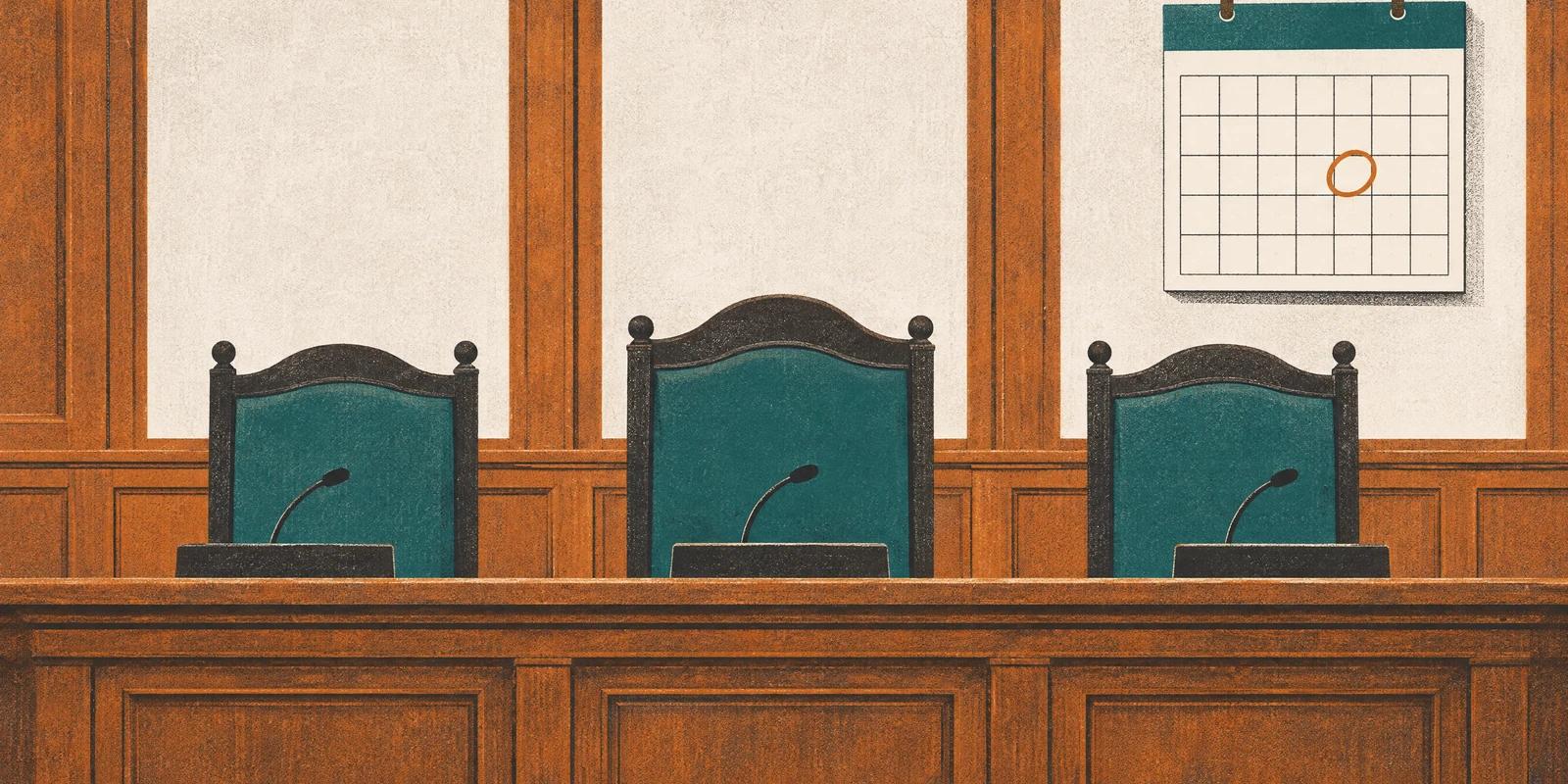
Images. The cover, listing and homepage images are AI illustrations (generated with Higgsfield, GPT Image 2.6): an empty court bench beside a calendar with a date circled, a prison gate at dawn with no people, and a stack of case files tied with string. They depict no real person, and no real place is depicted. We found no recent, freely licensed photograph of this story.
Sources. The case history, charges, sentences and courts are from 연합뉴스, 뉴시스, 로타임즈 and 부산일보. The special counsel's sentence requests are from YTN. The full-bench referral and the three-month dispute are from 뉴시스, 세계일보 and 한겨레. The pace of the court and the 김건희 comparison are from 경향신문, 연합뉴스 and YTN. The possible release and the 30 November verdict are from 한겨레, 부산일보 and 경향신문. The politicians' statements before the ruling are from JTBC and 한겨레. Article 92 is from the text of the Criminal Procedure Act as reproduced on casenote.kr. The setting of the ruling date is from 이투데이, the first-in-29-years point from 파이낸셜뉴스, and the special counsel's 13 November request from 이투데이 and 서울신문. The amendment to the indictment is from 뉴시스. The ruling, its reasoning, the dissent and the renewal of detention are from 연합뉴스, 뉴스1, 뉴시스, 한겨레, 한국일보, 중앙일보, 경향신문, 동아일보 and MBC. The reactions to the ruling are from 뉴시스, 뉴스1 and 연합뉴스. The headlines compared in our view are from 연합뉴스 (Korean and English services), 서울신문, 동아일보, 경향신문 and 뉴스1.
Stated rather than smoothed. The 9–3 vote is from 연합뉴스's round-up report and 중앙일보. 경향신문 describes the post-declaration findings as made final (확정). 연합뉴스 reports the whole guilty part was set aside because the counts shared one sentence; we describe that rather than label the findings final or not. The majority's point that the seriousness of the crime does not relax the basic principles of criminal law is from MBC's live summary alone. That this is the first time the Supreme Court has confirmed 12·3 as an insurrection is 경향신문's description, and the first-in-29-years point is from 파이낸셜뉴스 alone. The two-month length of the renewal is from 연합뉴스; 뉴스1 and 뉴시스 report the renewal itself. The special counsel's reaction is from 뉴시스 alone, and the People Power Party's reaction and the Democrats' emergency caucus are from 뉴스1 alone. We found no statement from 한덕수's defence by 17:38 on 19 November. We have left out Democratic MPs' posts about the ruling on Facebook, because we could not tie them to a named outlet. We could not read the day's Reuters, AP, Korea Herald or Korea Times reports, so the English introduction we discuss is 연합뉴스's alone. From before the ruling: we could not confirm why the detention limit fell on the 20th, and a six-month count from the Supreme Court's reported receipt date does not fit it exactly. We found no source on release conditions until the special counsel's 13 November request. We did not read the special counsel law's text and rely on press summaries, so whether the three-month rule binds the court is stated as a dispute, and that it was broken is the Democrats' claim. 김의겸's committee title is from JTBC alone. That the trial court added the charge of a key role in insurrection by amending the indictment in October 2025 is from 뉴시스 alone; we found no second source.
Keep Reading
More Stories

김건희's Four-Year Sentence Is Final, and So Is the Acquittal Over 명태균's Polls
On 19 November the Supreme Court's full bench upheld 김건희's convictions over Deutsche Motors shares and Unification Church gifts, making four years in prison and a ₩50 million fine final. It also upheld the acquittal over 명태균's polls, by 10 votes to 2. Many Korean headlines carried that acquittal. 연합뉴스's English headline left it out.

A Forged Tally Sheet Is an Alleged Crime. It Is Not a Stolen Election
On 10 November Korea's election special counsel raided two election commissions over a tally sheet for one polling station. The counsel itself says the result and the winner were unchanged. The opposition leader 장동혁 says the count was stolen. The record supports a serious investigation, and not that claim.
A Governor Called the Fire Service a Budget Straw. The Row Is Really About Who Pays for Korea's Firefighters
On 13 October Gyeonggi's governor, 추미애, told a National Assembly audit that firefighting was draining the province's finances. Three apologies later, the argument underneath has not gone away: firefighters became national civil servants in 2020, but provinces still pay almost nine-tenths of the bill. On 8 November the ruling party and the government said they would review about ₩2 trillion. Nobody has said over how long, or where it comes from.
The Weekly Dispatch
Korea, curated. Every week.
The best of K-culture, straight from Seoul. Written by people who actually live here.
Free, no spam, unsubscribe whenever.