Summoned to Testify, Korea's Chief Justice Came, Refused the Oath, Answered Anyway — and Left at Lunch
On 6 October 조희대 sat before the National Assembly's judiciary committee for two and a half hours, unsworn, defending a refusal to put forward a second name for a Supreme Court seat that has been empty since March. Then the Chief Justice went, and came back at ten to eleven at night to give closing remarks. Nobody voted to compel a return, and the seat is still empty.
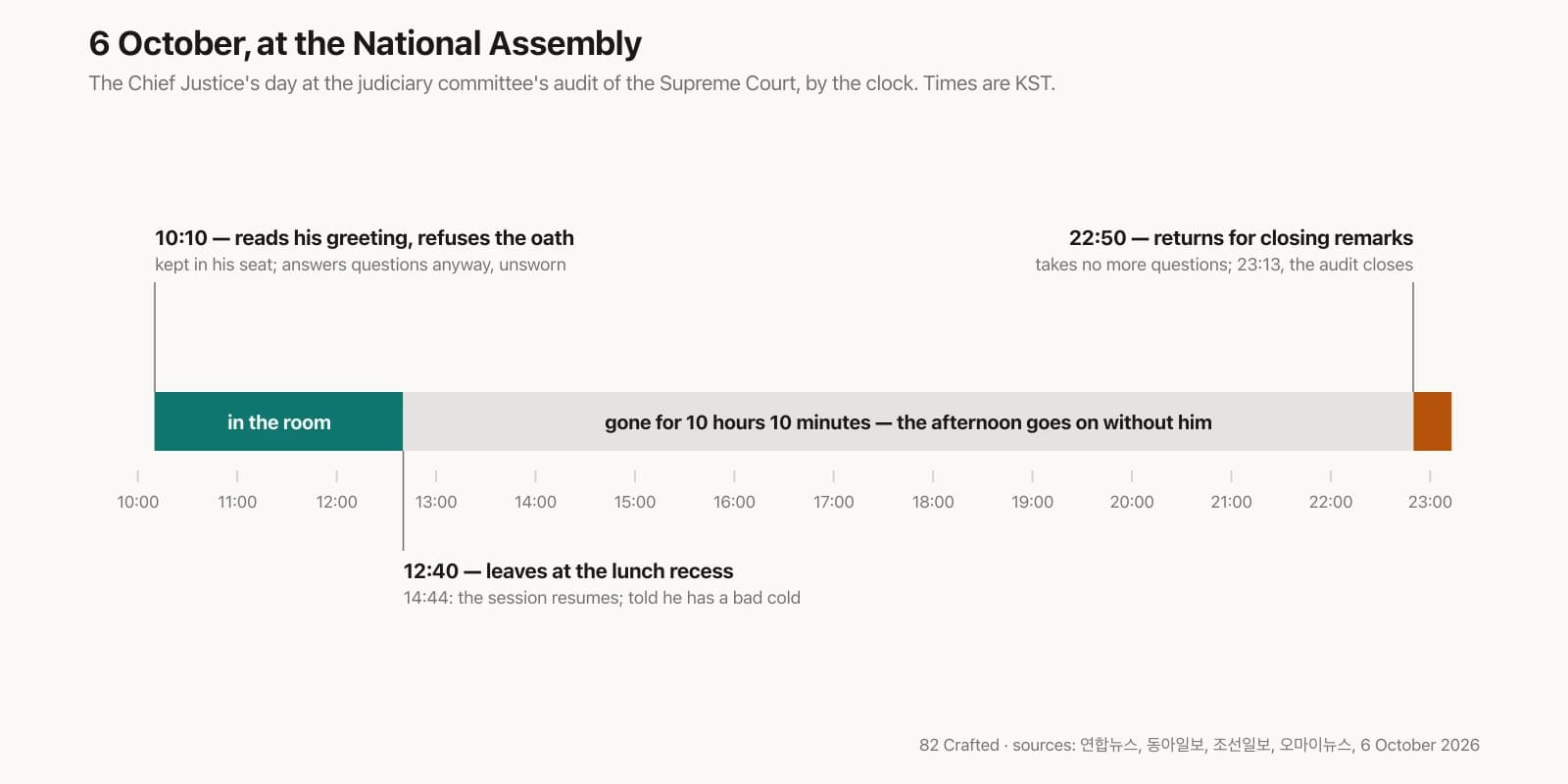
On the morning of Tuesday 6 October, in a committee room of the National Assembly, the witnesses for the day's audit of the Supreme Court stood to take the oath. One person stayed seated.
It was the person the audit most wanted to hear from. The Chief Justice, 조희대, had been named a witness by the Assembly's judiciary committee eight days earlier, and four days earlier had written to say that no witness would be appearing. The Chief Justice came anyway — in the other capacity the Assembly's customs allow, as head of the institution being audited, to read a greeting and go. The greeting was read. The oath was not taken. And the committee's chair refused the Chief Justice leave to go.
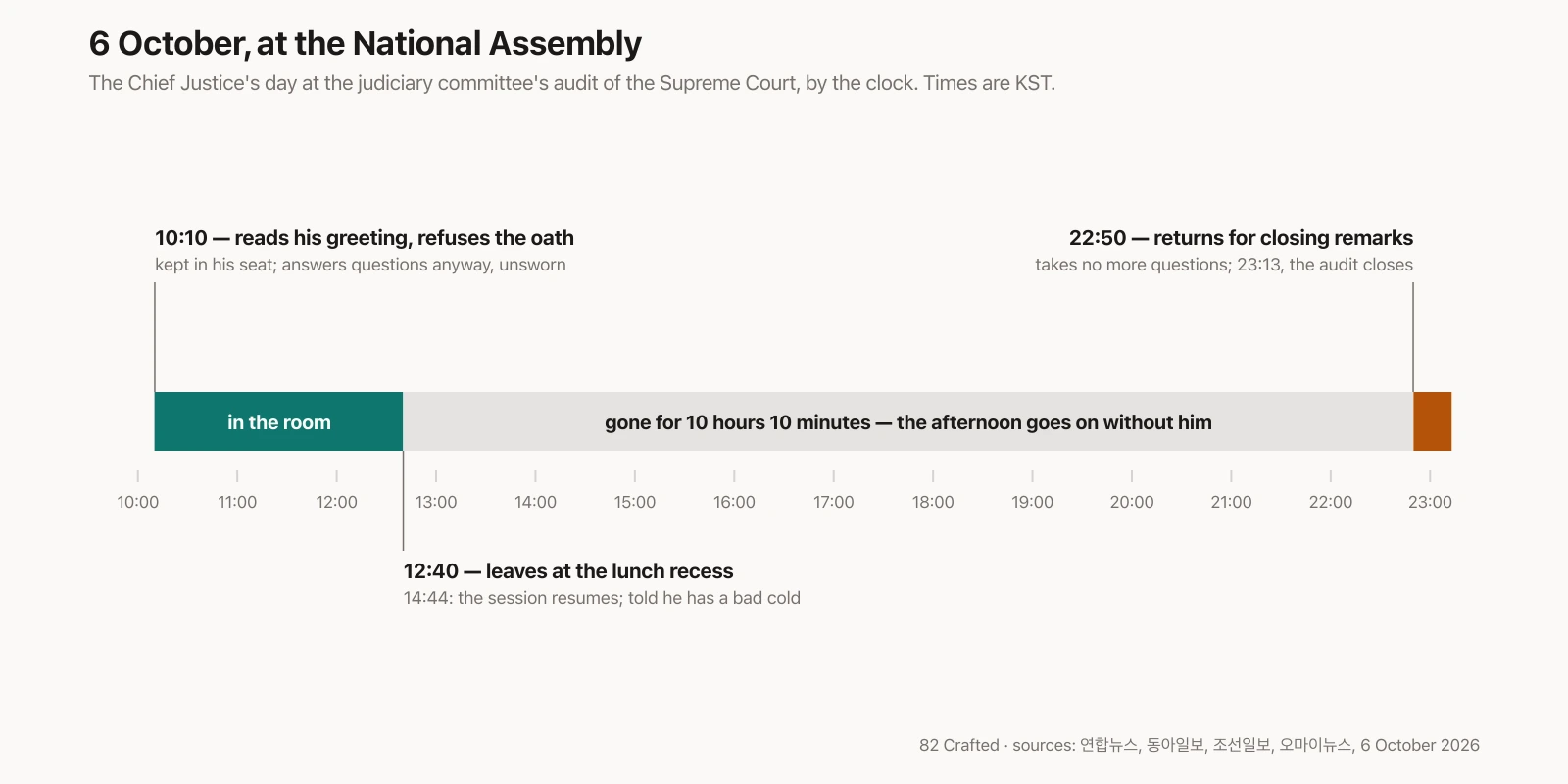
What followed has not happened in quite this way before. For most of the next two and a half hours the Chief Justice answered questions — unsworn, and selectively — and at one point took two sheets of A4 from a jacket pocket and read from them for about six minutes. Then, at the lunch recess, the Chief Justice left, and did not return for the afternoon. At ten to eleven that night came the closing remarks, a refusal to take any more questions, and, at 23:13, the end of the audit.
The argument at the centre of it is about one seat.
The seat
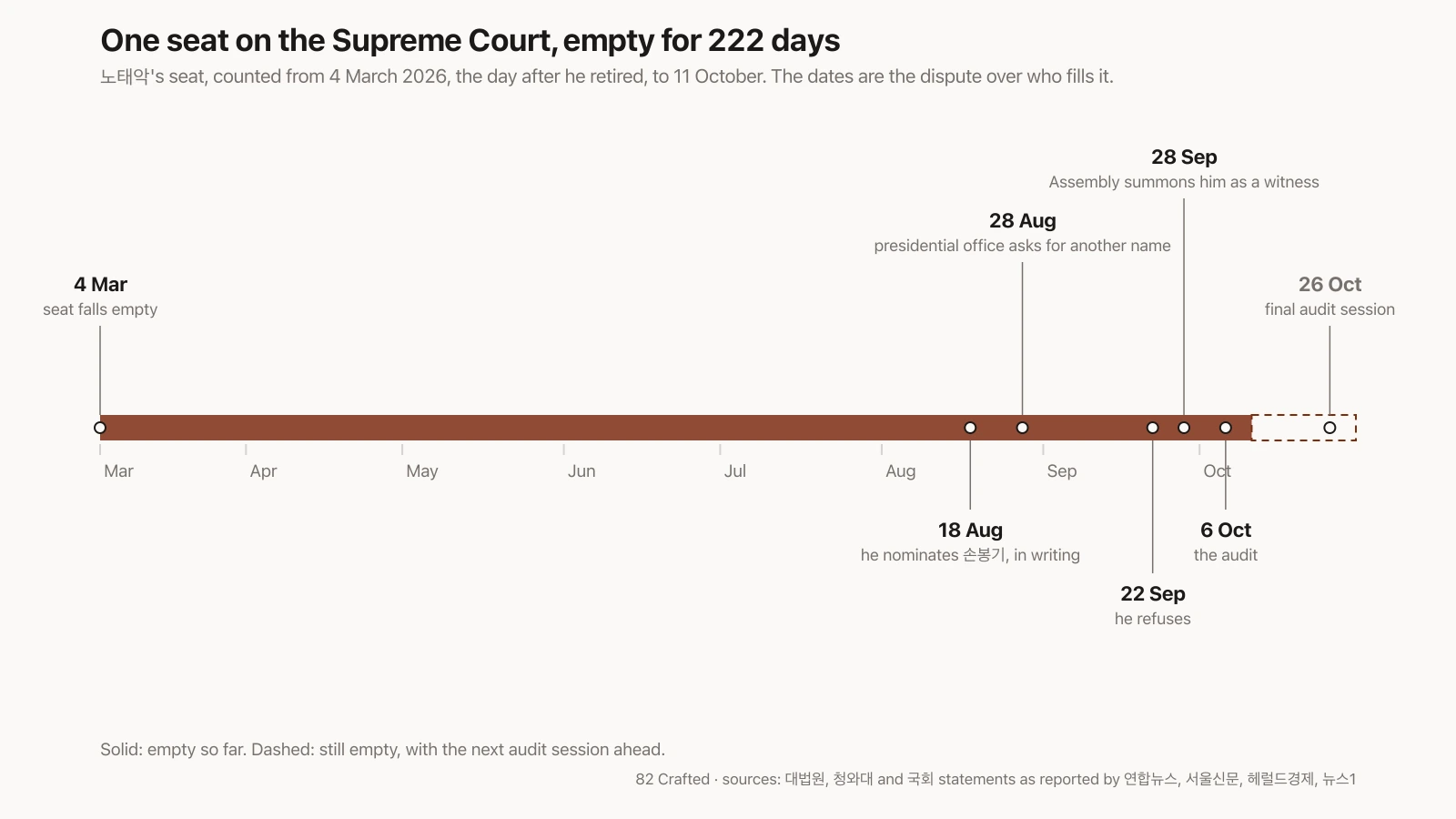
Justice 노태악's term on the Supreme Court ended on 3 March. The seat has been empty since the next day — 222 days as of 11 October, counting 4 March as the first.
Korea's constitution splits the job of filling it three ways. Article 104(2) begins "대법관은 대법원장의 제청으로…": a justice is appointed by the President, with the Assembly's consent, on the Chief Justice's nomination. The Chief Justice proposes; the Assembly consents; the President appoints. Each needs the others.
In August the three stopped meshing. On 18 August 조희대 nominated 손봉기 for 노태악's seat, and 김성수 for another vacancy, doing both in writing — a 서면 제청. 김성수 was appointed. 손봉기 was not. On 28 August the presidential office effectively sent that nomination back and asked for another name. On 22 September the Chief Justice refused. The presidential office's answer was that the refusal "국민에 의해 선출된 대통령의 임명권을 무력화하는 것" — neutered the appointment power of a President the people had elected. 데일리안 reports that no President under the current constitution had ever before asked a Chief Justice to nominate again.
That is the substance. Around it, the Assembly's majority had built a summons.
The summons, and the letter
On 28 September the judiciary committee adopted 조희대 as an 일반증인, an ordinary witness, for 6 October. The Democratic Party, 조국혁신당 and 진보당 voted for it; the People Power Party's members walked out before the vote. The same day, at an urgent session of the committee, the head of the court's administration office, 노경필, apologised for something else: attendance figures in the Chief Justice's expense-account records that had been written down "사실과 다르게" — other than as they were — when the Assembly asked for them. The investigative outlet 뉴스타파 had reported at least thirteen such entries in the first half of 2026.
A witness summons is not an invitation. The act on testimony before the Assembly says that anyone summoned must appear; that refusing to appear, to take the oath or to testify carries up to three years in prison or a fine of ₩10 million to ₩30 million; that a committee may order a witness who fails to attend to be brought in; and that once a committee finds an offence it must refer it for prosecution — since 2 October, to the anti-corruption agency, the new serious-crimes agency or the police.
On 2 October the Chief Justice wrote to the committee declining to appear as a witness. Making the Chief Justice testify about the nominating power, the letter said, "헌법 제104조 제2항에 반영된 삼권분립의 취지와 사법권 독립에 반한다" — would run against the separation of powers reflected in Article 104(2), and against judicial independence. It would be improper, too, to disclose what had passed in consultations with the President. And because a complaint had been filed over the use of the nominating power — a civic group, 사법정의바로세우기시민행동, had gone to the anti-corruption agency in August alleging abuse of authority and dereliction of duty — an investigation was something that "배제하기 어렵다", could not be ruled out.
The committee's chair, 서영교 of the Democratic Party, made the letter public and answered it: "조 대법원장은 성역이 아니고 사법부 독립은 위헌행위에 대해 침묵을 허용하는 방패가 아니다" — the Chief Justice is not untouchable, and judicial independence is not a shield for silence about unconstitutional acts.
None of this was new. In 2025, too, 조희대 was named a witness, declined, came as head of the court, was refused leave by the then chair, and sat in silence before leaving ahead of noon. Nobody, as far as we can find, has ever ordered a sitting Chief Justice brought to the Assembly, or referred one for prosecution.
The day
The greeting said what the letter had said, more briefly: asking the Chief Justice to testify about nominations "삼권분립과 사법 독립의 원칙을 훼손할 염려가 있다" — risked damaging the separation of powers and the independence of the courts. Asked by the chair to take the oath, the Chief Justice declined: "서두에 인사말에서 말씀드린 대로 선서나 증언을 할 수 없다" — as said in the greeting, there could be no oath and no testimony.
The chair did not allow the Chief Justice to leave. And then, pressed by the Democrat 김기표, the Chief Justice asked for time to answer, produced the two sheets of paper, and gave the committee the court's position in person. 노경필, sitting alongside, said afterwards that it was the first time the administration chief had seen the text.
"대법원장은 국회의 동의 절차, 대통령의 임명 절차에 전혀 관여할 수 없듯이 국회와 대통령도 대법원장의 제청에 전혀 관여할 수가 없다."
Just as the Chief Justice has no part in the Assembly's consent or the President's appointment, the Assembly and the President have no part in the Chief Justice's nomination.
Not consulting the President, the Chief Justice went on, raised no constitutional problem, and past presidents had in the end always respected the nominating power; once a nomination is made, the duty is done. 동아일보 called it the first time since the audit was revived in 1988 that a Chief Justice had answered the committee's questions beyond the courtesies of the greeting.
On money, the Chief Justice gave ground. The court's administration office holds the card, the committee was told, and the Chief Justice does not know what a meal costs: "금액이 아마 넘어간 경우가 있는 모양이다. 저도 이번에 처음 알았다" — it seems the limit was sometimes exceeded; this was the first the Chief Justice had heard of it. When the Democrats raised ₩108 million of wine bought on the expense account between 2022 and 2025, the reply was that the Chief Justice does not drink a drop. And 서영교 opened a new front: monthly cash payments of about ₩2 million to the justices, which the chair said could legally amount to embezzlement of state funds. That money, came the answer, is handled by a separate disbursing officer, and the Chief Justice has no part in it.
The room was not calm. When 손솔 of 진보당 asked whether the Chief Justice dreamed of becoming "제2의 윤석열" — a second Yoon Suk Yeol, the impeached former president — the committee erupted, and when the People Power Party's 김태규 shot back an insult the chair suspended 김태규's right to speak. 조희대's answer to the question, as 쿠키뉴스 reported it, was that it was "모욕적이고 서글픈 일" — insulting, and sad.
At the lunch recess, at 12:40, the Chief Justice left. When the session resumed at 14:44, 노경필 told the committee the Chief Justice had a bad cold. 서영교 said the Chief Justice had left without leave and must come back. The absence lasted ten hours and ten minutes. At 22:50 the Chief Justice returned, acknowledged "미흡한 점" — shortcomings — as the official ultimately responsible for running the courts, promised to do what was needed for the court to be at full strength, and, asked to stay for questions, said: "마무리 말씀을 드리러 온 것이지, 제가 질의를 받기 어렵다" — the visit was to give closing remarks, not to take questions.
What the Assembly did not do
For all the talk beforehand, the committee voted for nothing. There was no order to bring the Chief Justice back in the afternoon, and no referral for refusing the oath, which the act lists alongside refusing to attend. The compulsion order the act provides for is written for a witness who fails to turn up, and the Chief Justice had turned up. What 서영교 said was that a refusal without justifiable reason "후속 조치될 수 있다" — could lead to follow-up action under the act. Four days later a 한겨레 column was still urging the Assembly to make a referral quickly, which is as good a sign as any that it had not.
The pressure moved elsewhere. On 7 October the Democratic leadership called for the Chief Justice's resignation; some members talked about impeachment, and the leadership, one of them said, was "고심하고 있다" — still weighing it. 진보당 adopted impeachment as party policy, which it cannot carry without the Democrats. The People Power Party's 박형수 had called the refusal of leave "체포하고 감금하는 행위", an act of arrest and confinement, and its floor leader dared the Democrats to try impeachment. The presidential office said its position had not changed: nominate again, quickly.
Lawyers split. 차진아 of Korea University said the Chief Justice has no duty to answer on this at all. 정태호 of Kyung Hee University answered that judicial independence means "'재판 독립'이지 '인사권 독립'이 아니다" — independence in judging, not independence in personnel. Judges quoted anonymously by 연합뉴스 could not agree either: one said refusing the oath was right; another, that the Chief Justice should have walked out in a spirit of refer me if you dare, and that what happened instead would be a problem for judicial independence "두고두고" — for a long time to come.
What happens next
The committee's final audit session is on 26 October. 서영교 has asked the Chief Justice to make time to attend again; that is a request, not a resolution, and nothing has been voted. The complaint at the anti-corruption agency was reported at the end of September to be still under investigation, and no summons has been reported. The seat is still empty, and 연합뉴스 has suggested the deadlock may last until the Chief Justice retires in June 2027.
What it says
There are two arguments here, and each is right about something.
The Chief Justice is right that the constitution gives the nomination to the Chief Justice, and that a President who turns down the name put forward and asks for another is asking for something the constitution does not mention. If one majority can summon a Chief Justice under oath to explain a nomination, the next majority can do it too, about whatever it likes.
The Assembly is right that nobody in a democracy should be beyond the reach of its questions, and that the questions on 6 October were not only about the nominating power. They were also about the court's own accounts — dinners logged for more people than sat at the table, wine bought on a card the Chief Justice says is held by somebody else, cash another official is said to hand out. On those, the Chief Justice did not claim independence. The answer was an apology, and that the Chief Justice had not known.
What neither side has done is fill the seat. The court is short a justice for the eighth month running, because two of the three parties who must agree on one cannot agree with each other, and the third spent a day in a committee room arguing about the first two. By 동아일보's account, this Chief Justice answered more of the Assembly's questions than any before, and left before the afternoon. Nobody made the Chief Justice stay.
Images. All three are ours: the timeline of the empty seat, built from the dates reported by 연합뉴스, 서울신문, 헤럴드경제 and 뉴스1; the Chief Justice's day on 6 October by the clock, from 연합뉴스, 동아일보, 조선일보 and 오마이뉴스; and the count of days. We have not used a photograph of the Supreme Court building: South Korea has no freedom of panorama for architecture, and the one openly licensed photograph we found is of the building itself.
Sources. The day of 6 October is from 연합뉴스, 동아일보 (two reports), 조선일보, 문화일보, 뉴스핌, 쿠키뉴스, 폴리뉴스, 오마이뉴스 and JTBC; the reaction from 연합뉴스, 뉴스핌, 머니투데이, 데일리안, 진보당's own release and 한겨레. The letter of 2 October is from 파이낸셜뉴스, 뉴스1 and 쿠키뉴스, and 서영교's response from 파이낸셜뉴스. The nomination dates are from 헤럴드경제, 세계일보, 뉴스1 and 서울신문, and the presidential office's 22 September statement from 서울신문. The summons and the expense-record apology of 28 September are from 뉴스핌, 서울신문 and 뉴스타파; the 2025 precedent from 뉴스1 and 경향신문. The testimony act is quoted from 국가법령정보센터.
Stated rather than smoothed. The vacancy count depends on where you start: we count 4 March, the day after 노태악's term ended, as day one, which matches the committee chair's own figure; 연합뉴스 counts one day more. "The first time since 1988" is 동아일보's description, which 폴리뉴스 shares; we have not checked every audit since 1988 ourselves. The Chief Justice's reply to the "second Yoon Suk Yeol" question is worded differently in each outlet that carried it, so we have quoted one and named it; outlets also disagree on how many times the Chief Justice said "위헌", unconstitutional. Reports differ on whether the civic group's complaint names 노경필 as well as 조희대. The People Power Party leader's claim that the President insisted on one particular candidate is a party claim, unverified, and we have not printed it as fact. We do not know whether the request of ₩2.29 billion to renovate the Chief Justice's residence came up on the day. The views in the last section are the editors'.
Keep Reading
More Stories

A Portmanteau Walks into a Party: In Defence of the Koreaboo
The word 'koreaboo' travels fast and lands hard — but nobody can define it, nobody who matters invented it, and it applies, with suspicious consistency, almost only to East Asian cultures. Drawing on the Francophile, the Anglophile, and a 1,555-day Duolingo streak, a guest essay on the double standard that calls Western cultural enthusiasm personality and Korean cultural enthusiasm a phase.
Korea Abolishes Its Prosecution Service on 2 October. One Successor Opens Without a Chief or a Finished Building. The Other Opens With the Same Prosecutors Under a New Sign
At midnight on 1 October the 검찰청법 is repealed and the institution that has dominated Korean politics since 1948 splits in two: a 공소청 that charges and tries cases, and a 중대범죄수사청 that investigates serious crime. It is the largest change to Korean criminal justice in seventy years, and it begins with acting heads at the prosecution office, the justice ministry and the national police, no head at all at the new investigation agency, seven sets of rules still unpublished, four challenges pending at the Constitutional Court — and the President arguing on X, in the small hours, with his own party about whether a former prosecutor may run the agency that replaces prosecutors.
Three Soldiers Were Wounded by a Mine Ten Metres from the Line. It Took the Military Seven Days to Say It Was Probably North Korean, and a Front Page to Make It Admit What Its Own Men Had Reported
On 21 September, eighteen Korean soldiers cutting a new path through the DMZ for a UN Command inspection walked into two mine blasts a minute apart. During the evacuation, its own men reported that an object in the ground looked like a North Korean mine. The military said nothing of that for a week, refused to say it when asked, and confirmed it the morning a newspaper printed it. The opposition says the silence protected the President's speech at the UN; the President calls that a baseless conspiracy theory; a member of his own party told the cabinet to 'come down, we'll go in'. The record does not settle the motive. It settles the timeline, and the timeline is bad enough.
The Weekly Dispatch
Korea, curated. Every week.
The best of K-culture, straight from Seoul. Written by people who actually live here.
Free, no spam, unsubscribe whenever.