A Portmanteau Walks into a Party: In Defence of the Koreaboo
The word 'koreaboo' travels fast and lands hard — but nobody can define it, nobody who matters invented it, and it applies, with suspicious consistency, almost only to East Asian cultures. Drawing on the Francophile, the Anglophile, and a 1,555-day Duolingo streak, a guest essay on the double standard that calls Western cultural enthusiasm personality and Korean cultural enthusiasm a phase.

There is a specific social phenomenon that occurs at parties, in staffrooms, and in the comment sections of people who have just announced they are learning Korean, in which someone – usually someone who is, themselves, extremely into something and simply hasn't noticed – furrows their brow and says: but why, though? Not with genuine curiosity, but with the particular tone of a person who has already reached a verdict and is now conducting a courtesy hearing. The hearing is brief. The verdict was always guilty. I have exhausted all my appeals and am currently on day 1,555 of my Duolingo sentence.
The word they are looking for, but may or may not deploy depending on how much they've had to drink and how much they enjoy the feeling of knowing where a line is, is koreaboo – a portmanteau that has travelled from its origins in online K-pop discourse into broader usage as a term for someone who, through their enthusiasm for Korean language, culture, or media, has apparently crossed some invisible threshold between appreciation and embarrassing fixation. It is a word that performs the function of diagnosis without the inconvenience of criteria. Nobody is quite sure what behaviour triggers it, at what point passion becomes pathology, or who holds the classification authority. The only consistent variable, if you examine enough cases, is that the subject is interested in Korea. This is considered sufficient.
Koreaboo did not, it should be noted, emerge from a vacuum. It was modelled on weeaboo – the equivalent insult for people excessively into Japanese culture, which has been circulating since approximately 2005 – making the -boo suffix not a Korean problem specifically but an East Asian one, overwhelmingly. There is no francoboo. There is no italoboo. There is no suffix being applied to people who have developed what can only be described as a lifestyle commitment to Scandinavian interior design, despite the evidence. The internet has occasionally stretched it further – a wehraboo is someone a little too into the Wehrmacht – but as an insult for loving a living culture and learning its language, it has stuck almost entirely to East Asia, and has looked at France and Italy and decided, apparently, that they were fine. Nobody is arguing otherwise.
Compare this to the Francophile. The Francophile is not a joke. The Francophile is a personality type – romantic, aspirational, slightly insufferable at dinner parties but never without a point – who appears in literature, cinema, travel memoirs, and the marketing materials of at least three major airline alliances. Nobody at that same party furrows their brow at the person who spent six months learning French because they were going through something after a breakup. Nobody interrogates the woman who does a wine tour of Burgundy every August, who has formed opinions about specific appellations, who pronounces Côte de Nuits in a way that suggests she has been practising in the bathroom mirror, which she has. She is considered cultured. Aspirational. At worst, someone who takes holiday very seriously and would like you to know it. She is not, under any social convention currently in operation, considered a francoboo. This word does not circulate. The French are fine.
The person learning Spanish is a traveller, a pragmatist, a good-faith citizen of an increasingly interconnected world – or possibly someone preparing for a gap year, which is considered almost identical to citizenship. The person learning Mandarin is playing the long game: economically canny, globally minded, possibly threatening depending on your geopolitical anxieties, but not embarrassing. The person learning Italian learned it because they watched a film set in Tuscany and felt something shift in them, and this is called having a rich inner life. The person learning Portuguese is either preparing for Brazil or, more likely, is Australian and has fallen in love with Fado, which is the Portuguese musical tradition of yearning so profound it has its own taxonomy, and nobody has called them a portugaboo, because this word also does not exist, because the concept it would describe has not, somehow, been deemed worthy of a portmanteau.
The person learning English is not even having this conversation. English completed its conquest of the category so thoroughly, and so violently, and with such comprehensive institutional support, that it installed itself as the lingua franca of global commerce, academic publishing, aviation, diplomacy, and the export agreements of nations who would, in several cases, very much prefer it wasn't. Nobody has ever deployed the word 'Anglophile' as a criticism. It means something pleasant. It appears on tourism websites. It is, apparently, the appropriate response to enthusiastically adopting the most powerful language ever pressed upon the world through a combination of colonisation and administrative convenience.
Korean is a different matter – or rather, it has become one, which is its own interesting data point. Before approximately 2012 – before Gangnam Style became the first YouTube video to break a billion views, introduced the world to the concept of a Korean cultural export arriving without asking permission, and briefly broke the internet's view counter entirely – nobody much cared what you did with Korean. It was the language of a peninsula with a complicated twentieth century, a diasporic community distributed across the world in patterns that track neatly onto various historical pressures, a cuisine that was quietly and comprehensively converting the global palate well in advance of receiving any credit for it, and a film industry that was doing work of extraordinary quality in total obscurity.
Then BTS broke through in the West in 2017 and the algorithm got involved, and then a man named Bong Joon-ho took Parasite to Cannes, won the Palme d'Or, and at the Golden Globes in January 2020 stood at the podium and said that once you overcome the one-inch barrier of subtitles you would be introduced to many more amazing films – which was a generous and collegial thing to say about an industry that had been making amazing films for thirty years while the anglophone world was otherwise engaged. Then Squid Game happened – which led, with the grim inevitability of a well-written finale, to the global dissemination of Gong Yoo's face, an event for which the world was not prepared and from which it has not recovered – and then The Glory and Han Kang winning the Nobel Prize in Literature and the rest of it happened at a pace that gave everyone roughly fifteen minutes to form an opinion before the next wave arrived. And somewhere in that acceleration, a consensus calcified: Korean enthusiasm was suspect. Performed. A phase. It had a word now. The word arrived, as these words tend to, not from the culture being discussed. Koreans themselves have complex, often ambivalent, occasionally pointed opinions about how their culture travels globally, and those opinions are almost never expressible as a single portmanteau. It came from other foreigners, who had appointed themselves the custodians of appropriate enthusiasm and were now enforcing standards of authenticity that nobody, including the culture nominally being protected, had asked them to establish.
It is worth pausing on what the accusation actually does and, perhaps more pointedly, who it does it to. Research by the communication scholar David C. Oh (2024) has argued that the koreaboo label functions largely to police women fans – their emotional and parasocial investment in Korean celebrities – and that this policing is dressed up as cultural criticism while doing the considerably older work of telling women their feelings are embarrassing and excessive. The koreaboo accusation almost always conflates loving a culture with fetishising its people, a conflation that is applied with remarkable consistency to women who love Korean men, and virtually never to the men who have built entire tourism industries, dating app categories, and a genre of YouTube content around their love of East Asian women – a phenomenon with a well-documented vocabulary of its own, none of which is ever aimed at a man for learning the language. The Burgundy woman is not accused of fetishising French people. She is accused of nothing. She is on the flight home already, bathed in the blue light of a Booking.com tab, planning next August.
The koreaboo accusation is, in the main, foreigners policing other foreigners about a culture that belongs to neither of them, using a standard of appropriate interest that applies to no other nation on earth. It is the performance of cosmopolitanism as social currency – the particular self-satisfaction of being the person who knows where the line is – dressed up as cultural sensitivity and pointed, with impressive consistency, at the wrong target. Because here is what the accusation is never levelled at: people extracting Korean cultural output for profit, which happens, and which is the only version of this that merits examination.
But here is what it is almost exclusively levelled at: people who are learning the language to watch dramas without subtitles. People who are attempting, with the genuine enthusiasm of the converted, to understand something they love from the inside. People who are, in other words, doing precisely what every language teacher in every institution of higher learning in the world will tell you is the correct and culturally respectful approach to engaging with a foreign culture, which is: learn the language. This has been the advice for approximately as long as there have been languages and people travelling between them. It has never previously attracted a diagnostic category.
Meanwhile, in the background of this entire conversation, Korea has become one of the most significant cultural exporters in the world. Not by accident. Not by the spontaneous combustion of global interest that the koreaboo framing implies – as though millions of people simultaneously and inexplicably developed an obsessive fixation on a random country, like some kind of coordinated geopolitical parasocial event requiring clinical attention. Through deliberate, sustained, policy-backed investment in cultural production over decades. The Korean Wave – hallyu – was named by Chinese journalists in 1999 for something the market was already doing, and decades of deliberate government policy grew up alongside it. It has worked with a comprehensiveness that has few precedents in the history of cultural soft power, such that Korean cinema wins at Cannes, Korean television is watched on every continent, Korean food has restructured global restaurant culture, and Korean skincare has done to the beauty industry what its electronics manufacturers did to consumer technology: arrived quietly, became indispensable, and made everyone retroactively wonder why they were doing it the other way before. The inevitable endpoint of which is a Hollywood studio producing an animated film about K-pop that becomes the most-watched film in Netflix history – which is either a tribute to Korean cultural reach or an acquisition of it, depending on your framework, and which the koreaboo conversation has not yet found a way to account for.
The global interest in Korean culture is not a pathology that emerged from fan communities and required naming. It is, in large part, the outcome of a decades-long national strategy, encountering a generation raised on global streaming platforms and algorithmically delivered obsessions, and producing, as intended, a very large number of people who are genuinely, sometimes embarrassingly, deeply invested in Korean things. You can ask yourself why it is that people in the Global South learning English are called strivers and people in the Global North learning Korean are called obsessives – and sit with the answer, which arrives quite quickly and is not flattering to the question.
Learning a language is, in the end, an act of sustained attention paid to another way of thinking. Korean – with its honorific system that requires you to consciously categorise every relationship you have ever had before you can address a single sentence to another person, with its particles that restructure the logic of the sentence from the ground up, with its verb endings that compress entire emotional and social registers into a single syllable at the end of a thought you have to hold in suspension until you get there – is not something you pick up as a fashion accessory. It refuses you that. It requires that you sit with ambiguity longer than English ever asks you to, that you account for your social position before you open your mouth, that you consider the person you are speaking to before you speak. These are not the habits of someone engaged in cultural tourism. These are the habits of someone learning, sometimes through tears and always at grammatical gunpoint, to pay attention.
This conversation, at its least generous, is a mechanism for policing enthusiasm that happens to be attached to the wrong culture – one that is non-European, non-dominant, and sufficiently recent in its global emergence that it still carries, for certain observers, the faint and revealing whiff of novelty. Of the niche. Of something that will pass when the phase does, which is a prediction that has been made about Korean cinema, Korean music, Korean food, and Korean skincare in sequence, and which has been wrong in sequence, and which continues to be made with an optimism that is, at this point, its own kind of data.
Korean is not a phase. It is a language spoken by some eighty-one million people – fifty-one million in South Korea, around twenty-six million in North Korea, and a diaspora of seven million distributed, for the record, across every continent. It has a writing system elegant enough that linguists cannot agree on whether to classify it as an invention or a deliberate act of showing off. It has a literary tradition, a philosophical tradition, a culinary tradition of extraordinary depth and sophistication, and a creative industry that is, by any measurable standard, in the middle of one of the most remarkable periods of global influence any national culture has experienced in the last fifty years. The people learning it are not doing it to appropriate anything. They are doing it because something called to them across a language barrier and they decided, against the general advice of everyone telling them it was too hard and a bit weird and possibly a phase, to go toward it.
That decision deserves, at minimum, the same benign silence we extend to the woman who just got back from Burgundy and won't stop talking about the Pinot.
"A Portmanteau Walks into a Party" is Brooke McMaster's second essay for 82 Crafted's Opinion section — essays and arguments from outside contributors, published under their own names; her first was Idle Worship. Published in the week of Hangeul Day, 9 October. The views are the writer's own.
Brooke McMaster is an Australian screenwriter whose work spans Western film and television and, most recently, Korean TV drama. She holds degrees in Linguistics, Writing, Media & Communications, and is completing a Bachelor of Korean Studies — which she presents here not as context but as evidence. She travels to Seoul regularly, where she can be found at a GS25 at 2am conducting what she considers field research into banana milk and what everyone else considers standing in front of a fridge.
Images. Both are AI illustrations (generated with Higgsfield, GPT Image 2.5): a party guest reading a language textbook under her friends' raised eyebrows, and the same party split between a wine lover in warm light and a Korean learner under a cold one. They depict no real people.
Keep Reading
More Stories
Summoned to Testify, Korea's Chief Justice Came, Refused the Oath, Answered Anyway — and Left at Lunch
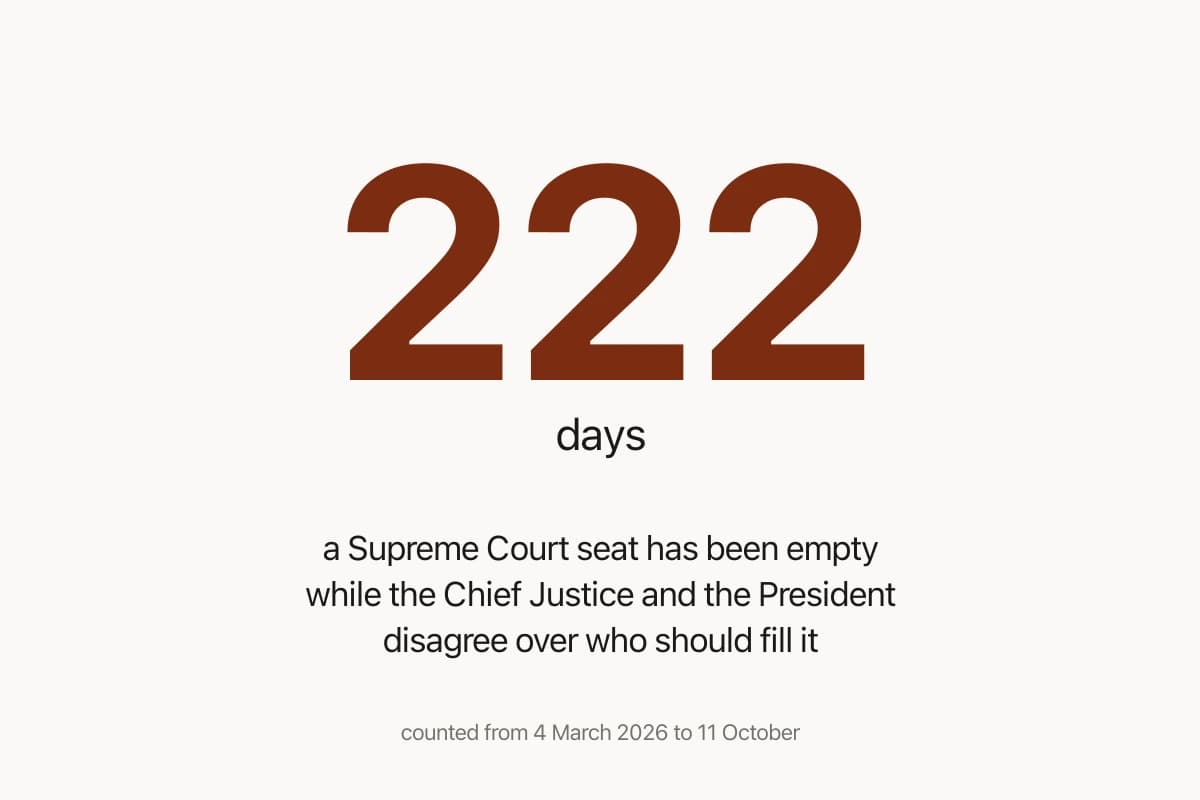
On 6 October 조희대 sat before the National Assembly's judiciary committee for two and a half hours, unsworn, defending a refusal to put forward a second name for a Supreme Court seat that has been empty since March. Then the Chief Justice went, and came back at ten to eleven at night to give closing remarks. Nobody voted to compel a return, and the seat is still empty.

Korea Abolishes Its Prosecution Service on 2 October. One Successor Opens Without a Chief or a Finished Building. The Other Opens With the Same Prosecutors Under a New Sign
At midnight on 1 October the 검찰청법 is repealed and the institution that has dominated Korean politics since 1948 splits in two: a 공소청 that charges and tries cases, and a 중대범죄수사청 that investigates serious crime. It is the largest change to Korean criminal justice in seventy years, and it begins with acting heads at the prosecution office, the justice ministry and the national police, no head at all at the new investigation agency, seven sets of rules still unpublished, four challenges pending at the Constitutional Court — and the President arguing on X, in the small hours, with his own party about whether a former prosecutor may run the agency that replaces prosecutors.

Three Soldiers Were Wounded by a Mine Ten Metres from the Line. It Took the Military Seven Days to Say It Was Probably North Korean, and a Front Page to Make It Admit What Its Own Men Had Reported
On 21 September, eighteen Korean soldiers cutting a new path through the DMZ for a UN Command inspection walked into two mine blasts a minute apart. During the evacuation, its own men reported that an object in the ground looked like a North Korean mine. The military said nothing of that for a week, refused to say it when asked, and confirmed it the morning a newspaper printed it. The opposition says the silence protected the President's speech at the UN; the President calls that a baseless conspiracy theory; a member of his own party told the cabinet to 'come down, we'll go in'. The record does not settle the motive. It settles the timeline, and the timeline is bad enough.
The Weekly Dispatch
Korea, curated. Every week.
The best of K-culture, straight from Seoul. Written by people who actually live here.
Free, no spam, unsubscribe whenever.