Korea Abolishes Its Prosecution Service on 2 October. One Successor Opens Without a Chief or a Finished Building. The Other Opens With the Same Prosecutors Under a New Sign
At midnight on 1 October the 검찰청법 is repealed and the institution that has dominated Korean politics since 1948 splits in two: a 공소청 that charges and tries cases, and a 중대범죄수사청 that investigates serious crime. It is the largest change to Korean criminal justice in seventy years, and it begins with acting heads at the prosecution office, the justice ministry and the national police, no head at all at the new investigation agency, seven sets of rules still unpublished, four challenges pending at the Constitutional Court — and the President arguing on X, in the small hours, with his own party about whether a former prosecutor may run the agency that replaces prosecutors.
At 00:00 on Friday 2 October, a law called the 검찰청법 stops existing. The 공소청법, promulgated in March, says so in a single line of its supplementary provisions: "검찰청법은 폐지한다."
The institution that law created goes with it. Korea's prosecution service traces itself to a decree of the South Korean Interim Government, under American occupation, dated 2 August 1948 — a fortnight before the Republic was declared; the Republic passed its own 검찰청법 in December 1949. Seventy-eight years after the first, the 검찰청 — the office that indicted presidents, investigated chaebol, led the anti-corruption drives of successive governments, and was accused by every opposition of doing the government's bidding — is split in two.
At ten o'clock on the morning of the 2nd, in the building in 서초동 that until midnight is the Supreme Prosecutors' Office, there will be an opening ceremony for its successor. The press is not invited. There is no farewell for the old institution that we have been able to find. The bamboo emblem is coming off 67 offices, at a cost of ₩6.5 billion from the government's reserve fund; at the Supreme Prosecutors' Office, workers ground the word 검찰 off the manhole covers.
What replaces it
Two bodies, under two ministries.
The 공소청 sits under the justice ministry. It decides whether to charge, argues the case in court, requests warrants — the constitution says only a prosecutor may — and directs the execution of sentences. It no longer investigates. The revised Criminal Procedure Act puts the division in one sentence: "검사는 공소제기 및 공소유지를 책임지고, 사법경찰관은 수사를 책임진다" — prosecutors are responsible for indictment and trial; police are responsible for investigation. A prosecutor who thinks a police file is incomplete can send it back with a demand for further investigation, and the police must comply within a month; the power to do that investigation themselves, which prosecutors fought to keep, is gone.
The 중대범죄수사청 — the 중수청 — sits under the interior ministry and investigates seven kinds of serious crime: corruption, economic crime, defence procurement, narcotics, crimes against the state such as insurrection, cybercrime, and the new offence of distorting the law. It has a headquarters and six regional offices, a staff quota of 2,874, and, for now, the national police's case-management system, because it does not have its own. Almost everything else — the burglary, the assault, the fraud too small for the 중수청 — becomes the police's alone.
It is the culmination of a project the Democratic Party has pursued for a decade under the banner of 수사-기소 분리, the separation of investigation from prosecution — known, through years of fighting over it, as 검수완박, taking investigation from prosecutors completely. The date itself was set in October 2025, when the government organisation act was amended to take effect a year later; the founding acts passed in March. Nobody can say this arrived by surprise.
The empty chairs
Which is what makes the state of the four offices at the centre of it so remarkable on the eve.
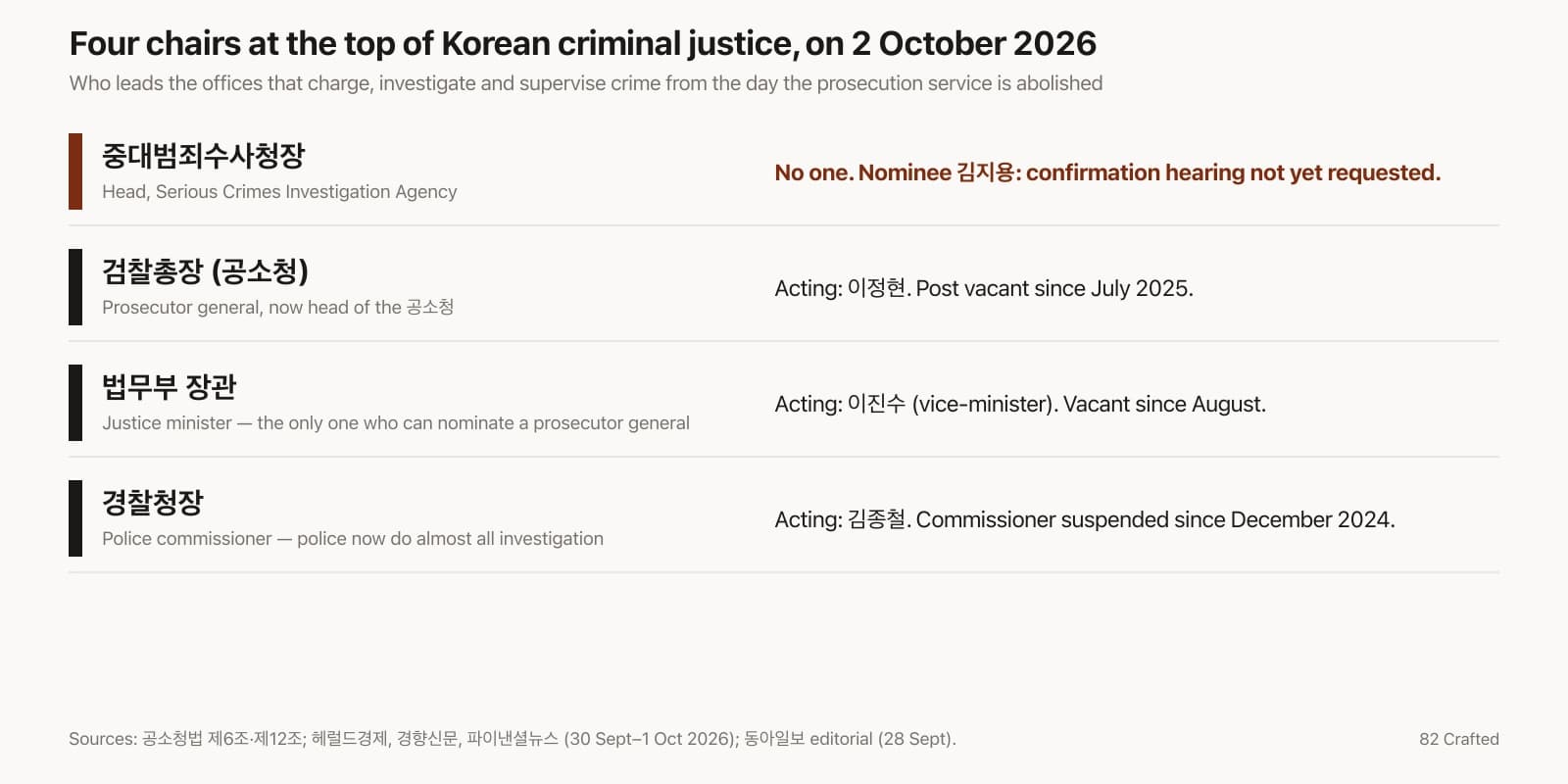
The new investigation agency has no head. The interior minister, 윤호중, put forward 김지용, a former prosecutor, as its first commissioner on 7 September. On the 14th the President ordered further vetting. As of 30 September the request for a confirmation hearing had still not been sent to the Assembly, and the presidential office said nothing had been decided; under the hearings act the Assembly then has twenty days, so the earliest he could plausibly be in post is late October. The 중수청 also has no deputy, no heads for any of its six regional offices, and, on the morning of 1 October, no announced senior postings. Its headquarters, a private office building in 중구, was still under construction — "모든 층이 아직 공사 중", every floor still being worked on, as 경향신문 found on 30 September — and a tender for air-conditioning went out the same day.
The new prosecution office's head is acting, and has been for fifteen months. The 공소청 is led, the law says, by a 검찰총장 — the old title of prosecutor general survives, because the constitution names it. The post has been vacant since 심우정 left in July 2025. Since 23 September it has been filled in an acting capacity by 이정현, the deputy, who becomes acting head of the 공소청 by operation of law at midnight. The committee that nominates a permanent prosecutor general has not been formed.
There is no justice minister to nominate one. 정성호 resigned on health grounds in August; his designated successor, 김승원, withdrew on 19 September amid lobbying allegations; the vice-minister, 이진수, is acting. Only a minister can put forward a prosecutor general, so the 공소청 cannot have a permanent chief until the government has a justice minister.
The national police — who from 2 October do nearly all of the country's criminal investigation — have had an acting commissioner for twenty-one months, since 조지호 was impeached and suspended over the martial-law decree of December 2024. 동아일보 put the arithmetic in an editorial on 28 September: "경찰청은 1년 9개월, 공소청으로 바뀌는 대검찰청은 1년 2개월간 '대행 체제'가 이어지고 있다."
The phrase the press has settled on, from right and left alike, is 개문발차 — a bus pulling away with its doors still open. 데일리안 used it on the 28th. 경향신문, which supports the reform, used it in an editorial on the 30th: "불완전한 상태로 일단 출범한 후 문제점을 보완해나갈 수밖에 없는 '개문발차' 상황이다."
The fight over the one nominee
The reason the 중수청 has no head is not the opposition. It is the governing camp's own reformers, who object to 김지용's record.
The sharpest objection came on 16 September from the governor of Gyeonggi, 추미애, a former justice minister and one of the reform's original champions, on Facebook. She compared his past conduct to Adolf Eichmann's — the man who said he had only followed orders — and concluded: "그냥 밀정이라고 본다" — I simply see him as a spy for the other side. The 민주당 lawmaker 김용민 called for the nomination to be withdrawn; 조국혁신당's spokesman told him to step aside; 임은정, a prosecutor famous for breaking ranks with the old service and herself moving to the 중수청, wrote that she feared "잘못된 검찰 문화가 그대로 이식되겠구나" — that the wrong prosecutorial culture would be transplanted intact. 민변 and 참여연대, the lawyers' and civic groups that have carried the reform for years, both called him unsuitable.
The President's answer arrived on X, in a run of replies posted on the night of 30 September and into the small hours of 1 October. He set out the record as he sees it — that 김지용 was promoted to chief prosecutor under the Moon government by its justice minister, who was 추미애, ordered a reinvestigation as a senior prosecutor into a case involving 윤석열's mother-in-law, was sidelined under 윤석열 and left — and asked his critics a question:
"중요 수사기구 책임자에 수사 전문가인 전직 검사를 검사 출신이라는 이유로 쓰지 말라고 하면 이것은 중수청을 망치자는 얘기나 마찬가지."
"To say a former prosecutor, an expert in investigation, may not lead a major investigative body because he is a former prosecutor is the same as saying we should wreck the 중수청."
"검찰개혁의 목표가 검찰에 복수하자거나 검찰을 망가뜨리자는 것은 아니지 않으냐" — the point of prosecution reform is not revenge on prosecutors, is it? He also left himself room, writing that whether to replace the nominee was "여전히 고민과 판단의 영역" — still a matter he was weighing.
So the head of state spent the last night of the old prosecution service defending a former prosecutor against the people who campaigned to abolish it — one of whom, by his account, had promoted the man — in public, on a social network, while the agency the nominee would run was still putting out a tender for air-conditioning.
The same people under a new sign
For all that changes on paper, the 공소청 will be staffed by the people who were prosecutors on 1 October. Serving prosecutors become 공소청 prosecutors automatically; the justice ministry expects 80 to 85 per cent of the 2,292 posts to be filled that way, and 80 prosecutors joined the 중수청's first intake instead. The structure — a national office, regional high offices, district offices — maps one for one onto the old 대검, 고검 and 지검. And on the reshuffle that takes effect at midnight, 17 of the 18 district offices will be led by the same people who led them as district prosecutors' offices, under their new names. 데일리안's headline on the 30th: "간판만 바꿨나" — did they just change the sign?
They did change the signs, in places. 서울동부 was first, under 임은정; the central Seoul office was being refitted on the morning of 1 October. At noon that day, the service's website still said 대검찰청.
The President's own cases
There is one more reason the empty chair at the top of the 공소청 matters, and the opposition has not been slow to make it.
A justice ministry fact-finding team set up in June is reviewing nineteen past prosecutions, eight of them connected to the President. On 18 September he asked the Assembly to strip the power to withdraw charges from a separate special-counsel bill so that, as he put it, no unnecessary controversy about dropping cases would arise. The effect, as 조선일보 noted, is to leave the 공소청 as the only body that could drop his. Asked on 23 September whether it might, 이정현 said: "진상조사단에서 진상조사가 진행 중에 있어서 그 결과를 살펴봐야 할 것 같다" — the review is under way and we will have to look at its results. 조선일보 called that answer, from the man about to run the 공소청, "매우 부적절했다". The opposition lawmaker 주진우 claims he was installed to drop the President's cases. That is a claim; what is on the record is that the decision, if one comes, will be his.
The rules nobody has read yet
The law the 공소청 and 중수청 run on is newer than it looks. All four statutes — the government organisation act, the two founding acts and the Criminal Procedure Act — were amended again on 29 September, three days before commencement, after the Assembly passed 51 follow-up bills on the 17th; a presidential decree amending 126 regulations was promulgated the same day. Seven justice ministry ordinances, including the rules for handling cases, had not been promulgated at all by the morning of 1 October, 중앙일보 reported.
Of the 165,000 cases pending in prosecutors' offices at the end of July, most simply stay where they are and become the 공소청's charging decisions. The roughly 1,500 that prosecutors were investigating themselves must go to the police or the 중수청, though some may continue for ninety days. Four challenges sit at the Constitutional Court — from a junior prosecutor, from the opposition party and its leader, from the service's head of internal inspection, and from a high-office prosecutor — and none has been decided; only an injunction could pause any part of this, and none has been granted. 104 prosecutors had resigned this year by 10 September, most with more than a decade's service — though 175 left in the whole of 2025, so the exodus is not the flood it has been described as.
What people are saying
The papers have split the way you would expect, and then agreed on more than you would expect.
한겨레, for: "수사권과 기소권을 함께 쥐고 막강한 권한을 휘둘렀던 '정치검찰'의 폐해를 근절하는 역사적 개혁이다" — a historic reform ending the harm done by a "political prosecution" that held the powers to investigate and to indict together. 경향신문, also for, but: "새 체계는 불안한 출발선에 서 있다" — the new system stands at an unsteady starting line. 중앙일보, against: "정치 논리 때문에 졸속으로 뜯어고친 대가가 국민 개개인에게 전가될 우려가 높다" — the cost of a hasty overhaul driven by politics is likely to fall on ordinary citizens.
참여연대, which has campaigned for this for years, called it "78년간 지속된 중앙집권적 검찰청 체제를 법률적으로 종식시킨 역사적 전환점" — a historic turning point legally ending 78 years of a centralised prosecution — and, in the same report, "검찰청 폐지는 검찰개혁의 완성이 아니다" — abolishing it does not complete the reform. On the way out, the acting prosecutor general who stood down on 22 September, 구자현, wrote to his colleagues that the change had "분명 검사제도의 근간을 훼손한 측면이 있다" — undeniably damaged the foundations of the prosecutorial system — and a departing senior prosecutor, 소창범, wrote: "우리는 단 한 번도 자신의 영달을 위해 일한 적이 없다" — we never once worked for our own advancement.
The public has not been asked this month. In July, 한국갤럽 found 61 per cent wanted prosecutors to keep the power to investigate further and 23 per cent wanted it abolished; the law abolished it.
What it says
Separating the power to investigate from the power to indict is not a radical idea; many democracies do some version of it, and Korea's prosecutors held both for longer and more aggressively than almost anyone. The case for the reform is real, and so is the record that produced it. What is being criticised, on the left as much as the right, is the execution — a change of this size, fixed in law a year in advance, arriving with acting heads in three of the four offices that run criminal justice and nobody at all in the fourth, rules still being amended three days out, an unfinished building, and a confirmation fight that the government is having with itself.
The prosecutors' office the reformers wanted to abolish was accused of serving whoever held power. On its last day, the man running its successor is an acting appointee, the minister who would supervise him does not exist, and the one decision everybody is watching him for concerns the President. That is not the old system. It is not yet a new one either.
Images. The lead photograph is the Seoul High and Central District Prosecutors' Offices in 서초동, photographed on 12 September 2026 by the Commons user Endearing9721 and released into the public domain (CC0), three weeks before the signs changed. The second photograph is the same building in July 2016, by the Commons user Neoalpha, also CC0. The cover is ours. The government's own briefing photographs are licensed for text only, and the press photographs of the signs being changed are agency copyright, so we have not used them. There is no licence-clean photograph of 김지용 or 이정현.
Sources. The statutes — 정부조직법 (법률 제21065호), 공소청법 (제21490호, amended 제21991호), 중대범죄수사청법 (제21491호, amended 제22016호) and 형사소송법 (제21857호, amended 제22009호) — are quoted from 국가법령정보센터 (law.go.kr), with the 1948 decree date from the prosecution service's own history page. The 중수청's remit, offices and quota are from 정책브리핑 (4 August). The nomination and hearing timeline from 연합뉴스 (27 September), 경향신문 (30 September) and 파이낸셜뉴스 (1 October); 추미애 from 매일경제 and kbc (16 September); 김용민 from 뉴스1 (18 September); 이성윤 from 뉴시스 (21 September); 임은정 from 뉴스핌 (18 September); the President's posts from 뉴스핌 and 헤럴드경제 (1 October). The vacancies from 헤럴드경제 (1 October), 경향신문 (24 August), 한국일보 (19 September), 뉴스핌 (2 September) and 동아일보's editorial (28 September). Staffing, the reshuffle and "간판만 바꿨나" from 데일리안 (28 and 30 September), 한겨레 (27 September) and 오마이뉴스 (1 October); the signs and manhole covers from 서울신문 (29 September), inews24 (1 October) and 경향신문 (30 September); the ceremony from 헤럴드경제 (1 October). The President's cases from 한겨레 (23 September), 서울신문 (18 September) and 조선일보's editorial (24 September). Resignations from 아시아투데이 (25 September). Editorials: 한겨레 (30 September), 경향신문 (30 September), 중앙일보 (1 October). 참여연대's report as reported by 경향신문 (17 September); 구자현 from 서울신문 (22 September); 소창범 from 주간경향 (30 September). Polling: 한국갤럽 (14–16 July) via 파이낸셜뉴스.
Stated rather than smoothed. Several things being said this week are slightly wrong. The head of the 공소청 is not legally a "공소청장" — the law calls the post 검찰총장, and the committee that has not been formed is the 검찰총장 nominating committee; "공소청장" is press shorthand. The figure of 1,962 for the 중수청 is the number of people who applied or were secured in two recruitment rounds, not posts filled, and the real starting strength will be lower. The 165,000 cases are all pending cases, not cases transferring to the new agencies. "78 years" counts from the 1948 decree; from the Republic's own 1949 act it is nearly 77, and the "72 years" in some outlets counts the prosecutors' power to investigate, which dates from the 1954 Criminal Procedure Act. The 104 resignations are this year's total, not departures caused by the reform alone. We found no poll on the reform taken in September. The opposition's claim about the President's cases is reported as a claim. And the objection inside the governing camp is to this nominee's record, not to former prosecutors as such: several of his critics are former prosecutors themselves, a point the President made too.
Keep Reading
More Stories
Three Soldiers Were Wounded by a Mine Ten Metres from the Line. It Took the Military Seven Days to Say It Was Probably North Korean, and a Front Page to Make It Admit What Its Own Men Had Reported
On 21 September, eighteen Korean soldiers cutting a new path through the DMZ for a UN Command inspection walked into two mine blasts a minute apart. During the evacuation, its own men reported that an object in the ground looked like a North Korean mine. The military said nothing of that for a week, refused to say it when asked, and confirmed it the morning a newspaper printed it. The opposition says the silence protected the President's speech at the UN; the President calls that a baseless conspiracy theory; a member of his own party told the cabinet to 'come down, we'll go in'. The record does not settle the motive. It settles the timeline, and the timeline is bad enough.

Korea Gave Artists a Cut of Every Resale, Then Left the Percentage Blank. The Right Also Dies Forty Years Before the Copyright Does.
In July 2027 Korean artists gain a legal claim on the resale of their work. The statute says they may claim 'an amount according to a rate prescribed by Presidential Decree.' No such decree exists, and none is drafted. The law leaves two blanks, not one — it has not said which artworks are covered either. And the clause granting the right is word-for-word the copyright term clause with the number changed from seventy to thirty.

Korea Added Two Public Holidays This Year and Gave Both of Them Saturday Protection. Chuseok Still Does Not Have It.
Chuseok's last day falls on a Saturday, and Monday is a normal working day. Eight days later National Foundation Day also falls on a Saturday, and everyone gets the Monday off. Same collision, two different answers — because the decree sorts holidays into three tiers, and the only two in the middle tier are Seollal and Chuseok. The government rewrote that exact clause in April to protect the two holidays it was adding. It left the biggest one where it was.
The Weekly Dispatch
Korea, curated. Every week.
The best of K-culture, straight from Seoul. Written by people who actually live here.
Free, no spam, unsubscribe whenever.