Korea Gave Artists a Cut of Every Resale, Then Left the Percentage Blank. The Right Also Dies Forty Years Before the Copyright Does.
In July 2027 Korean artists gain a legal claim on the resale of their work. The statute says they may claim 'an amount according to a rate prescribed by Presidential Decree.' No such decree exists, and none is drafted. The law leaves two blanks, not one — it has not said which artworks are covered either. And the clause granting the right is word-for-word the copyright term clause with the number changed from seventy to thirty.
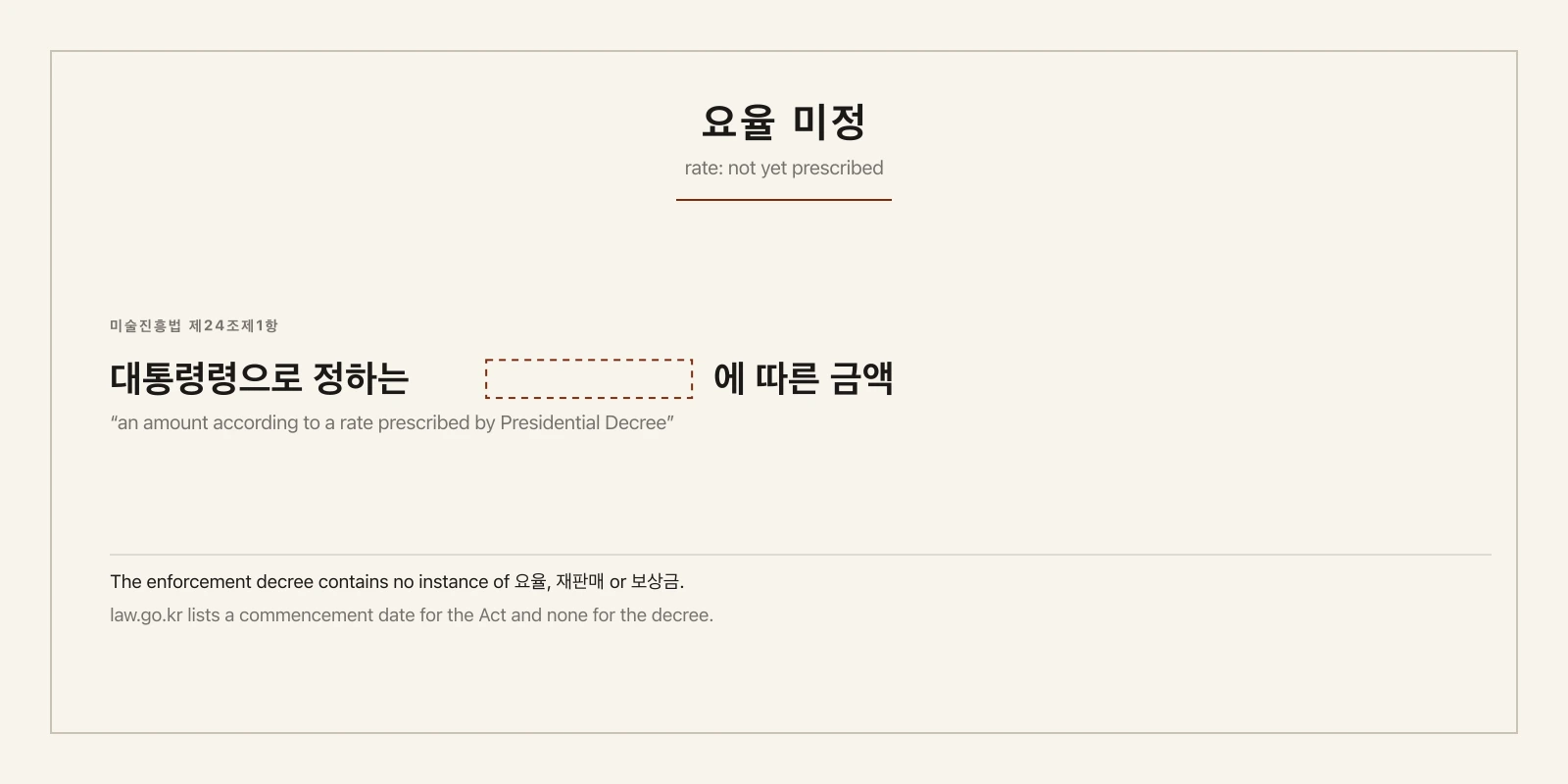
On 26 July 2027, Korean artists acquire a right they have never had: a claim on the money when their work is resold. It is called the 재판매보상청구권, and it is created by 제24조 of the 미술진흥법, the Art Promotion Act.
Here is what 제24조① says the artist may claim:
"해당 매도인에게 대통령령으로 정하는 요율에 따른 금액을 청구할 권리"
"the right to claim from that seller an amount according to a rate prescribed by Presidential Decree."
There is no such decree. We checked the current consolidated text of the enforcement decree — promulgated 24 July 2026, in force from the 26th — and it contains not one instance of 요율, 재판매, or 보상금. We checked law.go.kr's forthcoming-provisions index: the Act itself carries a scheduled-commencement entry for 20270726, and the decree carries no forthcoming entry at all. Nothing is drafted and waiting.
Ten months out from a right switching on, nobody has said what it is worth.
It is two blanks, not one
Read 제24조① again, in full, and count the gaps:
"작가는 대통령령으로 정하는 미술품의 소유권이 작가로부터 최초로 이전된 이후에 화랑업, 미술품 경매업, 미술품 자문업 또는 미술품 대여·판매업을 하는 자가 매도인, 매수인 또는 중개인으로 개입하여 해당 미술품이 재판매되는 경우에는 해당 매도인에게 대통령령으로 정하는 요율에 따른 금액을 청구할 권리…"
대통령령으로 정하는 미술품 — artworks prescribed by Presidential Decree. The statute has not said which artworks the right covers.
대통령령으로 정하는 요율 — a rate prescribed by Presidential Decree. It has not said how much.
So the law creates a right, and defers both what it applies to and what it is worth. A third gap sits one article along: 제25조 requires the right to be exercised through a designated collecting body, which then sets its own terms.
What the statute does specify is the exemptions, precisely. No claim where the resale price is under ₩5 million. None on works made for hire under 저작권법 제9조. None where the seller bought directly from the artist and resells within three years at under ₩20 million. The carve-outs are drafted to the won. The entitlement is a blank.
That asymmetry is the piece. It tells you which parts of this law somebody fought over.
The clause that gives the game away
Now put two sentences side by side.
미술진흥법 제24조②, on how long the resale right lasts:
"작가가 생존하는 동안과 사망한 후 30년간 존속한다."
저작권법 제39조①, on how long copyright lasts:
"저작자가 생존하는 동안과 사망한 후 70년간 존속한다."
Same construction. Same verb. Same shape. One number changed.
The drafters had the copyright term clause in front of them, copied it, and wrote thirty where the law everywhere else in Korea says seventy.
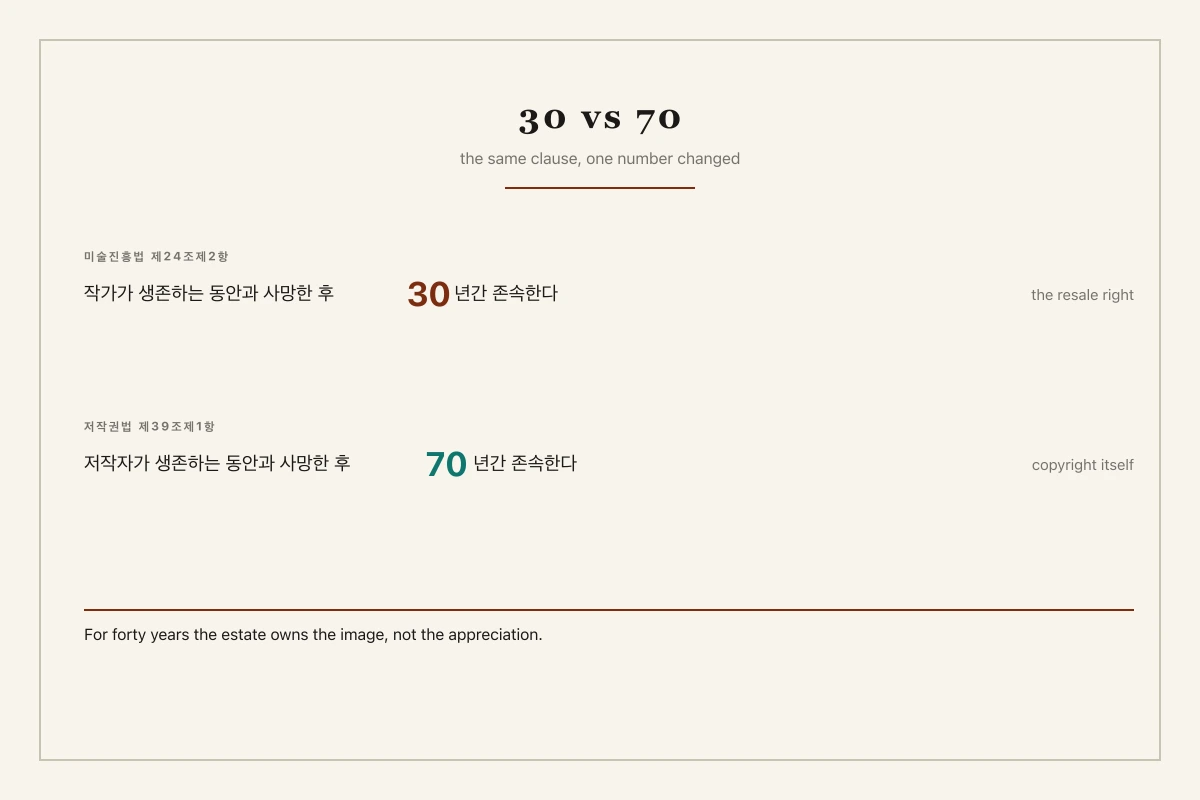
The consequence is concrete and slightly absurd. An artist dies in 2030. Until 2060, their heirs can claim a percentage of resales. From 2060 to 2100, they still control reproduction of the work — they can license posters, catalogues, merchandise, a museum's photographs — but the painting itself can be sold and resold at any price and they get nothing. For forty years the estate owns the image and not the object's appreciation, which is exactly backwards from the thing the right was invented to fix.
No English-language source we found makes this comparison. It is not hidden; it is just two statutes that nobody has laid next to each other.
The rollout already told us how this goes
Phase one of the Act is live. Since 26 July 2026, six categories of art business must register with a local authority — galleries, auction houses, advisories, rental-and-sale businesses, authentication services and exhibition businesses — with a fine of up to ₩5 million for trading unregistered.
Two details from the primary record are worth having.
The rule telling businesses how to register was promulgated on 27 July 2026 — and backdated to the 26th. Its 부칙 reads: 이 규칙은 2026년 7월 26일부터 시행한다. The instructions arrived the day after the obligation did.
And in the National Assembly, 김재원 put the preparation like this, as reported by 뉴스1 on 22 July:
"26일 시행인데 23일에야 온라인 설명회 1회."
"It takes effect on the 26th, and there was a single online briefing on the 23rd."
There is also a mismatch inside the registration scheme itself. Six trades must register and carry the fine exposure. But only four of them — 화랑업, 미술품 경매업, 미술품 자문업, 미술품 대여·판매업 — appear in 제24조 as triggering the royalty. Authentication and exhibition businesses get the compliance burden with none of the mechanism attached.
If that is how the easy half went, the hard half — setting a number that takes money from dealers and gives it to artists — is not obviously in better hands.
What the number would have to be
There is a benchmark, because Korea copied this law from somewhere. The EU's resale right, and the UK's after it, runs on a sliding scale: 4 per cent on the first tranche, then 3, 1, 0.5 and 0.25 per cent, with a hard cap of €12,500 (£12,500 in Britain) and a threshold around £1,000.
Korea's scope, carve-outs, reciprocity clause and collecting-society model all track that model closely. It diverged on precisely two things: it halved the term, and it left the rate empty.
The only figure in circulation for what Korea might choose — 1 to 2 per cent, capped at ₩15 million — comes from The Art Newspaper's reporting of a 2017 ministry study. We could not confirm it from any Korean source, and we are not going to launder a single English trade report into a fact. Treat it as one outlet's account of a nine-year-old study, which is all we can honestly say it is.
The honest case against, which deserves stating properly
The strongest argument against this right is not that dealers dislike it. It is that it may not do much.
Analysis by 미래산업전략연구소 put the entire national pot at ₩3.9–8.6 billion in the peak year of 2021, and only ₩1.4–2.6 billion for 2024 — against a Korean art market the culture ministry has valued at around ₩1 trillion. Under two per cent of the market, spread across the country's artists, and heavily concentrated on the names that trade at auction in the first place.
A resale right pays the artists whose work already resells. The artist who has never had a secondary sale gets a right worth precisely nothing.
And there is a live cautionary example in the region. The Philippines has had a resale right since 1998 — 5 per cent, under section 200 of its intellectual property code — and it collects, by most accounts, almost nothing, because no functioning collecting body was ever built around it. A right with a number but no infrastructure turns out to be a right on paper. (Which is also why "Asia's first" is a claim to avoid: Korea is not. Japan and China have no such right, and China dropped it from draft amendments after trade opposition.)
Kathleen Kim, quoted in The Art Newspaper, puts the whole problem in one line that cuts in favour of the law's critics and its supporters equally: this will be decided not by the text of the law but by the execution infrastructure.
One thing we are not going to say
It would be satisfying to write that Korea is a decade late on a treaty obligation. The Korea–EU free trade agreement, Article 10.10, is usually invoked for this, and at least one resale-rights advocacy site states that the FTA required both signatories to have the right in place within two years.
That is not what it says. The article commits the parties to enter into consultations to review the desirability and feasibility of introducing a resale right in Korea. Three hedges deep, no obligation to introduce anything, and pointed in one direction only.
So we will not run the "treaty deadline missed" line. But there is a better observation sitting underneath it, and it is true: the FTA asked Korea to study the feasibility of a resale right. Korea has now legislated one, thirteen years later — and the feasibility question the treaty actually posed, what rate would work, is the exact question still sitting blank in 제24조.
They skipped to the answer and left the working out.
What should happen
Set the rate now, and publish the draft decree for consultation while there is still time to argue about it.
Ten months sounds like a lot. It is not, for a decree that has to survive a legislative-notice period, ministry review and Cabinet, and that has to be understood by every gallery in the country before it binds them. On the evidence of phase one — a filing rule backdated by a day, one online briefing three days before commencement — the realistic drafting window closes early next year.
The alternative is a right that arrives on schedule with a number nobody has had a chance to contest, or a right that arrives without one. Neither is what an artist was promised.
The Act is called the Art Promotion Act. Promotion, in the end, is a number. Korea has written everything around it.
Sources. All statutory text is quoted from the current consolidated versions at 국가법령정보센터 — 미술진흥법 제24조 and 제25조, its enforcement decree as promulgated 24 July 2026, its enforcement rule and that rule's 부칙, and 저작권법 제39조① for the comparison. We pulled and read these ourselves rather than relying on a summary, and we did not use a third-party mirror: Korean Wikisource carries superseded texts and has burned us before. The absence of a rate is stated on three independent checks — the live decree contains no instance of 요율, 재판매 or 보상금; law.go.kr's forthcoming-provisions index has a scheduled-commencement row for the Act and none for the decree; and the only 2026 legislative notice from 문체부 concerns 제18조 filing procedure. The rollout criticism is from 뉴스1, 22 July 2026. The market analysis is 미래산업전략연구소's. The EU and UK scales are from EUR-Lex and DACS. The Philippine right is section 200 of RA 8293.
Flagged rather than smoothed. The "1–2 per cent, capped at ₩15 million" figure is The Art Newspaper's reporting of a 2017 ministry study and we could not confirm it from any Korean source — it is attributed in the text for that reason and should not be repeated as Korea's proposal. A legislative notice could appear any week, which would date this piece's central claim; it had not as of 11 September 2026. We do not say Korea is Asia's first — the Philippines preceded it by twenty-eight years. And we do not say the FTA imposed a deadline, because it did not; a widely-cited advocacy page saying otherwise is simply wrong, and the commencement date has been misreported elsewhere as 26 June 2027 by counting four years from the Assembly vote rather than from promulgation on 25 July 2023.
Images. There are no photographs, and there could not be: every artwork in the story is in copyright, art fairs and galleries are interiors, and press images of either are not licensed to us by being downloadable. Statutes, however, are state works under 저작권법 제7조 and free to reproduce. So the artwork is the law itself — the two near-identical clauses set side by side with the numbers picked out, and the blank where the rate should be. The one exception is the listing thumbnail, an AI illustration (generated with Higgsfield, GPT Image 2.5) of a blank canvas leaving an auction room; it depicts no real artwork, sale or artist.
Keep Reading
More Stories
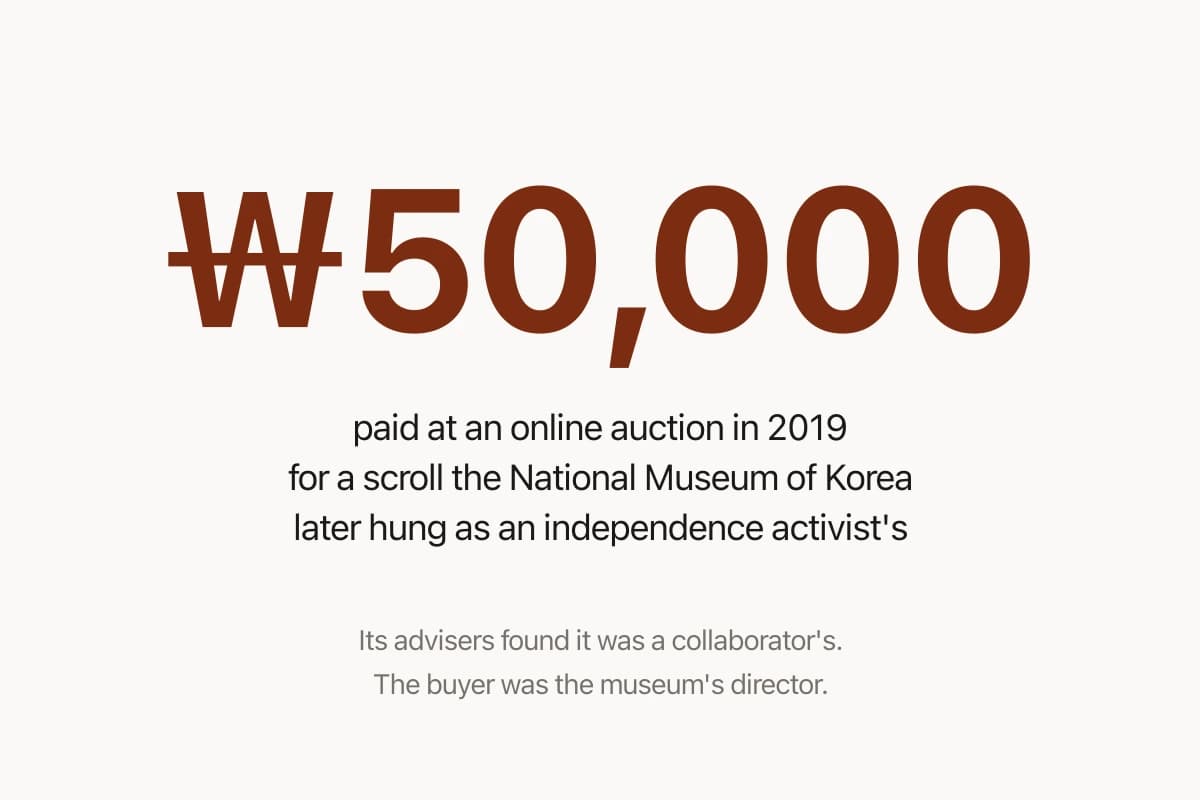
Korea's National Museum Showed a Patriot's Calligraphy. It Was a Collaborator's — and It Belonged to the Director
This summer the National Museum of Korea showed a scroll signed 韓人 朴源根 as the work of an independence activist killed in 1950. Seven advisers traced it to 박중양, one of the best-known collaborators of the colonial era. In October the Assembly learned whose scroll it was: the museum's director, 유홍준, had bought it online in 2019 for ₩50,000. Two days after the audit, the director resigned.
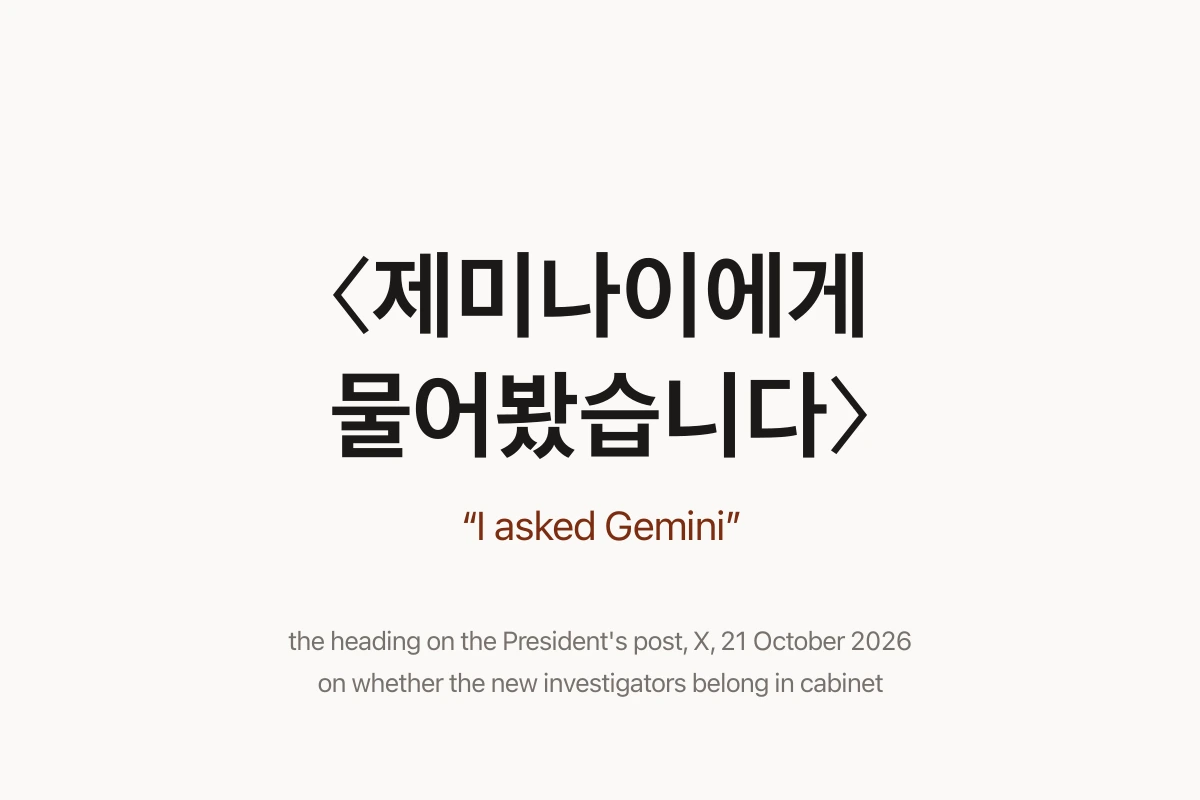
Korea's President Answered the Critics With a Chatbot. The Answer Got the Rule Wrong
On 21 October 이재명 posted a block of text on X under the heading 〈제미나이에게 물어봤습니다〉 — I asked Gemini. It argued that the head of the new Serious Crimes Investigation Agency belongs at the cabinet table. The opposition had a field day. The President said the point was to show how elementary the critics' case was. The rules do allow it, but not for the reasons the post gave.

A Portmanteau Walks into a Party: In Defence of the Koreaboo
The word 'koreaboo' travels fast and lands hard — but nobody can define it, nobody who matters invented it, and it applies, with suspicious consistency, almost only to East Asian cultures. Drawing on the Francophile, the Anglophile, and a 1,555-day Duolingo streak, a guest essay on the double standard that calls Western cultural enthusiasm personality and Korean cultural enthusiasm a phase.
The Weekly Dispatch
Korea, curated. Every week.
The best of K-culture, straight from Seoul. Written by people who actually live here.
Free, no spam, unsubscribe whenever.