Korea's Parliament Has Ordered an Investigation Into the Prosecutions of Its Own President. Each Side Has a Word for It
On 6 November the National Assembly voted 167–1, with the opposition not taking part, for a special counsel to examine twelve cases from earlier governments, six of them tied to President 이재명. The Democrats say Yoon-era agencies fabricated those cases. The People Power Party calls the law a jailbreak. The President will choose the counsel. The clause that would have let the counsel drop charges is gone; whether charges can still be dropped is the question nobody can yet settle.
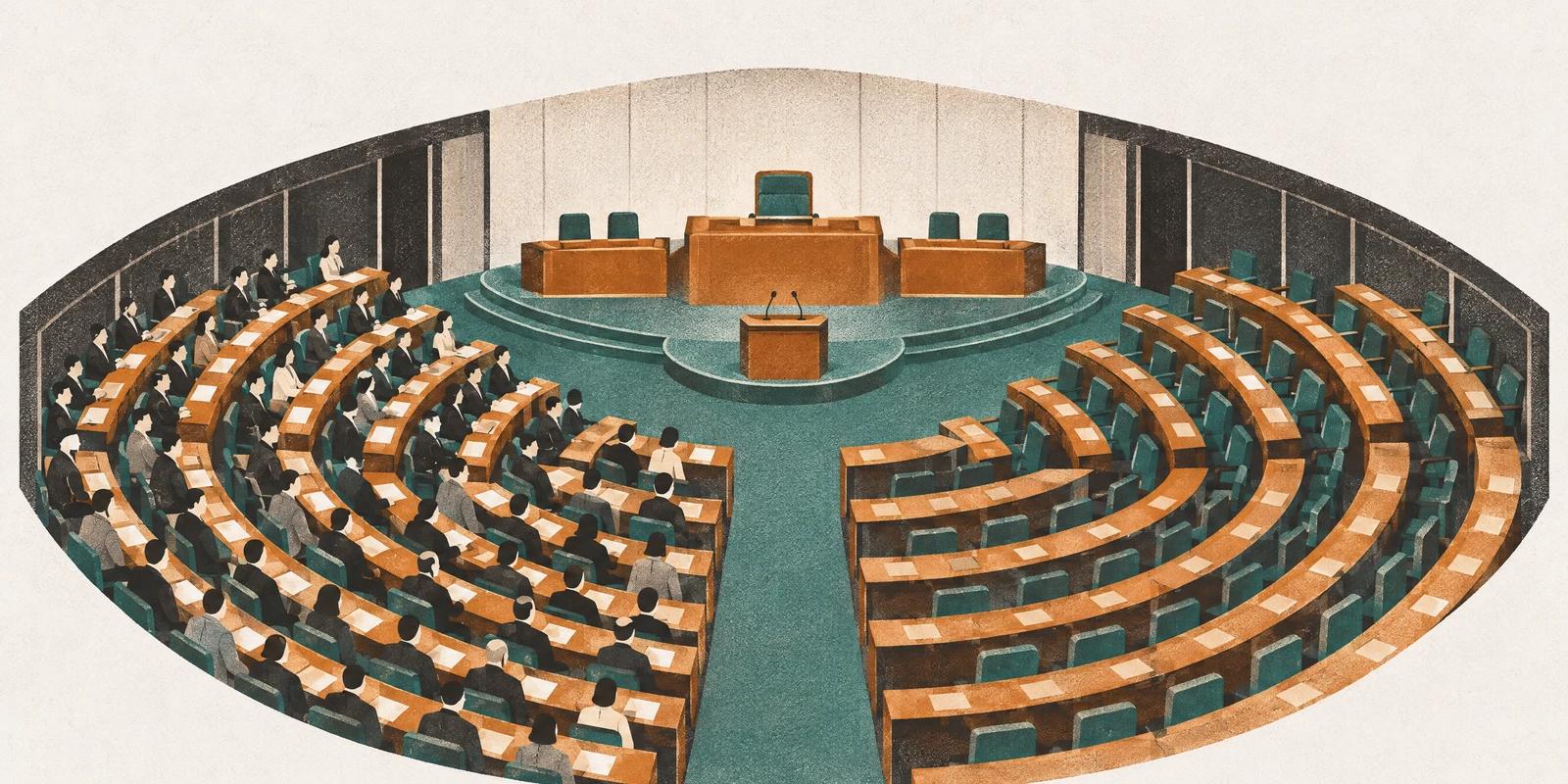
The filibuster ended after twenty-four hours, and on Friday 6 November the National Assembly voted. Of 299 members, 168 were present. A hundred and sixty-seven voted in favour. The single vote against came from 이주영 of the small 개혁신당. The People Power Party did not take part.
The law they passed has a long official name, which 연합뉴스 gives as an act to appoint a special counsel to uncover the truth of alleged fabricated investigations and indictments by the prosecution service, the National Intelligence Service, the Board of Audit and other state bodies under the 윤석열 government. Its supporters call it by that word, 조작기소, fabricated indictment. Its opponents call it the 탈옥법, the jailbreak act.
Neither word is a finding. We found no court ruling that the President's indictments were fabricated, and no evidence yet that the law will end the President's trials. It came into force on 19 November (see the updates below).
What it does
The counsel would examine how twelve matters were investigated and charged, rather than whether anyone was guilty.
Six are tied to President 이재명: the 대장동, 위례 and 백현동 breach-of-trust case; the 대장동 and 백현동 election-law case; the subornation of perjury case involving 김진성; the 쌍방울 remittances to North Korea; the 성남FC sponsorship bribery case; and the 경기도 corporate-card case. One concerns allegedly false reporting meant to defame 윤석열. Five date from the 문재인 government: the statistics case, the killing of a fisheries official in the West Sea together with the repatriation of North Korean fishermen, the job given to the former President's son-in-law, the THAAD leak and the 월성 reactor. 더팩트 reports that those were added partly to answer the charge that the law served one man.
The Democrats, the People Power Party and 조국혁신당 each recommend a candidate, and the President picks one of the three. The counsel gets eight deputies, seventy investigators, twenty seconded prosecutors and up to 210 other officials, 309 people in all, for up to 200 days including twenty of preparation. It is the seventh special counsel of this government. The Assembly's budget office estimated ₩38.056 billion, on an earlier and differently staffed draft.
A supplementary clause applies the old Criminal Procedure Act, so the seconded prosecutors keep investigative powers abolished for other prosecutors on 2 October. The acting justice minister wanted the number reviewed.
The clause that went
The April bill would have let the counsel take over cases already in court and decide whether to maintain them. That would have put the President's own appointee in charge of the President's own prosecutions. On 18 September the President asked the Assembly to delete the provision on transferring and disposing of indicted cases, and on 4 November the judiciary committee passed a text without it.
The Democrats treat that as the end of the argument. The floor leader, 한병도, says the withdrawal and transfer powers are gone, and 박주민 puts the chance of the counsel withdrawing a case at zero.
The opposition says there are other doors, and the text leaves room to ask. Article 6 keeps a power to maintain prosecutions, and 아시아경제's reading is that whether the counsel could directly withdraw a case the 공소청 is running has to be examined separately. Separately, a revised article 327 of the Criminal Procedure Act adds grounds for dismissing a case for seriously unlawful investigation or gross abuse of charging discretion, though courts are not bound by anything a counsel concludes. The People Power Party's 박형수 argues that charges can go through defence motions or a justice minister's order. The ministry's acting head, 이진수, has said the former minister made clear there was no intention of ordering withdrawal through case direction. 이용철, who faces a confirmation hearing, declined to commit either way.
Where the cases stand matters here. All of the President's trials have been halted since the inauguration, on a reading of article 84 of the Constitution, which shields a sitting president from criminal prosecution. The 대장동 group, 성남FC and the remittance case are at first instance, where withdrawal remains legally possible. The election-law case is at the Seoul High Court after a Supreme Court remand, and there it is not. The Seoul High Court's chief judge reportedly said in October that resuming is for each bench to decide.
What each side says
The Democrats say the 윤석열 government turned prosecutors, spies and auditors on its rivals. 서영교 dismisses talk of a conflict of interest as nonsense. 김한규 argues that the President already directs other investigative chiefs, so a counsel would be more independent than they are.
The opposition's leader, 장동혁, says that going ahead means starting impeachment and a drive to resume the trials. 정점식 calls the indictments fully legitimate, says a constitutional complaint is under review, and says signing will hasten the government's end. 주진우 says a law under which the ruling party recommends and the President appoints is a plain conflict of interest.
Doubts on the President's own side are worth noting. 조국 has said that applying the superseded Act raises constitutional problems. The former justice minister 정성호 accepted that past investigations went too far but questioned the word "fabrication", and warned of side effects if the probe finds nothing.
Legal voices divide in familiar ways, with less heat. 한상희 of 건국대 says any presidential role in the appointment leaves room for conflict. 차진아 of 고려대 expects courts to come under pressure to end the trials. 이근우 of 가천대 points out that the seconded prosecutors could themselves be exposed under the offence of distorting the law, 법왜곡죄. The lawyer 양홍석 says that cross-party agreement on the candidates would have avoided the problem. Four lawyers' and professors' groups critical of the law issued a joint statement calling it effectively a private counsel. 뉴스타파 has argued for the investigation, as advocacy.
The streets and the polls
The People Power Party claimed 150,000 people at its rally near 경복궁 on 7 November; the police provisional figure was about 6,000. Its judiciary-committee members have announced a boycott of that committee's sittings.
| Poll | Fieldwork | Approve | Disapprove | Democrats | People Power |
|---|---|---|---|---|---|
| Realmeter, automated | 2–6 Nov (party figures 5–6 Nov) | 35.9% | 60.6% | 36.5% | 39.7% |
| Gallup, live interviewers | 3–5 Nov | 41% | 50% | 36% | 28% |
Realmeter put the confrontation over the bill first in explaining the slide, followed by market turmoil. Gallup's fieldwork ended before final passage, and the two disagree on which party leads. We found no poll on the final law.
Update, 11 November: not on the 10 November agenda
The Cabinet did not take up the law on 10 November. The presidential office said the bill arrived from the Assembly on the afternoon of 6 November, after that week's agenda was set, and that listing it was not mandatory in any case. It is now expected at the meeting of Tuesday 17 November, and 경향신문 and TV조선 report that Prime Minister 한성숙 may chair it, so that the President does not preside over a law about the President's own cases. The People Power Party calls that a dodge, held meetings outside 청와대 on 9 and 10 November, and is demanding a veto. As of 11 November the law had not been promulgated, and no counsel candidate had been requested.
Two gaps in our first version can now be partly filled. Under article 3(5), as 경향신문, TV조선 and 디지털타임스 read it, if the President does not appoint within three days, the oldest of the recommended candidates is deemed appointed. And according to one outlet, 시대, a party that does not recommend within three days of the request is treated as having given up the right. That outlet also reports that the judiciary committee's own expert adviser warned on 4 November that letting the President's party recommend could conflict with the purpose of a special counsel. Both points rest on that single report.
Sources for this update: 경향신문, 뉴스1, MBN and TV조선 (11 November); 고코리아; 디지털타임스; 시대 (10 November); 국제신문 and 데일리안 (11 November).
Update, 19 November: passed by the Cabinet, now in force
The Cabinet passed the law on Tuesday 17 November at a meeting chaired by Prime Minister 한성숙, with the President abroad for the ASEAN and APEC summits. There was no veto. The law was promulgated in the official gazette on 19 November and took effect the same day, according to 연합뉴스, 조선일보, 아이뉴스24 and 법률신문. When the President approved it is disputed: 조선일보 reports approval on the afternoon of 17 November, in the Philippines, while the presidential office told 연합뉴스 that the time could not be confirmed, and denied a report that publication had been held back. 연합뉴스 reported that the steps to recommend a counsel were still to come.
Sources for this update: 연합뉴스, 조선일보, 아이뉴스24 and 법률신문.
What it says
There is a respectable case for looking at how these prosecutions were built. Korean prosecutors have long been accused of serving whoever held power, and a government's opponents are the people most likely to have been on the receiving end. Removing the withdrawal clause was also a real concession, and it was the President who asked for it.
But the design leaves the basic problem where it was. The person with the most to gain from a finding of fabrication chooses who looks for it, from a list on which the ruling party has a name. Nothing required that. As 양홍석 says, the parties could have been made to agree on a candidate, and a law with that clause would have been much harder to call a jailbreak.
Two things will show what this law is for. One is who gets picked. The other is what happens next to the cases at first instance, where the door everyone says is closed is still, legally, on the latch.
Images. The cover, listing and homepage images are AI illustrations (generated with Higgsfield, GPT Image 2.6): a parliamentary chamber with one side's seats empty, case files beside a gavel, and a balance with a file on one pan. The figures are not portraits of anyone. We found no recent, freely licensed photograph of the vote.
Sources. The vote and the debate are from 연합뉴스, 더팩트, 뉴스토마토 and 오마이뉴스; the scope, powers and staffing from 연합뉴스, 아시아경제, 더팩트 and 재경일보; the cost from 연합뉴스. The bill's history is from the Assembly's bill database, 연합뉴스 and 뉴스토마토. The legal questions are from 아시아경제, 법률방송 and 한국경제. The politicians' positions are from 연합뉴스, SBS, 뉴스토마토, 법률방송, 오마이뉴스, JKN and 한국경제; the academics from 경북매일, 법률방송 and 서울신문; the joint statement from 한국일보. The rally from 파이낸셜뉴스. Polling from Realmeter via 한국경제 and 국제뉴스, and Gallup via 경북매일.
Stated rather than smoothed. We could not retrieve the final amended text of the bill, so clause references come from press readings of it, and the official title should be checked at promulgation. We have found no statement that the President will step back from the appointment itself. The exact stage of the corporate-card case could not be established. That the first-instance acquittal closes off withdrawal in the perjury case is our own inference from article 255, so we have left it out of the text. The forfeit rule if the People Power Party declines to recommend, and the adviser's report of 4 November, rest on 시대 alone. "Fabricated" is the Democrats' word and "jailbreak" is the opposition's.
Keep Reading
More Stories

김건희's Four-Year Sentence Is Final, and So Is the Acquittal Over 명태균's Polls
On 19 November the Supreme Court's full bench upheld 김건희's convictions over Deutsche Motors shares and Unification Church gifts, making four years in prison and a ₩50 million fine final. It also upheld the acquittal over 명태균's polls, by 10 votes to 2. Many Korean headlines carried that acquittal. 연합뉴스's English headline left it out.

A Forged Tally Sheet Is an Alleged Crime. It Is Not a Stolen Election
On 10 November Korea's election special counsel raided two election commissions over a tally sheet for one polling station. The counsel itself says the result and the winner were unchanged. The opposition leader 장동혁 says the count was stolen. The record supports a serious investigation, and not that claim.
Supreme Court Sets Aside 한덕수's 15-Year Term but Finds Insurrection After Martial Law Was Declared
On 19 November the full bench sent 한덕수's case back to the Seoul High Court, which will set a new sentence. Urging a cabinet meeting before martial law was declared could not be proven to be insurrection, it held; what 한덕수 did after the declaration was, and the false-document and perjury convictions stand. Detention was renewed, so there was no release. The ruling, the dissent, and how the case got there.
The Weekly Dispatch
Korea, curated. Every week.
The best of K-culture, straight from Seoul. Written by people who actually live here.
Free, no spam, unsubscribe whenever.