Korea's President Fought a Newspaper Over the Word 'Much.' Then a Forum Post Set Off a Review of Help for Multicultural Mothers
At cabinet on 27 October, 이재명 said foreign workers were not much help to the economy because they send their wages home. When 한겨레's headline left out the word 'much', the President demanded a correction. The next day the President shared a post from the online forum 에펨코리아 about multicultural mothers' priority at Seoul-subsidised postpartum centres, and the government began reviewing the rule. Ten of the centres' 361 users had been multicultural.

On the morning of Tuesday 27 October, at the 46th cabinet meeting, the talk turned to farms. The countryside is short of hands for farming, livestock and fishing — industries the President called "국가안보전략산업", strategic industries for national security — and President 이재명 had an idea. The state could add a sizeable sum to farm wages when farms hired Koreans. "한 6개월 해서 한 달에 500만 원씩 하면 살 수도 있을 것 같다", the President said, by 서울경제's account: if it were about six months at ₩5 million a month, people could live on that. The agriculture minister, 송미령, said a plan like that would help a lot.
On the way there came the sentence that ran for four days. Outlets transcribe it slightly differently; three agree on this core:
"외국인 노동자들을 불러다가 해도 국가 경제에 크게 도움이 안 되고 전부 다 송금해 버리니까…"
Even if we bring in foreign workers to do it, it isn't much help to the national economy, and they send all of it home…
The word
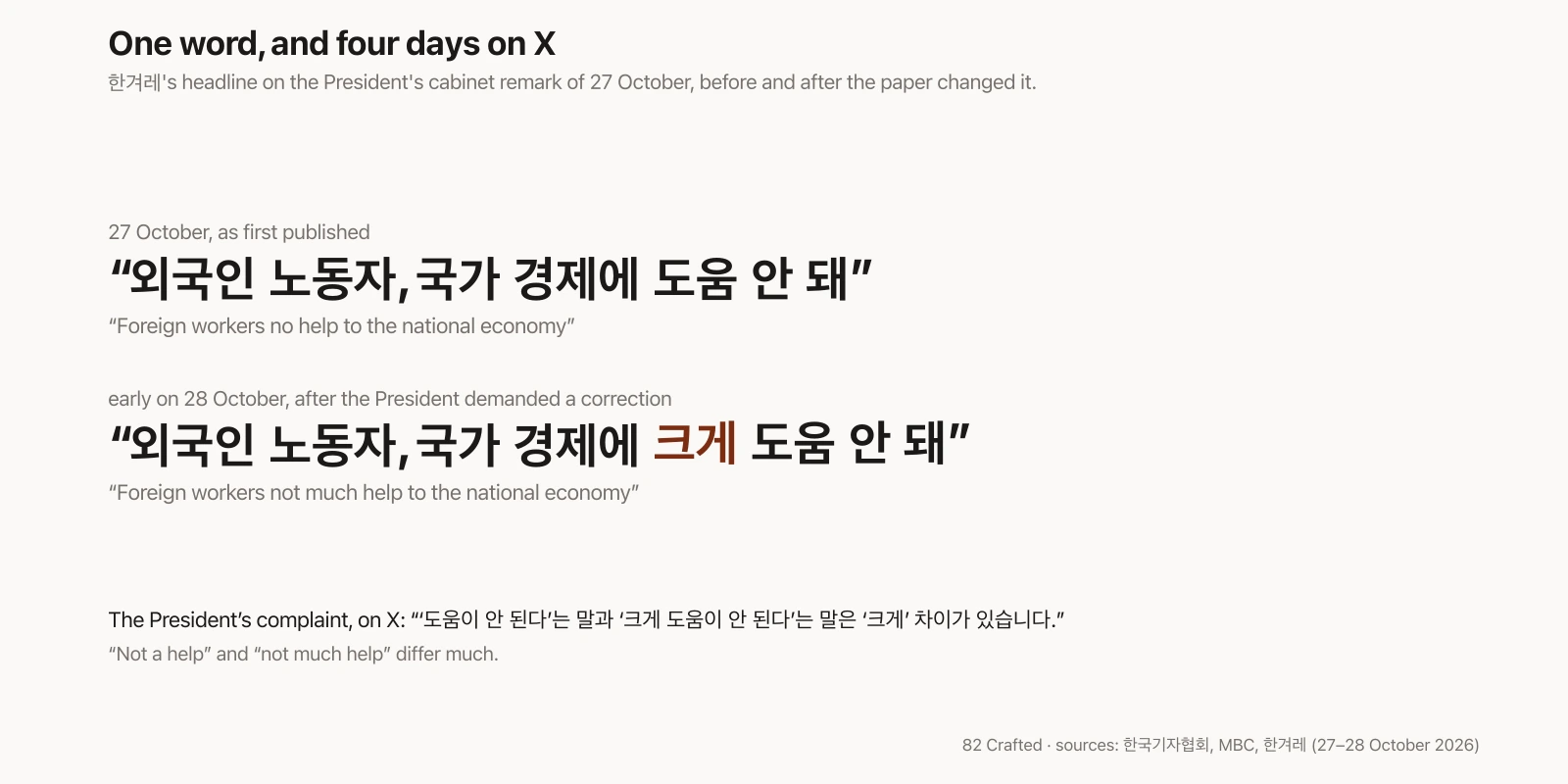
On 27 October 한겨레 ran the story under a headline that quoted the President as saying foreign workers were "국가 경제에 도움 안 돼" — no help to the national economy. It left out 크게: much.
That night the President wrote on X: "'도움이 안 된다'는 말과 '크게 도움이 안 된다'는 말은 '크게' 차이가 있습니다. 같은 기사의 본문 내용과 제목 내용이 다릅니다. 정론직필 하고자 하는 언론일 것이니 기사 정정하시고 사과하실 것으로 믿습니다." "Not a help" and "not much help" differ much. The body of the article and its headline say different things. As a paper that wants to report truly, I trust you will correct the article and apologise. In another post the President called the remark "비교화법", a comparison: foreign workers help, the President wrote, but not "much", compared with Korean workers.
In the early hours of 28 October, 한겨레 added the word. That morning the President posted again: "기사 제목을 바꿨으면 왜 바꿨는지 밝히고 기사를 고칠 만큼 잘못 했으면 사과하는 게 맞지 않을까요?" — if you changed the headline, shouldn't you say why, and apologise if it was wrong enough to fix? MBC reported a further line: "'짜장면 좋다는 건 짬뽕 폄훼' 시대가 도래하고 있다" — we are entering an age in which saying you like jajangmyeon means you are insulting jjamppong.
The paper's own union branch told the President to apologise to migrant workers first, and criticised its newsroom's handling of the headline. The President's fiscal-planning aide, 류덕현, wrote that "앞뒤 맥락을 자르고 외국인 혐오 논란으로 이어지는 것은 적절하지 않다" — cutting the context and turning it into a row about xenophobia is not appropriate — and that "외국인 노동자들의 기여는 분명하다", foreign workers' contribution is clear.
What the numbers say
The best figures on what foreign residents do with their money come from the government's own 2025 survey of immigrants' residence and employment, the 이민자체류실태및고용조사. Of their income, 25.5% went on remittances — and that counts money sent within Korea as well as abroad. 37.3% went on living costs, 15.4% into savings and 11.9% on housing. For workers on E-9 general-employment visas the remittance share is higher, 56.5%, again including transfers within Korea. 오마이뉴스's fact-check rated the President's remark "대체로 거짓", mostly false, because it "송금 규모를 과장하고… 중요 효과를 누락했다" — exaggerates the scale of remittances and leaves out important effects.
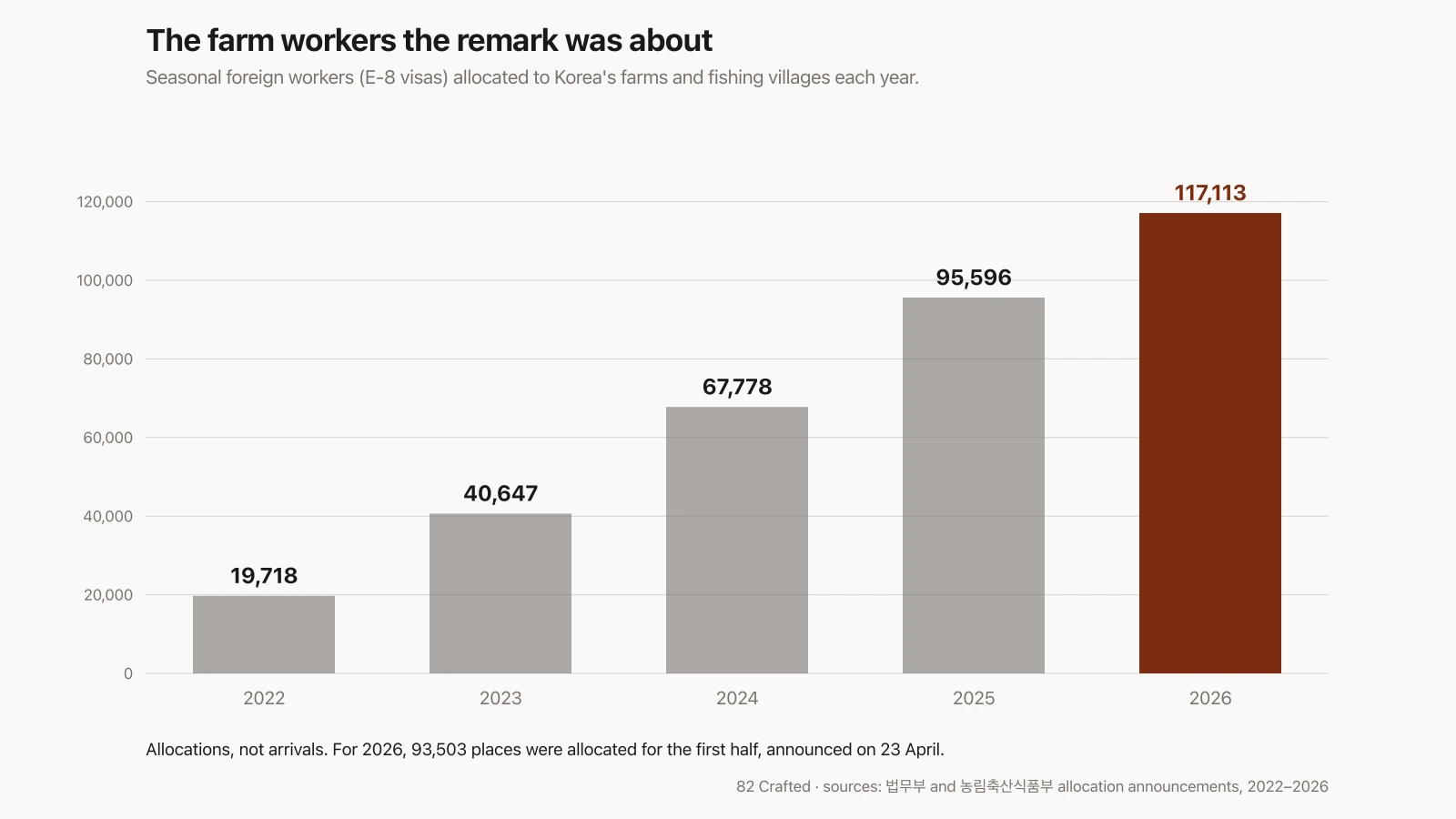
And the farms the President was talking about increasingly run on them. Allocations of seasonal foreign workers, on E-8 visas, have risen from 19,718 in 2022 to 117,113 this year, by the justice and agriculture ministries' figures; 93,503 places were allocated for the first half of 2026 alone. Korea had 1.109 million employed foreign residents aged fifteen and over in May 2025.
The sharpest reaction came from the left. The Justice Party said: "가족에게 생활비를 보낸다는 이유로 기여를 평가절하하다니, 대통령의 인식이 참담하기 그지없다" — to belittle their contribution because they send living money to their families: the President's view is utterly dismal. The Progressive Party's spokesperson, 홍성규, said it was "이주노동자들에 대한 혐오 발언임도 맞습니다", hate speech against migrant workers; the KCTU union federation called it "명백한 혐오 발언", clear hate speech. 경향신문's editorial was more careful: "의도와 무관하게 자칫 외국인 노동자에 대한 혐오를 자극할 수 있다는 점에서 우려스럽다" — worrying because, whatever the intent, it could stoke hatred of foreign workers.
The post
On the afternoon of 28 October the President shared a post from 에펨코리아, an online forum. Its title: "지금 민심 안 좋은 국가 유공자, 유가족들하고 동급인 다문화 산모 산후조리원 입실순위" — public mood is bad: a postpartum-centre admission ranking that puts multicultural mothers on a par with national-merit holders and bereaved families.
The President added:
"서울시 등 지방 정부들이 다문화 가족을 우대하는 제도가 문제가 되고 있다… 다문화 가족들이 피해를 입지 않는 것을 넘어 우대까지 할 필요성이 큰지, 우대제도 폐지가 필요한 지 등에 대해 지방정부와 협의는 물론 시행령 개정까지 포함해 깊이 검토해 보겠다."
Schemes in which Seoul and other local governments give multicultural families preferential treatment are becoming a problem… We will look deeply, consulting local governments and including revising the decree, at whether it is really necessary to go beyond protecting multicultural families from harm to favouring them, and whether the preference needs to be abolished.
To the poster: "좋은 지적 감사하다" — thanks for a good point. To a critic: "누가 하든 좋은 지적은 좋은 지적이고 네 편 내 편을 떠나 잘못은 시정해야 한다" — a good point is a good point whoever makes it, and a wrong must be put right whichever side you are on.
What the rule actually is
The post was about the 서울형 안심 산후조리원, a one-year pilot that runs from June 2026 to May 2027. Despite how it has been described, these are not public centres. Seoul designates and subsidises five private postpartum centres, in 양천, 강서, 도봉, 강동 and 금천, for mothers who have lived in the city for at least a year. (The city's two actual public centres, in 송파 and 서대문, are a separate scheme.) Places are allocated in four tiers:
| Tier | Who | Pays for two weeks (standard fee ₩3.9m) |
|---|---|---|
| 1 | Basic-livelihood recipients and the near-poor | nothing |
| 2 | 5·18 merit holders and families; national-merit holders and families; North Korean defectors; multicultural-family mothers; disabled mothers; single parents; mothers of triplets; mothers of a third child or more | ₩1.25m |
| 3 | Mothers of twins or a second child | ₩2.5m |
| 4 | Everyone else | ₩2.5m |
So multicultural mothers do share a tier with families of national merit — and with six other groups.
How many of them have used it? From June to September, 361 mothers went through the centres. About ten were from multicultural families: 2.8%, by 한겨레's figure.
The national rule behind it is a schedule to the decree under the Mother and Child Health Act, the 모자보건법 시행령. It dates from June 2016 and, as 한국일보 puts it, lets local governments give priority or discounts to listed groups, rather than requiring them to. 국민일보 checked 36 local governments with ordinances for public postpartum centres; 35 include multicultural mothers. 한국일보 also reported that in 2015, as mayor of Seongnam, 이재명 put multicultural families on the priority list for that city's public centre.
Since
On 29 October the presidential office's population-policy secretary, 임호근, said the schedule "10년 전(2016년 6월)에 마련된 규정" was a rule made ten years ago, and that "정부는 지방정부와 현장의 다양한 목소리를 경청해 '모자보건법 시행령 개정'을 검토하겠다" — the government will listen to local governments and the field and consider revising the decree. The senior spokesperson, 강유정, asked people, according to 중앙일보, to weigh the context and gist rather than particular words.
The Seoul mayor, 오세훈 of the People Power Party, went further: "다른 국민들이 상대적으로 불이익을 받는다는 우려가 없도록 다문화가족 지원 제도를 전면 재검토하겠다" — we will review multicultural family support across the board, so that other citizens need not fear being put at a relative disadvantage. 오마이뉴스 called the mayor the President's "뜻밖의 우군", unexpected ally. The health minister, 정은경, wrote on X that the ministry would review the criteria, as 국민일보 reported.
The Justice Party's spokesperson, 김나율, said the President was "다문화가족을 향한 혐오에 대통령이 직접 힘을 실어주고 있는 꼴" — lending the President's own weight to hatred of multicultural families — and demanded a withdrawal and an apology. 조국혁신당's 임명희 hoped for "진심이 담긴 사과", a sincere apology, to multicultural families who may have been hurt. From the President's own party, 김영진, an early ally, said the President should take in a range of public opinion.
The President kept posting. On the 29th: "일부 정책이 본래 취지를 벗어난 과잉으로 특혜에 이르거나 내국인 가정에 대한 역차별이 되어서는 안 된다" — some policies must not go so far beyond their purpose that they become privileges, or reverse discrimination against Korean families. On the 30th: "가난이 문제라면 가난한 내국인가정과 동일하게 취급하면 된다" — if poverty is the issue, treat them the same as poor Korean families. On the 31st: "왜 시중에서 PC주의나 내로남불, 진영주의에 기반한 발언에 대해 반감을 가지는지도 생각해 보아야 한다" — we should also ask why people out there resent remarks based on political correctness, double standards and tribalism.
As of 31 October no draft amendment has been published. Any change to the decree needs at least forty days' public notice.
Update, 9 November: the counting begins
There is still no draft amendment to the decree, but the reviews have spread. The justice ministry asked local governments in late October to list their benefits for multicultural families, with replies due by 3 November. Seoul's first count found 26 schemes, 20 of them with no income test; 22 can be changed by local rule and four need a national change. 문화일보 reported that the city plans income tests and lower bonus points, to be settled by the end of the year. The education ministry began a survey of nursery-admission points on 2 November.
The President wrote on X on 1 November that fixing a flaw in a policy is not the same as shutting multicultural families out. 오세훈, an ally on this at first, said on 3 November that reordering priorities was reasonable, but that the run of posts was troubling at a time when rents needed attention.
Sources for this update: 연합뉴스 (5 November); 파이낸셜뉴스 (2 November); 문화일보 (30 October); SBS (2 November); 오마이뉴스 (3 November).
What it says
On the first fight the President had a point. The headline did leave out a word that the President had said, and the paper changed it. "Not much help" is not "no help".
But the correction does not rescue the claim. The government's own survey says three-quarters of what foreign residents earn is not remitted at all, and the remittance figure includes money sent within Korea. And the farms the President wants Koreans to work on at ₩5 million a month have been allocated 117,113 seasonal foreign workers this year, nearly six times the number of 2022. The remark set out to make the case for Korean workers, and on the way it priced foreign workers as a cost.
The second fight is about scale. A forum post on a pilot scheme at five private centres, used in four months by about ten multicultural mothers, became within a day a presidential review of a national decree, with abolition named as an option, and then three more days of posts about reverse discrimination and political correctness. The President's office asked for attention to the gist rather than the words. Taken together, the gist of four days was that help for migrants and multicultural families is a problem in need of review, from a President who, 한국일보 reports, had put those families on just such a list as a mayor. 이재명 said on X that a good point is a good point whoever makes it. The same goes for a bad one.
Images. The cover, listing and homepage images are AI illustrations (generated with Higgsfield, GPT Image 2.6): farm workers in a field at dawn, an adult's hand holding a newborn's, and a magnifying glass over one word in a newspaper. They depict no real person, farm or care centre. The two graphics in the text are ours: the headline wording as reported by the Journalists Association of Korea and MBC, and the allocations from the justice and agriculture ministries' announcements. We have not used the government's photographs of the cabinet meeting, which are not under a licence we can use.
Sources. The cabinet meeting is from 서울경제, 농민신문 and SBS; the headline and the President's posts on it from the Journalists Association of Korea (한국기자협회), MBC and 한겨레; the union and 류덕현 from 한겨레. The survey figures are from the 2025 이민자체류실태및고용조사 as reported by the Korea Herald and 오마이뉴스; the allocations from the justice and agriculture ministries; the fact-check from 오마이뉴스. Reactions are from 한국일보, SBS, 프레시안, 경향신문 and 한겨레. The forum post and the President's text are from 연합뉴스, 한국일보, 한겨레, 경향신문 and 위키트리. The scheme's rules are from Seoul city's own page; usage from 한겨레 and 한국일보; the decree and the ordinances from 뉴시스, 국민일보 and 한국일보. 임호근 is from 뉴시스 and 국민일보; 강유정 from 중앙일보; 오세훈 from 한겨레; the later posts from 한국일보, 위키트리 and 한겨레.
Stated rather than smoothed. We could not check the cabinet remark against the official video, so we have used the wording three outlets agree on. 한국일보 says remittances are over 70% for some seasonal workers; we found no source for that and have used the survey's figures instead. The ten mothers are 2.7% by 한국일보's arithmetic and 2.8% by 한겨레's. The health minister's post, 강유정's remark and the 2015 Seongnam policy each come from a single outlet, and are attributed. A claim that 한겨레 changed its headline without the reporter's knowledge comes from a politician's Facebook post and is not used. We have not characterised 에펨코리아 beyond calling it an online forum.
Keep Reading
More Stories

김건희's Four-Year Sentence Is Final, and So Is the Acquittal Over 명태균's Polls
On 19 November the Supreme Court's full bench upheld 김건희's convictions over Deutsche Motors shares and Unification Church gifts, making four years in prison and a ₩50 million fine final. It also upheld the acquittal over 명태균's polls, by 10 votes to 2. Many Korean headlines carried that acquittal. 연합뉴스's English headline left it out.

A Forged Tally Sheet Is an Alleged Crime. It Is Not a Stolen Election
On 10 November Korea's election special counsel raided two election commissions over a tally sheet for one polling station. The counsel itself says the result and the winner were unchanged. The opposition leader 장동혁 says the count was stolen. The record supports a serious investigation, and not that claim.
Supreme Court Sets Aside 한덕수's 15-Year Term but Finds Insurrection After Martial Law Was Declared
On 19 November the full bench sent 한덕수's case back to the Seoul High Court, which will set a new sentence. Urging a cabinet meeting before martial law was declared could not be proven to be insurrection, it held; what 한덕수 did after the declaration was, and the false-document and perjury convictions stand. Detention was renewed, so there was no release. The ruling, the dissent, and how the case got there.
The Weekly Dispatch
Korea, curated. Every week.
The best of K-culture, straight from Seoul. Written by people who actually live here.
Free, no spam, unsubscribe whenever.