Korea's Pros Lost 0–5 to Japan's Company-League Players, Then Beat Them 3–1 in the Rain for a Fifth Straight Asian Games Gold
Two days before the final, Korea's all-professional squad was shut out by a Japanese side of corporate-league employees, its first Asian Games loss to Japan in twenty years. Then it rained on Toyohashi with no reserve day, Gwak Bin threw 111 pitches through it, and Kim Do-young — a week after breaking his nose, hitting .250 for the tournament — chopped an infield single off the third baseman's glove in the eighth. Sixteen players walked off the field with their military service converted into 34 months of baseball. Korean coverage calls that an exemption. It isn't, and a former defence-committee lawmaker spent Monday arguing it shouldn't exist at all.
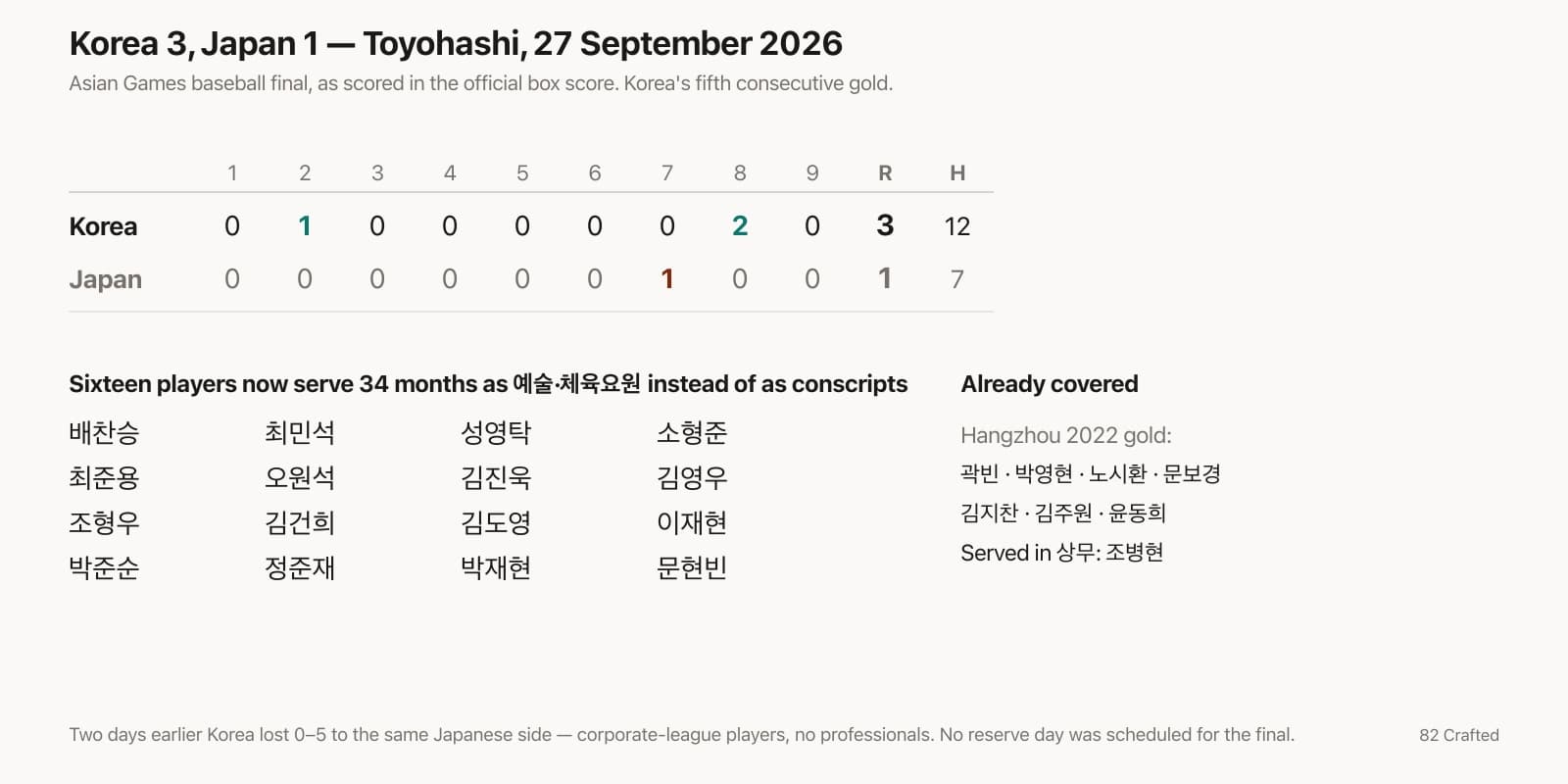
On the evening of Sunday 27 September, at the Toyohashi municipal ballpark in Aichi, the rain that had cancelled batting practice stopped just before first pitch, held off for six innings, and came back hard in the seventh. There was no reserve day. That mattered, because of what had happened on Friday.
On Friday, Korea had lost to Japan 0–5. Japan's team was made up entirely of corporate-league players — employees of Oji, NTT, Toyota, JR — and its starting pitcher, a 23-year-old named 樋口新 who is expected in this autumn's NPB draft, threw seven scoreless innings at a Korean line-up drawn from the KBO's best young professionals. It was Korea's first Asian Games defeat to Japan since Doha in 2006, and it left Japan at 3–0 in the Super Round and Korea at 2–1. If Sunday's final were rained off, 한겨레 worked out on the afternoon of the game, the medals would go on the table — silver for Korea. The organisers had never formally told the KBO that, and the two managers had agreed to play unless the rain became torrential. It didn't, quite.
Korea won 3–1. It is the country's fifth consecutive Asian Games baseball gold — 2010, 2014, 2018, 2022 (played in 2023) and now 2026 — and its seventh in the nine tournaments held. Sixteen of the twenty-four players will not now do ordinary military service.
How the game was won
A line score first, because the shape of it is the story:
| 1 | 2 | 3 | 4 | 5 | 6 | 7 | 8 | 9 | R | H | |
|---|---|---|---|---|---|---|---|---|---|---|---|
| Korea | 0 | 1 | 0 | 0 | 0 | 0 | 0 | 2 | 0 | 3 | 12 |
| Japan | 0 | 0 | 0 | 0 | 0 | 0 | 1 | 0 | 0 | 1 | 7 |
Twelve hits for three runs, and a dozen runners left on base. Korea led from the second inning, when 윤동희 doubled to open it and 문현빈 — after a failed bunt — singled to left-centre to bring him home. Then it did not score again for six innings.
It held because of 곽빈. The 두산 starter, one of three over-age wildcards on the roster, had thrown six no-hit innings against Chinese Taipei in the opening game a week earlier; on Sunday, in the rain, he held Japan to one hit through six. His line when he left with one out in the seventh: 6⅓ innings, four hits, two walks, nine strikeouts, one run, 111 pitches. The run had just scored — three singles, the last of them by the third baseman 佐藤勇基 — and there were runners on first and second. 조병현 came in and struck out the next two batters. It was 1–1.
The eighth was decided at the plate twice. First 김지찬 was tagged out at home on 정준재's grounder, and manager 류지현's appeal for obstruction was refused. Then, with two out and runners on first and third, 김도영 hit a hard ground ball at the third baseman, who could not handle it. It went as an infield single; 김주원 scored; 2–1. 문보경 followed with a clean single to centre, and it was 3–1. 박영현 got the last five outs, stranding two runners in the eighth and two more in the ninth, and struck out a pinch-hitter to end it.
Three pitchers, then, and one inning that turned on a ball the third baseman didn't field. 곽빈, 조병현 and 박영현 between them had already done their service or won their exemption at Hangzhou; the men whose lives changed on Sunday were mostly watching from the dugout.
Who Japan sent, and why it nearly worked
Japan's squad was the 侍ジャパン社会人代表 — twenty-four players selected by the Japan Amateur Baseball Association from the corporate leagues, no NPB professionals, no university players, no independent-league men. These are not hobbyists. They are salaried employees of large companies who played elite baseball through high school and university, train and travel as full-time athletes, and in some cases go on to the professional league afterwards; their starting pitcher against Korea is a case in point. Japan had won all five of its games before the final, was chasing its first Asian Games title since Hiroshima 1994, and had only nine pitchers, which is why the same starter opened both the Friday and the Sunday game against Korea and lasted three innings the second time.
The Japanese press, afterwards, was more admiring of its own side than wounded by the result. 報知 framed it as the corporate-league team falling one game short of a second title in 32 years against a Korea "built from professionals". The final was not on terrestrial television in Japan.
Korea's side is worth describing precisely, because the argument that followed depends on it. Since Hangzhou the KBO has capped the Asian Games squad by age: twenty-one of the twenty-four must be 25 or under, or within four years of their debut, with three wildcards allowed up to 29. This year's wildcards were 곽빈, 노시환 and 문보경. No overseas-based Korean was picked. So it was all-professional, and it was not full strength — it was the professional league's best young players, sent at the peak of a pennant race that did not stop for them.
Sixteen names
Under the 병역법, a gold medal at the Asian Games (or any medal at the Olympics) makes an athlete eligible to serve as a 예술·체육요원 — roughly, an arts-and-sport auxiliary — rather than as a conscript. Korean headlines call this 군 면제, exemption. The Military Manpower Administration's own description is different: 34 months of continued activity in the sport, plus 544 hours of public-service work that must be completed during that period, after a short spell of basic training — about three weeks, going by the recent cases of 손흥민 in 2020 and 임성재 in 2025. Fail to complete the hours and the status can be revoked. It is a conversion of service, not a release from it. It is also, for a professional athlete in his early twenties, the difference between a career and an eighteen-month hole in one.
The sixteen who qualified on Sunday, by position:
| Pitchers | Catchers | Infielders | Outfielders |
|---|---|---|---|
| 배찬승 (삼성) | 조형우 (SSG) | 김도영 (KIA) | 박재현 (KIA) |
| 최민석 (두산) | 김건희 (키움) | 이재현 (삼성) | 문현빈 (한화) |
| 성영탁 (KIA) | 박준순 (두산) | ||
| 소형준 (KT) | 정준재 (SSG) | ||
| 최준용 (롯데) | |||
| 오원석 (KT) | |||
| 김진욱 (롯데) | |||
| 김영우 (LG) |
The other eight were already covered: seven by the Hangzhou gold three years ago — 곽빈, 박영현, 노시환, 문보경, 김지찬, 김주원, 윤동희 — and 조병현, who served in the army's sports unit. 문현빈, asked about it afterwards, said "정말 너무 기쁘다" and turned straight to finishing the season with 한화.
"A typically unfair contest"
The objection arrived on Monday, from a familiar direction. 하태경, a former 국민의힘 lawmaker who sat on the National Assembly's defence committee and now heads the Insurance Training Institute, wrote on social media that the benefit for Asian Games gold should be abolished, and that baseball was the clearest case:
"특히 야구는 전형적 불공정 승부다. 우리만 프로팀이고 다른 나라는 아마추어 팀."
"Baseball especially is a typically unfair contest. We alone send a professional team; the other countries send amateurs."
And: "한국은 이제 세계적인 국가… 이런 나라가 아시아 1등 한다고 군 혜택을 주는 것도 우습다" — Korea is a world-class country now, and for such a country to hand out military benefits for coming first in Asia is absurd. He said the same in 2018.
Half of that is true and half of it is not, and 서울신문, reporting the post, said so. Japan does send corporate-league players, though not hobbyists. Taiwan does not send amateurs. Taiwan is a conscription country too — its term went from four months to a year in 2024 — and its baseball team wants the same thing Korea's does. This year it fielded a Diamondbacks minor-league pitcher, 린위민; 한화's 왕옌청, an eleven-game winner in the KBO this season; and NPB players. It took the bronze, and lost 3–7 to the same Japanese corporate side. The honest version of 하태경's argument is not that Korea plays amateurs. It is that a tournament whose main prize, for Korean players, is a military-service outcome will always look different from the one everyone else is playing.
What Kim Do-young said
The go-ahead hit was his, and his tournament was, by his own account, poor. He came to Japan six days after breaking his nose with his own bunt, hit .250 with no home runs in twenty-four at-bats, and went 2-for-5 with two strikeouts in the final. Asked how he felt afterwards, he said:
"일단 금메달을 땄기 때문에 정말 기분은 좋지만 찝찝한 것 같다."
"We won the gold, so of course I'm happy — but it doesn't sit right."
That line has been quoted in Korea as if it were about the team. It was about himself: he went on to say he felt he had to start over from scratch, and at the airport on Monday he rated his own tournament at under ten out of a hundred and apologised to the fans. He is 22, he has the most home runs in the KBO — forty, one ahead of 오스틴 딘 and 샘 힐리어드, neither of whom he could see for two weeks — and he is due back in a KIA uniform for the home series against league-leading KT from 29 September. KIA went 4–2 without him.
Update, 1 October. He was back on 29 September, and he homered in his first at-bat: his 41st of the season, in the first inning against KT at Gwangju, off the KT starter 로건. It broke the Tigers' single-season record of 40, set by Tracy Sanders in 1999, which he had tied on 8 September, and it put him two clear of 오스틴 딘 at the top of the league. KIA lost the game 5–8. (뉴스1, 한국일보, 조선일보, 29 September; 엑스포츠뉴스 for the score.)
What it says
Korea's Asian Games baseball gold is the most reliable result in Korean sport and the least comfortable one. This year it was reliable in the end and uncomfortable all the way through: an all-professional side beaten by employees, a final that could have been decided by a weather forecast, a winning run that came off a fielder's glove, and a benefit the players will spend three years earning and that a former defence lawmaker thinks they should not have. The streak is five. The argument is older than that.
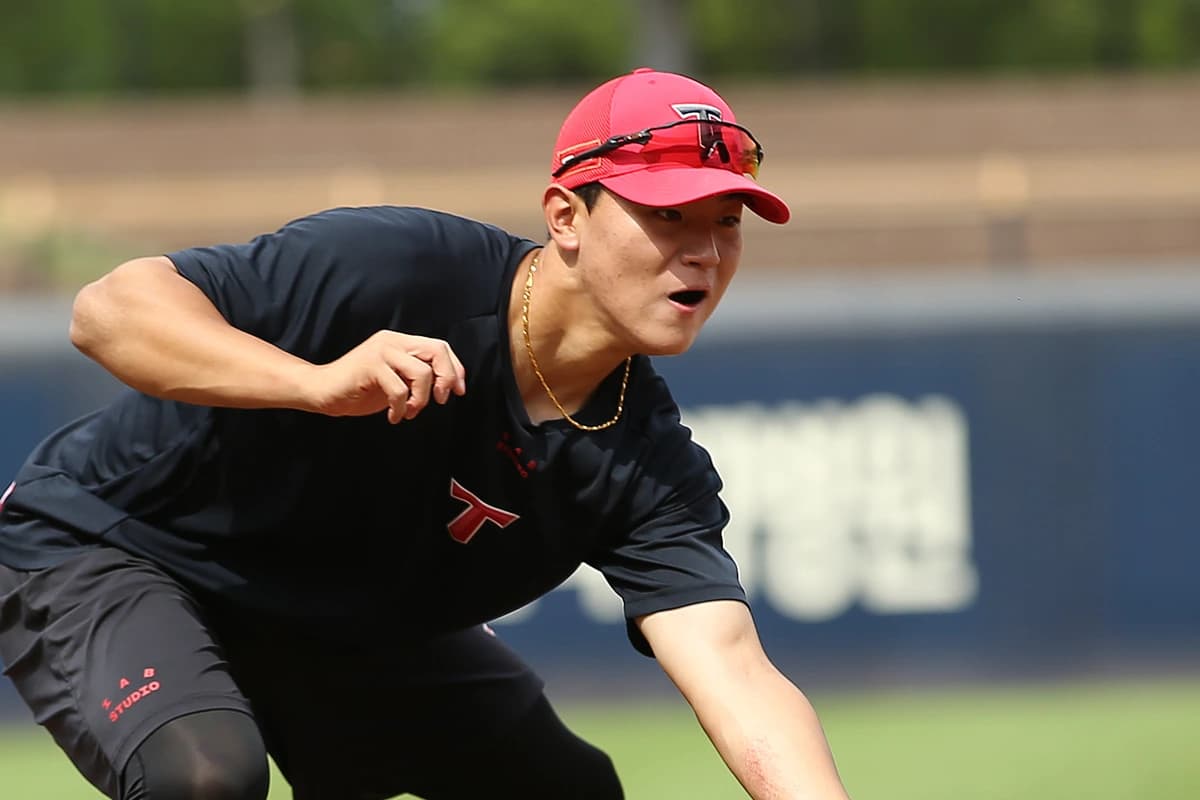
Images. The ballpark is 豊橋市民球場, the Toyohashi municipal stadium where the final was played, photographed in February 2025 by the Commons user 円周率3パーセント, CC BY-SA 4.0, licence verified on the file page; the pitcher is 곽빈 in a 두산 uniform in August 2023, by the Commons user Seohae1999, CC BY-SA 3.0, a genuine camera photograph. The scoreboard is ours, from the official box score. The photograph of Kim Do-young below is one of three supplied to us by the KIA Tigers in September for our coverage of him, and is used again here with their credit: 사진 제공: KIA 타이거즈. There is no licence-clean photograph of the final; the organisers' match photography is not licensed for reuse and we have not used it.
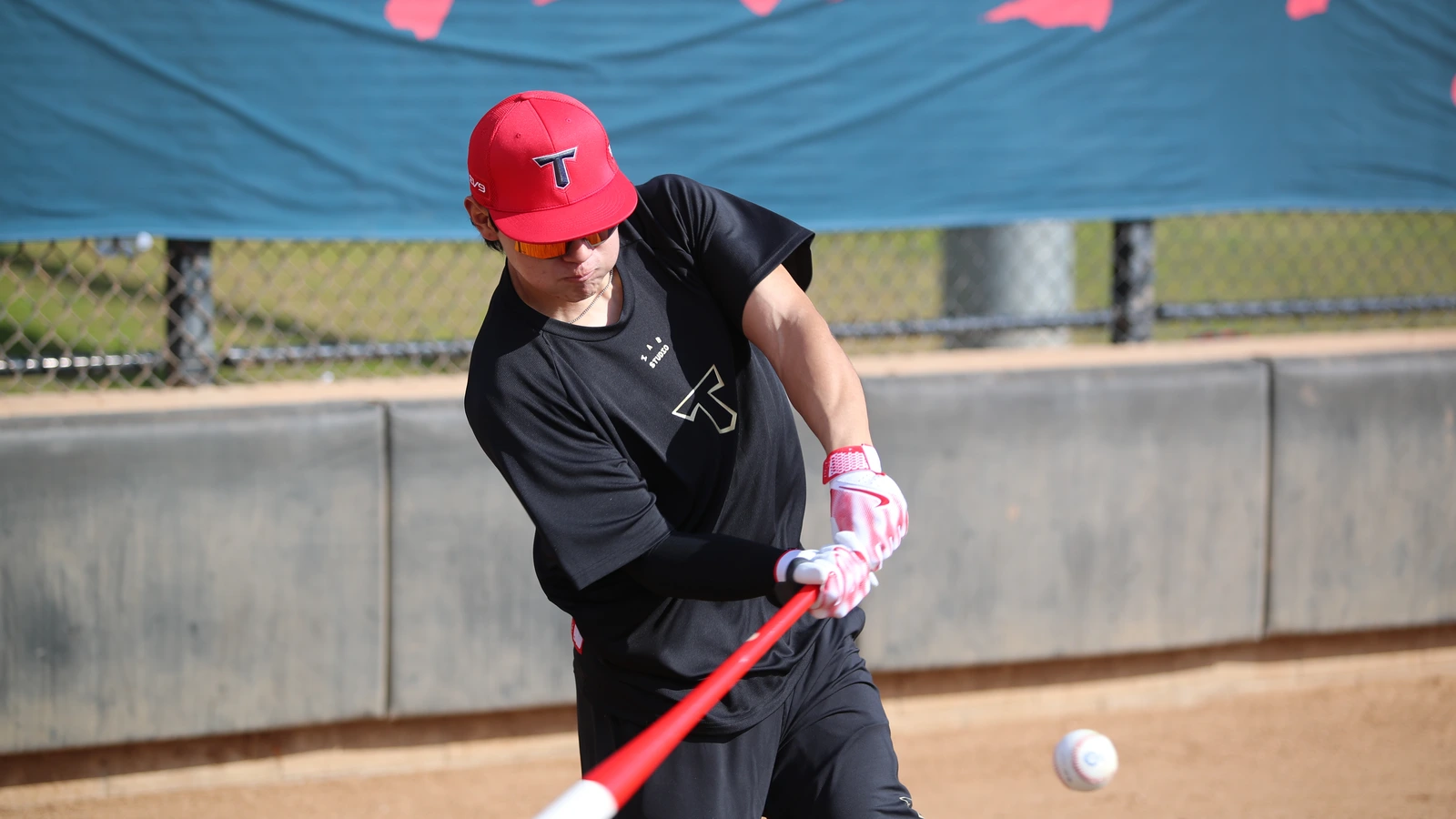
Kim Do-young. 사진 제공: KIA 타이거즈.
Sources. The final: 중앙일보 (27 September), 연합뉴스 (28 September), 위키트리 and 한국일보 (28 September) for the pitching lines, and the official 侍ジャパン match report and box score for the line score, the Japanese pitchers and the weather. The Friday game and the "first loss since 2006" line from 경향신문 (25 September); the rain-out arithmetic from 한겨레 (27 September) and 엑스포츠뉴스 (26 September) on what the organisers had and had not told the KBO. Japan's roster from the Japan Amateur Baseball Association's announcements of 10 July and 11 September; the Japanese reaction from 報知 and 日テレ (27 September). The age cap and the June squad announcement from 엑스포츠뉴스 and SPOTV (11 June). The sixteen names from 위키트리 and OSEN (27–28 September), identical lists; the terms of 예술·체육요원 service from the Military Manpower Administration's own pages, with the length of basic training from the reported cases of 손흥민 (조선일보, 2020) and 임성재 (2025). 하태경's post as quoted by 서울신문 and 노컷뉴스 (28 September); Taiwan's squad from 서울신문. Kim Do-young's words from 연합뉴스 and 노컷뉴스 (28 September) and 위키트리 (29 September); the home-run table from the KBO's own site on 29 September before that day's games.
Stated rather than smoothed. We have written "about three weeks" of basic training because the Military Manpower Administration's pages give no figure and recent athletes did three; older reporting says four. We have written "one run" for 곽빈 rather than "one earned run" because no box score we opened settles it. We have not printed an attendance figure because none was published. A claim circulating that the manager named 곽빈 the tournament's most valuable player appears only in a headline we could not open, so it is not here. And we have left out remarks attributed to the team captain about criticism of the squad, because by Tuesday there was a dispute about whether they were reported accurately, and we could not resolve it.
Keep Reading
More Stories
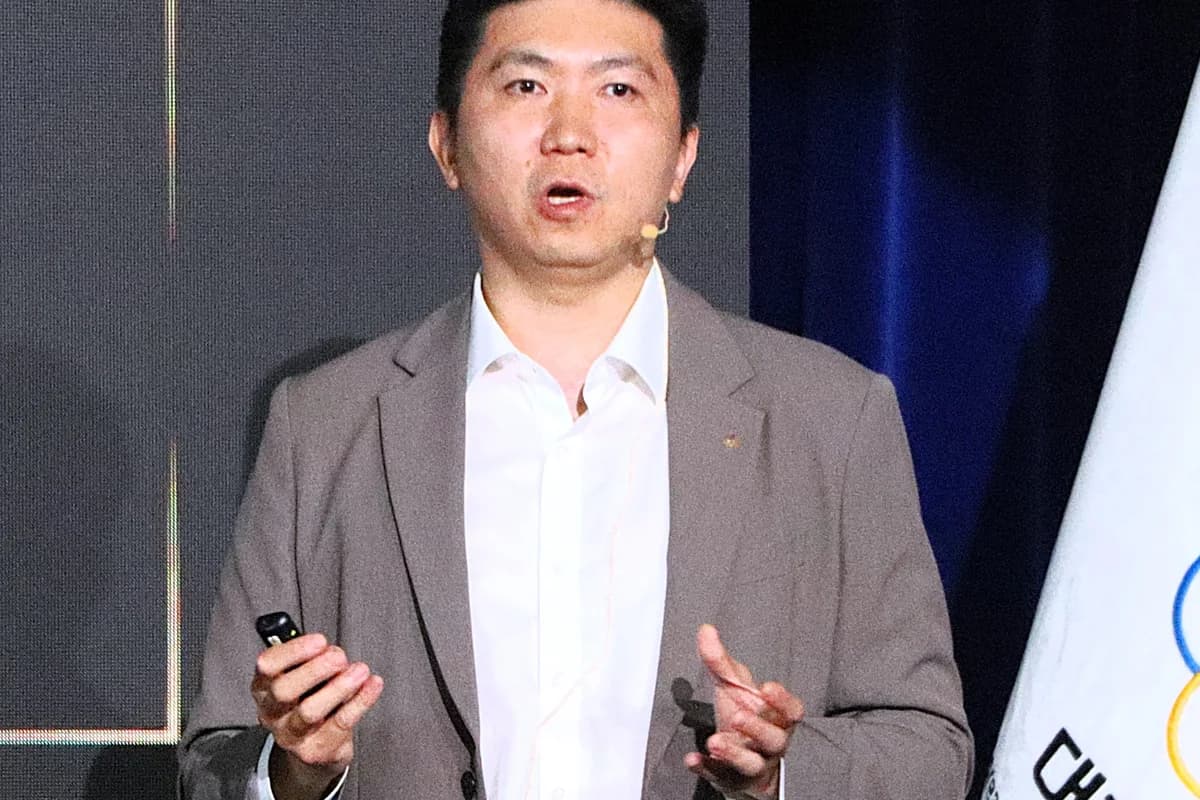
Korea's Sports Chief Gave Japan's Asian Games an F. Then the Organisers Apologised — to Japanese Spectators — for a Sign Saying the Rising Sun Flag Was Banned
The hosts of Aichi–Nagoya 2026 played North Korea's anthem for South Korea's hockey team, introduced Korea as the Republic of China at a medal ceremony, put Hideyoshi on the welcome stage, lost the basketball team's bus before the final, and housed athletes in leaking containers. Then a ballpark sign listed the Rising Sun flag among banned items, and the organising committee said sorry — in Japanese only, to its own crowd — because the flag was 'naturally' allowed. Its own rulebook bans flags that suggest political claims. It chose not to read it.
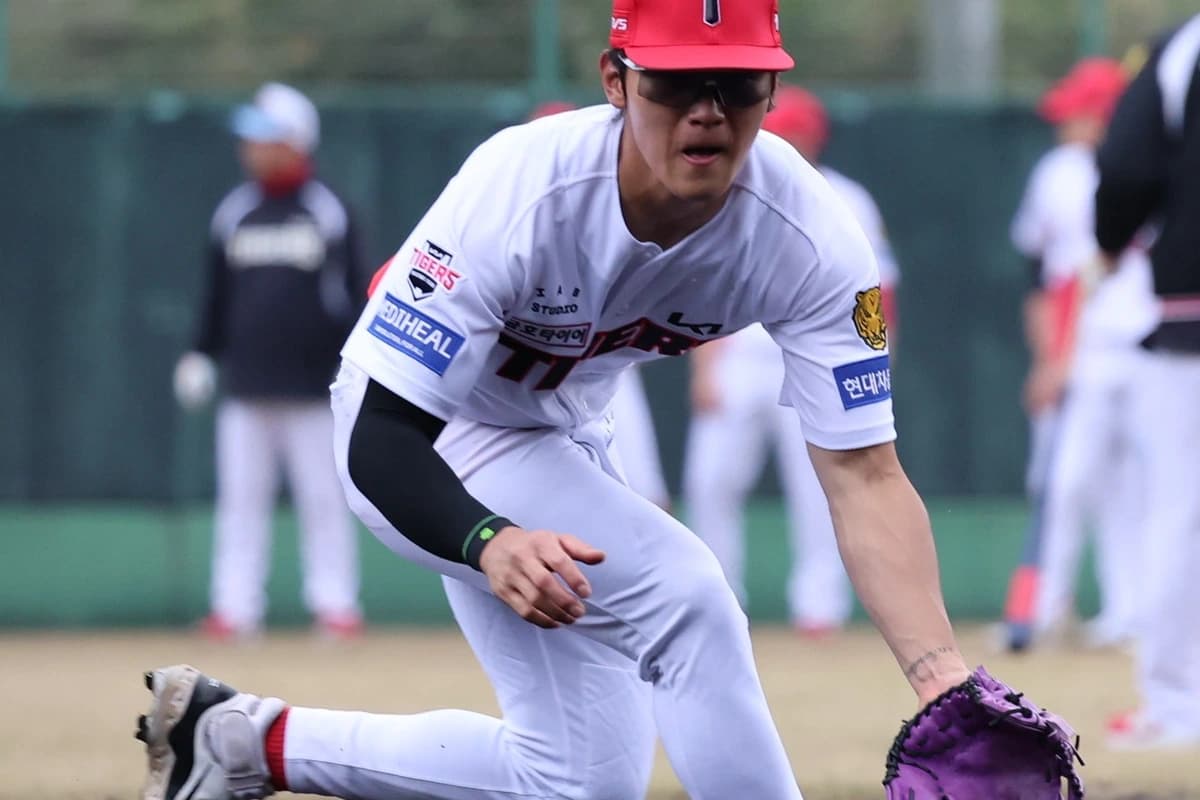
Kim Do-young Missed One Record by a Day and Set Another by Nine, With a Broken Nose in Between
He hit his fortieth home run on 8 September — one day after the window to become the youngest ever had closed. The next night his own bunt attempt broke his nose. He had surgery that night, came back four days later wearing a face guard, and drove in his hundredth run to become the youngest player in Korean baseball history to a 40–100–100 season, beating a 1999 mark by nine days. Then he reported to the national team. The league he leaves in fourth place does not stop while he is gone.
Kim Do-young Went 4-for-4 on the Last Possible Day and Missed the Record by One Home Run. He Says He Could Not Carry the Crown.
He hit his 39th on 26 August with Yankees and Rangers scouts in the stand, needing one more before he turned older than Lee Seung-yeop was in 1999. Then somebody checked the record-holder's birthday and found a lunar date, a week of games was cancelled for heat, four more were rained off, and the deadline arrived anyway. On the last day he could still have beaten it, Kim went four-for-four — four singles, nothing over the fence — and afterwards said the thing nobody expected him to say out loud.
The Weekly Dispatch
Korea, curated. Every week.
The best of K-culture, straight from Seoul. Written by people who actually live here.
Free, no spam, unsubscribe whenever.