Kim Do-young Missed One Record by a Day and Set Another by Nine, With a Broken Nose in Between
He hit his fortieth home run on 8 September — one day after the window to become the youngest ever had closed. The next night his own bunt attempt broke his nose. He had surgery that night, came back four days later wearing a face guard, and drove in his hundredth run to become the youngest player in Korean baseball history to a 40–100–100 season, beating a 1999 mark by nine days. Then he reported to the national team. The league he leaves in fourth place does not stop while he is gone.
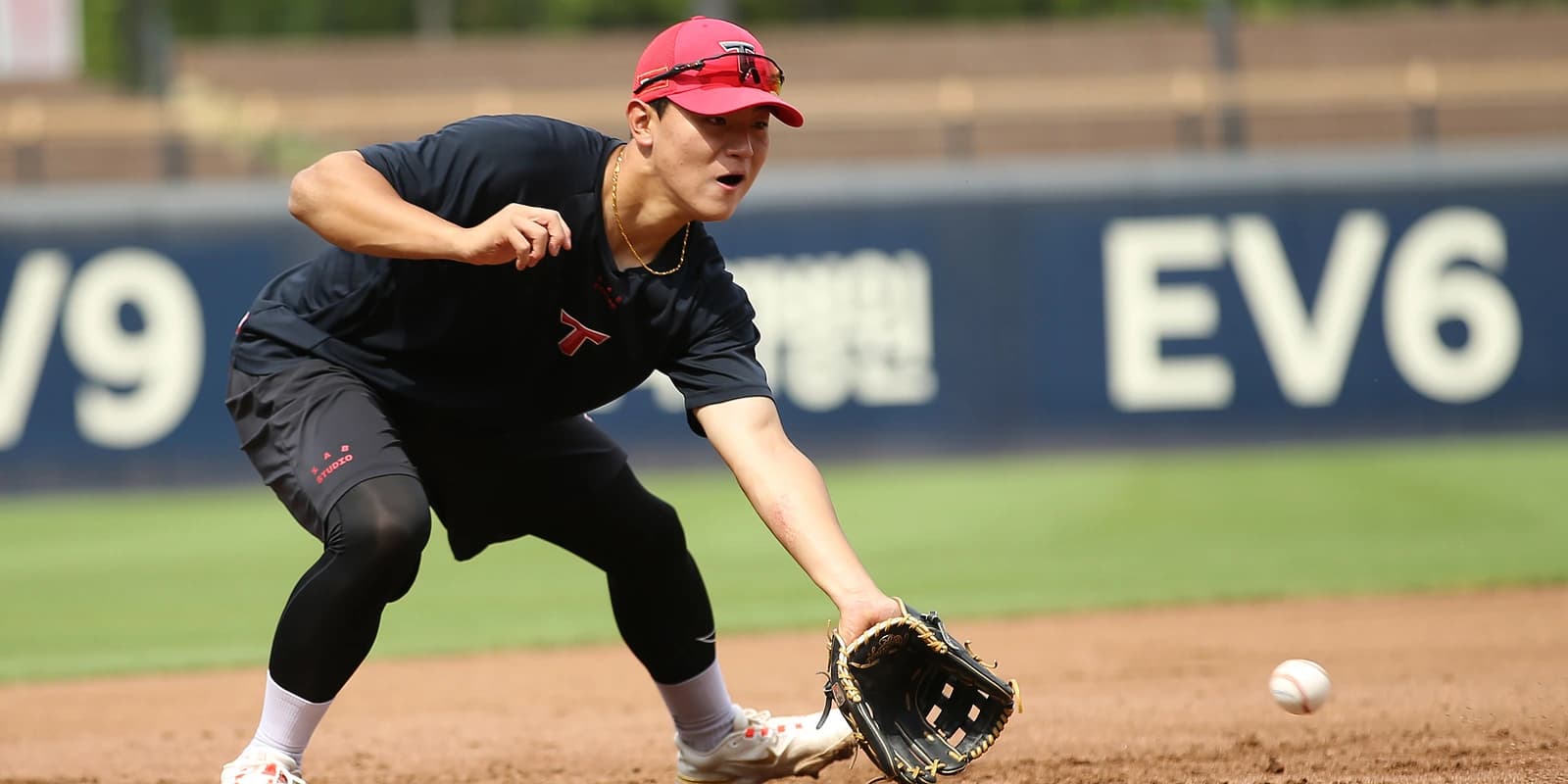
Here is Kim Do-young's week, in order.
Tuesday 8 September, Daegu. Sixth inning, KIA trailing Samsung 1–4. First pitch, 149km/h, pulled 130 metres over the left-field fence. His fortieth home run of the season.
He is 22 years, 11 months and 6 days old. The record for the youngest player to forty belongs to Lee Seung-yeop at 22 years, 11 months and 5 days. We spent two weeks on that chase. It ended on the Saturday with him going four-for-four and hitting nothing over the fence. There was no game on the Monday. The home run arrived on the first day it could no longer count. One day.
Wednesday 9 September, Gwangju. Fourth inning against NC, runner on first, KIA down 0–3. He squares to bunt — a surprise, 기습 번트 — and the ball comes off the bat and up into his face. He leaves the field bleeding from the nose. The diagnosis is a fractured nasal bone, 비골 골절, and he is in surgery that night at the club's designated hospital.
Thursday, Friday, Saturday. He misses three games. KIA go 1–2 without him.
Sunday 13 September, Gwangju. Discharged on the Friday, cleared by the KBO on a hospital certificate, he is back in the lineup as designated hitter, having trained in a face guard. Bottom of the fifth, one out, runner on third: a single to left-centre for his hundredth RBI. He finishes the day three-for-four with three runs batted in, KIA win 9–2, and his season line reads 40 home runs, 102 RBI, 106 runs.
At 22 years, 11 months and 11 days, that makes him the youngest player in the history of the league to a 40–100–100 season. The previous youngest was Lee Seung-yeop, in 1999, at 22 years, 11 months and 20 days.
Nine days.
Monday 14 September. He reports to the national team.
The two records, side by side
It is worth sitting with the arithmetic, because the same season and the same 1999 comparison produced opposite results a week apart.
| Kim Do-young | Lee Seung-yeop (1999) | Margin | |
|---|---|---|---|
| Youngest to 40 HR | 22y 11m 6d (8 Sept) | 22y 11m 5d | missed by 1 day |
| Youngest to 40–100–100 | 22y 11m 11d (13 Sept) | 22y 11m 20d | beaten by 9 days |
The first record was decided by a calendar and four rainouts. The second was decided by a man with a broken nose, back in the lineup on the fourth day.
He and Lee remain the only two hitters ever to reach forty before turning twenty-three. Forty also made him the first Korean-born Tiger to do it, tying the club record Tracy Sanders set in 1999, and the first Korean-born hitter to forty anywhere in the league since 2018.
What he said about the nose
Not much, and what there was came through the club and the league rather than from him — which is the correct order of priorities for a man who has just had his face reset. The KBO's statement on the Saturday: the hospital's certificate showed "특이 소견이 없으며 훈련 및 경기 출장 가능" — no notable findings, fit to train and play — and on that basis he would join the national team squad on the 14th as scheduled.
He played the next day. Three hits.
The team he leaves, and the league that keeps playing
Korea's baseball squad for the Aichi-Nagoya Asian Games assembled on the 14th: twenty-four players, named on 11 June by the manager 류지현, with three over-age wild cards — 곽빈, 문보경 and 노시환 — and no amateurs. They train at Gocheok on the 15th and 16th, play a practice game against the military team Sangmu on the 17th, and fly to Nagoya on the 18th.
The tournament is short and sharp. Korea is in Group B with Chinese Taipei, Hong Kong and Thailand; Japan, China, the Philippines and Palestine are in Group A.
| Date | Opponent | Venue | Time (KST) |
|---|---|---|---|
| Mon 21 Sept | Chinese Taipei | Okazaki | 18:30 |
| Tue 22 Sept | Hong Kong | Toyohashi | 18:30 |
| Wed 23 Sept | Thailand | Okazaki | 12:00 |
| 25–26 Sept | Super round | both | — |
| Sun 27 Sept | Gold-medal game | Toyohashi | 18:30 |
Korea has won this event four times running — 2010, 2014, 2018, 2022 — and is going for a fifth. The players return on the 28th.
And here is the structural fact that makes this a Korean story rather than a baseball one. The KBO does not pause.
The league considered it and decided against. Instead, under a plan announced on 25 August, it expanded active rosters to thirty-four registered and thirty-two eligible from that date, banned doubleheaders for the duration of the Games so no club would be gutted twice in a day, and let the season run on — to 7 October, since pushed back by rain to 12 October, with 105 rescheduled games still to be crammed in, sixty of them rainouts from the wettest late summer anyone can remember.
So every club plays two weeks without its internationals. The damage is uneven.
| Team | Called up |
|---|---|
| KT (1st) | 3 — all pitchers |
| Samsung (2nd) | 3 — including the shortstop and centre-fielder |
| KIA (4th) | 3 — Kim Do-young, 박재현, 성영탁 |
| Doosan (5th) | 3 |
| LG (3rd) | 2 |
| NC (6th) | 1 |
What KIA is playing for without him
The standings after Sunday, from the KBO's own table:
| # | Team | W–L–T | Pct | GB |
|---|---|---|---|---|
| 1 | KT | 75–46–3 | .620 | — |
| 2 | Samsung | 74–49–3 | .602 | 2.0 |
| 3 | LG | 70–55–1 | .560 | 7.0 |
| 4 | KIA | 68–56–2 | .548 | 8.5 |
| 5 | Doosan | 64–60–4 | .516 | 12.5 |
| 6 | NC | 59–61–2 | .492 | 15.5 |
Fourth place is the last one that starts the postseason with a structural advantage: the wild-card round pits fourth against fifth, and fourth advances with a single win or a tie, at home. Fifth has to win twice.
KIA are 4.0 games clear of Doosan for that spot, with eighteen to play — and they play the next two weeks without their league-leading home-run hitter, their centre-fielder and a pitcher. Doosan lose three too, including the wild-card starter 곽빈. NC, three games further back, lose one.
The Tigers' schedule while he is away: at SSG on the 15th, Kiwoom at home on the 17th, two at Changwon on the 19th and 20th, LG at Jamsil on the 23rd, LG at home on the 26th and 27th. He is back for KT on the 29th. Whether fourth place is still there when he lands is the thing to watch.
What it says
A record measured to the day was missed by a day. A record nobody was watching for was taken by nine, four days after facial surgery. And the league that produced both is the one that will not stop for its own national team — which is either a failure of sentiment or a statement of confidence that thirty-two players are enough to hold a pennant race together for two weeks. We will know by the 28th.
He said, after the Saturday it did not happen, that he would be disappointed until the end of that day only. On the evidence of the week that followed, he meant it.
The chase itself — the lunar birthday, the four rainouts, the four-for-four on the last day — is here, now with its postscript.
Postscript, 29 September: forty-one, and the club record
He came home from the Asian Games with a gold medal and, in his first at-bat back, hit his 41st home run of the season — in the first inning against KT at Gwangju on 29 September. That broke the Tigers' single-season record of 40, set by Tracy Sanders in 1999, which the 40th had only tied, and put him two ahead of 오스틴 딘 in the race for the league title. (뉴스1, 한국일보, 조선일보, 29 September.)
Update, 5 October. That lead did not hold, and the sentence above was incomplete even on the day: 힐리어드 of KT was also on 39 that night. He hit his 40th on 30 September and his 41st on 1 October, both against KIA in Gwangju, and on 4 October LG's 오스틴 딘 hit his 40th — the first 40-homer season in LG's history. At the end of 4 October the KBO's leaderboard reads 힐리어드 41, 김도영 41, 오스틴 40. The regular season, extended by rain, now ends on 12 October. (KBO official records; 스포츠경향, 1 October; OSEN and 뉴스핌, 4 October.)
Update, 14 October: forty-five, and the title. The race went to the last day. 힐리어드 hit back-to-back home runs on 11 October to draw level on 44 and did not homer on the 12th. 김도영 did — in the eighth inning at Gwangju with the score 2–2, a two-run shot to centre off LG's John Kennedy, in a final at-bat of the season. It was the 45th, the 100th of a career, and it clinched third place for KIA. Final totals, from the KBO's official records: 김도영 45, 힐리어드 44, 오스틴 41. The line: .308, 45 home runs, 118 RBI, 120 runs, an OPS of 1.060 and a league-leading .647 slugging percentage. 스포츠경향 notes it makes 김도영 the youngest player ever to combine .300, 40 home runs, 100 RBI and 100 runs, joining only 이승엽, 심정수 and 박병호, and KIA's first home-run champion since 2009. Asked about sharing the title, the answer was "동률(공동 홈런왕)은 멋 없어서 차라리 힐리어드가 오늘 치기를 바랐다" — a tie would have been uncool, so better that Hilliard had homered. (KBO official records; 스포츠경향 and 서울신문, 12–13 October.) The summary at the top of this piece, written in September, has KIA in fourth place; the club finished third and went straight into the semi-playoff.
Update, 25 October: the semi-playoff, and the last home runs at Jamsil. KIA swept LG three games to none in the best-of-five semi-playoff, and 김도영 was named its MVP, with 84 of 97 votes. The series line was three hits in nine at-bats, all three of them home runs, with eight RBI and four runs. Two came in the first game, at Gwangju on 17 October. The third came on 20 October, in the last professional game at Jamsil. It was a grand slam in the second inning off John Kennedy, the same LG pitcher who gave up the 45th. It measured 145.8 metres by Trackman and 145 by the KBO, which ties 타이론 우즈's 2001 mark for the longest postseason home run since the KBO began measuring in 2000. Three outlets call it the youngest grand slam in postseason history, at 23 years and 18 days. Our own arithmetic from the date of birth agrees, but we have not seen the KBO say so. "정규시즌 최종전 홈런이 상황은 더 짜릿했지만, 배트에 맞았을 때의 손맛은 오늘이 더 좋았다", 김도영 told 위키트리: the last home run of the regular season was more thrilling for the situation, but today's felt better off the bat. KIA's playoff against Samsung opens in Daegu on 25 October. (연합뉴스, 경향신문, 노컷뉴스, 파이낸셜뉴스, 일간스포츠, OSEN and 위키트리, 17–20 October.)
Images. 사진 제공: KIA 타이거즈. The three photographs were supplied by the KIA Tigers' 홍보팀 on request, for these articles, on the single condition that the source be credited — which we are glad to do, because they are the first photographs of him we have been able to run. They are training-ground pictures rather than the games described here: a batting-cage swing and a fielding drill in the black training kit, and a low fielding reach in the white home uniform. We had searched every free route first — the 공공누리 portal, Korea.net, the Olympic committee's photo bank, Wikimedia Commons, Flickr — and found nothing usable, so we asked the club, which is how the press gets its pictures too. The two records as a ledger, the standings and the fixture list, which illustrated this piece before the photographs arrived, remain in the body as tables.
Sources. The 8 September home run from 경향신문, OSEN, 머니투데이 and STN스포츠, with the at-bat line from the Naver box score; the 9 September injury and surgery from 서울경제, 한국일보 and 전남일보; the return and the 100th RBI from 한국일보, 경향 (English) and the box score; the KBO's clearance statement from 세계일보. The Asian Games schedule was checked against the organising committee's own venue session tables for Okazaki and Toyohashi, current to 10 September — the tables list sessions rather than opponents, so the opponent assignments come from the KBO's reporting and the tournament's published groups. The roster and wild cards from 이투데이's report of the 11 June announcement; the no-pause plan from the KBO's 25 August release as carried by 데일리안 and OSEN; the roster expansion from the KBO executive committee's 8 June decision. Standings from the KBO's official table after 13 September, cross-checked against a 13 September roundup. The wild-card rule as stated is the 2025 rule and we could not find a KBO-issued 2026 postseason page confirming it unchanged.
Stated rather than smoothed. The scout's version of this had the 40th on the 13th. It was the 8th; the 13th was the 100th RBI, and the difference is the whole point. One outlet gives the home run's distance as 128 metres against the others' 130; we used the majority. Whether there was one out or none when the bunt went wrong is reported both ways; we have not specified. The earlier plan had the team leaving on the 17th; the most recent report says the 18th, and we used that. Whether any of the three days he missed changes the fourth-place arithmetic is unknowable and we have not pretended otherwise.
Keep Reading
More Stories
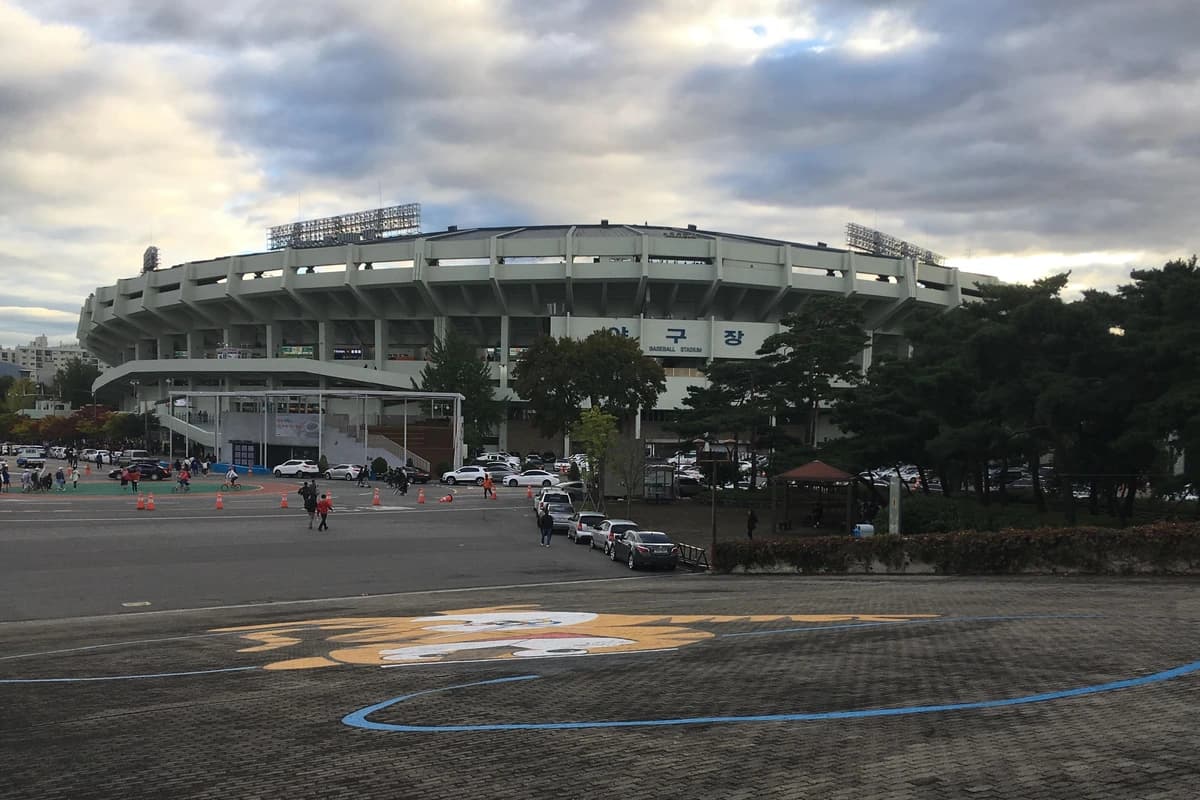
The Lights Went Out at Jamsil on Monday Night. Korea's Most Famous Ballpark Isn't Quite Finished Yet
On 12 October, after the last regular-season game at 잠실야구장, four Doosan legends stood at the bases in the dark and lifted home plate. LG had said its own goodbye five days earlier. The 44-year-old stadium is due to come down for a domed replacement — but the postseason, starting tonight with LG against Doosan, will keep it open for at least two more games.
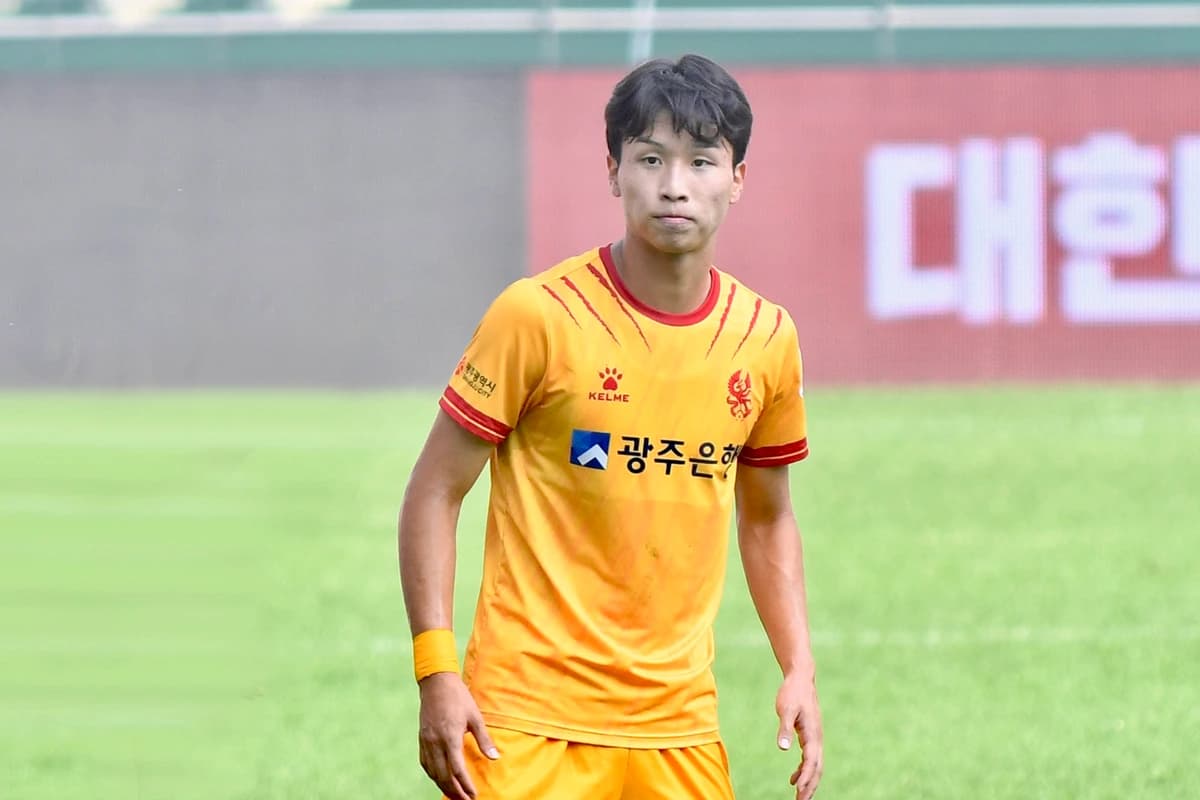
Korea Beat Japan for a Fourth Straight Asian Games Football Gold. Then Its Captain Held Up the Medal and Said, 'I'm Not Going to the Army'
엄지성's 61st-minute goal at Toyota Stadium made Korea the first side to win the men's tournament four times running, and exempted 20 of its 23 players from active military service. Within a day three of them were apologising for saying what the medal was for — and the argument about the exemption itself had started again.
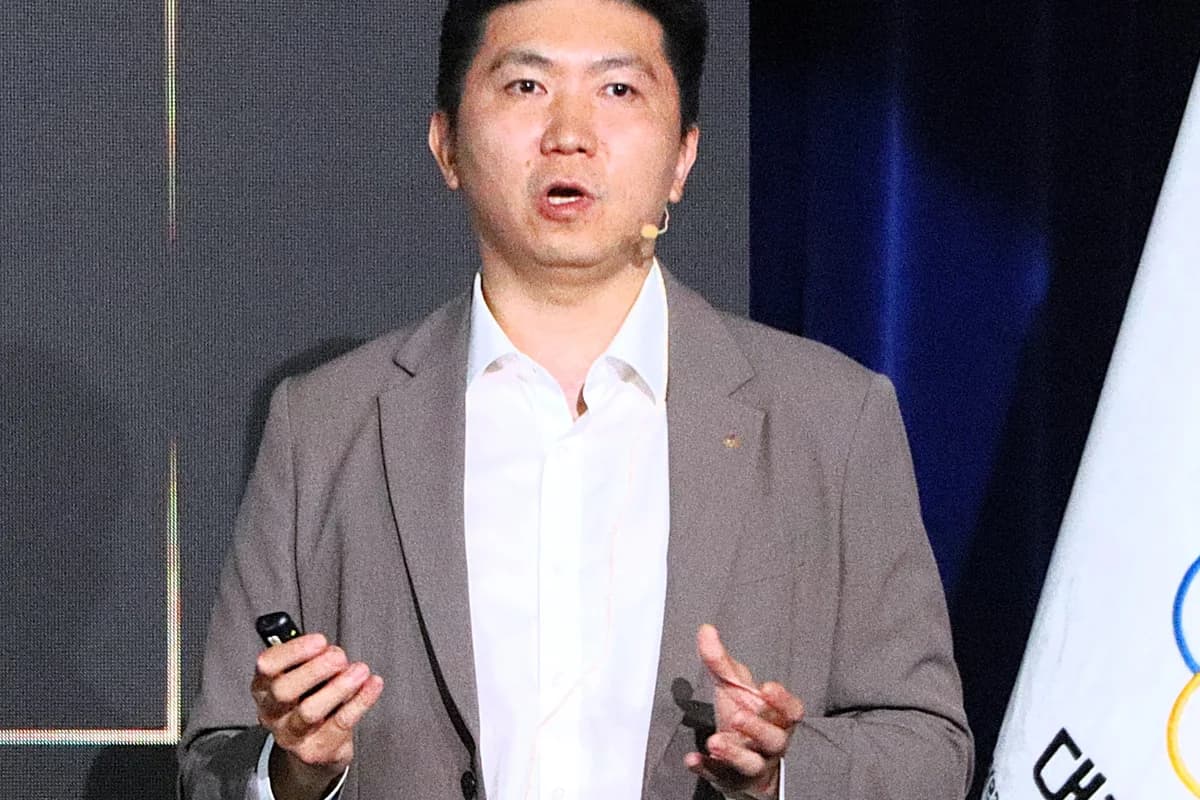
Korea's Sports Chief Gave Japan's Asian Games an F. Then the Organisers Apologised — to Japanese Spectators — for a Sign Saying the Rising Sun Flag Was Banned
The hosts of Aichi–Nagoya 2026 played North Korea's anthem for South Korea's hockey team, introduced Korea as the Republic of China at a medal ceremony, put Hideyoshi on the welcome stage, lost the basketball team's bus before the final, and housed athletes in leaking containers. Then a ballpark sign listed the Rising Sun flag among banned items, and the organising committee said sorry — in Japanese only, to its own crowd — because the flag was 'naturally' allowed. Its own rulebook bans flags that suggest political claims. It chose not to read it.
The Weekly Dispatch
Korea, curated. Every week.
The best of K-culture, straight from Seoul. Written by people who actually live here.
Free, no spam, unsubscribe whenever.