The Lights Went Out at Jamsil on Monday Night. Korea's Most Famous Ballpark Isn't Quite Finished Yet
On 12 October, after the last regular-season game at 잠실야구장, four Doosan legends stood at the bases in the dark and lifted home plate. LG had said its own goodbye five days earlier. The 44-year-old stadium is due to come down for a domed replacement — but the postseason, starting tonight with LG against Doosan, will keep it open for at least two more games.
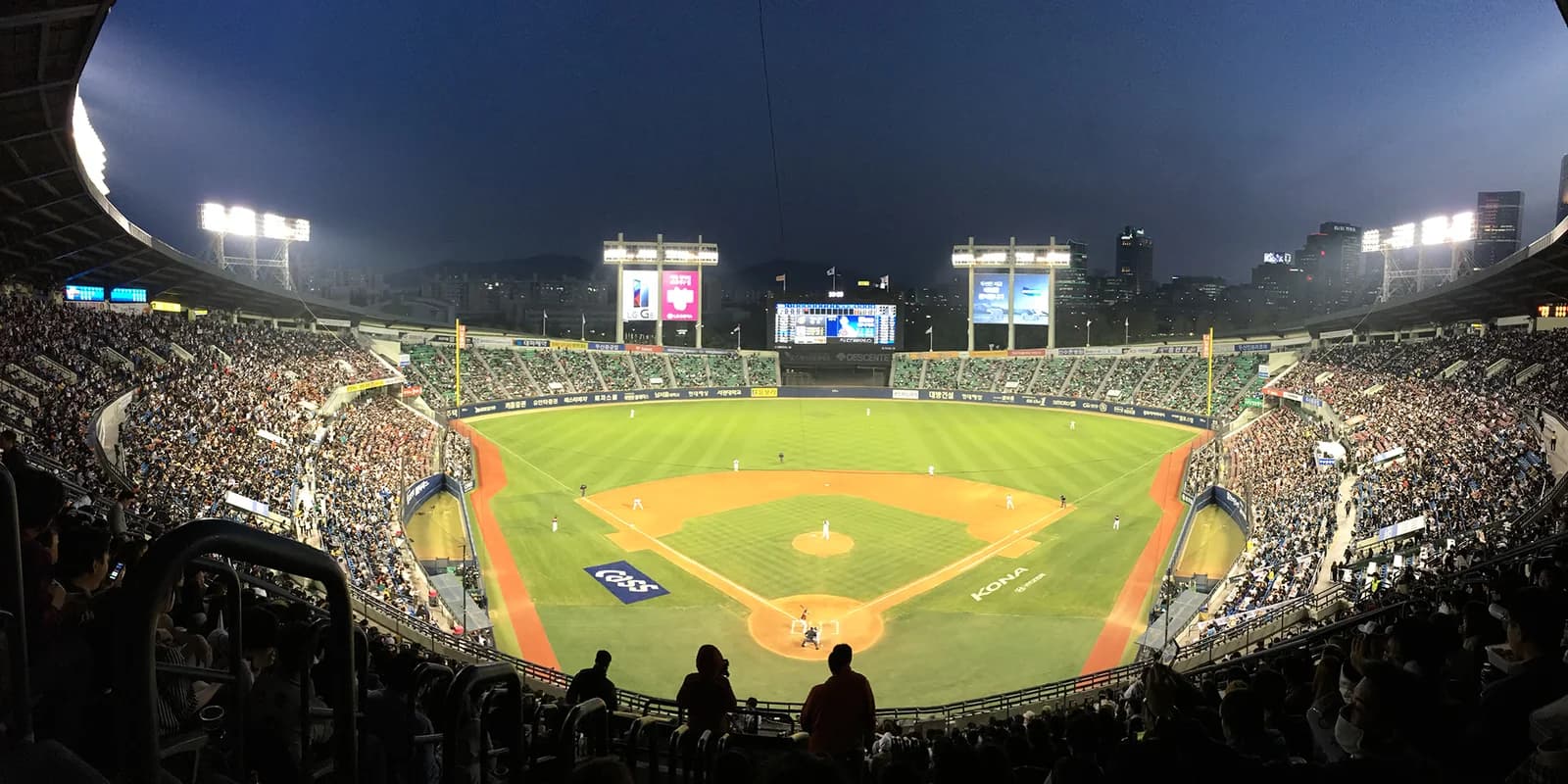
The game had been over for a while when the lights went out. Monday night, 12 October: a crowd of 23,750, the number that means sold out at Jamsil, a 7–4 defeat to Lotte, and then the club's goodbye. A video began to play on the big screen, running backwards — through the 2010s, the 2000s, the 1990s, back to the beginning.
When the lights came up again there was a man at each base. At first, 김재호, twenty-one years with one club in one position. At second, 정재훈, now the pitching coach. At third, 김형석, from the 1990s. And at home plate, 박철순 — number 21, retired, the ace of the OB Bears side that won the first professional championship Korea ever played, in 1982.
The four of them lifted a home plate and handed it to the club's captain, 양의지, as a sign that the team was moving on. Then a moment of silence; then 김종진 of the band 봄여름가을겨울 sang "Bravo, My Life" and kissed the turf on the fans' behalf.
"내게 잠실은 말 그대로 집이었다," 김형석 told the crowd, as 스포츠동아 reported it — to me, Jamsil was quite literally home. 박철순 put it the way a club would like it put: "더 좋은 환경서 뛰기 위한 잠시동안의 이별이라고 생각하겠다. 그동안 고마웠다. 잠실." I'll think of it as a short parting, so we can play somewhere better. Thank you for everything, Jamsil.
It was the last regular-season game that will ever be played at 잠실야구장, the Jamsil Baseball Stadium, home of the LG Twins and the Doosan Bears. It was not, as it turns out, the last game.
The night
The game was a make-up: Lotte at Doosan had been rained off on 25 September, and its new date made it the final day of the KBO regular season. Lotte won it with home runs from 한동희, 손성빈 and 레이예스, who went four for five and finished the season with 211 hits, a new single-season record for the league. Doosan used eleven pitchers. The crowd sold out fifty minutes before the start — Doosan's 33rd sell-out of the year — and took the club past 1.5 million home spectators for the first time. All three games in the league that day sold out, and the KBO finished with a record 12,770,551.
The first pitch was thrown by 김인식, who managed the Bears to championships in 1995 and 2001. "잠실야구장의 마지막 정규시즌 경기에서 시구를 하게 돼 감회가 남다르다," 김인식 told 한국일보 — to throw the first pitch at the last regular-season game at Jamsil stirs something different. Then came an embrace with both managers: Doosan's 김원형, and Lotte's 김태형. "내 야구 인생이 거의 다 여기 있다," 김태형 said: nearly my whole baseball life is here.
The ceremony the club called Our Time, Our Memories had been planned for 1 October, after what was then Doosan's last home game; the rain-out pushed it back to the real final night. The players lined up along the first-base line, 김원형, 양의지, 정수빈 and 이영하 each spoke to the stands, the fireworks went up, and the lights went out.
The other goodbye
Jamsil is a shared ground, and LG had already said its own farewell, five days earlier. On 7 October, at LG's last regular-season home game, the club's two retired numbers, 이병규 and 박용택, threw the first pitch together, and the two clubs posed for a joint photograph before the game. LG beat Doosan 7–5. Afterwards a banner was unrolled over the outfield and the fireworks went up for LG too.
"잠실 30-30은 영원히 이병규의 것," 이병규 said, as 서울신문 reported — Jamsil's 30–30 belongs to 이병규 forever, the only Jamsil player to hit thirty home runs and steal thirty bases in one season, in 1999. 박용택: "그동안 고마웠고 즐거웠다고 말해주고 싶다" — I want to tell it: thank you, it was fun. The manager, 염경엽, said the team had badly wanted to win the last home game and then thank the fans. LG finished the season with 1,622,238 at home, 47 sell-outs, the first time any club at Jamsil has passed 1.6 million.
Both clubs are selling the ground itself. Infield and mound dirt in a glass bottle — LG's shaped like its mascots, Lucky and Star — costs ₩20,000; a model of the stadium with real turf inside costs ₩49,000, and both, the shop pages say, ship from late December.
The groundskeeper who looked after that turf, 김종문, had thrown LG's first pitch on 3 October, the start of its farewell series; 김종문 has worked the ground since 1999. "27년 일한 구장이 올해가 마지막이라니 믿기지 않는다" — it is hard to believe that a ground tended for twenty-seven years is in its last season.
Forty-four years
Ground was broken on 17 April 1980. The stadium opened on 15 July 1982, designed by the architect 김인호, at a cost of about ₩12.6 billion — not, as is sometimes said, for the 1986 Asian Games, where baseball was not yet a medal sport, but as the main venue of the 27th Baseball World Championship that September, and then for baseball at the Seoul Olympics in 1988, where it was a demonstration event. It held 30,500 when it opened. The first event was a tournament for four of the country's great high-school baseball schools; the first professional game, on 1 August 1982, was Lotte against MBC 청룡.
MBC became the LG Twins in 1990. The OB Bears moved in in the mid-1980s — 스포츠동아 says 1985, 한국일보 1986 — and took the name Doosan in 1999. Since then the two clubs have shared one ground and one city's baseball crowd, in two colours.
It was also, for a long time, where the Korean Series was won. By 더팩트's count, KIA clinched nine of its twelve championships at Jamsil, and Samsung five of its eight. Today it holds 23,750, and if you have stood in its crowd, you will know the noise is most of the point.
What replaces it
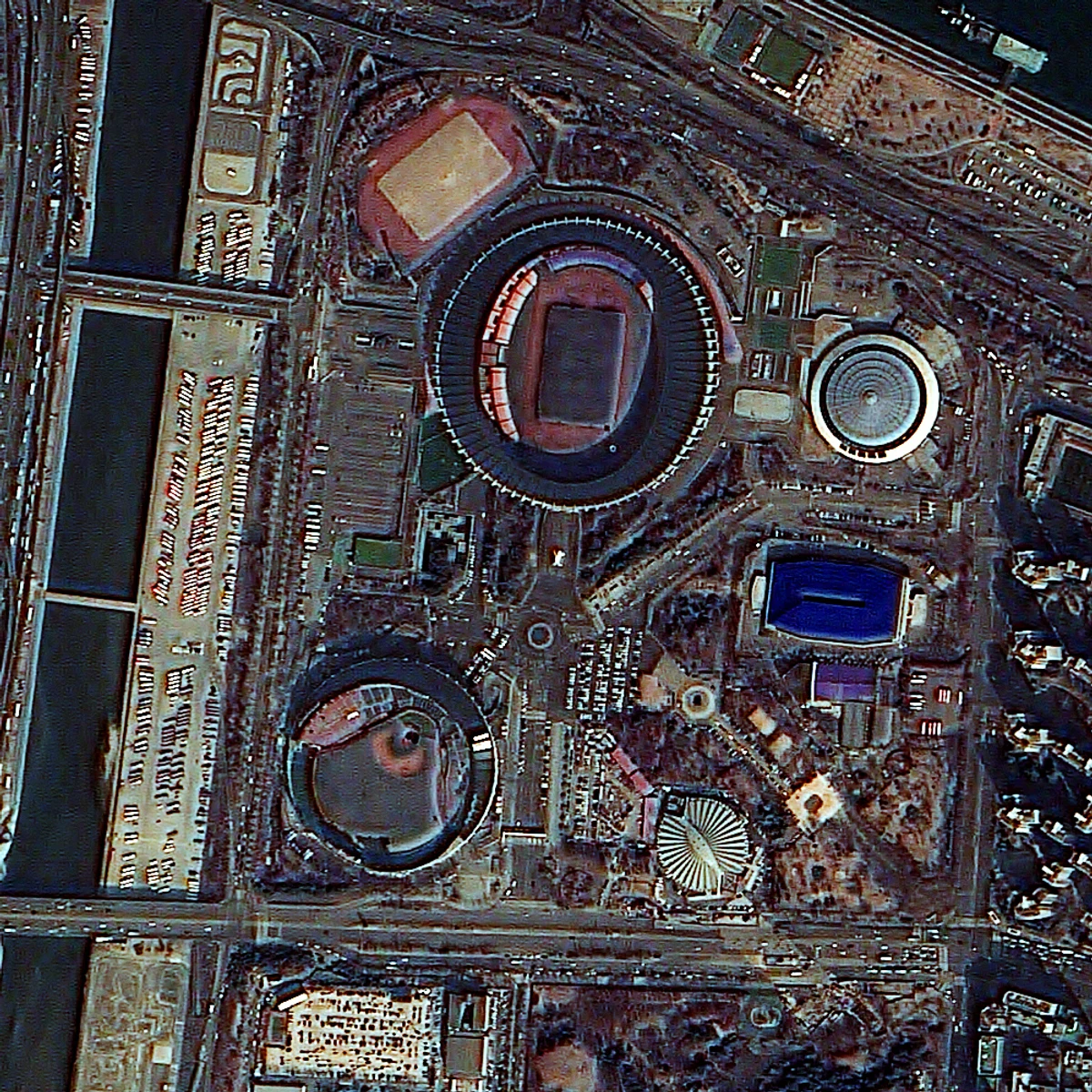
Seoul city's plan is a domed ballpark of 30,000 seats on the same site, part of a sports and convention complex to be built and then run for forty years by a private consortium led by Hanwha E&C, at a cost the city puts at ₩2.6955 trillion in 2016 prices — the ₩3.3 trillion figure in some reports is the same project at current prices. The agreement was signed in July; completion is targeted for 2032.
In between, both clubs move across the complex to the Olympic Main Stadium, the main stadium of the 1988 Games, for five seasons from 2027. It is being refitted as a ballpark — the third-base side for LG, the first for Doosan — with about 18,000 seats on its first two tiers, and the city has said the third tier could open for the postseason and big games, taking it past 30,000, if it can be shown to be safe. The work is due to finish in December. When the move was proposed, fans of both clubs formed a joint association to oppose it; the city's answer was safety.
Not quite yet
Here is the thing about Monday night: it was the last regular-season game. The season ended that night in Gwangju too, where 김도영 hit a 45th home run in a final at-bat of the year, off an LG pitcher, to win the home-run title, clinch third place for KIA — and leave LG fourth.
Fourth place hosts the wild card. So the postseason begins at Jamsil tonight, 14 October, at 18:30: LG against Doosan, the two tenants, in the last meeting between them at the old ground. LG goes through with a win or a draw; Doosan needs two wins in two nights.
And whoever wins plays semi-playoff games three and four at home — which is Jamsil either way — on 20 and 21 October. If the Jamsil club keeps winning, the stadium could host playoff games on 28 and 29 October, and Korean Series games as late as Saturday 7 November. After that, the retired players' association 일구회 has booked the ground for a legends exhibition on 14 November, under the title 《잠실 더 라스트 이닝》 — Jamsil, the Last Inning.
The farewells, in other words, have been said. The stadium has not finished. The 1982 ace who stood at home plate on Monday night gets the last word for now: a short parting, so we can play somewhere better.
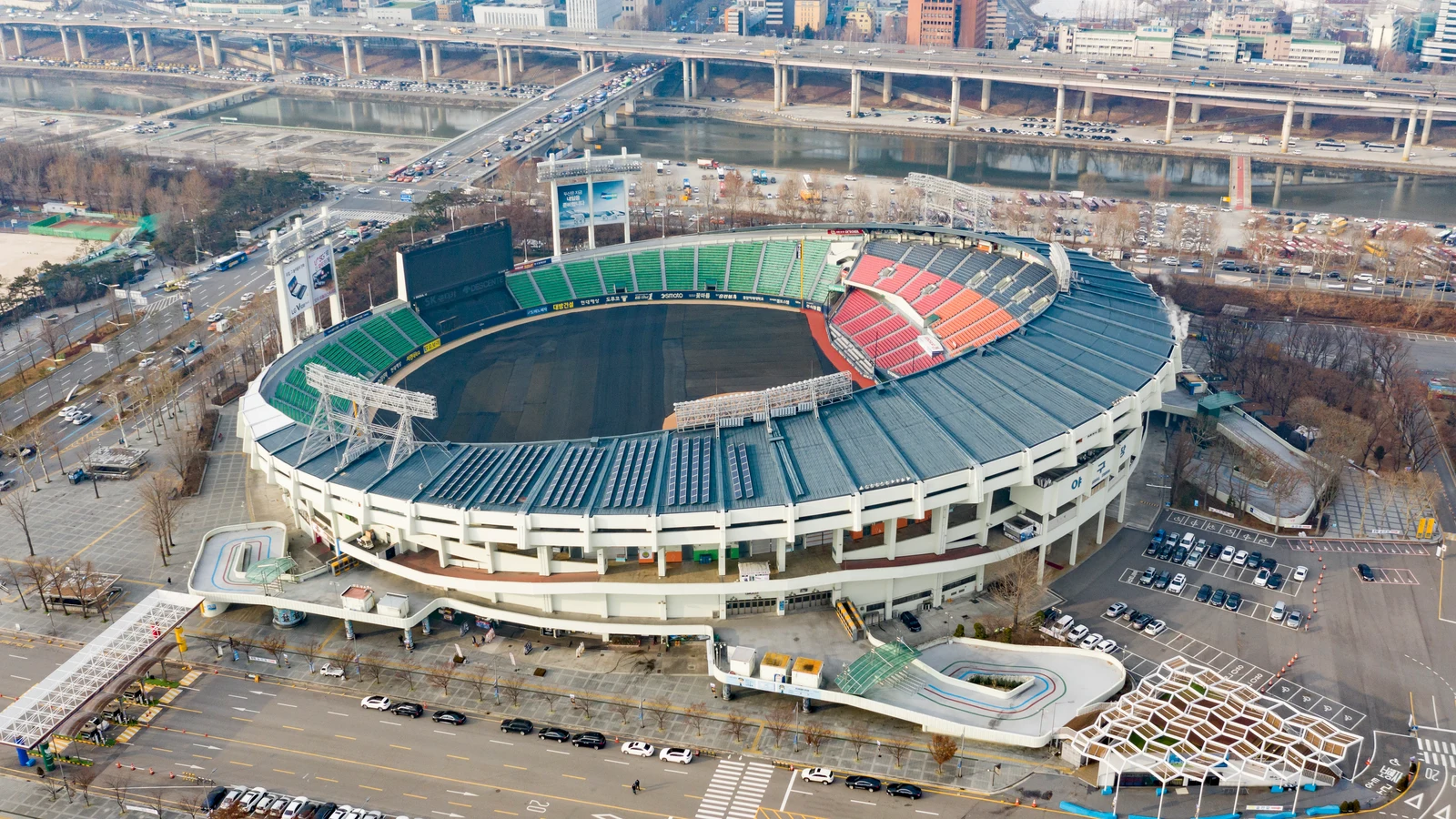
Images. The lead photograph is Jamsil Baseball Stadium at night, full, on 28 April 2017, by the Commons user Cyberdoomslayer, CC BY-SA 4.0, cropped. The aerial is by Arne Müseler / www.arne-mueseler.com, CC BY-SA 3.0 DE, cropped; it was taken in winter, with the field under covers. The listing card is the stadium's exterior in October 2018, by the Commons user Christophe95, CC BY-SA 4.0, cropped. The satellite image is from the Korea Aerospace Research Institute's 아리랑 2호, taken on 10 December 2015 (한국항공우주연구원, 공공누리 제1유형), cropped. Our crops are offered under the same terms. None shows the ceremony on 12 October, of which we found no freely licensed photograph.
Sources. The 12 October game and ceremony are from 뉴스1, 더게이트, 일간스포츠, 머니투데이, 스포츠동아, 한국일보 and 서울신문; the attendance records from 더게이트 and 서울신문. LG's farewell from 서울신문, SPOTV, 마이데일리 and 뉴스1; 김종문 from 더게이트. Keepsake prices from both clubs' product pages on the official shop. The stadium's history from Seoul city's digital archive, 더팩트 and 한경매거진. The dome from Seoul city's own project page and 서울신문; the interim stadium from the mayor's office (July 2024), 서울신문 and 한국경제. Final standings and the postseason schedule from the KBO, via OSEN; tonight's game from 세계일보 and 서울신문; the 14 November exhibition from 일간스포츠.
Stated rather than smoothed. When the OB Bears moved to Jamsil is given as 1985 and as 1986 by two reliable papers, and we have not settled it. The ceremony's quotations differ slightly from outlet to outlet — one version reads like the club's own copy — so we have used 스포츠동아's throughout and not combined them. Whether the plate the legends lifted was the stadium's actual home plate, dug up, is not stated in any report; they all say only that it was lifted. A commemorative coin promised for the original 1 October ceremony may have been handed out on the 12th; no report says so. The stadium's capacity is 23,750 by the clubs' sell-out figure and about 24,000 by Seoul city's archive. Postseason dates can move with rain or a drawn game.
Keep Reading
More Stories
Korea Beat Japan for a Fourth Straight Asian Games Football Gold. Then Its Captain Held Up the Medal and Said, 'I'm Not Going to the Army'
엄지성's 61st-minute goal at Toyota Stadium made Korea the first side to win the men's tournament four times running, and exempted 20 of its 23 players from active military service. Within a day three of them were apologising for saying what the medal was for — and the argument about the exemption itself had started again.
Korea's Sports Chief Gave Japan's Asian Games an F. Then the Organisers Apologised — to Japanese Spectators — for a Sign Saying the Rising Sun Flag Was Banned
The hosts of Aichi–Nagoya 2026 played North Korea's anthem for South Korea's hockey team, introduced Korea as the Republic of China at a medal ceremony, put Hideyoshi on the welcome stage, lost the basketball team's bus before the final, and housed athletes in leaking containers. Then a ballpark sign listed the Rising Sun flag among banned items, and the organising committee said sorry — in Japanese only, to its own crowd — because the flag was 'naturally' allowed. Its own rulebook bans flags that suggest political claims. It chose not to read it.
Korea's Pros Lost 0–5 to Japan's Company-League Players, Then Beat Them 3–1 in the Rain for a Fifth Straight Asian Games Gold
Two days before the final, Korea's all-professional squad was shut out by a Japanese side of corporate-league employees, its first Asian Games loss to Japan in twenty years. Then it rained on Toyohashi with no reserve day, Gwak Bin threw 111 pitches through it, and Kim Do-young — a week after breaking his nose, hitting .250 for the tournament — chopped an infield single off the third baseman's glove in the eighth. Sixteen players walked off the field with their military service converted into 34 months of baseball. Korean coverage calls that an exemption. It isn't, and a former defence-committee lawmaker spent Monday arguing it shouldn't exist at all.
The Weekly Dispatch
Korea, curated. Every week.
The best of K-culture, straight from Seoul. Written by people who actually live here.
Free, no spam, unsubscribe whenever.