Hanbok at the Palace, Honestly: The First-Timer's Guide to the Gyeongbokgung Experience (2026)
Yes, you should rent one. No, it's not cultural appropriation — Koreans encourage it. Here's the real money math (₩3,000 ticket → free with hanbok), the four rental shops worth knowing, the Discover Seoul Pass perk that gets you a full-day hanbok for nothing, and the only photo-etiquette rule that actually matters.
A Threads post that landed in our feed this week, from someone who'd just gotten back from a Korea trip:
"One of the highlights of my South Korea tour was definitely the hanbok experience ✨ I honestly didn't expect to enjoy it as much as I did, but wearing such a beautiful piece of Korean culture made the whole experience feel so special. Walking around in a hanbok, surrounded by historic palaces, felt like stepping into another era — and surprisingly, it became one of my favorite memories."
This is the most consistent feedback we hear from anyone who actually does it. Not "fun for a photo." Not "cute idea." One of my favorite memories from the entire trip. And yet it's still the experience first-time visitors most often talk themselves out of — too touristy, too performative, is it even allowed?
So here is the honest version, written from Seoul, with the 2026 prices, rental shop comparison, and one cultural question answered up front so you can stop overthinking it.
The cultural question, first
Is it cultural appropriation for a non-Korean to wear hanbok at a Korean palace?
No. Koreans across Korean Threads, Korean Quora, and Korean cultural commentary have repeatedly said this is encouraged, not appropriated. The cultural debate that exists around hanbok in 2026 is about China's claims that hanbok originated from Ming Dynasty hanfu — a sovereignty-of-origin question that has nothing to do with whether a Norwegian tourist puts on a chima-jeogori at Gyeongbokgung. Koreans see foreigners wearing hanbok as appreciation. The government literally rewards it with free palace entry. The rental industry that's built around the four major Seoul palaces is explicitly designed for tourists.
The internal Korean debate that does exist is between traditional and modern-fusion hanbok styles — and even there, the conclusion has been that both can coexist (Korea Times, 2024). The respectful approach is straightforward: wear it properly (both top and bottom), don't cosplay it (no jeans-and-jeogori "fashion mashup" that breaks the silhouette), and treat the palace grounds as the historic site they are.
That's the entire conversation. Now to the math.
The money math: ₩3,000 saved, four palaces unlocked
A standard adult ticket to Gyeongbokgung Palace (경복궁) costs ₩3,000 for ages 19-64, ₩1,500 for ages 7-18, and is free for children under 7 and adults over 64 (Korea Heritage Service). Free entry for everyone on Culture Day — the last Wednesday of every month.
The hanbok rule, per the same source: if you are wearing both the top (저고리 / jeogori) and the bottom (치마 chima for women / 바지 baji for men), entry is free. Not just at Gyeongbokgung — at all four of Seoul's royal palaces: Gyeongbokgung, Changdeokgung (창덕궁), Deoksugung (덕수궁), and Changgyeonggung (창경궁). Pair a jeogori with jeans and they will (politely, and you will see it happen at the entrance) deny you the free-entry path. Both pieces, or neither. There is no half-credit.
This is also the answer to "why pay ₩20,000 to save ₩3,000?" — you're not. You're spending it to also get into multiple palaces same-day, photograph yourself inside one of Asia's most beautiful historic sites, and own the strongest single memory most visitors bring home. The ticket-savings line is the Korean tourism board's joke about it. The real value is everything else.
When the palace is actually open
Gyeongbokgung is closed every Tuesday. Hours shift seasonally, but the practical version is:
- June-August: 09:00-18:30 (last entry 17:30)
- March-May & September-October: 09:00-18:00 (last entry 17:00)
- November-February: 09:00-17:00 (last entry 16:00)
The single highest-leverage decision on your day-of timing is the Changing of the Royal Guard ceremony at the main Gwanghwamun gate. The schedule, confirmed via the Korea Heritage Service:
- Changing of the Guard (수문장 교대의식): 10:00 AM and 2:00 PM (20 min each), Wednesday-Monday
- Guard-on-Duty Show: 11:00 AM and 1:00 PM (10 min each)
- Public Military Training: 9:35 AM and 1:35 PM (15 min each)
Heavy rain or snow may cancel. The 10:00 AM ceremony is the easier one to catch in good light if you're showing up early to beat tour-bus crowds. Get to the gate by 9:50.
The four rental shops worth knowing
There are dozens of hanbok rental shops within a five-minute walk of Gyeongbokgung. Most are fine. Four are useful to know specifically because they handle different things well.
| Shop | Best for | 2-4hr basic | Full day | Notes |
|---|---|---|---|---|
| Daehan Hanbok (대한한복) | All body types, families | ~₩18,000-30,000 | ~₩30,000-50,000 | Carries petite and plus sizes, accessories included, matching family options. Free full-day rental with Discover Seoul Pass. Right next to the palace. |
| Oneday Hanbok (원데이한복) | Volume of options | ₩18,000 (4hr) | ₩24,000 (24hr) | Largest selection. Close to Gyeongbokgung and Changdeokgung and Bukchon — useful if you're palace-hopping. |
| Seohwa Hanbok (서화한복) | Closest to palace, 2-day rentals | ₩25,000 (1-day) | ₩35,000 (2-day) | Practically at the palace gate. The two-day option is uncommon — useful if you want to wear it the next morning at Changdeokgung or Bukchon. |
| Hanboknam (한복남) | Budget-conscious first-timers | ₩15,000-20,000 | ~₩30,000 | The volume budget play. Smaller selection but Korean-hair styling is included in some packages. ~1 min walk from Gyeongbokgung Station (Line 3, Exit 4 — turn around at the exit and look for the yellow building). |
A few general patterns we keep seeing:
- Pre-booking is cheaper than walk-up. Klook, kkday, and Creatrip consistently undercut shop counter rates by ₩3-5k and often include free hair upgrades in the bundle.
- The busy hours are 09:00-12:00, especially at the most-known shops. Walk in at 8:50 or after 14:00 if you want any of the well-photographed designs.
- Free locker storage is standard at every shop on this list. You can leave your day pack and walk the palace genuinely hands-free.
- Accessory pricing is the real catch. Hanbok rental: ₩20,000. Hair accessories + bag + traditional shoes: another ₩5-15k stacked. Read the package list before you pay.
The Discover Seoul Pass play (worth doing the math on)
The Discover Seoul Pass is a multi-attraction city pass aimed at tourists. Standard rate as of 2026: ₩39,900 for 24 hours, ₩49,500 for 48 hours, ₩90,000 for 72 hours (source: official site).
The hanbok play: the pass includes a free full-day hanbok rental at participating shops including Daehan Hanbok — hairband, handbag, and gat (men's traditional hat) included. That's a ₩30,000-50,000 value before the pass starts paying for itself on any other attraction.
The break-even math for a 48-hour traveler:
- Pass: ₩49,500
- Free Daehan Hanbok full-day: ₩30,000-40,000 value
- Free Gyeongbokgung + Changdeokgung + Deoksugung entries: ~₩9,000 (₩3k each — but already free with hanbok, so this perk overlaps for hanbok-wearers)
- Free N Seoul Tower observatory: ₩29,000 walk-up (source: N Seoul Tower)
- Free Lotte World Tower SEOUL SKY observatory: ₩31,000 walk-up (source: Lotte)
The pass tips into "obviously worth it" the moment you visit one major paid attraction beyond the palaces. The free hanbok alone covers most of the 48-hour pass cost. If your only Seoul plan is palace-hopping in hanbok, just rent the hanbok directly. If you were going to visit N Seoul Tower or Lotte anyway, the pass is the cheapest ride.
What you actually get vs what costs extra
The standard hanbok rental package, across shops we've checked, includes:
- The hanbok (top + skirt/pants — both required for free palace entry)
- An inner skirt (속치마 sokchima) to give the chima its bell shape — this is critical for the silhouette and is usually free
- Hair styling at most shops — a simple traditional updo, sometimes a fishtail braid, takes 5-10 minutes
- Free locker for your bag and street clothes
- Free entry pass to Gyeongbokgung and the other three royal palaces
What's commonly not included:
- Hair accessories (₩2-5k each — pearl pins, ribbons)
- Hanbok shoes / slippers (₩2-5k, optional — most people just wear their own white sneakers, which Korean Instagram has decided looks fine)
- Traditional handbag (₩3-5k — small embroidered bags that match the hanbok)
- Gat / hat for men (₩3-5k)
- A photographer. This is its own category. See below.
Photography: phone vs hire a professional
The DIY answer is fine. Korean palace courtyards are landscape goldmines, and your phone in 2026 will produce great photos. Most hanbok travelers go with phone-and-tripod (the small ones run ~₩10-20,000 at any Daiso or large convenience store) or just hand the phone to a friendly stranger — Korean palace etiquette is friendlier than most tourist sites on this; nobody minds being asked for a quick shot.
The professional answer is also genuinely good. We've cross-checked packages on GetYourGuide, Trazy, Klook, and Airbnb's photo services in Seoul. Typical structure:
- ~₩200,000-330,000 (roughly $150-250 USD) for a 1-hour shoot
- Hanbok rental sometimes included, sometimes separate
- 10-30 edited photos, full unedited gallery for self-selection
- Tuesday photoshoots automatically relocate to Changdeokgung (Gyeongbokgung is closed Tuesdays)
When the pro is worth it: anniversary trip, proposal, a milestone birthday, family group photos where you actually want everyone in the picture instead of someone behind the phone.
When DIY beats pro: a half-day quick experience where the rental + palace ticket time is already eating four hours, and adding a third hour of photographer time changes the shape of your day too much.
What to wear underneath
A real practical concern. Korean hanbok is voluminous and traditional inner garments aren't part of the rental — so what's worn underneath becomes your problem.
The honest answer: a fitted cotton tank top or t-shirt and bike-short-style leggings. The neck of the jeogori sits high so any top with a low neckline is fine. The inner skirt (속치마) handles modesty and shape under the chima for women; men wear the baji directly over the underclothes provided.
In summer (June-September), Seoul humidity will make the chima feel like a personal sauna. Bring a small face-cooling towel and stop at any convenience store for a chilled bottle of water before you enter the palace. In winter (November-March), thermals under the hanbok are absolutely allowed and most shops will hand you a thin shawl to throw over the jeogori in the courtyards.
Photo etiquette: the one rule that matters
Selfie sticks: fine. Tripods: fine. Phone photography: fine. Standing inside the throne pavilions: fine if the pavilion is open. Climbing on architectural elements (railings, the throne platform itself, the dragon-decorated steps): not fine — and the palace guards will move you off.
The one universal rule: respect performers during the Changing of the Guard ceremony. Don't cross the line of marching guards for a photo. Stand behind the rope. The ceremony is short (20 min); you have ample time to photograph it without disrupting it.
A simple half-day plan
If you're picking this up cold without a specific itinerary, this is the plan we'd hand to a friend:
- 08:30 — Coffee + a quick breakfast near Anguk Station or Gyeongbokgung Station
- 09:00 — Walk into your chosen rental shop. Dress + hair styling: ~45 minutes
- 09:50 — Arrive at Gyeongbokgung's main gate. Show the rental receipt for free entry
- 10:00 — Changing of the Royal Guard ceremony at Gwanghwamun (the ceremony is performed outside the palace, so position yourself accordingly)
- 10:30-12:30 — Walk the palace at unhurried pace. Hit Geunjeongjeon (the throne hall) first while crowds are still light, then Gyeonghoeru (the pavilion-on-a-pond), then the back-courtyard gardens
- 12:30-13:30 — Lunch in nearby Bukchon or Insadong (hanbok keeps you in free-entry mode at additional palaces, so consider extending)
- Optional 13:30-15:00 — Walk to Changdeokgung (~1.2 km, 15-20 min walk) or Bukchon Hanok Village for photo continuity
- 15:00 — Return hanbok before the 4hr rental window closes
The 4-hour rental window is enough for one palace and a Bukchon walk. The full-day window is the right call if you're hitting two palaces or hiring a photographer.
The mindset shift
The Threads post we opened this article with said "I honestly didn't expect to enjoy it as much as I did." That same line — almost verbatim — appears in conversations we have with first-time visitors who actually do this. The expectation going in is touristy photo op. The experience coming out is the day I felt closest to Korean culture.
It's an unusual feature of the hanbok experience that it doesn't feel performative once you're inside the palace courtyard, because everyone around you is doing the same thing. Korean schoolchildren on field trips. Korean couples on their wedding-album day. Korean grandparents with their grandkids. Visitors from Singapore, the Philippines, Spain, Brazil, Japan, the US — all in hanbok, all walking the same courtyards. The Korean tourism design that built this experience knew exactly what it was doing. The palace becomes a shared, anachronistic, communal space.
Wear both pieces. Stand for the ceremony. Take the photo by Gyeonghoeru. It really is one of the best half-days available in Seoul.
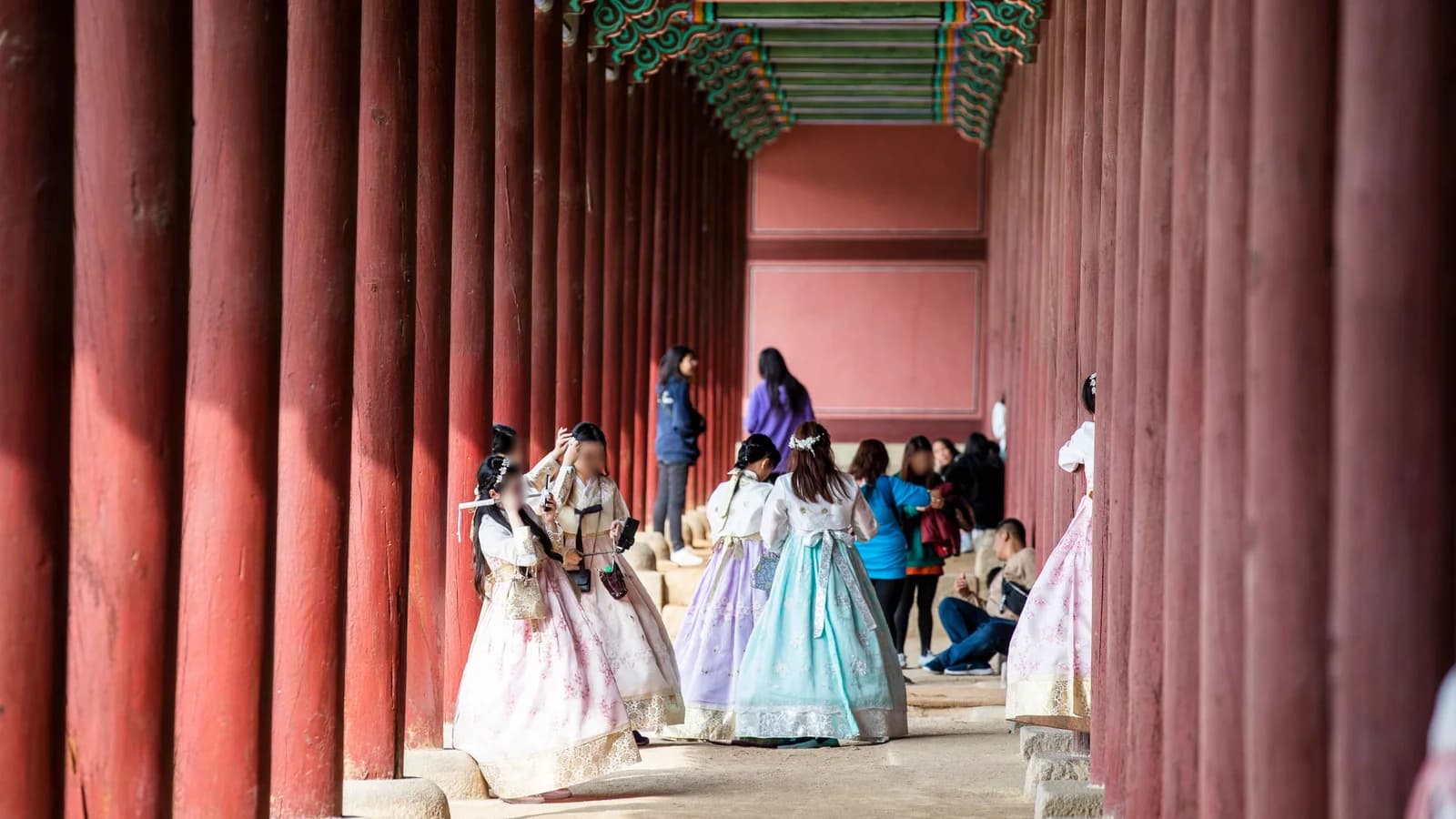
Cover photo: Visitors in hanbok walking the colonnade at Gyeongbokgung Palace, Seoul. ⓒ Korea Tourism Organization Photo korea — Lee Bumsu. Licensed under KOGL Type 1.
Keep Reading
More Stories
황사 Is Not 미세먼지: What Korea's Air Quality Alerts Actually Mean
English coverage treats yellow dust and fine dust as the same problem. Korea's own forecasters subtract one from the other before publishing. A guide to the two seasons, the alert thresholds, what KF94 actually certifies, and why 'it all comes from China' is a number swap.
The Mud Korea Decided to Save: Getbol and the UNESCO Vote in Busan
The least Instagrammable thing Korea could nominate — a coastline of mud — is a UNESCO World Heritage site, and on July 25, 2026, in the one year Korea controlled the room, it was made bigger. A guide to getbol: the flats that feed millions of migrating birds, the women who ride wooden sleds across them, and why a country that once paved its tidal flats now enshrines them.
Jjimjilbang for First-Timers: How Korea's Bathhouses Actually Work
Yes, the bath part is fully nude. No, nobody cares. A step-by-step guide to the Korean spa-sauna-sleepover — the sheep-head towel, the scrub that removes a layer of you, which famous venues have quietly closed — and why the neighborhood bathhouse is disappearing even as the tourist jjimjilbang thrives.
The Weekly Dispatch
Korea, curated. Every week.
The best of K-culture, straight from Seoul. Written by people who actually live here.
Free, no spam, unsubscribe whenever.