K-Beauty Just Had Its Biggest August on Record. Its Two Largest Companies Went Backwards.
Korean cosmetics exports hit $1.31 billion in August, up 52 per cent — the fastest monthly growth in nearly three years. Almost none of it belongs to AmorePacific or LG Household & Health Care, whose export value fell 23 per cent in the first half. Small brands are now 68.7 per cent of what Korea ships. And China, which took more than half of it five years ago, now takes one seventh.
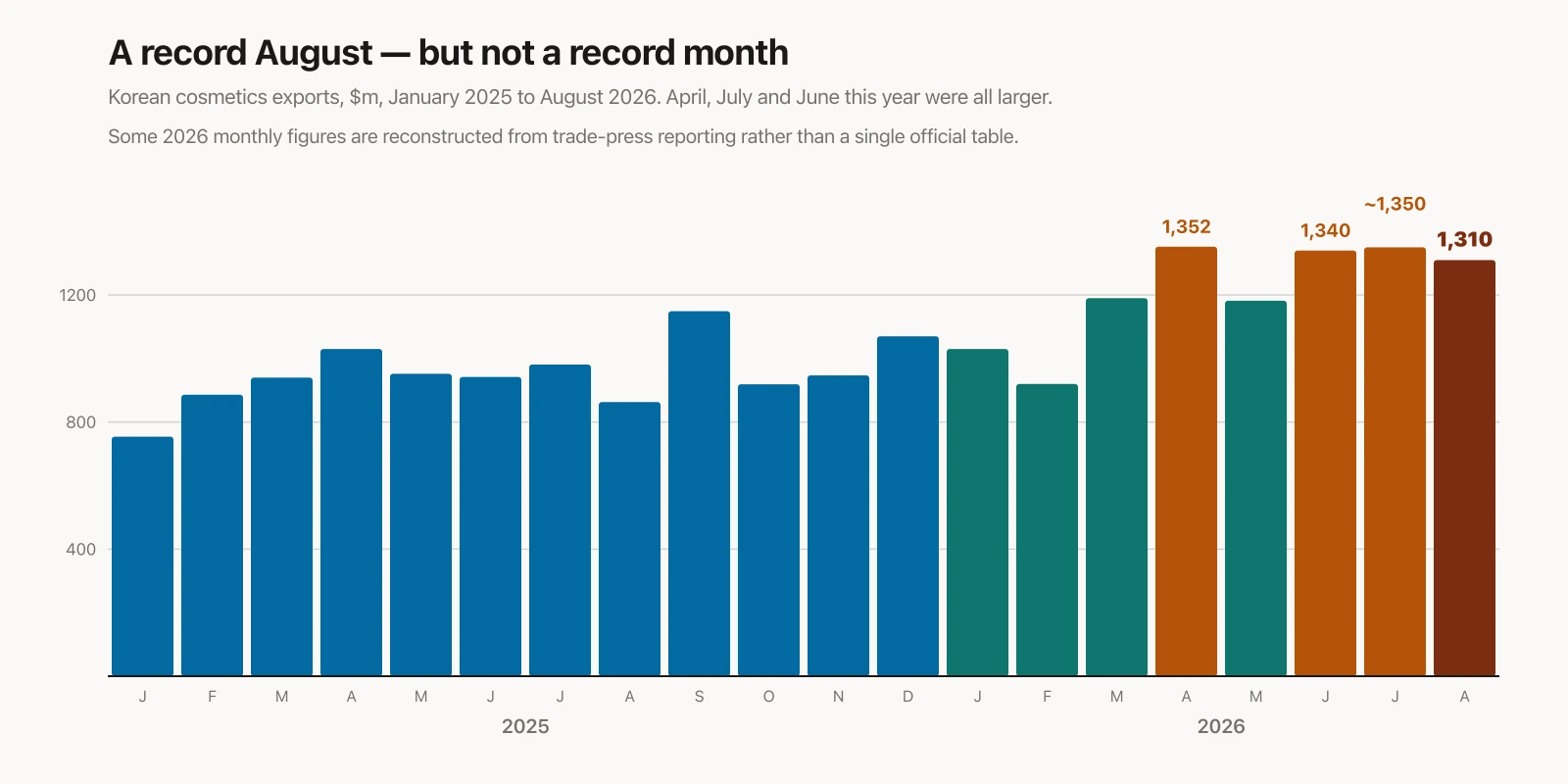
Korean cosmetics exports in August came to $1.31 billion, up 52.1 per cent on the same month last year. That is the largest August the industry has ever had, and the fastest year-on-year growth in 31 months — since January 2024.
It was the tenth consecutive month of growth.
Two things should be said immediately, before the number gets away from us.
It is not an all-time monthly record. Three months this year were larger: April at $1.352 billion, July at about $1.35 billion and June at $1.34 billion. August was the biggest August, which is a real record and a smaller one, and the distinction matters because the two get conflated constantly.
And part of the 52 per cent is arithmetic. August 2025 was a weak month — up only 4.8 per cent, one of the slowest of that year. A soft base inflates a growth rate. The absolute dollar figure is still the largest August on record, and the surrounding year is genuinely strong, but anyone quoting "52 per cent" without that caveat is quoting a number the calendar helped make.
What is underneath it is more interesting than the headline anyway, and it is not the story most people think K-beauty is.
The big two are going backwards
Korea's cosmetics industry has two household names abroad — 아모레퍼시픽 (AmorePacific) and LG생활건강 (LG Household & Health Care). For most of the last two decades, K-beauty's export story was their story.
In the first half of 2026, export value from Korea's large conglomerates fell 23 per cent.
Over the same period, mid-tier companies rose 16.3 per cent and small companies rose 30.8 per cent. Small and independent brands now account for 68.7 per cent of the value of everything Korea exports in cosmetics.
That is the actual finding. The category is having a record year while its most famous companies shrink inside it. What is growing is a long tail of brands most people outside Korea could not name, selling through Olive Young's international arm, through Amazon, and through TikTok Shop.
There is a useful piece of context for how far this has come: KOTRA's ranking has cosmetics as Korea's 37th-largest export category in 2015. In 2025 it was tenth.
Who actually makes it
The reason a brand nobody has heard of can ship internationally is that in Korea it does not have to build a factory.
Korea's ODM manufacturers — original design manufacturers, who develop and produce the product for whoever puts their name on the jar — are among the largest in the world. Three of them had a quarter that explains the export figures better than any brand story:
| Q2 operating profit | Change | |
|---|---|---|
| 한국콜마 (Kolmar Korea) | ₩110.3bn | +50.2% |
| 코스맥스 (Cosmax) | ₩73.7bn | +21.3% |
| 코스메카코리아 (Cosmecca Korea) | ₩32.1bn | +39.3% |
Kolmar's was the first time its quarterly operating profit has topped ₩100 billion. Cosmax's American subsidiary turned its first quarterly profit in thirteen years. On 12 August, when the trade data and the earnings landed together, Kolmar closed up nearly 23 per cent and Cosmax nearly 17.
This is the machinery that makes the indie boom possible. A three-person brand in Seoul can commission a formulation, a fill and a finished product from a company that also manufactures for global multinationals, and be exporting within months. The barrier that used to protect the conglomerates — you needed a factory — is a service you can now buy.
China is not the story any more
Here is the part that most reporting on K-beauty still gets wrong, because the framing is a decade old.
In 2021, China took 53.2 per cent of Korea's cosmetics exports. The relationship then broke down, for reasons that were partly political and partly the rise of Chinese domestic brands, and the share has fallen every single year since:
53.2% (2021) → 45.4% → 34.7% (2023) → 25.2% (2024) → 19.6% (2025) → 14.4% (first half of 2026).
In absolute terms, China took roughly $4.9 billion of Korean cosmetics in 2021. The current run rate is around $2 billion. Exports to China today are less than half what they were at the peak.
And yet the total is at an all-time high — $11.4 billion in 2025, and roughly $9.6–9.7 billion in the first eight months of this year alone.
So the growth is not a China recovery. It is China being replaced, and then substantially overshot. The United States passed China as Korea's single largest cosmetics market in 2025 and has stayed there.
In the first 25 days of August — and that is the period these figures cover, a preliminary customs cut rather than the full month — the United States took $230 million, up 58 per cent, and the European Union $130 million, up 106.6 per cent. China took $120 million.
The European number looks spectacular and mostly reflects small bases getting less small: the Czech Republic up 492 per cent, Estonia 399, the Netherlands 374, the United Kingdom 233. The Netherlands and the UK now each buy more Korean cosmetics than Hong Kong does. We looked for a tariff change or a trade agreement that would explain the European figure mechanically and could not find one. It appears to be ordinary retail expansion — more shelves, more listings — off a low starting point.
How big is this, really
Small. It is worth saying plainly.
Korea's total exports in August were $98.25 billion, up 68.7 per cent. Cosmetics were about 1.3 per cent of that.
We initially disbelieved the total, which is a reasonable reaction, and it is correct: semiconductor exports alone were $46.65 billion, up 209 per cent, the third consecutive month above $40 billion, on the global build-out of AI infrastructure. Nearly half of everything Korea sold to the world in August was chips. That is an enormous story and it is not this one.
Set against that, a billion-dollar month in face cream is a rounding error in the national accounts.
It is also the tenth-largest export category in a country whose exports are famously concentrated, growing at 52 per cent, built substantially by companies with no factories and no international marketing budgets. Both things are true, and the second is why it is worth writing about at all.
What could go wrong
Two warnings are in the Korean coverage and neither is vague.
The first is 양극화 — polarisation. The analysts' concern is that the ODM giants capture a disproportionate share of the benefit, and that if growth slows, the small brands riding on top of them are the ones with no cushion. The manufacturers are compounding an advantage; their customers are not.
The second is capacity. At least one supplier in the chain — a packaging and components maker, not one of the three ODM majors — has reported a considerable volume of orders rolled over into the third quarter because it could not produce them in time. Growth of this speed strains the least glamorous parts of a supply chain first.
What is not in the coverage, and we looked, is any warning about an inventory glut at Western retailers. If anything the opposite: the indie-brand inventory correction that hit American beauty retail appears to have finished, which is feeding orders rather than choking them.
What it says
The version of K-beauty that most English-language coverage still carries is a decade old: a few big Korean houses selling ten-step routines into China.
That business has been shrinking for five straight years. What replaced it is stranger and more durable — a contract-manufacturing base deep enough that brand-building and product-making have come apart entirely, a long tail of small companies that now account for two-thirds of export value, and a customer list where the Netherlands outbuys Hong Kong.
August was the biggest August the industry has had. Almost none of it was won by the companies whose names are on the story.
For what Koreans themselves actually buy, rather than what gets exported, see the Olive Young top ten. And for the other Korean industry currently posting numbers that look like typos, see why Korea makes the world's memory chips.
Images. All three are charts we built ourselves from customs and trade-ministry figures: China's share of Korean cosmetics exports collapsing from 2021 to now; the monthly export series across 2025 and 2026, with April and June marked so the August record is not mistaken for an all-time high; and the split between conglomerate, mid-tier and small-company export growth. There are no photographs. Brand press images are not licensed to us by being downloadable, Wikimedia Commons treats South Korea as a no-freedom-of-panorama country, (Corrected 11 September: we had written that Korea has no freedom of panorama at all. It has one — 저작권법 제35조②, which lets works permanently displayed in streets, parks and on building exteriors be reproduced "by any method whatsoever" — but it carves out reproduction for the purpose of sale, and that carve-out is why Wikimedia Commons, which requires commercial reuse, treats Korea as a no-FoP country and will not host such photographs. Our sourcing decision is unchanged; the reason we gave for it was wrong.), and Korea's trade-association statistics portal explicitly prohibits reuse of its material — so we took the numbers, which are facts and not copyrightable, and drew our own.
Reported from Korean cosmetics trade press covering the customs release — CNC뉴스, 코스인코리아, 코스모닝 and 뷰티누리 — together with financial coverage of the second-quarter ODM earnings in 뉴시스, 이투데이 and 헤럴드경제, and the trade ministry's August export release as reported by the Korea Times. Corrections we made to our own brief before writing: we had the three ODM makers' profit figures attached to the wrong companies, and we doubted the $98.25 billion total-exports figure, which turned out to be correct — semiconductors really did triple. Stated precisely rather than rounded: $1.31bn is a record for August, not an all-time monthly high, since April and June this year were both larger; the destination breakdown covers 1–25 August only, a preliminary customs cut, not the full month; and part of the 52.1 per cent growth is a soft comparison base. Not asserted: any causal link between the European figure and a specific tariff or trade-agreement change, which we looked for and could not find; the volume-versus-price split within the growth, which no source we found breaks out; and the second-quarter ODM figures are as reported by Korean financial press citing company disclosures rather than read by us directly from the filings.
Keep Reading
More Stories
Is Korea the Plastic Surgery Capital of the World? The Numbers, Honestly
The claim rests on a 2011 survey. ISAPS hasn't published a Korean procedure count since. The figure Korean media reported as an ISAPS finding in 2024 is the one row in its own source table that can't be reproduced — and the standard calculation counts a million foreign patients as if they were Korean.
Glass Skin, Honestly: How Much of K-Beauty's Most Famous Look Is Real?
It's the most screenshotted goal in all of K-beauty — poreless, lit-from-within, smooth as a pane of glass. Here's where the term actually comes from, the richer Korean vocabulary it flattens, and the honest breakdown of how much is skincare, how much is makeup and a ring light, how much is a dermatologist's needle — and how much is just genetics.
Korean Face Yoga, Honestly: Does 중안부 운동 Actually Work?
Your Korean feed is full of it right now — five-minute 'midface lifting' routines that promise to take ten years off, with dermatologists themselves doing them on camera. Here's what the science actually shows, what it quietly can't do, and the one mistake that makes it backfire.
The Weekly Dispatch
Korea, curated. Every week.
The best of K-culture, straight from Seoul. Written by people who actually live here.
Free, no spam, unsubscribe whenever.