Is Korea the Plastic Surgery Capital of the World? The Numbers, Honestly
The claim rests on a 2011 survey. ISAPS hasn't published a Korean procedure count since. The figure Korean media reported as an ISAPS finding in 2024 is the one row in its own source table that can't be reproduced — and the standard calculation counts a million foreign patients as if they were Korean.
In January 2024, Korean national broadcasters and newspapers reported a striking statistic: according to the International Society of Aesthetic Plastic Surgery, South Korea performed 8.9 cosmetic procedures per 1,000 people, the highest rate in the world.
ISAPS never said that.
The figure came from a US investment-listicle website, which had built a per-capita ranking from ISAPS's 2021 survey data. You can check its arithmetic — we did. Argentina reproduces to two decimal places. So do Brazil, Colombia and Greece.
South Korea, at number one, cannot be reproduced at all — because South Korea does not appear in the ISAPS 2021 report.
That is the shape of this entire subject. The claim that Korea is the plastic surgery capital of the world is the most repeated fact about Korean beauty culture in English. It rests on a survey from 2011, a calculation ISAPS never performed, and a denominator that is wrong by about a million people.
Here is what the numbers actually say.
What ISAPS Published in 2011
The origin is real and traceable. ISAPS's International Survey on Aesthetic/Cosmetic Procedures Performed in 2011 reported, for South Korea:
| 2011 | |
|---|---|
| Plastic surgeons | 1,250 (7th) |
| Surgical procedures | 258,350 |
| Non-surgical procedures | 391,588 |
| Total procedures | 649,938 |
| World rank by total | 7th |
Seventh — behind the US, Brazil, China, Japan, Mexico and Italy.
And here is the first thing almost nobody knows: the 2011 ISAPS report contains no per-capita table at all. No per-capita ranking, anywhere. "Highest rate per person in the world" was never an ISAPS finding. It was arithmetic performed on ISAPS's absolute numbers by journalists — most influentially The Economist, in a January 2013 chart.
The arithmetic works: 649,938 ÷ 49.94 million ≈ 13.0 procedures per 1,000 residents, which was indeed the highest among the 25 countries ISAPS reported.
But run the same sum for the country in second place. Greece: 142,394 ÷ 11.1 million ≈ 12.8 per 1,000.
Korea's world-beating lead was about 1.5% — on a voluntary survey of 996 responding surgeons worldwide, whose own methodology section warns that "the pool of responding physicians varies from year to year and the sample sizes for specific countries may significantly fluctuate between years."
A 1.5% gap is not a finding. It's a coin toss that landed on Korea and then got repeated for thirteen years.
Then ISAPS Stopped Publishing Korea
This is the correction that matters most, and it takes about ten minutes to verify.
We looked at the ISAPS full reports for 2019, 2021, 2022, 2023 and 2024. In every one of them, South Korea has no procedure data. No country page. No row in the surgical or non-surgical tables. No entry in "Countries Ranked by Total Number of Procedures."
Korea appears in exactly one place in the recent reports: the count of plastic surgeons — 2,808 in 2024, fifth in the world.
ISAPS explains the rule itself: "Specific data are only shown for locations that provided a sufficient number of responses for the results to be considered statistically valid." Not enough Korean surgeons respond to the survey for ISAPS to publish a Korean number.
For scale, here is ISAPS's actual 2024 top ten by total procedures: the United States, Brazil, Japan, Italy, Germany, Mexico, India, Türkiye, France, Chinese Taipei.
Korea is not on it. Korea has not been on it for over a decade.
So any article published today saying "according to ISAPS, Korea leads the world in cosmetic procedures per capita" is citing a number ISAPS does not have.
The Two Contradictory Figures, Resolved
Two per-capita figures circulate, differing by roughly two and a half times. Both fail, in different ways.
8.9 per 1,000 — the one Korean media ran. Traced to a US investment-listicle site in January 2024, whose stated method was ISAPS 2021 data. Its formula is reconstructable: surgical procedures only, divided by total population. Check it against the primary report:
| Country | Listicle figure | Reproduces from ISAPS 2021? |
|---|---|---|
| Argentina | 8.81 | ✅ exact |
| Colombia | 7.26 | ✅ exact |
| Greece | 6.33 | ✅ exact |
| Brazil | 7.62 | ✅ |
| South Korea | 8.9 (rank 1) | ❌ no Korean row exists |
Every entry checks out except the one the headline was about. Korean outlets then reported it back into Korea as an ISAPS finding.
23.5 per 1,000 — the larger figure, which appears on statistics-aggregator sites and clinic marketing pages. It rests on a claimed 1,233,000 Korean procedures in 2022. The ISAPS 2022 report has no South Korea row either. The arithmetic is internally consistent; the underlying number has no traceable source. We're naming where it circulates and going no further, because repeating an untraceable figure — even to debunk it — is how untraceable figures survive.
The reason the two differ is definitional: 8.9 counts surgical only, 23.5 purports to count surgical plus non-surgical — botox, fillers, lasers, which are roughly 55–60% of global volume. That ratio is plausible as a definitional gap. It just doesn't help, because neither number has a Korean measurement behind it.
The Denominator Is Wrong by About a Million People
Even if a reliable Korean procedure count existed, dividing it by Korea's population would produce a wrong answer — and the size of the error is roughly the size of the whole disputed gap.
Korea's Ministry of Health and Welfare publishes foreign-patient statistics:
| Year | Foreign patients |
|---|---|
| 2019 | 497,000 |
| 2020 | 120,000 (COVID) |
| 2023 | 606,000 |
| 2024 | 1,170,000 — a record, up 93% year on year |
By specialty in 2024: dermatology 705,000 (up 195% in a year) and plastic surgery 114,000.
The legal definition of a 외국인환자 is a foreigner not resident in Korea, not enrolled in Korean national health insurance. These are, by definition, people who are not in the Korean population denominator.
So the standard calculation — Korean clinic procedure volumes divided by 51.7 million Korean residents — counts 819,000 foreign dermatology and plastic-surgery patients a year as though they were Korean. Foreign dermatology patients alone rose 181% between 2019 and 2023.
Korea does have an extraordinary concentration of cosmetic medicine. A large and fast-growing share of it is being performed on people who flew in.
And Korea Doesn't Count Its Own
Here's the structural reason this vacuum exists.
Cosmetic surgery in Korea is 비급여 — non-reimbursed, outside national health insurance. The Health Insurance Review and Assessment Service collects prices for non-covered procedures, but not counts. No Korean government agency publishes how many cosmetic procedures are performed in Korea each year.
The OECD doesn't collect it either — cosmetic-procedure volume isn't among its health indicators.
So: ISAPS stopped publishing Korean numbers. Korea never published its own. The OECD doesn't measure it. There is no primary dataset from which anyone — including us — can calculate a current Korean per-capita rate.
That absence is what got filled by listicles, and then by clinic marketing, and then by everyone else.
"One in Three Korean Women" — Real Survey, Wrong Decade
The other famous statistic is that one in three Korean women in their twenties has had cosmetic surgery. This one has a genuine, high-quality source: 한국갤럽 (Gallup Korea), which has run a survey called 「외모와 성형수술에 대한 인식」 — perceptions of appearance and cosmetic surgery — since 1994. Face-to-face interviews, national probability sample of 1,500 adults.
Here is the full published series for women in their twenties:
| Year | Have had cosmetic surgery |
|---|---|
| 1994 | 5% |
| 2004 | 13% |
| 2015 | 31% |
| 2020 | 25% |
"One in three" is a correct reading — of the 2015 wave.
Gallup's most recent wave, in 2020, puts it at 25% — roughly one in four, and the first decline in the 26-year series. The English-language internet has been quoting the 2015 peak for eleven years and has never reported the fall.
An honest caveat, which Gallup's own publication supports: within a 1,500-person national sample, women in their twenties number somewhere around 100–130 respondents. Gallup publishes a ±2.5-point margin for the whole sample but not for subgroups; on a subgroup that size the real margin is closer to ±8 or 9 points. The 31%-to-25% move is directional, not conclusive. We'd report it as "no longer rising," not as a proven decline.
A separate figure often confused with this one — "one in five Korean women" — comes from a 2009 commercial consumer panel, not a probability survey. It is seventeen years old.
The Statistic Nobody Quotes
While the surgery numbers went sideways, something else in the same Gallup survey moved a great deal.
Koreans who say appearance is "very important" in life:
| Year | Share |
|---|---|
| 1994 | 42% |
| 2004 | 29% |
| 2015 | 25% |
| 2020 | 20% |
It has halved in 26 years.
The 2020 survey also found that 67% considered cosmetic surgery for a job or a marriage something one "could do," against 28% who said it's better not to — broad tolerance rather than compulsion. And 12% of adults said they had considered surgery and decided against it.
The gendered gap is real and we won't pretend otherwise: 18% of Korean women reported having had cosmetic surgery in 2020, against 2% of men. But the trend line underneath the famous statistic points the opposite way from the story that usually accompanies it — written, generally, by outlets citing a 2011 procedure count and a 2015 survey wave.
The Regulatory Story Nobody Covers
If you want the genuinely underreported thing about Korean cosmetic medicine, it isn't a per-capita rate. It's who is allowed to hold the scalpel.
Korea has 2,881 board-certified plastic surgeons (성형외과 전문의), per the Korean Society of Plastic and Reconstructive Surgeons' own register as of March 2026.
Under Korea's Medical Service Act, only a certified specialist may display the specialty name 성형외과 on their clinic. A general practitioner opening a cosmetic clinic must instead sign it 진료과목 성형외과 — "treatment subject: plastic surgery."
That is a two-character difference on a sign, and almost invisible to a patient.
But there is no legal restriction on which procedures a licensed physician may perform. Korean law defines permitted medical practice by profession — doctor, dentist, oriental-medicine doctor — not by specialty. The Supreme Court noted this gap directly in a 2016 en banc judgment, observing that the Act penalises practising outside one's licence while not specifying what "licensed medical practice" actually contains for each professional.
So a non-specialist may legally perform cosmetic surgery in Korea. The regulation is on the signage, not on the scalpel.
The concentration is as extreme as the reputation suggests, but in a specific way: of roughly 1,008 plastic-surgery clinics nationwide, 530 are in Seoul, and 400 of those are in Gangnam-gu — 74% of the city's total, in one district.
Ghost surgery (대리수술) — where the surgeon a patient met is replaced by someone else once they are unconscious — is the practice that emerged from this gap. The Korean Association of Plastic Surgeons has estimated that more than 100,000 people were affected from 2008 onward; that is an industry body's estimate with no disclosed methodology, and should be read as one.
The case that changed the law was the death of a patient after cosmetic surgery in Seoul in September 2016, where operating-room CCTV footage proved decisive. In January 2023 the Supreme Court finalised a three-year prison sentence for the clinic director, and the family was awarded 430 million won.
The legislative response made Korea the first country in the world to mandate CCTV in operating rooms. The amendment passed the National Assembly on 31 August 2021, was promulgated on 24 September 2021, and took effect on 25 September 2023 after a two-year grace period. It covers operating rooms where patients are under general anaesthesia, with recording mandatory on the patient's request.
Installation has been reported at effectively 100% of covered rooms. The main criticism is that there is no duty to inform patients they can request a recording.
For the non-surgical end of the same industry — the injectables and clinic treatments that make up most of the volume — see our piece on PDRN and reedle shots.
So: True, False, or Unprovable?
Unprovable — and, on the only reproducible evidence, no longer supported.
To be precise about each part:
It was defensibly true once, for one year, on one dataset. In 2011, ISAPS's numbers put Korea at about 13 procedures per 1,000 residents, the highest of the 25 countries it reported — by roughly 1.5% over Greece, on a survey that warns about its own sample volatility.
It has not been measurable for over a decade. ISAPS no longer publishes Korean procedure volumes. Korea publishes none domestically because cosmetic surgery sits outside the insurance system. The OECD doesn't collect it.
The figures now circulating are not merely out of date — they're untraceable. 8.9 can't be reproduced from the source it cites. 23.5 rests on a procedure count that doesn't exist in the report it's attributed to.
And the standard calculation is structurally wrong anyway, because it divides clinic volumes that include 1.17 million foreign patients by a resident population that doesn't include them.
The honest sentence is this: Korea probably did have the world's highest rate of cosmetic procedures per person around 2011. Nobody has been able to measure whether that is still true for more than a decade — and every number you've read claiming otherwise traces back either to that 2011 survey, or to nothing at all.
None of which makes Korean cosmetic medicine small, or the Gangnam clinic density imaginary, or the medical-tourism boom anything other than enormous. It makes the ranking unsupported. Those are different claims, and the difference is the whole article.
If you'd like the same treatment applied to the other famous Korean beauty claim, we did that in glass skin, honestly — and the routine most Koreans actually follow is in the Korean skincare routine, explained.
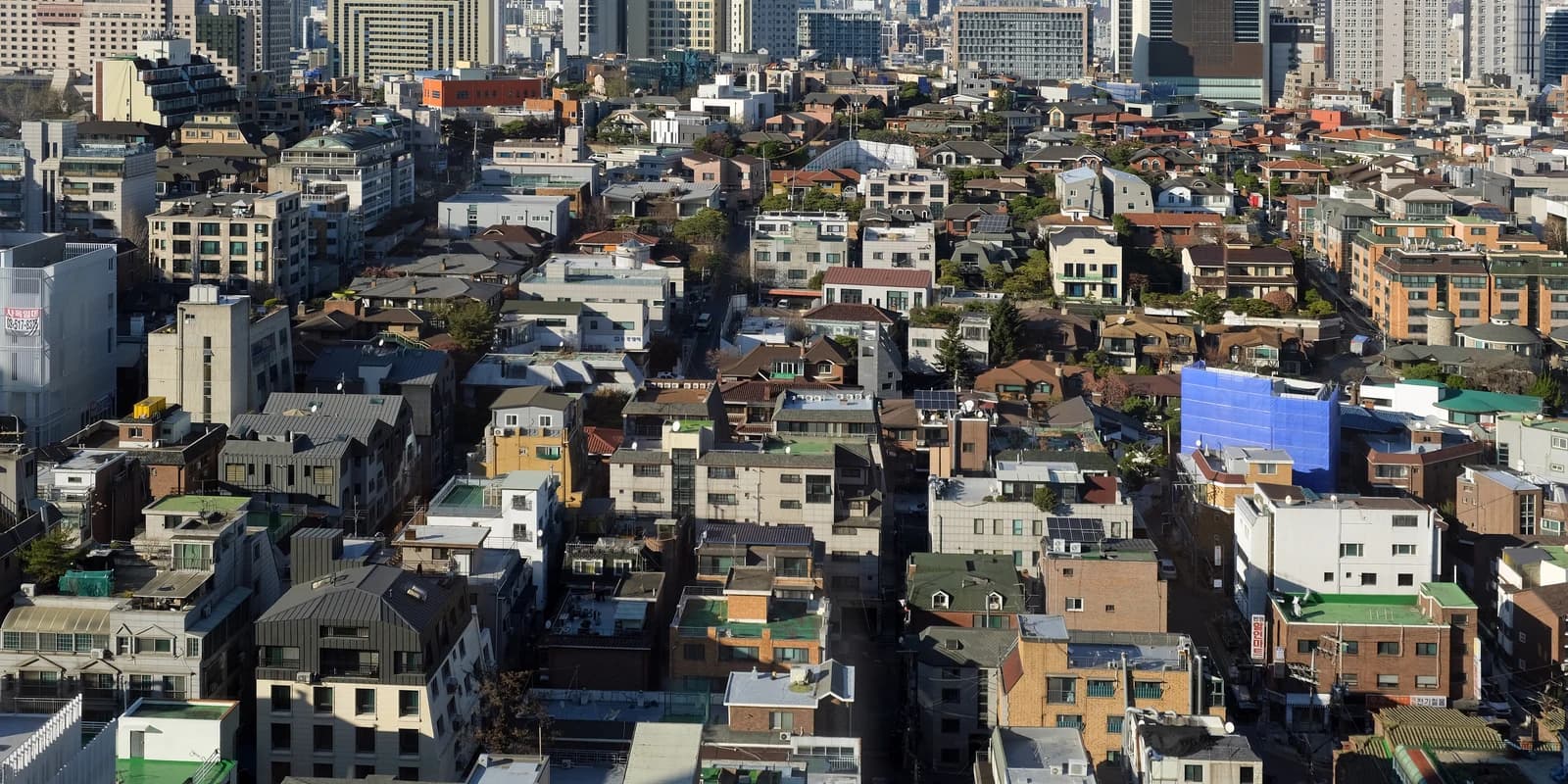
ISAPS figures are read directly from the society's own full-report PDFs for 2011, 2019, 2021, 2022, 2023 and 2024, not from summaries; the 2011 report's absence of any per-capita table, and Korea's absence from every procedure table since, were checked page by page. Per-capita reproductions are our own arithmetic with inputs stated, so readers can check them. The "8.9 per 1,000" figure is traced to a US listicle site of January 2024 citing ISAPS 2021, whose other entries reproduce exactly and whose Korean entry cannot, because that report contains no Korean row. The "23.5" figure is named as circulating and not repeated as data: its underlying procedure count has no traceable primary source. Survey figures are from Gallup Korea's 「외모와 성형수술에 대한 인식」 series (1994, 2004, 2015, 2020), a face-to-face national probability sample of 1,500; we flag that the twenties-women subgroup carries a materially wider margin than the headline sample, so the 2015-to-2020 move is reported as directional rather than conclusive. A frequently cited "one in five" figure is identified as a 2009 commercial panel. Foreign-patient statistics are from Korea's Ministry of Health and Welfare and KHIDI; absolute counts are used rather than departmental percentages, which use a different denominator. The ghost-surgery scale figure is an industry-body estimate with no published methodology and is labelled as such. No claim is made about any individual's procedures, and no judgement is offered about anyone's choices — this piece corrects statistics, nothing else. Images: hero — Gangnam-daero at Gangnam Station, where the sign stacks carry 미미성형외과, 한메성형외과, 윌성형외과 and 오라클피부과 among others, by 이인희 via 공유마당 (Korea Copyright Commission), CC BY 4.0; listing card — a clinic advertising wrap inside Apgujeong Station; cover — Gangnam-gu seen from Yeoksam. Note that Gangnam-daero is itself the Seocho-gu/Gangnam-gu boundary at this point, so the frame straddles two districts and we name the road rather than the district. No image depicts a patient, a procedure, a before-and-after, or any identifiable person presented as a surgery subject.
Keep Reading
More Stories
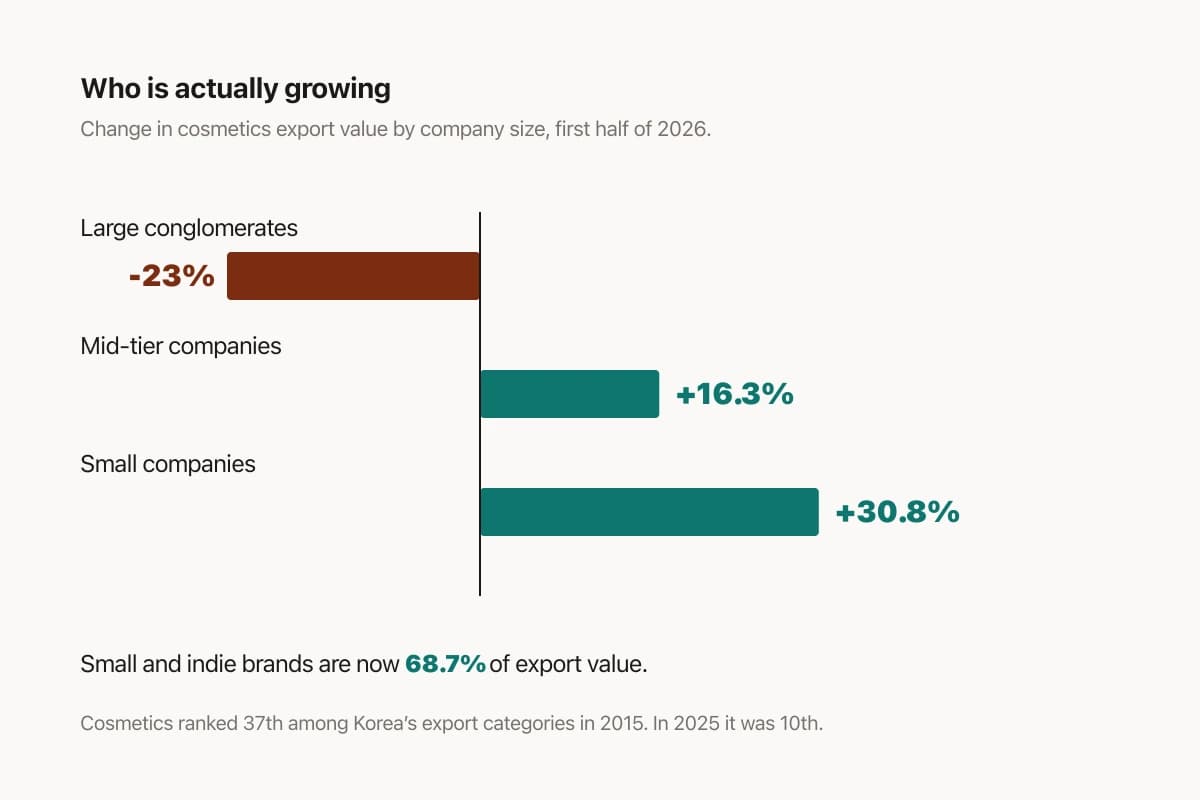
K-Beauty Just Had Its Biggest August on Record. Its Two Largest Companies Went Backwards.
Korean cosmetics exports hit $1.31 billion in August, up 52 per cent — the fastest monthly growth in nearly three years. Almost none of it belongs to AmorePacific or LG Household & Health Care, whose export value fell 23 per cent in the first half. Small brands are now 68.7 per cent of what Korea ships. And China, which took more than half of it five years ago, now takes one seventh.
Glass Skin, Honestly: How Much of K-Beauty's Most Famous Look Is Real?
It's the most screenshotted goal in all of K-beauty — poreless, lit-from-within, smooth as a pane of glass. Here's where the term actually comes from, the richer Korean vocabulary it flattens, and the honest breakdown of how much is skincare, how much is makeup and a ring light, how much is a dermatologist's needle — and how much is just genetics.
Korean Face Yoga, Honestly: Does 중안부 운동 Actually Work?
Your Korean feed is full of it right now — five-minute 'midface lifting' routines that promise to take ten years off, with dermatologists themselves doing them on camera. Here's what the science actually shows, what it quietly can't do, and the one mistake that makes it backfire.
The Weekly Dispatch
Korea, curated. Every week.
The best of K-culture, straight from Seoul. Written by people who actually live here.
Free, no spam, unsubscribe whenever.