The House of SK: The Textile Mill That Became the AI Era's Kingmaker
SK started with 15 looms in a bombed-out Korea. Seventy years later, a company few Westerners can name makes the memory chips that make Nvidia's AI possible — and, for one day in 2026, it was worth more than Samsung. This is how a textile house became the quiet kingmaker of the artificial-intelligence boom.
For one day in the summer of 2026, the most valuable company in South Korea was not Samsung.
On June 22, 2026, shares of SK Hynix rose far enough to push its market value past 2.1 quadrillion won — about US$1.35 trillion — and, briefly, the chipmaker overtook Samsung Electronics as the most valuable listed company in the country, something that had not happened in more than two decades (Nikkei Asia, Fortune). The reign lasted exactly one day; SK Hynix shares slipped the next session and Samsung took the crown back. But the moment was the point. A company most people outside Korea cannot name had, for an afternoon, become the country's crown jewel — on the strength of a single, unglamorous product: memory.
This is the story of how that happened. It is the fifth house in our series on how Korea got rich — after why Korea makes the world's memory chips, the chaebol itself, the House of Samsung, and the House of Hyundai — and it is the strangest of them. Because SK did not start in electronics, or steel, or cars. It started with cloth.
Fifteen Looms in the Rubble
In 1953, with the Korean War barely over, a young entrepreneur named Chey Jong-gun (최종건) took over a defunct textile mill in Suwon — property abandoned by the Japanese after the war — and restarted it with 15 looms. He called the company Sunkyong Textiles (선경직물) (SK Group, SK official history).
The name itself is a small fossil of the colonial era. "Sunkyong" was stitched together from the two Japanese firms that had preceded it on the site — Sŏnman (Senman) and Kyŏto (Kyŏng) — "Sŏn" plus "Kyŏng." When the group later took initials, those two syllables became "S.K." (Encyclopedia.com). A conglomerate that would one day supply the artificial-intelligence industry is, at its root, named after two vanished silk factories.
Sunkyong did what the best chaebol did in that era: it climbed the value chain. It produced Korea's first domestically made polyester in 1958, then pushed toward vertical integration — "from petroleum to fibers" — adding Sunkyong Oil in 1973 (Encyclopedia.com). Cloth led to chemicals; chemicals led to oil.
Then came the succession that would define the house. Founder Chey Jong-gun died in 1973, at just 47. His younger brother, Chey Jong-hyun (최종현), took over and ran the group for a quarter-century, steering it into telecommunications before his own death in 1998. Leadership then passed to Jong-hyun's eldest son, Chey Tae-won (최태원), who became chairman in 1998 at the age of 38 — and, that same year, renamed the sprawling group SK (Chey Tae-won, SK Group). It is Chey Tae-won who would make the bet this whole story turns on.
From Petroleum to Phone Lines
Before the chips, there was the phone network. In the 1990s SK made the leap that turned it from an energy-and-chemicals house into a household name: it took control of the country's dominant mobile carrier, the business now known as SK Telecom. By the 2000s, SK was one of Korea's largest conglomerates, spanning oil refining, chemicals, and wireless — a textbook chaebol, diversified to the point of abstraction, but with no real presence in the one industry that was rewriting the global economy: semiconductors.
That gap is what makes the next move so audacious. SK did not build a chip company. It bought a dying one.
The Chip Nobody Could Keep Alive
The chip in question had been born inside a rival dynasty. In 1983, the Hyundai group — the house that poured Korea's foundations — founded Hyundai Electronics (SK Hynix). For years it was a credible but second-tier memory maker. Then the 1997 Asian financial crisis hit, and the Korean government forced the country's over-extended conglomerates to consolidate.
The result was the "Big Deal." In 1999, under state pressure, Hyundai Electronics absorbed its domestic rival LG Semicon — the chip arm of the House of LG — buying roughly 59% for about 2,560 billion won (~US$2.1 billion) and merging Korea's two big memory makers into one (SK Hynix). Overnight, the combined firm became the world's number-two DRAM maker — and staggered under a mountain of debt from the deal.
The timing could not have been worse. In 2001 the company was renamed Hynix Semiconductor just as a brutal global memory glut sent chip prices into free-fall — DRAM prices reportedly collapsed by around 80% (SK Hynix). Bleeding cash, Hynix was handed to its creditor banks and spent more than a decade in financial purgatory: sold-off divisions, failed rescue attempts, a national champion nobody could quite kill and nobody could quite save.
The $3 Billion Bet (2012)
Enter Chey Tae-won. In 2011, SK Telecom entered the bidding for the wounded chipmaker. Rivals dropped out, leaving SK the last suitor standing, and in February 2012 it completed the purchase: 3.37 trillion won (about US$3 billion) for a 21.05% controlling stake. Hynix became SK Hynix (Korea Times, EE Times, SK Hynix).
At the time, the deal looked eccentric. A telecom company was spending billions to rescue a serially unprofitable memory maker in one of the most brutally cyclical businesses on earth. Chey pushed it through anyway — and the SK Hynix stake, today held largely through the investment company SK Square (spun off in 2021), would become the most consequential purchase in the group's history (SK Square ownership).
It is worth stating the chairman's record plainly, because Korean corporate history rarely comes clean. Chey Tae-won's tenure includes two criminal convictions: in 2003, in the SK Global accounting-fraud case, for which he received a three-year sentence; and in January 2013, for embezzling nearly 50 billion won (about US$45 million) from SK affiliates, for which he was sentenced to four years and imprisoned. He was released under a special presidential pardon granted by President Park Geun-hye in August 2015 (Chey Tae-won). Those are the facts of record. They sit, as they do with every Korean chaebol chief, alongside the equally factual record that his contrarian 2012 bet on memory is the reason SK briefly outweighed Samsung in 2026.
The Bet on a Chip No One Wanted Yet
Buying Hynix was the first gamble. The second was quieter, and for years it looked like a mistake.
Back in 2013–2014, SK Hynix partnered with the American chip designer AMD to co-develop something new: High Bandwidth Memory, or HBM — memory dies stacked vertically, like floors of a skyscraper, and wired together to move data far faster than the flat memory in an ordinary computer (High Bandwidth Memory, SK Hynix newsroom). SK Hynix shipped the world's first HBM in 2014; the first consumer product to use it was an AMD graphics card in 2015.
And then, for years, almost nothing. HBM was exotic, expensive, and niche — a clever answer to a question the mass market wasn't really asking yet. SK Hynix kept iterating anyway: HBM2, HBM2E, and in 2022 the mass production of HBM3. It was slow-burn engineering with no obvious payoff.
The payoff arrived with a name: Nvidia.
Becoming Nvidia's Kingmaker
When the generative-AI boom detonated, it turned out that the scarce ingredient in an AI supercomputer was not just the processor — it was the ultra-fast memory feeding it. That memory was HBM. And SK Hynix, after a decade of unglamorous stacking, was first in line.
In 2022, SK Hynix became the first company to supply HBM3 to Nvidia's H100 — the accelerator at the heart of the AI build-out — and it has led the generation race since (SK Hynix newsroom, SK Hynix). It moved on to HBM3E, began mass production of 12-layer HBM3E in September 2024, and announced that it had completed development of the next generation, HBM4, in September 2025 (SK Hynix).
The market position that resulted is genuinely dominant, though the exact number depends on how you count. By bit shipments in Q2 2025, the research firm Counterpoint put SK Hynix at about 62% of the HBM market; by revenue in the first half of 2025, TrendForce put it around 52% (Counterpoint via Astute, TrendForce). Either way, SK Hynix holds roughly 60% of the world's HBM — and around 38% of the broader DRAM market as of Q2 2025, one of the "big three" memory makers alongside Samsung and America's Micron (SK Hynix). The company's revenue for fiscal 2024 was 66.19 trillion won.
There is a shadow in those numbers. SK Hynix's fortunes are now bound tightly to a single customer: Nvidia reportedly drove about 27% of SK Hynix's revenue in the first half of 2025, up from far less a year earlier (TrendForce). The chip that made the company a kingmaker also made it dependent on the AI boom continuing — and on one buyer, in California, continuing to build.
What SK's Story Tells Us About Korea
Step back and the arc is almost absurd. A textile mill assembled from two abandoned Japanese silk factories climbs from cloth to chemicals to oil to phone lines, buys a bankrupt chipmaker that a rival dynasty had spun off, bets on a strange stacked-memory technology a decade before anyone needs it — and ends up, for one day in June 2026, worth more than Samsung.
But that arc is the chaebol story in its purest form. Korea got rich not by inventing from a blank page but by reinvention — by houses willing to abandon the business that built them and lunge at the next one. The Lees of Samsung went from groceries to semiconductors; the Chungs of Hyundai went from a rice shop to shipyards and cars; the Cheys of SK went from looms to the memory inside the world's AI. The through-line is not a product. It is the appetite to bet the whole house on a new one.
It is also a story with a warning folded inside it. The same concentration that made "how Korea got rich" possible — a few families, a few champions, a few products — is exactly what makes the boom fragile. A country whose crown jewel can be a single memory maker, whose memory maker leans a quarter of its revenue on a single foreign customer, has built something spectacular and precarious at once. For one day in 2026, that precarious thing was the most valuable company in Korea. The looms are long gone. The bet goes on.
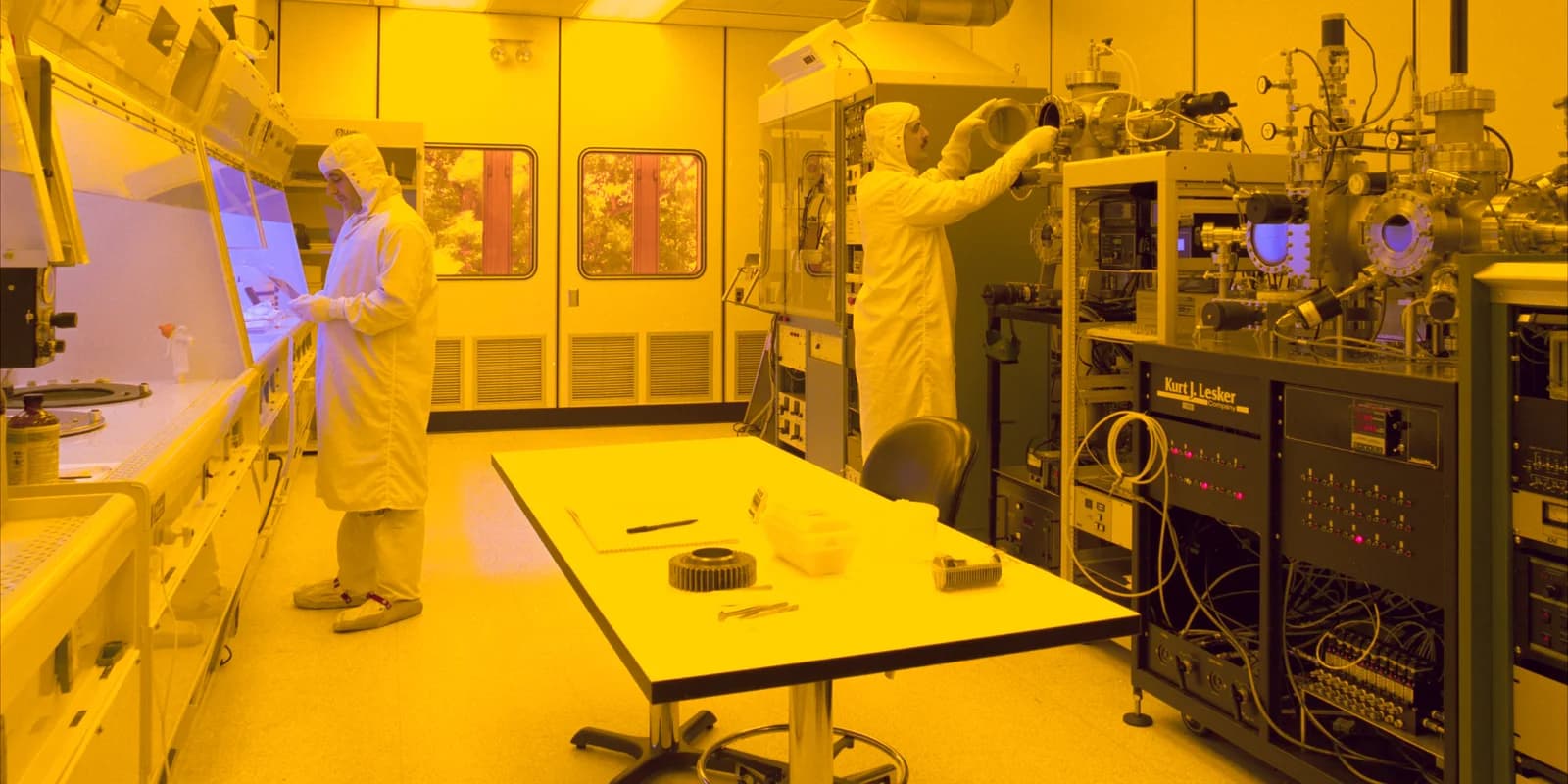
Hero: four Nvidia H100 AI accelerators — the chips SK Hynix's HBM helps power — photo by 极客湾Geekerwan, Wikimedia Commons, CC BY 3.0. Cover: a semiconductor cleanroom (illustrative — not an SK facility), Wikimedia Commons, public domain. Listing card: a silicon wafer by Inductiveload, Wikimedia Commons, public domain. Market-cap, market-share and revenue figures are dated in-text and drawn from the linked sources.


Keep Reading
More Stories
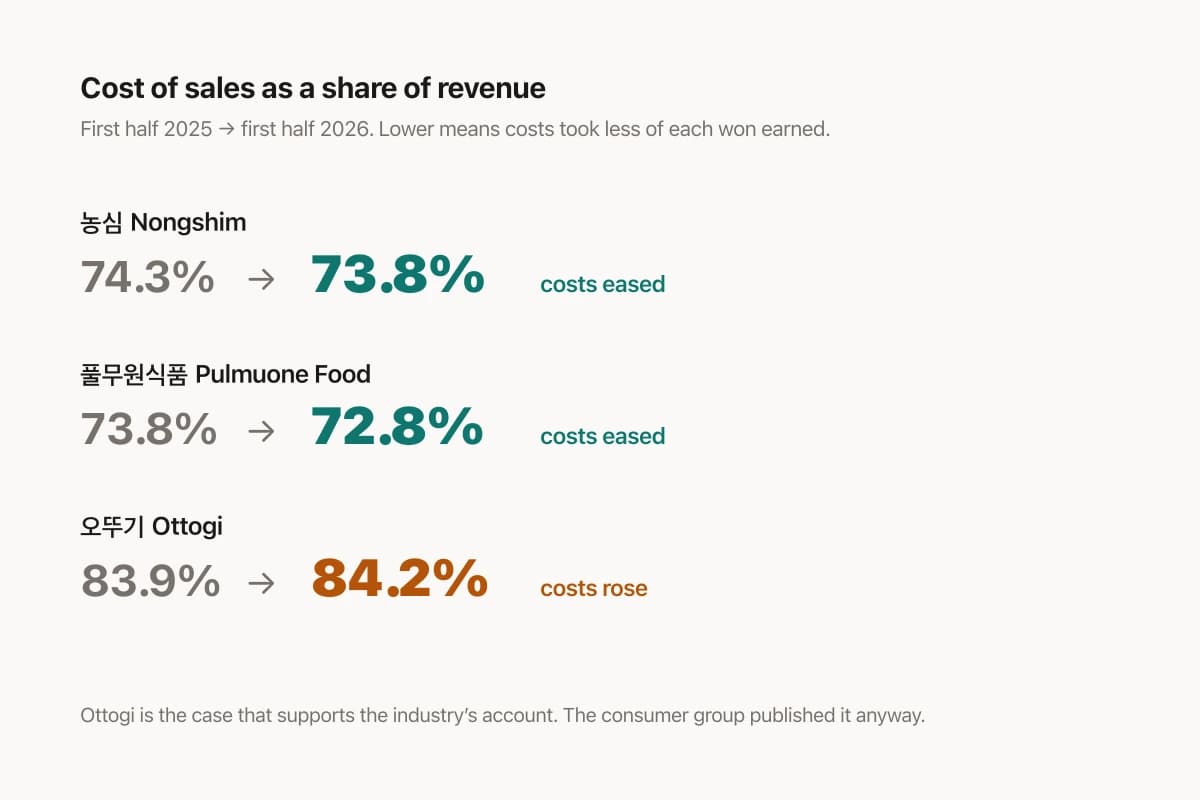
In April, Nongshim Cut Prices to Help With Inflation. In August It Raised Them, Using the Same Sentence.
Korea's biggest noodle company cut sixteen products in the spring, framed as joining the government's price-stability drive. Four months later it raised forty-three, framed as joining the government's price-stability drive. The products it cut are precisely the ones it left alone in August — and its own filings show the cost pressure it blames has not yet reached its margins. The awkward part is that the cost pressure is real.
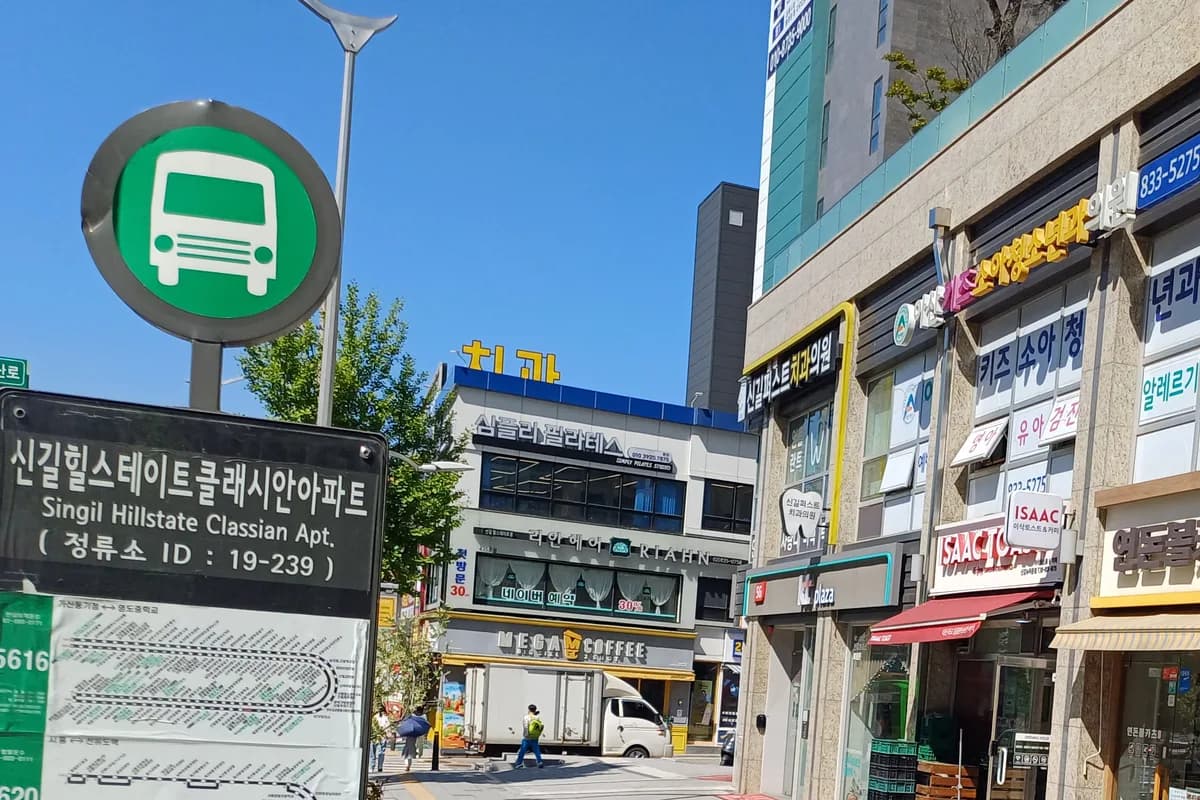
Korea's Longest Apartment Name Is 25 Characters — Seven Longer Than the Joke
Everyone says the names got long so mothers-in-law couldn't find the address. Twenty years of Korean and English coverage repeat that, and not once does anyone say it in the first person. Here is what actually happened: a decoder ring for 센트럴 and 포레, a Swedish word from a company with no Swedish business, and a 2021 study showing the thing residents vote hardest for doesn't work.
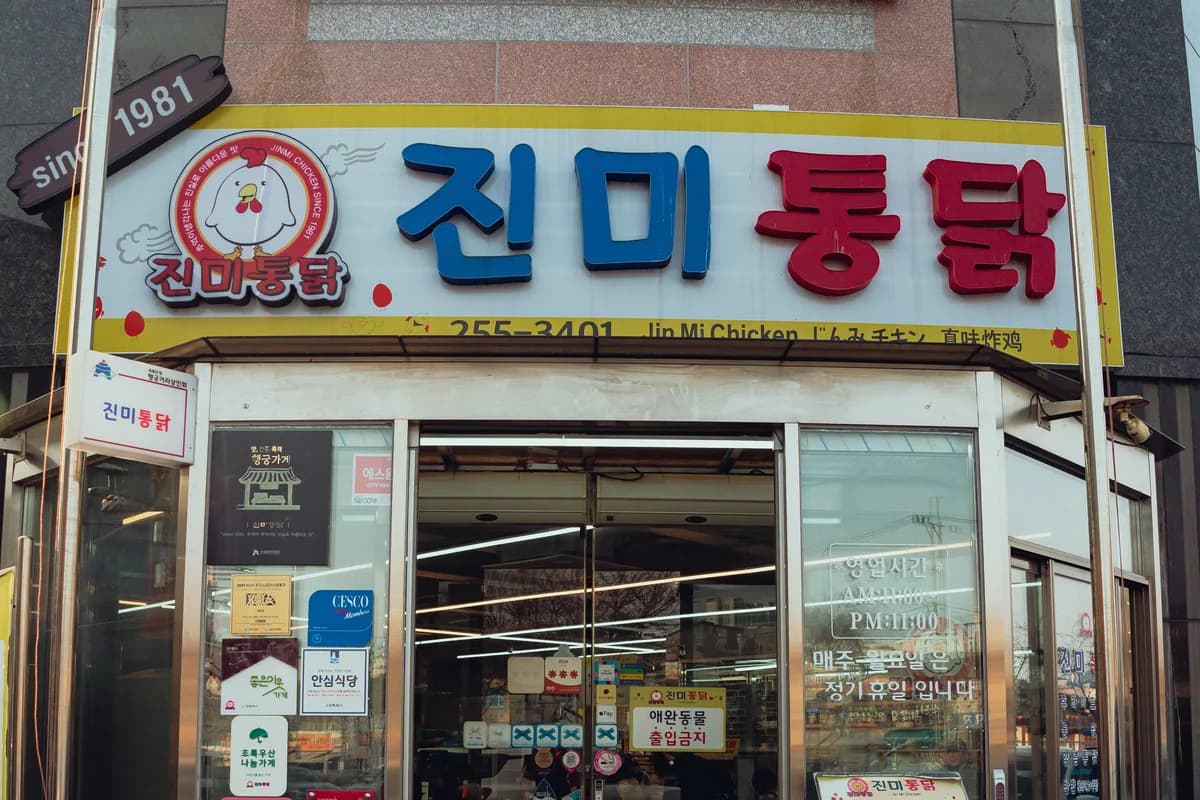
Korea Has Fewer Chicken Shops Than McDonald's Has Restaurants — the Famous Claim Was Counting Beer Halls
The number everyone quotes comes from a 2019 bank report whose own footnote says it includes 호프/통닭 licences and differs from the official count. On the like-for-like series the comparison is now the wrong way round. Four government bodies count Korean chicken shops four ways, two of them moving in opposite directions in the same year — and a decree amended last week finally requires the shops that closed to appear in the revenue forecast you're handed before you sign.
The Weekly Dispatch
Korea, curated. Every week.
The best of K-culture, straight from Seoul. Written by people who actually live here.
Free, no spam, unsubscribe whenever.