The Chaebol, Explained: The Families That Run Korea
Wake up in Seoul and you can spend the whole day inside a handful of family empires without noticing — your phone, your car, your apartment, the hospital you'd rush to. Here's what a chaebol really is, the 1961 shotgun marriage between a general and a dozen tycoons that built them, and the double edge of a country a few bloodlines run: the miracle, the gapjil, and 'too big to jail.'
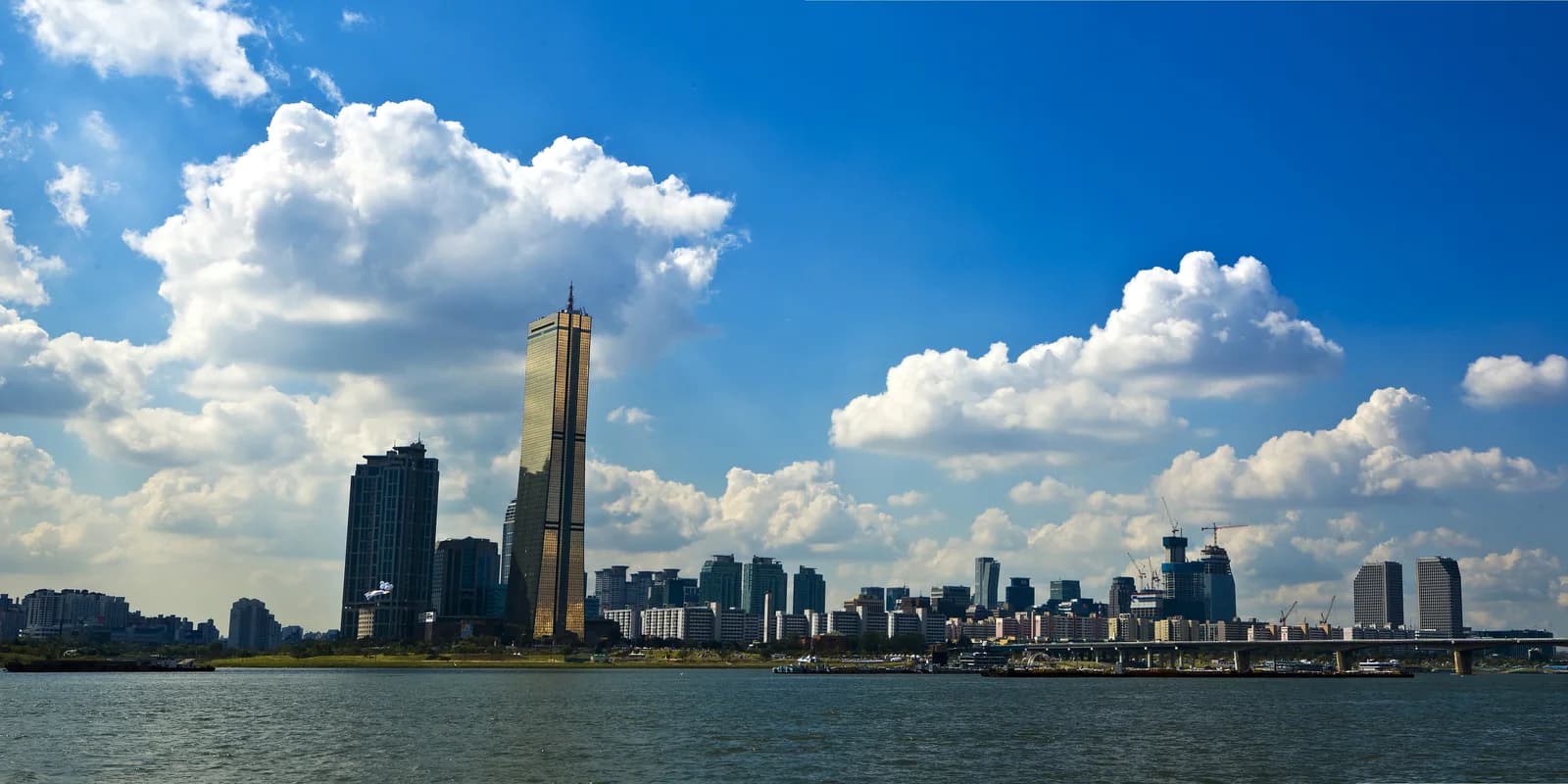
Wake up in Seoul and you may spend the whole day inside a single family's empire without noticing. The phone on the nightstand is a Samsung. The apartment it charges in was built by a Samsung or Hyundai construction arm. The car in the garage is a Hyundai. The convenience store on the corner, the department store downtown, the baseball team on the TV, the hospital you'd rush to in an emergency, the life-insurance policy in the drawer, the memory chip inside the laptop — again and again, they trace back to the same short list of surnames.
This is the strange, defining fact of modern Korea: a democracy of 50-plus million people whose daily life is quietly organized around a handful of family business empires. Koreans call them chaebol (재벌). And the word itself gives away what they really are.
What a Chaebol Actually Is
A chaebol is a large, family-controlled South Korean business conglomerate that sprawls across many unrelated industries — and the founding family runs the whole thing, handing control down across generations (Wikipedia, CFR).
Start with the name. Chaebol is written with the Chinese characters 財閥 — 財 (chae), "wealth" or "property," and 閥 (beol), "clan" or "faction." Literally, it means something close to "wealth clan." It shares its roots — and its exact characters — with the Japanese zaibatsu (財閥), the pre-war conglomerates it's often compared to (Wikipedia).
"Wealth clan" is the key. A chaebol is not a normal shareholder-owned company that happens to be big. It's a dynasty that wears a corporation's clothes — which is exactly why Koreans talk about the "royal families" of business, and why marriages, inheritances and succession battles inside these clans are treated as national news, not corporate footnotes.
Here's the part that sounds impossible. The founding family often controls an entire group while directly owning only a modest slice of it. Take Samsung's chairman, Lee Jae-yong. He directly owns only about 1.67% of Samsung Electronics — the group's crown jewel — yet steers it with a firm hand, because his control doesn't run through that flagship stake (Korea Herald). Instead it runs through a chain: the Lee family holds a much larger stake in the group's control apex, Samsung C&T, which in turn anchors a web of affiliates that ultimately steer Samsung Electronics (Seoulz).
How? Through a bit of financial plumbing called cross-shareholding, or circular ownership (순환출자). Picture a loop: company A owns shares in company B, B owns shares in C, and C owns shares back in A (Wikipedia). Because the companies mostly own each other, a small pool of family equity gets leveraged into control over the whole web of firms. Near-total control from a slim direct stake — that gap is the beating heart of the chaebol story.
This isn't just cultural shorthand; it's a formal legal category. South Korea's antitrust regulator, the Korea Fair Trade Commission (KFTC), designates "large business groups" each year — those whose assets top a legal threshold, historically about 5 trillion won — and back in 1999 regulators moved specifically against the classic circular-shareholding structure and the practice of affiliates guaranteeing each other's debts (Wikipedia).
The best-known names are the "Big Four" or "Big Five": Samsung, SK, Hyundai Motor, and LG, with Lotte or POSCO often rounding out a top five. By assets in recent (2025) rankings the order runs Samsung, SK, Hyundai Motor, then LG — with SK overtaking Hyundai for the No. 2 spot around 2021, powered by SK Hynix's memory-chip business (Korea Herald).
And the defining habit is sprawl. A single group commonly spans electronics, heavy industry, construction, finance, retail, chemicals and more — all under one family (CFR). That's how one clan ends up touching your phone, your apartment and your baseball team on the same afternoon.
How It Got This Way: A Shotgun Marriage
To understand why Korea is built like this, you have to go back to a scene that reads more like a thriller than an economics textbook.
The founding families are old — older than most people assume. Samsung was started in 1938 by Lee Byung-chul, as a trading firm dealing in dried fish, produce and noodles. Hyundai was founded in 1947 by Chung Ju-yung. LG (originally Lak Hui / Lucky Chemical) also dates to 1947, under Koo In-hwoi. SK Group began as a textile company in 1953 under the Chey family (Britannica, Wikipedia). A few proto-chaebol had already emerged under the Japanese colonial period (1910–45), and after Japan's 1945 withdrawal some Korean businessmen picked up formerly Japanese-owned "vested" assets (Wikipedia).
Then comes 1961. In the weeks after his May military coup, Major General Park Chung-hee had 51 of the country's leading businessmen arrested on charges of "illicit profiteering." Samsung's Lee Byung-chul, who happened to be in Japan, was placed under house arrest on his return (American Affairs).
But this wasn't a purge. It was an opening bid. The arrested tycoons were released after agreeing to donate property "for national construction" and to build factories; roughly the 13 most important were handed industrialization tasks, with promises of further favors if they hit export targets (American Affairs). Arrest, then partnership. That was the founding bargain of the state–chaebol pact.
Park then made the deal enforceable. One of his first moves after seizing power was to nationalize the commercial banks, putting the state in charge of who got credit. From there the machine was simple and brutal: firms that met the government's export quotas were rewarded with cheap loans, tax cuts, easy licenses and subsidies; firms that fell short lost access (Miracle on the Han River — Wikipedia). In January 1973 he declared the Heavy and Chemical Industrialization drive, targeting six strategic sectors — steel, petrochemicals, nonferrous metals, machinery, shipbuilding, and electronics (Wikipedia). These are, more or less, the industries the chaebol still dominate today.
The results were staggering. South Korea's exports jumped from about 3% of GDP in 1960 to over 30% by the early 1980s, and the combined sales of the largest business groups climbed from roughly 31% of GDP in 1975 toward nearly 100% by 1985 (Miracle on the Han River — Wikipedia). This is the "Miracle on the Han River," named for the river running through Seoul. It took the country from one of the poorest in the world in the early 1960s to a top-15 economy within a single generation.
But the miracle has an asterisk, and Koreans know it. Critics argue the growth was inseparable from repression and corruption — the state–chaebol pact rested on authoritarian labor suppression and cozy money-for-favors ties (IIAS). The mixed inheritance modern Koreans still live with — world-class Samsung and Hyundai on one side, concentrated dynastic power and a habit of corruption on the other — was written into that founding contract from day one.
The Economy Everyone Depends On (and Few Work For)
Fast-forward to now, and the numbers are almost hard to believe.
In 2024, Samsung Electronics alone — the flagship company — posted about 301 trillion won (roughly $219 billion) in revenue, one of its highest years ever (Samsung Newsroom). That single company equals roughly one-eighth of South Korea's entire GDP; the wider Samsung Group's sales have been estimated at over one-fifth of it — around 23% (Statista). One family group, a fifth of the economy — a scale of concentration with few parallels among developed economies.
Their reach shows up most vividly in exports. Korea's total exports hit an all-time record of $683.8 billion in 2024 (korea.net). Of that, semiconductors alone were $141.9 billion — about 20.8% of everything the country sold abroad, after a surge driven by AI-memory demand (KED Global). That single export category is essentially Samsung and SK Hynix — the two firms that, between them, make most of the world's memory chips.
Now here is the twist that makes the chaebol a genuinely cultural story, not just an economic one. These giants barely employ anyone. The chaebol conglomerates employ only about 10% of South Korea's workforce, while small and medium enterprises make up 99.9% of registered businesses and employ roughly 80% of workers (Facts and Details). Even Samsung Electronics — the crown jewel — employed only about 267,000 people worldwide at the end of 2024 (Statista).
So Korea's global image — Galaxy phones, Hyundai cars, the memory chips inside the world's AI boom — is written by a few family empires, while the lived reality for most citizens is the smaller, lower-paid firm down the street. Nearly everyone depends on companies almost nobody works for.
And the dependence is deepening, not loosening. Samsung Electronics alone was about 14.5% of the entire KOSPI stock market's value as of June 2025 — and that was actually its lowest weight in nine years (Korea Herald). Then the AI-memory boom took over: by 2026, Samsung and SK Hynix's combined weight in the KOSPI reportedly climbed above half the market — described as the highest two-stock concentration on record, enough to prompt warnings about forced foreign-investor outflows (KED Global). (These figures swing week to week — they're a snapshot, not a fixed line.) The upshot: when the world's appetite for memory chips rises or falls, it moves the retirement savings of an entire nation.
The Double Edge: Succession, Gapjil, and "Too Big to Jail"
If all of this were just efficient, Koreans would feel pride and nothing else. What they actually feel is pride braided with fury — because the families who run these firms have a long habit of seeming to live above the laws that built the country.
Succession is where the double edge starts. Because control rides on those cross-shareholding chains, passing the empire to the next generation is a legal engineering problem, not just an inheritance — and reinforcing that chain is, according to prosecutors, the alleged motive behind the deal at the center of Samsung's biggest scandal.
Here's the chain of events. Samsung heir Lee Jae-yong was convicted of bribery and embezzlement for bribing then-President Park Geun-hye and her confidante Choi Soon-sil to win government backing for a 2015 merger that tightened his grip on Samsung. In January 2021 he was sentenced to 2 years 6 months in prison (NBC News). He was released on parole in August 2021, then granted a full presidential pardon by President Yoon Suk Yeol in August 2022 — with the government explicitly citing Samsung's importance to the national economy as the reason (PBS). In a separate case over the same merger, he was acquitted of stock manipulation and accounting fraud, and South Korea's Supreme Court upheld the acquittal in a final ruling on July 17, 2025 (UPI).
The pattern isn't new, and it isn't just Samsung. Lee Jae-yong's father, founder-chairman Lee Kun-hee, was convicted twice — of bribing politicians in 1996 and of tax evasion in 2008 — and was pardoned both times, in 1997 and again in 2009, serving no prison time in either case (Lee Kun-hee — Wikipedia). SK Group chairman Chey Tae-won was convicted of embezzlement in 2013 and sentenced to four years — one of the longest sentences ever handed to a chaebol chief. He was pardoned in August 2015 after serving about two and a half years, and was reinstated to SK's board in 2016 (Chey Tae-won — Wikipedia).
Legal scholars have a name for this: the "too big to jail" problem. Korean judges often apply a "three-five rule" — a three-year sentence, suspended for five years — so chaebol executives typically serve no time, with judges citing the executive's economic contributions as mitigating factors (ProMarket). A peer-reviewed study put numbers on the bias: among 28 controlling shareholders and managers from large business groups charged with embezzlement or breach of duty between 2004 and 2008, none were imprisoned without probation — versus 19 of 50 comparable managers from other public firms who did get real prison time (ProMarket).
Then there's the everyday version of chaebol power, the one ordinary Koreans meet in person. In December 2014, Cho Hyun-ah (Heather Cho) — a Korean Air vice president and daughter of the chairman — ordered a taxiing aircraft back to the gate at New York's JFK because a flight attendant served her macadamia nuts in a bag instead of on a plate. She was convicted of obstructing the flight's operation and served about four and a half months before an appeals court suspended her sentence in 2015 (NPR). The "nut rage" episode became Korea's defining example of gapjil (갑질) — from gap, the dominant party in a contract, and jil, undesirable behavior — meaning abuse of authority by the powerful over those beneath them (Wikipedia).
The Cho family's troubles didn't stop there. In April 2018, younger daughter Cho Hyun-min reportedly threw water at an advertising executive during a meeting — the alleged "water rage" — and matriarch Lee Myung-hee faced allegations that she assaulted staff. Hanjin Group publicly acknowledged at the time that "some of the assaults are factual" (CNN). The backlash was unprecedented: hundreds of uniformed Korean Air employees protested in Seoul's Gwanghwamun square wearing Guy Fawkes masks to hide their identities (CNN).
Even the dynasty's endings are outsized. When Lee Kun-hee died in 2020 and control passed to Lee Jae-yong — the third generation of the Samsung line — the family faced an inheritance-tax bill of roughly 12 trillion won (about $8 billion), reported as the largest in South Korean history. That reflects how Korea taxes inherited controlling stakes: the controlling-share portion is taxed at roughly 60% — the country's 50% top rate plus a 20% surcharge for controlling stakes (Korea Herald).
Living With the Wealth Clans
Put it all together and you get one of the more honest contradictions in modern national life. Koreans are genuinely proud of Samsung, Hyundai, SK and LG — these are the firms that dragged the country out of poverty in a single generation and made "Korea" mean cutting-edge technology to the rest of the world. And Koreans are genuinely angry at the same firms — at the concentration of power in a few bloodlines, at the gapjil, at the sense that a conviction is just a step on the way to a pardon.
That's not a bug in the story; it's the whole story. The chaebol were drafted into existence by a military strongman in 1961, grown on state-directed credit, and never fully weaned off the idea that the nation needs them too much to let them fall. The "wealth clans" still run much of Korea — and Korea, for now, still runs on them.
The same growth-era machinery that built the chaebol also built the way ordinary Koreans housed themselves — jeonse, the no-rent lump-deposit lease that's now dying as the miracle economy cools.
Ownership stakes, market-cap weights and GDP shares move constantly; the figures here are 2024–2026 snapshots, not fixed lines. Court outcomes described are matters of public record — where something is an accusation rather than a finding (the Hanjin "water rage" and related allegations), it is flagged as such.
Keep Reading
More Stories
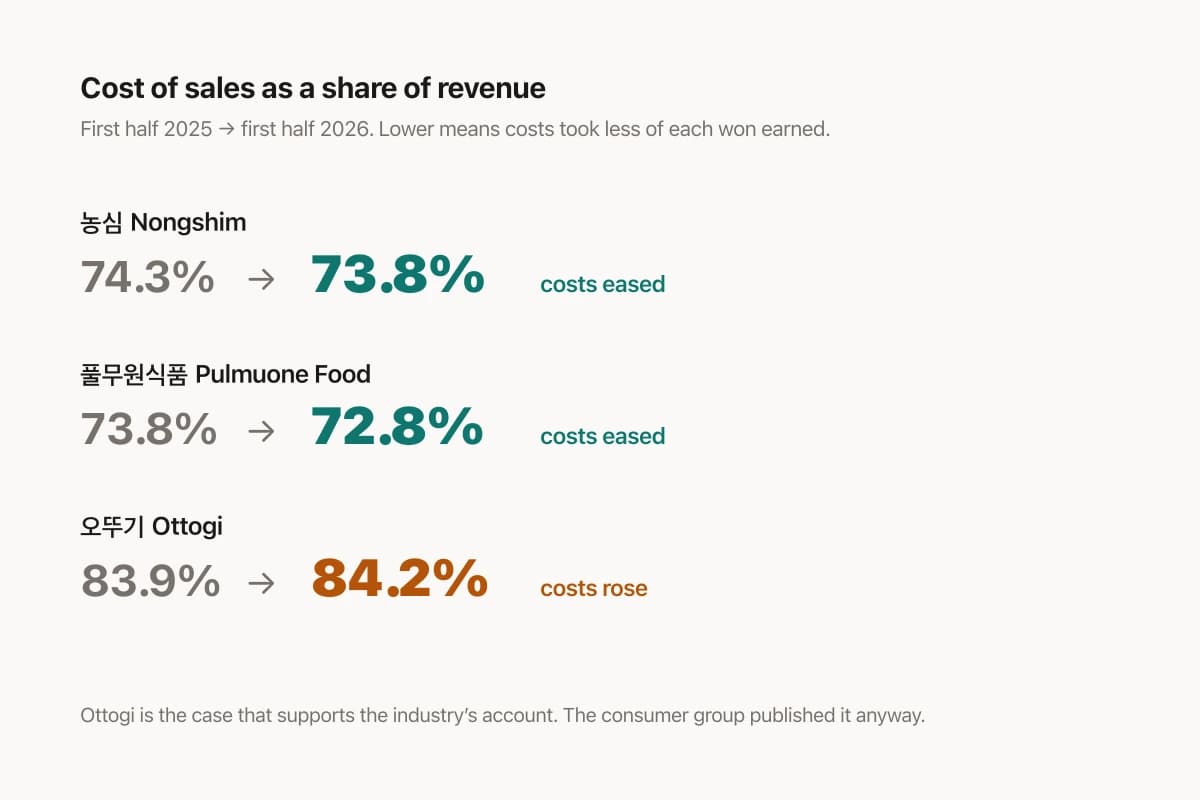
In April, Nongshim Cut Prices to Help With Inflation. In August It Raised Them, Using the Same Sentence.
Korea's biggest noodle company cut sixteen products in the spring, framed as joining the government's price-stability drive. Four months later it raised forty-three, framed as joining the government's price-stability drive. The products it cut are precisely the ones it left alone in August — and its own filings show the cost pressure it blames has not yet reached its margins. The awkward part is that the cost pressure is real.
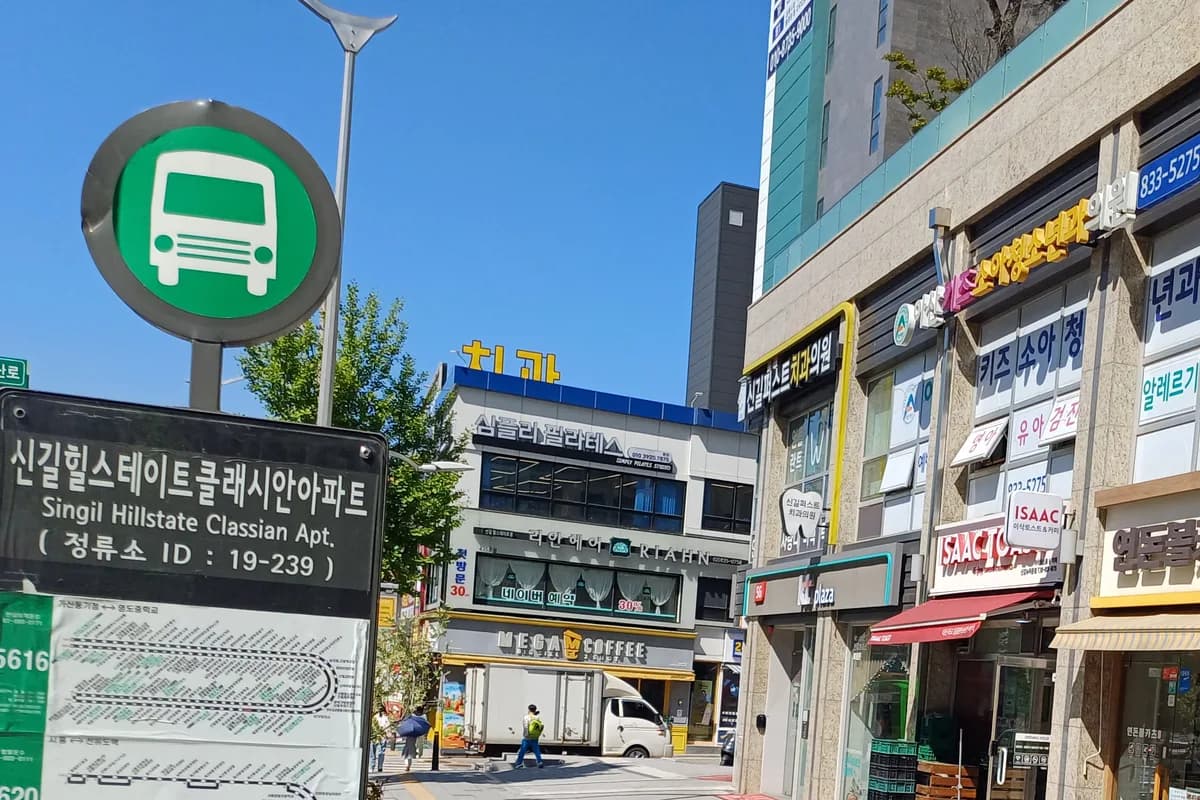
Korea's Longest Apartment Name Is 25 Characters — Seven Longer Than the Joke
Everyone says the names got long so mothers-in-law couldn't find the address. Twenty years of Korean and English coverage repeat that, and not once does anyone say it in the first person. Here is what actually happened: a decoder ring for 센트럴 and 포레, a Swedish word from a company with no Swedish business, and a 2021 study showing the thing residents vote hardest for doesn't work.
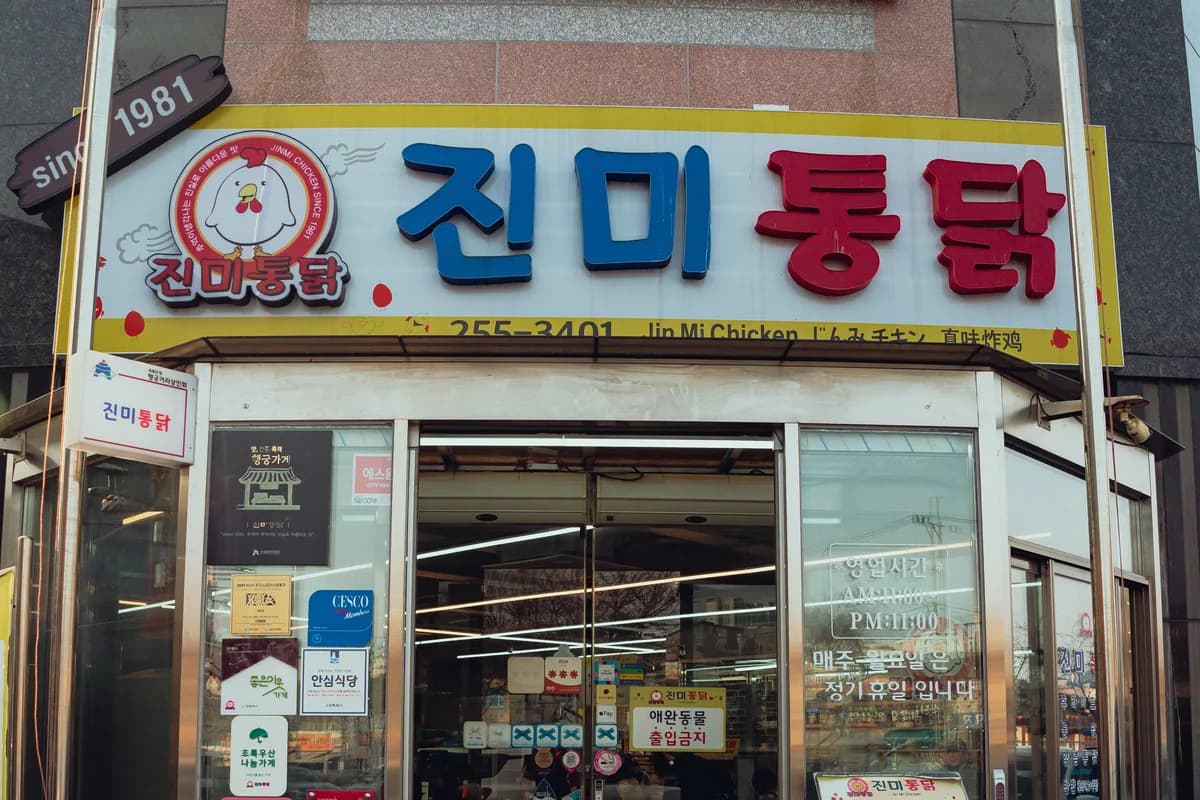
Korea Has Fewer Chicken Shops Than McDonald's Has Restaurants — the Famous Claim Was Counting Beer Halls
The number everyone quotes comes from a 2019 bank report whose own footnote says it includes 호프/통닭 licences and differs from the official count. On the like-for-like series the comparison is now the wrong way round. Four government bodies count Korean chicken shops four ways, two of them moving in opposite directions in the same year — and a decree amended last week finally requires the shops that closed to appear in the revenue forecast you're handed before you sign.
The Weekly Dispatch
Korea, curated. Every week.
The best of K-culture, straight from Seoul. Written by people who actually live here.
Free, no spam, unsubscribe whenever.