Korea's Stock Market Stopped for Twenty Minutes on 15 October. It Is Down 39% Since June
KOSPI fell 7.57% on 15 October and tripped its circuit breaker for the sixteenth time ever, and the tenth time this year. It was the seventh straight day of losses, and still not 2026's worst day. The index that closed above 9,000 in June has lost nearly two-fifths of its value. So far the government's answer has been a warning to brokers about lending.
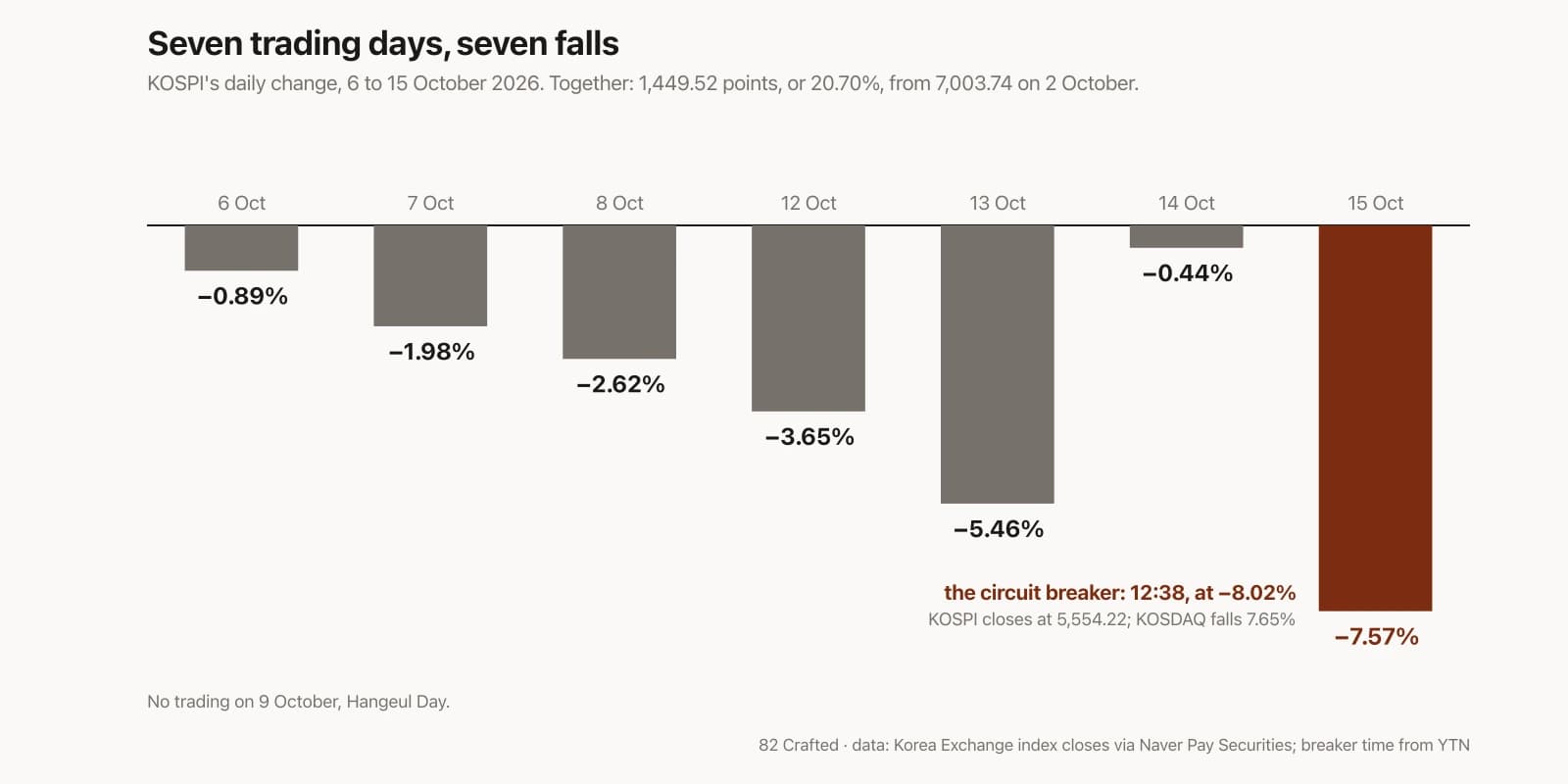
At 12:38 on Thursday 15 October, trading stopped on Korea's main stock market.
The KOSPI index was down 8.02%, at around 5,527. Under the Korea Exchange's rules, a fall of 8% or more that lasts for a minute trips the first stage of the circuit breaker: all trading halts for twenty minutes, and then there are ten minutes of single-price auction before normal trading resumes. Fifteen minutes earlier, at 12:23, the same had happened on KOSDAQ, the junior board, at −8.03%.
It had been coming since the open. KOSPI started the day 5.59% down, at 5,673.01, and within ten minutes a sell-side sidecar (a short pause on programme selling) had kicked in, its second since 13 October. At its lowest the index was 9.29% down, at 5,450.81. It closed at 5,554.22: down 454.59 points, or 7.57%. KOSDAQ closed 7.65% lower, at 760.82. Samsung Electronics fell 9.48%, to ₩210,000, and SK hynix fell more than 11%, to ₩1,262,000. At the 3:30 pm close the won was 6.3 weaker, at ₩1,344.6 to the dollar.
By YTN's count this was the sixteenth time KOSPI's circuit breaker had tripped, and the fifteenth for KOSDAQ. For KOSPI it was the tenth time in 2026 alone. It was also the first time since 29 July that both boards had stopped on the same day.
And it was not the worst day of the year.
Not the worst day
15 October was the biggest fall since 28 July, when KOSPI lost 10.84%. Among this year's daily falls it ranks seventh. The worst single day in KOSPI's history came this year too. On 4 March the index fell 12.06%, a fall 헤럴드경제 put down to the US–Iran war. That beat the 12.02% lost on 12 September 2001. The 9.99% fall of 23 June is the fifth-largest ever.
What set 15 October apart was what came before it.
Seven days
KOSPI closed at 7,003.74 on 2 October. It then fell on each of the next seven trading days: 6, 7, 8, 12, 13, 14 and 15 October, with the market shut for Hangeul Day on the 9th. Together the seven falls came to 1,449.52 points, or 20.70%.
Before the 15th, the worst of them was 13 October, at −5.46%. That day foreign investors were net sellers of ₩4.58 trillion. Brokers' forced sales of customers' margin positions, 반대매매 (shares bought on credit and sold off when the collateral runs short), reached ₩59.3 billion, the most since late July. Outstanding margin loans stood at ₩34.25 trillion, about US$26 billion. That was up some ₩7 trillion since early August.
On the 15th itself, foreigners sold more than ₩3.6 trillion net. Counts of their October selling up to that day differ: ₩17.8 trillion in one tally, ₩20.7 trillion in another. Both tallies put about four-fifths of it in the two chipmakers, SK hynix and Samsung. Going the other way, Korean retail investors bought ₩7.07 trillion of those same two stocks between 1 and 14 October. By 스페셜타임스's figure, the foreign share of KOSPI's market value fell to 38.29%, the lowest since 4 May.
Why, as reported
The reasons officials and reporters gave were the same three, more or less everywhere.
- American inflation. US consumer prices for September rose 3.7% on the year, against 3.6% expected, raising fears of another rise in US interest rates.
- AI. There is doubt about whether the enormous spending on artificial intelligence will pay for itself, and a risk that AI companies cut back.
- Oil. Prices were higher.
The officials at the Financial Services Commission's emergency meeting that afternoon named the same three: the US rate risk, uncertainty over AI chips, and oil. They also said the market had "다소 과도하게 반응" — reacted somewhat excessively. The next day officials gave a reason particular to Korea: "국내 증시는 다른 시장에 비해 업종 비중의 차이 등으로 변동성이 상대적으로 크게 나타나고 있다". That is, compared with other markets, Korea's is showing relatively large swings, because of differences such as how heavily it is weighted towards particular industries. On 15 October, that meant two chipmakers.
From 9,114
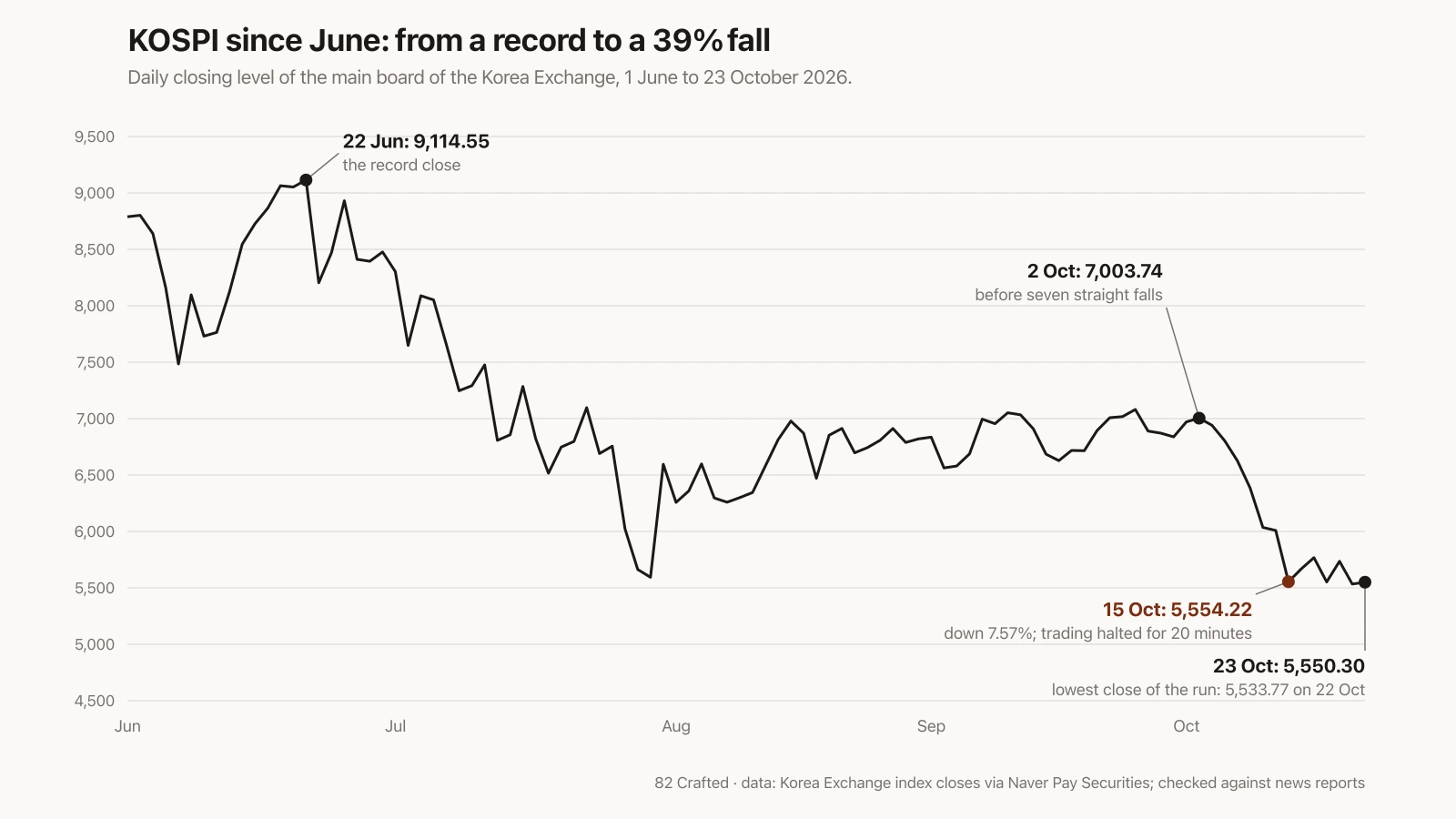
The fall is from a great height. In 2025 KOSPI rose 75.6%, to 4,214.17, its third-best year on record. The Korea Exchange credited the new government's policies on shareholder value and market manipulation, and an upturn in chips. Then 2026 went faster still:
| Milestone | First close |
|---|---|
| Above 4,000 | 27 October 2025 |
| Above 5,000 | 27 January 2026 |
| Above 6,000 | 25 February |
| Above 7,000 | 6 May |
| Above 8,000 | 26 May (it first touched 8,000 during trading on 15 May) |
| Above 9,000 | 18 June, at 9,063.84 |
| Record | 22 June, at 9,114.55 |
The highest point reached during trading was 9,385.59, on 19 June. By 2 October, before the seven-day slide began, KOSPI was already about 23% below its record. By 23 October it was 39.1% below it. KOSDAQ was about 38.7% below its own record of 1,226.18, set on 27 April.
And KOSPI is still about 31.7% higher than at the end of 2025. Whether this year has been a boom or a bust depends on when you bought. Anyone who bought the index on the first day of trading in January is ahead. Anyone who bought at the June peak has lost nearly two-fifths.
Since the 15th
The bounce did not last. KOSPI rose 2.05% on the 16th and 1.76% on the 19th, to 5,768.01. On the 20th it fell 3.73%. On the 22nd it closed at 5,533.77, the lowest close of the run and the lowest since 7 April.
On Friday the 23rd it opened 2.36% down and fell as far as 5,305.98, below the lowest point of 15 October. It then climbed back to close 0.30% up, at 5,550.30. That was still 0.07% below where it had closed on the day of the circuit breaker. SK hynix closed 4.42% up, after putting on hold a planned US listing of Solidigm, its subsidiary. Foreigners sold another ₩1.09 trillion net. KOSDAQ closed at 751.69, its lowest since 3 August.
What the government did
On the afternoon of the 15th, the chair of the Financial Services Commission, 이억원, held an emergency meeting on the markets at the Government Complex in Seoul. The Financial Supervisory Service, the Korea Exchange and market experts attended. The chair asked them to "작은 변동성에도 경각심을 갖고 금융시장 안정과 투자자 보호에 적극 대응해달라" — to stay alert to even small swings and act actively for market stability and investor protection. Financial firms were told "무분별한 신용공여를 자제하고, 고객 보호와 리스크 관리에 만전을 기해 줄 것" — to refrain from reckless lending on credit, and to take every care over customer protection and risk management. A contingency plan was made ready. The commission promised zero tolerance for rumours, manipulation and illegal short-selling, and a closer watch on money flows.
The meeting announced no market-stabilisation fund, no ban on short-selling and no new limits on credit.
On the 16th the government held a joint meeting on the markets. It was chaired by 권대영, the finance ministry's first vice-minister, because the Deputy Prime Minister for the economy, 이형일, and the Governor of the Bank of Korea, 신현송, were in Bangkok for the IMF and World Bank meetings. The officials pointed to the IMF's upgrade of Korea's growth forecast for 2026, from 2.6% to 3.3%. We found no statement from the Bank of Korea on the fall.
The President spoke on 19 October, at a press meeting at 춘추관, the presidential press centre. President 이재명 said a full report was due soon, after which "필요한 조치를 할 것" — necessary measures would be taken. The President went on: "'아닐 거야, 아닐 거야' 하다가 소위 물린 분들이 많지 않나. 그런 상황을 최소화할 필요는 있다". Aren't there many people who kept telling themselves "it won't happen, it won't happen" and got, as they say, bitten? That kind of situation needs to be kept to a minimum.
The next day, the 20th, KOSPI fell 3.73%. That day the President posted on X about "한국경제 기초체력의 극적인 반전, 반가운 소식" — a dramatic turnaround in the Korean economy's fundamentals, welcome news. The People Power Party's chief spokesman, 박충권, called the post "자산이 토막 난 국민들의 성난 마음에 부채질을 해대는 무감각과 무책임의 극치": the height of insensitivity and irresponsibility, fanning the anger of people whose assets have been cut to pieces.
What it says
By the exchange's own account, the rally was partly a policy story. It credited the government's push to make Korean shares worth holding. A government that shares the credit for a rising market will be asked about a falling one. Its answer so far has been a contingency plan, made ready. It has also said the market overreacted, and told brokers to stop lending recklessly.
That last instruction came on the 15th. The forced sales of margin positions had already hit their highest since July two days earlier. Outstanding margin loans had grown by about ₩7 trillion since early August, which was after the record and on the way down. The people the President called "물린 분들", the ones who got bitten, are by definition the ones who bought before the fall, and some of them did it with borrowed money.
KOSPI is still up almost a third on the year. That figure is true, and it is no comfort to anyone who bought in the summer.
Images. All three graphics are ours, built from the Korea Exchange's daily index closes as published through Naver Pay Securities and checked against news reports for every date we cite. We used no photograph. Commons has only one photo of the Korea Exchange, of its Busan building in 2012, and South Korea's freedom of panorama does not cover this use.
Sources. The day's figures, the open, the low and the fall in points are from SBS Biz and 스페셜타임스. The circuit-breaker times, levels and counts are from YTN and 비즈워치, with earlier counts from MTN and SBS Biz. The rankings of falls are from SBS Biz, 헤럴드경제 and YTN, and from the index data. Samsung and SK hynix are from MBC and 조선일보. The won is from SBS Biz and 뉴스핌. The causes are from 스페셜타임스, SBS Biz, YTN and MTN. Foreign selling, the market share and margin debt are from 스페셜타임스, 세계일보, 비즈워치 and 뉴스핌. The FSC meeting is from SBS Biz, MTN and SatEconomy. The 16 October meeting is from MTN. The President's remarks are from 매일신문, and 박충권's from 위키트리. The 2025 rally is from 스마트투데이, and the milestones from 뉴시스, 서울신문 and the index data.
Stated rather than smoothed. The "sixteenth" is YTN's count for KOSPI. "Tenth this year" is our own arithmetic from MTN's count of seven by 4 March. Foreign net selling on 15 October is ₩3.6463 trillion in one report and ₩3.624 trillion in another, so we have said "more than ₩3.6 trillion". The October totals differ more, as given above. We found no figure for what individuals and institutions bought on the 15th, only that both were net buyers. A report that the big brokers cut credit limits did not check out, and we have not used it. The cause of 4 March is as 헤럴드경제 gave it. Single-stock prices are taken from news reports rather than from the index data, which we found unreliable for individual shares. Nothing here is investment advice.
Keep Reading
More Stories
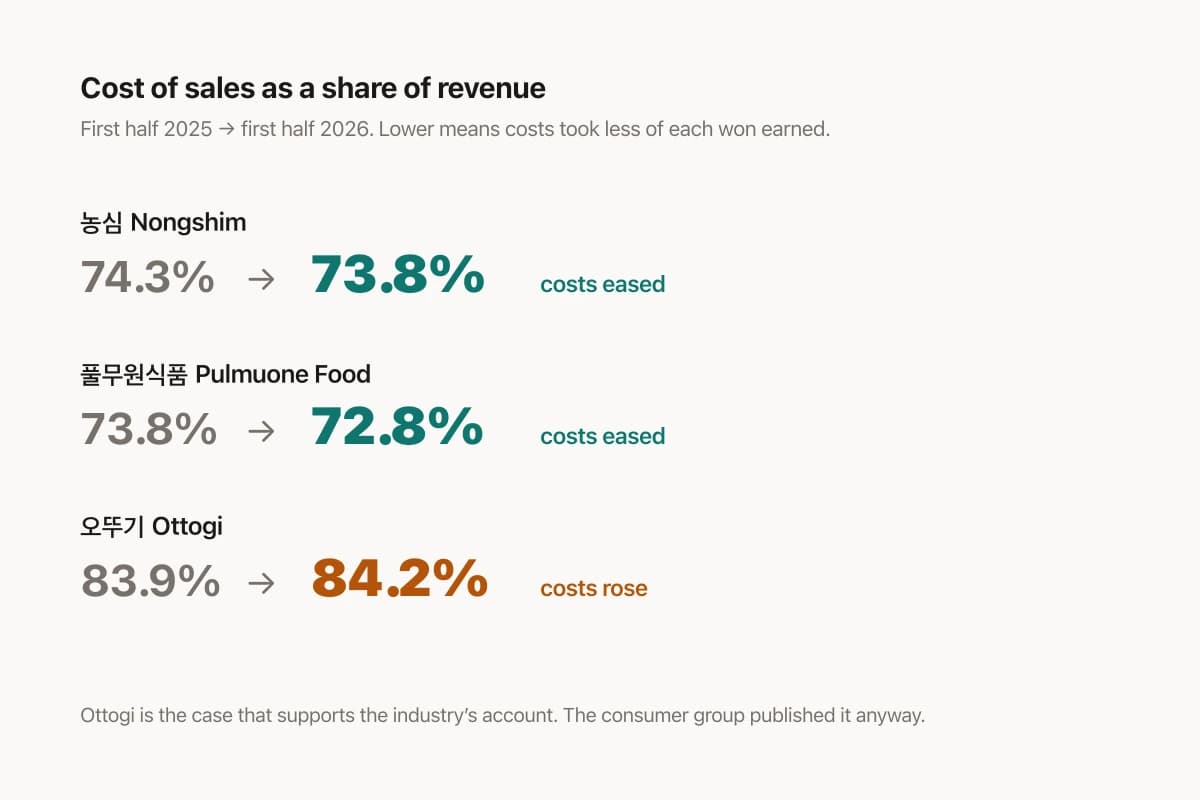
In April, Nongshim Cut Prices to Help With Inflation. In August It Raised Them, Using the Same Sentence.
Korea's biggest noodle company cut sixteen products in the spring, framed as joining the government's price-stability drive. Four months later it raised forty-three, framed as joining the government's price-stability drive. The products it cut are precisely the ones it left alone in August — and its own filings show the cost pressure it blames has not yet reached its margins. The awkward part is that the cost pressure is real.
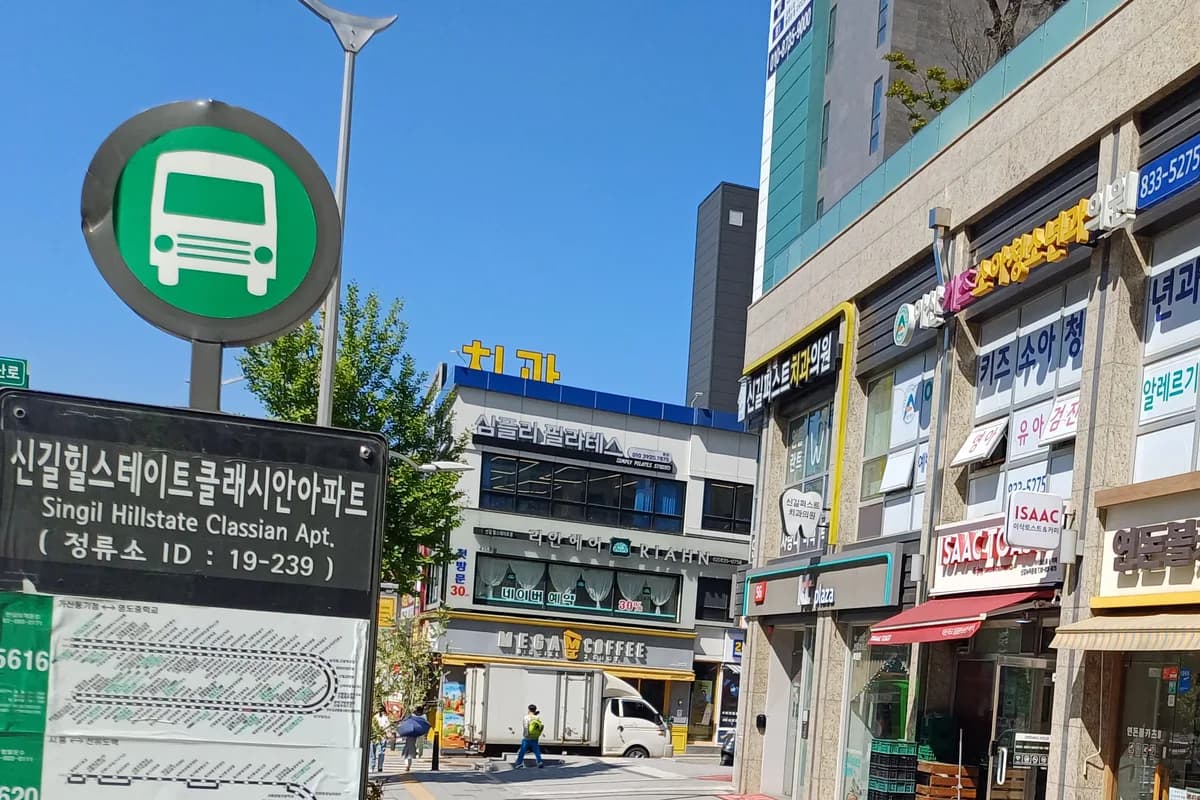
Korea's Longest Apartment Name Is 25 Characters — Seven Longer Than the Joke
Everyone says the names got long so mothers-in-law couldn't find the address. Twenty years of Korean and English coverage repeat that, and not once does anyone say it in the first person. Here is what actually happened: a decoder ring for 센트럴 and 포레, a Swedish word from a company with no Swedish business, and a 2021 study showing the thing residents vote hardest for doesn't work.
Korea Has Fewer Chicken Shops Than McDonald's Has Restaurants — the Famous Claim Was Counting Beer Halls
The number everyone quotes comes from a 2019 bank report whose own footnote says it includes 호프/통닭 licences and differs from the official count. On the like-for-like series the comparison is now the wrong way round. Four government bodies count Korean chicken shops four ways, two of them moving in opposite directions in the same year — and a decree amended last week finally requires the shops that closed to appear in the revenue forecast you're handed before you sign.
The Weekly Dispatch
Korea, curated. Every week.
The best of K-culture, straight from Seoul. Written by people who actually live here.
Free, no spam, unsubscribe whenever.