Korea's Longest Apartment Name Is 25 Characters — Seven Longer Than the Joke
Everyone says the names got long so mothers-in-law couldn't find the address. Twenty years of Korean and English coverage repeat that, and not once does anyone say it in the first person. Here is what actually happened: a decoder ring for 센트럴 and 포레, a Swedish word from a company with no Swedish business, and a 2021 study showing the thing residents vote hardest for doesn't work.
Try saying this to a taxi driver:
초롱꽃마을6단지GTX운정역금강펜테리움센트럴파크
Twenty-five characters. It is a real housing estate in Paju, Gyeonggi Province. It is also, as of 2024, tied for the longest apartment name in South Korea — level with 광주전남공동혁신도시빛가람대방엘리움로얄카운티 (1차 and 2차), which despite starting with the word Gwangju is in Naju, and is named that way because the site is the joint Gwangju–South Jeolla innovation district.
For scale: when Chosun Ilbo went looking for a benchmark, it measured these against 김수한무 거북이와 두루미 삼천갑자 동방삭… — the famously absurd endless name from a classic Korean comedy sketch, the one whose entire joke is that it is impossible to say.
That gag name is 18 characters. Real Korean apartments now beat the joke by seven.
The residents, incidentally, call their own estates 「초롱꽃 6단지」 and 「빛가람동 대방」. Six characters. The long names survive only on paper.
The Climb
Korean apartment names were not always like this. A 2014 survey of 16,342 complexes nationwide tracked the average by completion decade:
| Built | Average characters |
|---|---|
| Before 1979 | 3.0 |
| 1980s | 3.5 |
| 1990s | 4.2 |
| 2000s | 6.1 |
| 2010 onward | 8.0 |
By 2019 the average for newly supplied complexes was 9.84. In 2023 it was 9.86 — essentially flat, which is worth noting: the inflation has stopped, it just stopped at a bad number. Between 2020 and mid-2026, 42.7% of new names ran nine to eleven characters.
And the record itself keeps growing. In 2014 the national longest was 19 characters, in Paju. In 2023 it was 25, also in Paju. That city has held the title twice, ten years apart, with two different estates.
The Decoder Ring
Here is the useful part. Modern Korean apartment names are assembled from parts, and once you know the parts you can read any of them.
The structure is roughly: place + builder's brand + 펫네임 (pet name) — and it is the pet name, bolted on in the late 2000s, that actually made everything long. The brands themselves are covered in our piece on why Koreans live in apartments; what matters here is the fourth and fifth elements stapled on after them.
Korean media have documented the convention, and it is almost mechanical:
| If the site has… | The name gets |
|---|---|
| nothing nearby at all | 더 퍼스트 |
| a road of four lanes or more | 센트럴 |
| a river or a lake | 리버 / 레이크 |
| a park | 파크 / 파크뷰 |
| a mountain or trees | 포레 / 포레스트 |
| a subway station | 메트로 |
| cram schools | 에듀 |
That last one carries a Korean joke attached: 에듀가 붙은 아파트가 제일 비싸다 — the ones with 에듀 in the name cost the most.
In July 2017, five of the nine complexes launched in Seoul used 센트럴. One builder put 에듀카운티, 에듀하이, 에듀힐스 and 에듀타운 on four different developments in the same city.
Now the Story Everyone Tells
Ask anyone — Korean or foreign — why the names got long, and you will get this: so that mothers-in-law couldn't remember the address and therefore couldn't turn up unannounced.
It is everywhere. It is in the Korea Herald. It is in Korean newspaper headlines. It is the first thing that comes up in English-language forums about Korean housing.
We went looking for its source. In twenty years of Korean and English coverage, the claim is never once made in the first person and never once attributed to anyone.
The earliest trace we could find is a 2006 OhmyNews column, and even there it is already secondhand and already flagged as a joke: "어떤 분은… '시어머니 집 못 찾아오게 하기 위해서'라고 우스갯소리도 합니다" — some person says this, as a joke. By 2012 a blogger was writing it in the past tense: there was a joke that went like this. When the Korea Herald carried it into English in 2015, the source was an estate agent saying "some say jokingly." A 2022 Kyunghyang piece put mothers-in-law in the headline and then never mentioned them in the article. By 2024 Chosun was writing "과거엔… 했는데" — people used to say. Another 2024 Herald piece: "some jokingly speculate."
Twenty years of "some say." Nobody has ever been "some."
Two things settle it.
The joke has a sequel that contradicts it. When names briefly started getting simpler again, people explained that the same way — that names got easier so the mother-in-law would come alone, instead of dragging the sister-in-law along to help her navigate. A variant holds that easier names mean your own mother can't find you either. An explanation flexible enough to account for a trend and its reversal is not an explanation. It is a joke format.
And the anecdote everyone half-remembers is a different, better one. The story that genuinely circulated on Korean message boards: an elderly woman who could not recall her estate's name told a taxi driver to take her to "니미XX 아파트" — a profanity that happens to rhyme with it. The driver understood immediately and delivered her to 호반리젠시빌, Hoban Regencyville, in Naju.
Kyunghyang, retelling it, notes drily that by modern standards Regencyville is not even a hard name.
What Actually Happened
The real answer is duller and better.
Consortium building. Large redevelopments are built by two or more construction firms, and each one wants its brand in the name. You get 마포자이힐스테이트 because two companies both had to be paid in syllables. One 19-character estate in Hwaseong is legible as exactly this: 월드메르디앙 plus 반도유보라, two builders bolted together.
Redevelopment takes a decade. Union members spend ten to fifteen years on a project and want the grandest possible name at the end of it.
And the neighbourhood is the problem. This is the honest structural admission, and it came from a marketing executive at GS E&C: "재건축·재개발 조합 대부분 자기 지역명을 배제해달라고 요청한다. 동네 이름이 안 들어가면 이상한 펫네임이 붙을 수밖에 없다." Most redevelopment unions ask for their own district's name to be left out. And if the neighbourhood's name isn't in there, something weird has to go in its place.
The pet names exist because people are embarrassed by where they live.
"Build Home, Beyond House"
The brand etymologies are best quoted straight. They do the work themselves.
래미안 (來美安) is three Chinese characters, and Samsung C&T's own brand page gives each of them a full sentence: the space of an advanced future where dreams are realised (來), a beautiful living space where the future breathes (美), a comfortable living space promising the highest safety and security (安).
푸르지오 is 푸르다 — Korean for green or blue — welded to GEO. A 2006 columnist pointed out that 푸르지오 is, in ordinary Korean grammar, simply a misspelling of 푸르지요: as though the building were named "It's green, innit."
자이 (Xi) stood for eXtra Intelligent for twenty-two years. In November 2024, GS E&C rebranded it to mean eXperience Inspiration, at a launch event the company actually called 자이 리-이그나이트. It took twenty-two years to change what two letters stand for.
힐스테이트 is HILL plus STATE, and the official gloss names Beverly Hills as the reference. 더샵 is the musical sharp sign, ♯, because it "rounds up the value of the customer's life." e편한세상 launched in 2000 with the e meaning the internet, reserved for fibre-wired estates; it now stands for expert, exclusive and experience — a brand that outlived its own vowel. 롯데캐슬's official brand philosophy, in English, is "Build Home, Beyond House."
포레나 is Hanwha's, launched 2019, and it is Swedish for "connect." Asked by Kyunghyang whether Hanwha does any business in Sweden, the company confirmed that it does not.
Individual estates go further. There is a 래미안 루체하임 — Italian luce, German Heim. A 래미안 목동 아델리체, which Samsung says fuses Spanish, German and English into one word that exists in no dictionary. A Gimpo estate called 오브센트, produced after union members demanded the builder remove its perfectly serviceable Korean brand: Latin ob plus English central.
And there is 디에이치 클래스트 — "THE H Class+est." When the Korea Herald showed it to a British man who had lived in Korea for three years, he asked whether it was a typo.
Seoul Has Banned This Before, and It Worked
Here is the fact almost nobody outside Korea knows: in 1976, Seoul moved to stop builders using loanwords in apartment names.
It worked. The era everyone now feels nostalgic about — 압구정 현대, and estates simply called 개나리, 진달래, 상록수, 장미 — is the era that policy produced. Place plus builder, or a flower. Three characters.
What ended it was 1998, when apartment price caps were deregulated and a supply-led market became a demand-led one. Builders suddenly needed to differentiate. The brand war followed almost immediately: Samsung filed 래미안 as a trademark in October 1999 and declared it at a ceremony in January 2000; Daelim filed e편한세상 in January 2000 and had the first one on sale by March. Both companies still claim to have been first, which is the natural consequence of one winning on paperwork and the other on sales.
(There was an earlier attempt nobody remembers: a 1993 brand called HOMEX, from Home + Excellent, applied to a Suwon development in 1994. It sank without trace.)
The 2024 attempt is a different animal. On 28 February 2024, after three public hearings across fourteen months, the Seoul Metropolitan Government published 「새로 쓰는 공동주택 이름 길라잡이」 — the first apartment-naming guidance ever issued by a Korean local government. Five guidelines: avoid difficult foreign words, use real local place names, go easy on the pet names, follow a proper resident-consultation process, and keep it to around ten characters.
Eleven major builders signed a declaration to join in. Seoul's own survey of a thousand citizens had found 77.3% thought current names were too long and complicated — and that the public's preferred length was four to five characters, which is to say half what Seoul was recommending, and roughly what names were in 1995.
Within four months, estates were launching with 15- and 16-character names.
The 1976 version was a ban. The 2024 version is a guidebook. Once residents vote on a name, district offices have no legal ground to refuse it.
The Part That Makes It Expensive
Estates rename themselves. This is a real legal procedure — a supermajority of unit owners, then local-government approval — and the reason is money.
The clearest case: an estate in Bukahyeon-dong called 아현역 푸르지오, named for the station a ten-minute walk away. In early 2019, 76% of residents voted to rename it 신촌 푸르지오. Sinchon is over thirty minutes away.
It is a genre. Mapo estates that were 신촌 became 마포. Goyang estates adopted DMC, which is in Seoul. A Dongjak-gu redevelopment proposed 「서반포 써밋 더힐」 — "West Banpo," a place that does not exist, borrowed from the district next door. A Yangcheon-gu estate that wanted 목동 in its name was refused by the district office and went to litigation.
So does it work?
A 2021 study by the Korea Real Estate Analysts Association ran a difference-in-differences analysis across Seoul transactions. As reported in the Korean press, renaming to a better-known builder brand produced a premium of around 7.8% against unchanged neighbours — but the effect was short-lived, roughly a year, and confined to that single estate rather than lifting the local market.
And renaming to a fancier place name produced no statistically significant effect at all. DMC instead of Susaek: nothing. Mapo instead of Sinchon: nothing.
Which means the thing residents fight hardest over, hold votes about, and take to court is the thing that demonstrably does not work. A Mapo agent's summary, quoted in 2026, is brutal: renaming mostly "relieves the frustration of residents who mistakenly think the name is why their prices lag."
Korea Already Solved This
There is one more twist, and it is the reason none of this is quite the crisis it sounds like.
Koreans do not use these names. 마포래미안푸르지오 is universally 마래푸. 고덕래미안힐스테이트 is 고래힐. The 25-character record-holder in Naju is 빛가람동 대방.
Every name, however long, gets crushed back down to four syllables on contact with an actual human mouth. The language is self-correcting. It is only the paperwork that isn't.
There is also a counter-movement, and by 2026 it has a sharp edge: 아시아경제 ran the line "무근본 영어 이름 촌스러워" — rootless English names are tacky now. GS has an estate called 목동윤슬자이, using 윤슬, the Korean word for sunlight glittering on rippling water. One builder's chairman has put 사랑으로 — "with love" — on all thirty-three of his company's developments as a matter of personal conviction, complete with two mandarin ducks on the sign.
Although as of the most recent Hangul Day coverage, not one of Korea's fifty largest builders uses a purely Korean housing brand.
There is a serious argument on the other side, and a Korean business paper published it: an apartment is private property, there is no objective standard for how long is too long, and handing district officials discretion over names invites what one columnist memorably called 창구행정 — counter-window government, "more fearsome than the constitution." If you would not order a temple to render its signboard in plain Korean, the argument runs, you should not order a housing estate to either.
Which is a reasonable position, and it has one problem. Somebody still has to say the name out loud to a taxi driver.
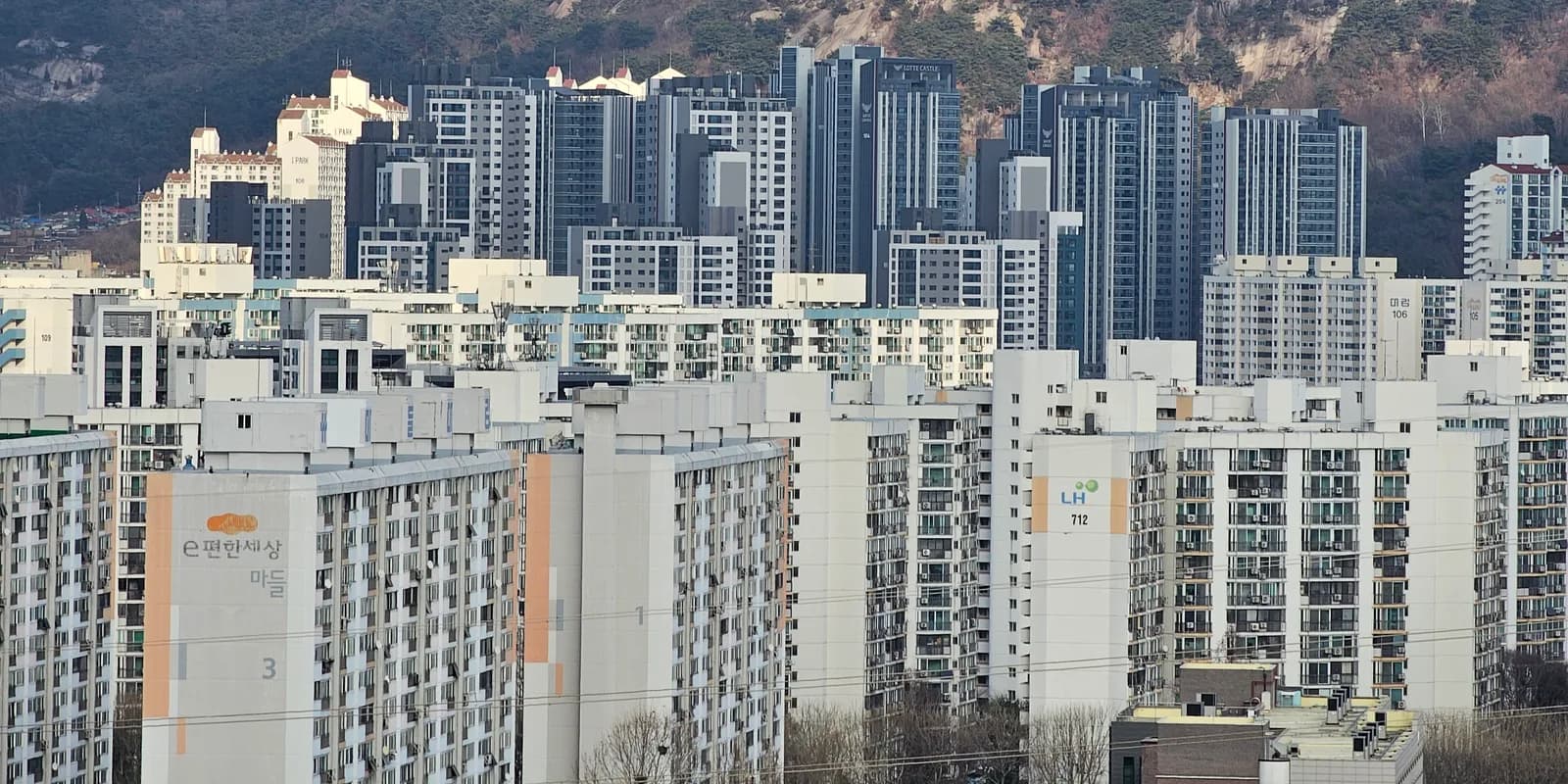
Photographs, all via Wikimedia Commons and cropped by us: the 신길힐스테이트클래시안아파트 bus stop in Yeongdeungpo-gu, Seoul, by Striker9498, CC0 (GPS-confirmed to Singil-ro); apartment towers in Nowon-gu seen from Dobong-gu, showing e편한세상 마들 3 and four other builder brands in one frame, by Ox1997cow, CC BY-SA 4.0; and 도램마을 6단지 in Sejong by Minseong Kim, CC BY-SA 4.0. Wikimedia Commons treats South Korea as a no-freedom-of-panorama country, so we excluded every file it flags accordingly. (Corrected 11 September: we had written that Korea has no freedom of panorama at all. It has one — 저작권법 제35조②, which lets works permanently displayed in streets, parks and on building exteriors be reproduced "by any method whatsoever" — but it carves out reproduction for the purpose of sale, and that carve-out is why Wikimedia Commons, which requires commercial reuse, treats Korea as a no-FoP country and will not host such photographs. Our sourcing decision is unchanged; the reason we gave for it was wrong.) Crops exclude a partially legible vehicle plate; no faces, unit numbers or household identifiers are legible, checked at native resolution. Four further candidates were rejected for false licence claims — corporate press photographs and map-service screenshots uploaded as "own work." The image this article would most like to show — a genuinely long, brand-laden estate gate stone — does not exist under a clean licence anywhere we could reach.
Verified against Korean-language sources: 부동산114's 2014 survey of 16,342 complexes for the historical character-count series and 부동산인포 for 2019 onward; Seoul Metropolitan Government's 「새로 쓰는 공동주택 이름 길라잡이」 (28 February 2024) and its accompanying citizen survey and builder declaration; Kyunghyang, Chosun Ilbo, 서울신문, 아시아경제 and 에너지경제 for the record-holders, renaming cases and the pet-name convention; developers' own brand pages for the etymologies, quoted as they publish them; and Korean press reporting of the 2021 한국부동산분석학회 study for the price effects. The 7.8% figure is given as the Korean press reports it from that study rather than from the paper itself, which we could not obtain. We describe Seoul's 1976 action as moving to stop loanwords rather than as a named regulation, because no source we found cites the instrument. Deliberately omitted: which specific estate was the first 래미안, where sources give two different answers; and the widely repeated claim that the naming guidebook came with incentives, which does not appear in the published guidance.
Keep Reading
More Stories
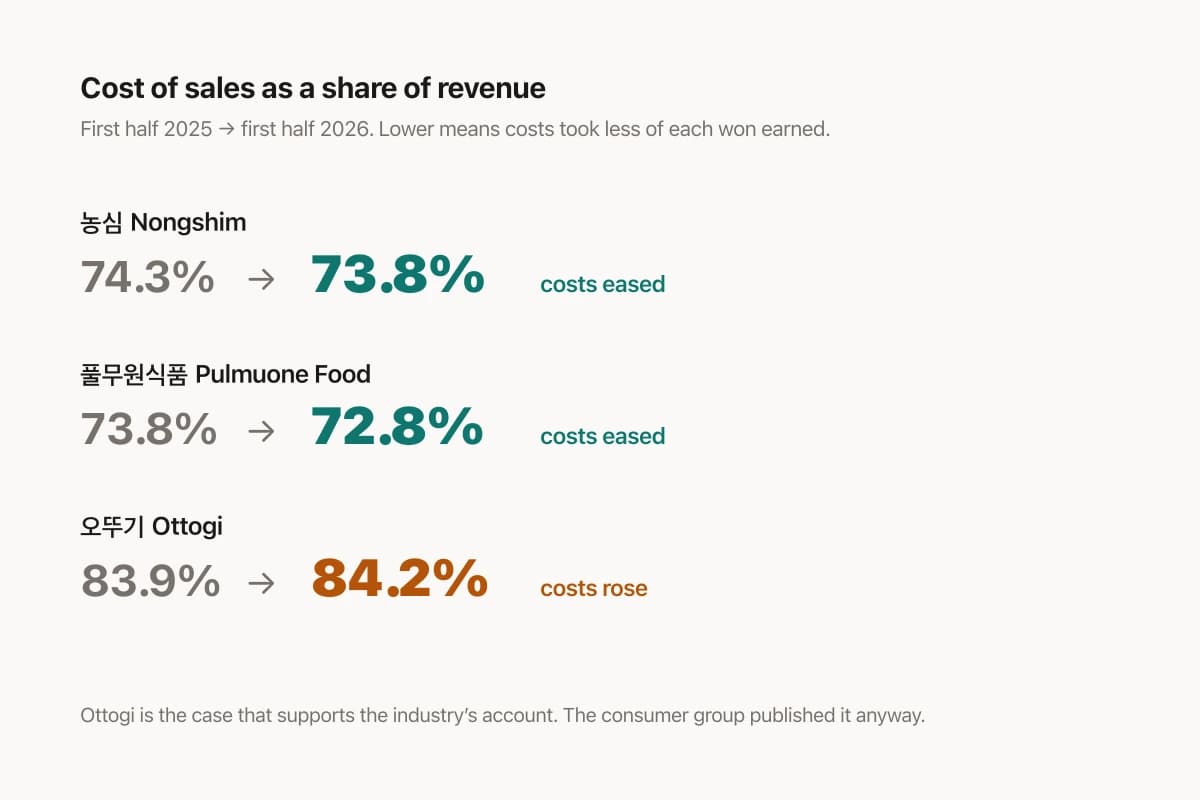
In April, Nongshim Cut Prices to Help With Inflation. In August It Raised Them, Using the Same Sentence.
Korea's biggest noodle company cut sixteen products in the spring, framed as joining the government's price-stability drive. Four months later it raised forty-three, framed as joining the government's price-stability drive. The products it cut are precisely the ones it left alone in August — and its own filings show the cost pressure it blames has not yet reached its margins. The awkward part is that the cost pressure is real.
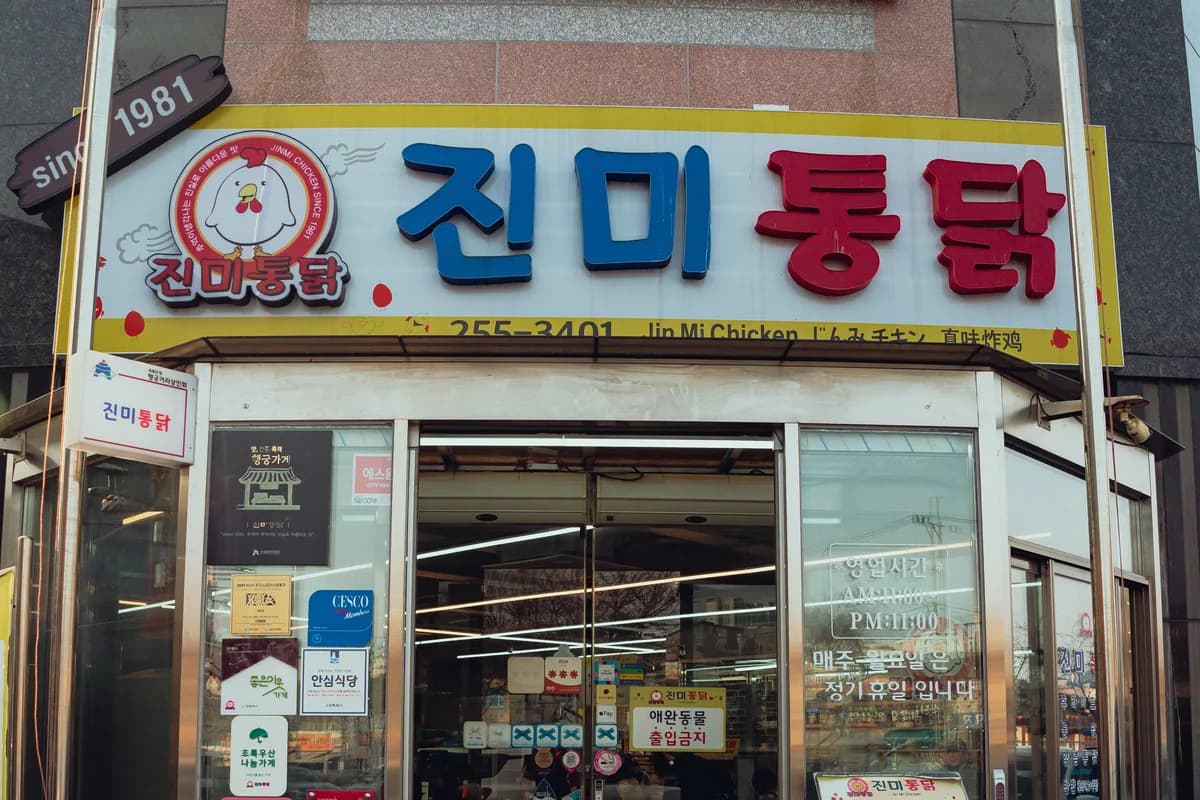
Korea Has Fewer Chicken Shops Than McDonald's Has Restaurants — the Famous Claim Was Counting Beer Halls
The number everyone quotes comes from a 2019 bank report whose own footnote says it includes 호프/통닭 licences and differs from the official count. On the like-for-like series the comparison is now the wrong way round. Four government bodies count Korean chicken shops four ways, two of them moving in opposite directions in the same year — and a decree amended last week finally requires the shops that closed to appear in the revenue forecast you're handed before you sign.
Korea Has Spent 26 Years Deleting Its Corporate Ladder. It Keeps Rebuilding It.
CJ abolished job titles in 2000 and never went back — but the business cards still printed the rank. POSCO and Naver have each now demolished and restored the same hierarchy twice. A look at the 사원-대리-과장-차장-부장 ladder, why 'General Manager' is a mistranslation, and the survey number that everyone quotes backwards.
The Weekly Dispatch
Korea, curated. Every week.
The best of K-culture, straight from Seoul. Written by people who actually live here.
Free, no spam, unsubscribe whenever.