Korea Has Spent 26 Years Deleting Its Corporate Ladder. It Keeps Rebuilding It.
CJ abolished job titles in 2000 and never went back — but the business cards still printed the rank. POSCO and Naver have each now demolished and restored the same hierarchy twice. A look at the 사원-대리-과장-차장-부장 ladder, why 'General Manager' is a mistranslation, and the survey number that everyone quotes backwards.

In 2000, CJ became the first large Korean company to abolish its job-title system. No more 부장, no more 과장, no more 대리. Everyone would be called by name plus 님.
It is the success story. Twenty-six years later CJ has never reverted, and every Korean article about flattening corporate hierarchy cites it as proof the thing can work.
There is a detail those articles tend to bury. In 2015, and again in 2020, Korean reporting noted that CJ employees' business cards still carried their rank. The company that most famously deleted the ladder deleted it from conversation and kept it on the object you hand to strangers.
That gap — between what a Korean company says it has abolished and what it has actually abolished — is the whole subject.
The Pendulum
The story usually told in English is a two-act one: Korean companies tried flattening their job titles, and it didn't take. That is a 2018 story, and it is not quite right.
What has actually happened is a pendulum, and it is still swinging.
POSCO replaced its ranks with 매니저 and 시니어 매니저 in July 2011 — its first change to the system in twenty-four years. It restored 대리, 과장, 차장 and 부장 in February 2017. Then in October 2025, POSCO E&C abolished 차장 through 부장 again, replacing them with 프로.
Naver abolished its executive ranks in 2017. In March 2019 it brought the tier back under a new name, 책임리더 — an unregistered executive on an annually renewed contract. In April 2024 it abolished that too.
KT replaced everything below team leader with 매니저 around 2009–10, and restored five ranks in June 2014.
Hanwha went to 매니저 in November 2012 and reversed on 9 March 2015.
Nobody in this story is arriving at a settled answer. They are oscillating, and the most recent demolitions are eighteen and twenty-two months old.
The Ladder Itself
Here is what is being repeatedly abolished and restored. Years-in-grade are conventional rather than fixed; the hard numbers come in a moment.
| Korean | Hanja | Literal sense | Usual English | What it actually is |
|---|---|---|---|---|
| 사원 | 社員 | "company member" | Staff / Associate | Entry grade. Samsung split it three ways by education until 2017 |
| 주임 | 主任 | "chief of the task" | Senior Staff | Often skipped entirely |
| 대리 | 代理 | "acting on behalf of" | Assistant Manager ⚠️ | An individual contributor. Assists no particular manager |
| 과장 | 課長 | "head of a 과 (section)" | Manager / Section Chief | The first rank that reads as senior. May head nothing |
| 차장 | 次長 | "the next one" | Deputy General Manager ⚠️ | Deputy to nobody. A rung inserted to slow the queue |
| 부장 | 部長 | "head of a 부 (division)" | General Manager ⚠️ | Top non-executive rank. Implies neither budget nor reports |
| 이사 | 理事 | "director" | Director | First executive rung, often on annual contract |
| 상무 | 常務 | "standing duties" | Managing Director | |
| 전무 | 專務 | "exclusive duties" | Senior Managing Director | Merged into 부사장 at Samsung in November 2021 |
| 부사장 · 사장 · 회장 | — | — | EVP · President · Chairman |
The three marked entries are where English readers are actively misled, and the reason is sharper than "the authority doesn't match."
All three English renderings name a relationship to a manager. Assistant manager, deputy general manager, general manager of something. None of the Korean words does. 대리 and 차장 describe a position in a queue. A 부장 is the top of the queue. English business titles almost all describe a job; these describe a place in line.
Three Words English Has One Word For
Korean HR draws a distinction that matters here:
- 직위 — the rank ladder. Formal seniority. Fixed until a personnel order changes it. 사원, 대리, 과장, 부장.
- 직책 — the job with responsibility attached. Given and taken away in reorganisations. 팀장, 본부장, 실장.
- 직급 — the pay-and-competency grade underneath, usually not public. 과장 2호봉, CL3.
The consequence is load-bearing. Two people can hold the identical job — team leader — at different ranks. And the reverse: you can be a 부장 with nobody reporting to you and no division to head. A 직위 is something you are. A 직책 is something you do. English business titles are almost entirely the second kind, which is why every translation of the first kind comes out wrong.
One honest caveat, because it would be easy to turn this into a story about English getting Korean wrong. In ordinary Korean usage — including Samsung's own announcements about its "7단계 직급 체계", KT's about 직급제 restoration, and virtually all Korean business press — 직급 is routinely used to mean 직위. Korean companies conflate the two as freely as anyone. The accurate version is that Korean HR draws a distinction Korean companies themselves ignore, and English has no vocabulary for either half.
(The separate question of how you speak to a 부장 — 님, 씨, and the grammar of deference — is a different subject, and we've covered it in Korean honorifics.)
Fourteen Years
The one hard published number on how long the climb takes came from KT on the day it restored its ladder in June 2014: three years as 사원, three as 대리, four as 과장, four as 차장. Fourteen years from joining to 부장.
KT introduced a fast-track for exceptional performers at the same time, and a performance-linked pay band per rank.
At Samsung Electronics, before the system changed, advancing a single grade required eight to ten years.
Both companies published these figures themselves, which is worth noting: the time cost of the ladder was never a secret.
The Number Everyone Quotes Backwards
If you read about this topic in Korean you will meet 88.3%, usually presented as the share of companies that tried flattening and went back.
It is not that.
The source is a 2018 survey by Saramin of 962 companies. It found that 11.6% had ever adopted a flattened-title system — 112 firms. The 88.3% is that figure's arithmetic complement, and Saramin's own wording bundles two very different groups: "도입을 하지 않거나, 도입을 해도 다시 직급 체계로 회귀한 기업" — companies that never adopted it or adopted and reverted.
Since the same survey reports 822 firms that never adopted, the genuinely reverted group is roughly 28 companies — under 3% of the sample, and about a fifth of those who ever tried. (That subtraction is ours, not Saramin's.)
So the headline finding is not mass reversion. It is mass non-adoption: nine in ten Korean companies never removed their job titles at all. Among those that did, most kept them off.
The rest of that survey explains why the other nine-tenths declined. Asked their reasons, 37.3% said changing what you call someone doesn't change who obeys whom; 30.3% said responsibility became unclear; and 15.6% said it removed employees' motivation to achieve. Two-thirds of all respondents thought the practice had little effect — and so did a quarter of the companies actually running it.
Why the Reverters Reverted
Three documented reasons, none of them folk explanation.
It broke at the company boundary. This is the best-evidenced cause, and it is entirely mundane. Hanwha, on the record in 2015: employees would introduce themselves to a client as "manager," and the client would ask again what their actual rank was. The company's stated reason for reverting was "고객 및 거래 상대방의 편의를 위해서" — for the convenience of customers and counterparties. A salesman at Hanwha Chemical put it more plainly: in the petrochemical industry, nobody had heard of a 매니저, and clients found it 매우 생소.
Mercer's Korea office framed the same phenomenon in 2019 with the word that matters: employees complained that with no rank, 외부 고객응대에 체면이 서지 않는다 — you cannot maintain face when dealing with outside clients. Mercer's view is that this is a change-management failure rather than a design flaw, which is a defensible reading and also an admission that it kept happening.
Promotion stopped feeling like anything. Kyunghyang's headline when KT restored its ladder was "승진 맛 살리기" — reviving the taste of promotion. The reasoning: with everyone called the same thing, moving up produced no perceptible change, and morale fell. KT's own spokesman cited employee morale and the need to attach appropriate responsibility to advancement.
The most telling evidence is that the lesson got applied. When POSCO E&C flattened again in October 2025, it abolished 차장 through 부장 — and deliberately kept 사원 through 과장 in place, stating the reason as 승진을 통한 동기부여: motivation through promotion. Keep the rungs people are still climbing; remove the ones they've stopped reaching.
And 님 was never neutral. Samsung employees told 매경이코노미 in 2023 that calling a much older colleague 프로님 risked sounding impertinent, so the convention never settled. An HR trade journal made the more damning observation: the titles were unified, but the old cohort culture persisted, so "그 안에서도 암묵적인 '계급'은 있다" — an unspoken hierarchy inside the flat one.
Though it genuinely cuts both ways. A Samsung employee told 경인일보 in 2018 that it had stung to lose the title just as he made 차장 — and that he now preferred being called 프로님. And when LG acquired CJ's cable business, the acquired company kept CJ's 님 convention, with incoming LG executives adapting to it rather than the reverse.
A Yonsei management professor's read: flattening settles in startups and internet firms where everyone is roughly the same age, and struggles in large companies with a wide age spread.
The Thing Samsung Didn't Notice for Four Years
Samsung Electronics announced its change on 27 June 2016 and implemented it on 1 March 2017: seven ranks collapsed into four career levels, CL1 to CL4, with everyone addressed as 님 (프로, 선후배님 and English names were among the permitted alternatives, and 프로 became dominant in practice).
The effect, according to 매경이코노미, was slight — for a reason nobody had designed for. You could search a colleague's CL grade on the company intranet. Look up someone in another department, see CL3, and go right on calling them 차장님.
Samsung's fix came on 29 November 2021, described in its own newsroom: delete rank and employee-number information from the intranet, and abolish the annual March announcement of who had been promoted. It also removed the standard time-in-grade requirement, and merged 전무 into 부사장.
Note what that is not. Some Korean coverage at the time reported that Samsung would eliminate its rank system entirely; the actual announcement did not. CL survived. What was abolished was the waiting period and the visibility.
Which is its own finding: for the first four and a half years, Korea's largest company ran a flattened-title system on top of a rank database its employees could query.
0.82%
In November 2025 the Korea CXO Institute published the arithmetic of the ladder's top.
Across Korea's 100 largest listed companies: 861,076 employees and 7,028 unregistered executives. That is one executive per 122.5 employees, or an arithmetic probability of 0.82% — down from 0.84% the year before, with 107 fewer executive posts.
The spread is enormous. At Samsung Heavy Industries it is one per 316.9; at LG Display one per 313.2. At KB Financial it is one per 6.2.
Two cautions. This is a ratio of executives to staff, not the share of any joining cohort that eventually makes executive — it is not a promotion rate. And the ladder's real cruelty isn't at the top, it's in the middle: Korean has the phrase 만년 과장, the perpetual section chief, for someone whose 진급 누락 — being passed over — has become permanent. The structure is a pyramid, so most people stop somewhere.
Korean media reported the 0.82% figure under headlines invoking 김 부장, the archetypal middle-aged salaryman of recent Korean television. The joke works because everyone already knows the answer.
They Refused the Summit, Not the Staircase
Here is where the obvious story goes wrong.
The obvious story is that younger Korean workers reject hierarchy, which is why companies flattened. The survey data says something more specific and more awkward.
Jobkorea asked 1,114 younger office workers in May 2023. 54.8% said they had no intention of becoming an executive — most often because of the burden of a responsible position, then because work-life balance would become impossible.
But asked how fast they wanted to be promoted, a plurality — 50.8% — said at the same pace as everyone else. Only 27.3% wanted to move quickly.
They are not refusing the ladder. They are refusing its top. They want a normal promotion, on schedule, and then to stop.
Which is precisely why the flattening annoyed them too. When SK Innovation collapsed everything below executive into a single rank in 2021, Korean coverage noted the consequence in one line: "승진이라는 개념도 자연스럽게 사라졌다" — the concept of promotion naturally disappeared as well. Half the workforce wanted a promotion on schedule, and the reform abolished the schedule.
There is a phrase now in Korean workplace commentary for the other half of this: 승진을 거부할 권리, the right to refuse promotion — on the reasoning that moving up moves you closer to the restructuring list.
Flattening Gets a Press Release. Reverting Gets a Memo.
The most consistent thing we found in this topic isn't in any survey.
Every abolition of a title system was announced. Company statements, newsroom posts, press coverage, a named executive explaining the philosophy. CJ in 2000, Samsung in 2016, Hyundai Motor in 2019, SK Innovation in 2021.
We could not find a single official company announcement of a reversion. Every restoration we documented was reported by journalists with a spokesman quoted afterwards, or communicated internally — Hanwha's was a notice sent round to affiliates on 9 March 2015.
Companies publish the moment they decide hierarchy is the problem. They do not publish the moment they decide it was the answer.
That asymmetry is worth holding onto, because it is also why the English-language version of this story stops in about 2018 with "Korea is flattening its corporate culture." The flattenings were press-released into the record. The rebuildings were memos.
And the pendulum is still moving. In April 2024 Naver deleted an executive tier it had created five years earlier. In October 2025 a POSCO subsidiary abolished the top half of a ladder its parent had restored in 2017 — while carefully keeping the bottom half, because people were still climbing it.
The ladder is not the same thing as the deference that runs along it, which we've written about in Korean honorifics, or the abuses that hierarchy can license, covered in 갑질. It is an administrative object: a queue with a published waiting time, printed on a business card. Korean companies have been trying to throw the object away for twenty-six years, and keep discovering that their customers, their counterparties and their own staff want it back.
And for the 99.18% who never reach the top of it: Koreans leave their main career job at an average age of 53, and a great many land in small business. What happens there — and why the most famous statistic about it is counting beer halls — is its own story.
Photographs: Teheran-ro × Yeongdong-daero at street level and at dusk, both by kallerna; Yeouido skyscrapers and the Hangang Railway Bridge by TurnOnTheNight — all CC BY-SA 4.0 via Wikimedia Commons, cropped by us and re-shared under the same licence. Wikimedia Commons treats South Korea as a no-freedom-of-panorama country, so these files are hosted on a de-minimis basis; we use them as editorial commentary. (Corrected 11 September: we had written that Korea has no freedom of panorama at all. It has one — 저작권법 제35조②, which lets works permanently displayed in streets, parks and on building exteriors be reproduced "by any method whatsoever" — but it carves out reproduction for the purpose of sale, and that carve-out is why Wikimedia Commons, which requires commercial reuse, treats Korea as a no-FoP country and will not host such photographs. Our sourcing decision is unchanged; the reason we gave for it was wrong.) No individuals are identifiable in any frame.
Verified against Korean-language primary and contemporaneous sources: Saramin's May 2018 survey of 962 companies (including its own wording of the 88.3% figure); the Korea CXO Institute's November 2025 analysis; Jobkorea's May 2023 survey of 1,114 younger workers; Samsung Electronics' own newsroom announcement of 29 November 2021; Kyunghyang's June 2014 reporting on KT; Daily Hankook and ChosunBiz on Hanwha; and Korean HR trade press. Hanja readings for the non-executive ladder were confirmed against Korean reference sources; we have deliberately left the top executive ranks without hanja because we could not source them to the same standard. Also deliberately omitted: all Korean wage-system percentages, where the published series are mutually irreconcilable; a claimed 2025 title change at a company that would have sharpened the argument but which we found in only one source; and a much-repeated anecdote about newly promoted CJ staff being addressed by their old rank for a month, which we could not verify at all. CJ's business-card practice is confirmed to 2020; we have not confirmed it since.
Keep Reading
More Stories
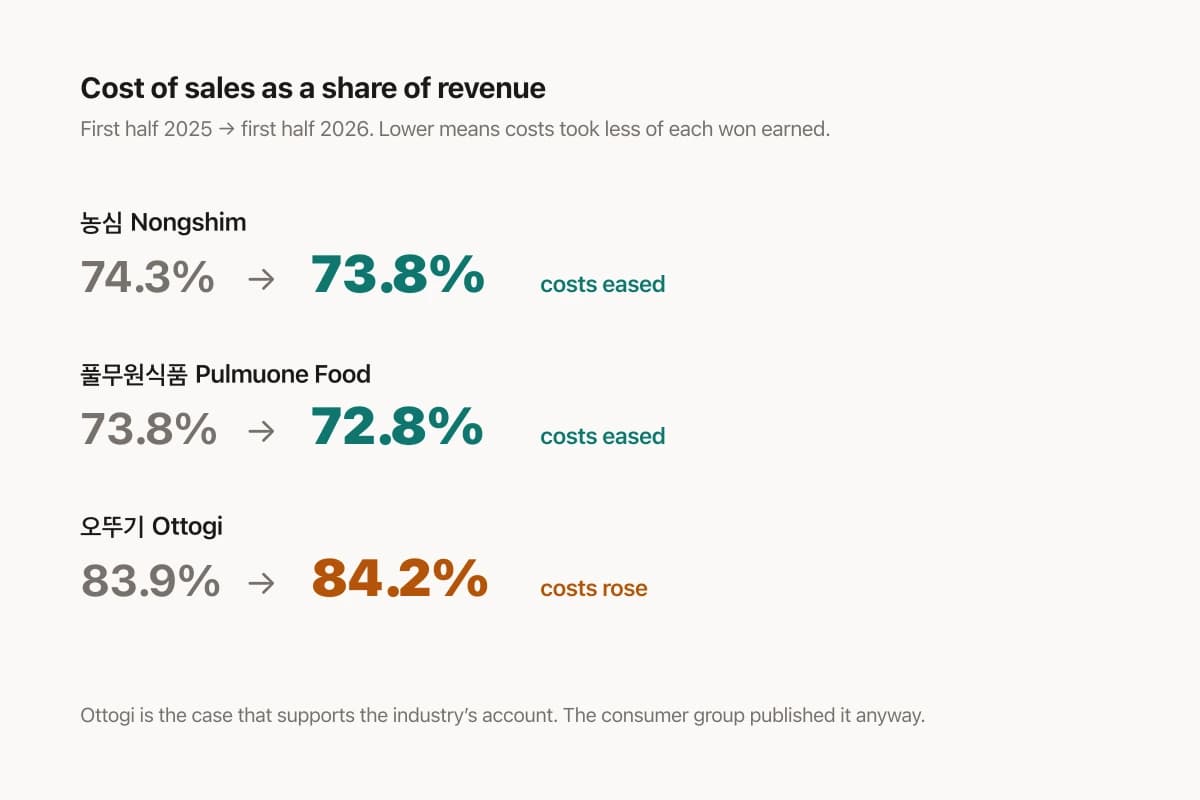
In April, Nongshim Cut Prices to Help With Inflation. In August It Raised Them, Using the Same Sentence.
Korea's biggest noodle company cut sixteen products in the spring, framed as joining the government's price-stability drive. Four months later it raised forty-three, framed as joining the government's price-stability drive. The products it cut are precisely the ones it left alone in August — and its own filings show the cost pressure it blames has not yet reached its margins. The awkward part is that the cost pressure is real.

Korea's Longest Apartment Name Is 25 Characters — Seven Longer Than the Joke
Everyone says the names got long so mothers-in-law couldn't find the address. Twenty years of Korean and English coverage repeat that, and not once does anyone say it in the first person. Here is what actually happened: a decoder ring for 센트럴 and 포레, a Swedish word from a company with no Swedish business, and a 2021 study showing the thing residents vote hardest for doesn't work.

Korea Has Fewer Chicken Shops Than McDonald's Has Restaurants — the Famous Claim Was Counting Beer Halls
The number everyone quotes comes from a 2019 bank report whose own footnote says it includes 호프/통닭 licences and differs from the official count. On the like-for-like series the comparison is now the wrong way round. Four government bodies count Korean chicken shops four ways, two of them moving in opposite directions in the same year — and a decree amended last week finally requires the shops that closed to appear in the revenue forecast you're handed before you sign.
The Weekly Dispatch
Korea, curated. Every week.
The best of K-culture, straight from Seoul. Written by people who actually live here.
Free, no spam, unsubscribe whenever.