Korea Has Fewer Chicken Shops Than McDonald's Has Restaurants — the Famous Claim Was Counting Beer Halls
The number everyone quotes comes from a 2019 bank report whose own footnote says it includes 호프/통닭 licences and differs from the official count. On the like-for-like series the comparison is now the wrong way round. Four government bodies count Korean chicken shops four ways, two of them moving in opposite directions in the same year — and a decree amended last week finally requires the shops that closed to appear in the revenue forecast you're handed before you sign.
The claim is one of the most travelled facts about South Korea: there are more fried-chicken restaurants in Korea than there are McDonald's outlets in the entire world.
It is usually deployed to mean something — that Korea's middle class has been pushed into hopeless small business, that the country is drowning in fried chicken, that a nation of 52 million has arranged itself around one dish.
The number is 87,000. It comes from a specific document, and that document explains itself.
Footnote 3, Page 9
The source is KB금융지주 경영연구소, KB 자영업 분석 보고서 ①: 치킨집 현황 및 시장여건 분석, published 3 June 2019. It reports roughly 87,000 chicken shops as of February 2019.
On page nine, footnote three, KB says how it counted:
"지방행정인허가 데이터개방서비스 제공 2019년 2월 기준 음식업 인허가 자료 중 업태가 **'통닭(치킨)', '호프/통닭'**으로 분류된 자료를 분석, 이는 주된 상품을 기준으로 분류하는 통계청 서비스업조사의 '치킨전문점'과는 차이가 있음."
KB counted food-business licences whose registered category is "통닭(치킨)" or "호프/통닭" — and states plainly that this differs from Statistics Korea's 치킨전문점, which classifies by principal product.
호프 is a beer hall. Korean drinking establishments serve fried chicken as a matter of course, and a great many of them are licensed under the combined category. The 87,000 includes them.
It is not a hidden caveat or a technicality retrieved from an appendix. It is the ninth page of a twenty-page report, and KB wrote it precisely so the number would not be misread. It was misread anyway, in two languages, for seven years.
On the Like-for-Like Numbers, It's Backwards
Set the two series side by side properly.
Korea's official count of businesses whose principal product is chicken — 치킨전문점 — was 39,789 in 2023, down from 42,743 in 2020. It has been falling for three years.
McDonald's publishes its systemwide restaurant count in its annual report to the US Securities and Exchange Commission:
| Year-end | McDonald's restaurants worldwide |
|---|---|
| 2022 | 40,275 |
| 2023 | 41,822 |
| 2024 | 43,477 |
| 2025 | 45,356 |
So: roughly 40,000 Korean chicken specialists against 45,356 McDonald's restaurants. The famous comparison does not merely wobble. It now points the other way.
It was closer once. The English-language version began with a Korea Herald piece built on 2013 figures, which put Korean chicken shops at around 36,000 against a McDonald's total in the mid-35,000s — a margin of about 1.6%. That is a coin-flip of a gap, resting entirely on which Korean series you pick. Then McDonald's grew by roughly a quarter over the next decade while Korea's chicken specialists declined, and the claim quietly expired without anyone noticing.
The counting method itself is not KB's invention or KB's error — Korea's national land research institute uses the identical 통닭 + 호프/통닭 licence definition in its own work. The definition is a legitimate way to answer a different question: how many premises in Korea will sell you fried chicken? Around 87,000 is a reasonable answer to that. It is not an answer to how many chicken restaurants are there, and KB said so.
The number is still circulating uncorrected in Korea, too. In September 2025 a professor of statistics at Seoul National University used the 87,000 in a 한국일보 column — a column whose entire subject was how to communicate numbers well.
Four Bodies, Four Counts, Two Directions
The footnote explains one gap. It does not explain the others, and the others are stranger.
| What is counted | Who counts it | 2023 | 2024 |
|---|---|---|---|
| 치킨 가맹점, from franchise disclosure filings | 공정거래위원회 | 29,711 | 28,750 (−3.2%) |
| 치킨 프랜차이즈 가맹점, from survey | 국가데이터처 | 29,805 | 31,397 (+5.3%) |
| 치킨전문점, franchise + independent | 국가데이터처 | 39,789 | — |
| 치킨집, by licence category | KB, 2019 | — | ~87,000 (Feb 2019) |
Look at the first two rows. In 2023 they are 94 outlets apart — three-tenths of one per cent, near-perfect agreement. In 2024 they are 2,647 apart, and the gap is not a level difference. It is a sign difference. The competition regulator says Korea's chicken franchise sector shrank by 3.2%. The national statistics body says it grew by 5.3% and passed 30,000 outlets for the first time. Both are government. Both describe 2024. They also disagree about revenue per outlet — ₩328m against ₩279.6m, seventeen per cent apart.
This is not a mystery, and it is worth resolving rather than shrugging at. The FTC's number is a count of filings: franchisors above a size threshold must lodge a 정보공개서, a disclosure document, and the FTC tallies the outlets recorded in them. The statistics body runs a survey of the sector. One is an administrative by-product with a registration boundary; the other is an estimate with a sampling frame. They answer adjacent questions and there is no reason for them to converge.
The lesson is not that Korean data is bad. It is that four organisations are answering four different questions, and the version that travelled the world is the one whose author wrote a footnote explaining that his answer was to a different question than the one readers would assume.
The Person in the Story Doesn't Exist Any More
The claim is usually attached to a picture: the manager pushed out in his late forties, the redundancy cheque, the franchise, the fryer.
Korea published fresh numbers on this in August 2026, and the picture does not survive them.
The average age at which Koreans leave the longest-held job of their career is 53.0 — men 55.3, women 51.1. The statutory retirement age is 60, set by 고령자고용법 제19조, which says an employer shall set it at 60 or above and that a lower figure is deemed to be 60.
So most people are gone seven years early. But not for the reason the story assumes:
| Reason for leaving the longest-held job | Share |
|---|---|
| Business downturn, suspension or closure — their own | 24.9% |
| Health | 22.1% |
| Family care | 15.2% |
| Reaching retirement age | 13.2% |
| Redundancy, forced resignation, or voluntary-retirement schemes | 9.9% |
The corporate ejection everyone talks about is 9.9% of it. The single largest reason people leave their main career job is that their own business failed — which means a large share were already self-employed when it ended. Only 13.2% get to use the retirement age the law guarantees them.
The trend is wrong in the popular telling too. Korea's self-employed share of total employment was 19.4% in 2024 — the first reading below 20% since the series began in 1963. The sector peaked at 6.21 million people in 2002 and has been unwinding for two decades. On the broader OECD definition, which adds unpaid family workers, Korea is at 23.2% against an OECD average in the mid-teens: a genuine outlier among rich countries, but a shrinking one.
And it is not chicken any more. Inside the FTC's own table, for 2024:
| Franchise outlets, year-end 2024 | |
|---|---|
| 한식 | 43,882 |
| 커피 | 29,101 |
| 치킨 | 28,750 |
| 주점 | 10,036 |
| 제과제빵 | 8,717 |
Coffee overtook chicken in 2024. The largest franchise category in Korea overall is not food service at all — it is the convenience store, at 55,927.
The demographics have moved too. New business registration is falling fastest among people in their fifties. The explosive growth is at the other end: sole proprietors aged 60 and over rose 76–80% between 2017 and 2024, against roughly 30% population growth in that cohort. People aged 60+ were 36.4% of all self-employed Koreans by 2023, a record, up from 18.1% in 2003.
The sector is not filling with redundant middle managers. It is ageing into a pension substitute — and the average monthly pension across the 55-to-79 age group is about ₩880,000.
That is a harder story. Among self-employed Koreans aged 50 and over, 48.8% earn less than the monthly minimum wage — 28.7% of those in their fifties, and 75.8% of those over 60. The dividing line is not age but staff: 56.3% of those working alone fall below the minimum wage, against 10.9% of those with employees. And for those who entered an industry they had no experience in, the below-minimum share is 82.9%.
What the Law Makes Them Tell You
Which brings us to the documents, and to the part of this that is genuinely unusual.
Korea regulates franchising by statute — 가맹사업법 — and one of its instruments has no real equivalent in most countries. Certain franchisors must hand a prospective franchisee a 예상매출액 산정서: a written projection of what the outlet will earn.
The decree sets out how the range is built. The projection may be assembled from the five nearest outlets of the same brand in the same province, dropping the highest and the lowest and quoting the middle three. And the top of the range may not exceed 1.7 times the bottom — a legal cap on how wide a franchisor may make its own forecast.
That is a serious piece of consumer protection. Now the three things about it that matter.
First: on 4 August 2026 — last week — the decree was amended to make explicit that outlets which have since closed belong in that set of five. The FTC described the change in plain words: "예상매출액 산정시 근거가 되는 인근 가맹점의 범위에 폐업한 가맹점이 포함됨을 명확히 한다" — to clarify that closed outlets are included among the nearby outlets used to calculate the projection.
Korea had to write into a Presidential Decree that the shops that died still count.
Second: most chicken franchisors do not have to give you one at all. The obligation applies only to franchisors that are not small or medium enterprises, or that had 100 or more outlets of the brand at the previous year-end. Of Korea's 681 chicken franchise brands, the distribution is:
| Brand size | Brands | Share |
|---|---|---|
| 100+ outlets | 54 | 7.9% |
| 10–99 outlets | 167 | 24.5% |
| Under 10 outlets | 460 | 67.5% |
627 of 681 brands sit below the threshold. Two-thirds have fewer than ten outlets. For the overwhelming majority of chicken brands in Korea, no revenue projection is owed to you before you sign.
Third: you cannot look up whether the brand's shops survive. A brand's survival rate — three-, five- and ten-year continuing-operation counts, and the average operating period of outlets that closed — does not become a required disclosure item until 1 January 2028. It was passed by cabinet on 28 July 2026 and promulgated on 4 August alongside the closed-outlet clarification. The same package adds average termination penalties, private-equity ownership of the franchisor, and itemised costs, and moves outlet-count reporting from annual to quarterly.
A person deciding this month whether to open a chicken shop cannot, in the official document designed for exactly that decision, find out how long the brand's shops last. That becomes possible in seventeen months.
The Money, Before You Get to the Chicken
What the disclosure documents do already contain is a line item with a statutory name: 차액가맹금. The FTC defines it as the amount by which the price a franchisee pays for compulsory supplies exceeds a reasonable wholesale price — the franchisor's markup on the ingredients you are required to buy from it, given a legal name and forced into the filing.
| 차액가맹금, 2024 | Per outlet | Share of sales |
|---|---|---|
| 치킨 | ₩41m | 9.5% |
| 커피 | ₩26m | 7.3% |
| 피자 | ₩24m | 4.6% |
| 제과제빵 | ₩30m | 4.9% |
| 한식 | ₩20m | 2.6% |
| Food service overall | ₩26m | 4.4% |
Chicken pays the highest supply markup of any Korean food-franchise category, on both measures, and it rose 17% in a year.
Against average outlet revenue of ₩328m, and with chicken's opening and closing rates now near-identical at 11.7% and 12.0%.
The spread between brands is enormous. 교촌치킨 outlets average ₩727m a year, 청년치킨 ₩610m, bhc ₩530m — against a category average of ₩328m. At the other end, 58 of 313 chicken brands average under ₩100m per outlet, and another 116 fall between ₩100m and ₩200m. "A chicken shop" is not one business.
Leaving Costs ₩22 Million
The exit has a price, and Korea has measured it. A 2025 survey of small-business owners who had closed since 2021 found:
- 39.9% closed within three years
- Average time from opening to closing: 6 years 6 months
- Average debt at the moment of deciding to close: ₩102,360,000
- Average cost of closing: ₩21,880,000 — demolition ₩5.18m, restoring the premises to original condition ₩3.79m, staff severance ₩5.63m, taxes ₩4.20m
- 78.2% used no government support programme at all
You pay roughly ₩22 million to stop.
In 2024 Korea recorded 1,008,282 business closures — the first time above one million. Restaurants were 15.2% of them, and the restaurant closure rate, at 15.8%, was among the highest of any sector. Just over half of all closures gave business downturn as the reason.
One caution on the survival figures, because it is a real measurement problem rather than a rhetorical one. Seoul's commercial-district service put three-year survival for chicken restaurants at 39.2% in early 2026. A different national series puts three-year survival for chicken and pizza shops at 46.8%. Same concept, seven and a half points apart — and neither is wrong, because they are built on different registries.
The mechanism is identifiable. Franchise filings record outlet turnover in four separate columns: new openings, contract expiry, contract termination, and change of registered operator. The FTC's closure rate uses only expiry and termination. So a franchisee who sells a going concern to a new owner is not a closure in the FTC series — but generates a new licence record in the local-government data the survival rates are built from. Part of what "six in ten don't last three years" measures is the death of a business registration, which includes shops that changed hands and never shut their doors.
The Counter-Case
It would be easy to end this as a lament, and the evidence does not support one.
The self-employed share is at a 60-year low and has been falling for twenty years. Korea's parliamentary futures institute concluded in January 2026 that the change is structural rather than cyclical — demography and regional labour markets — and found that people in their forties and fifties are increasingly re-entering their own former industry rather than opening a shop cold.
Franchising is also, on the regulator's own numbers, the less-bad option: average franchise outlet revenue rose 4.3% in 2024 to ₩370m, while average revenue across small businesses generally fell to ₩197m. And the best chicken outlets are real businesses — 교촌's average outlet turns over more than twice the category mean, and the major brands are opening in Spain, Indonesia and the United States.
The sharpest version of the problem is not self-employment at all. It is solo self-employment: 56.3% below the minimum wage alone, against 10.9% with even one employee. That is a fivefold difference, and it points at a different policy than the one the chicken-shop story implies.
But the counter-case has a limit. The shrinkage is concentrated among the young and the middle-aged. At 60 and over, the sector is growing fast — into a cohort whose average pension is ₩880,000 a month.
The through-line here is not that Korea is drowning in fried chicken. It is that a country can be measured four ways at once, that the version which travels is rarely the one with the methodology attached, and that the fix — when it comes — arrives as a clause in a Presidential Decree that nobody reads either.
We've written about what happens on the way up in Korea's corporate title ladder, where the arithmetic of promotion says 0.82% of employees at Korea's largest firms become executives. This is where a good many of the rest end up. For the housing end of the same squeeze, see 지옥고.
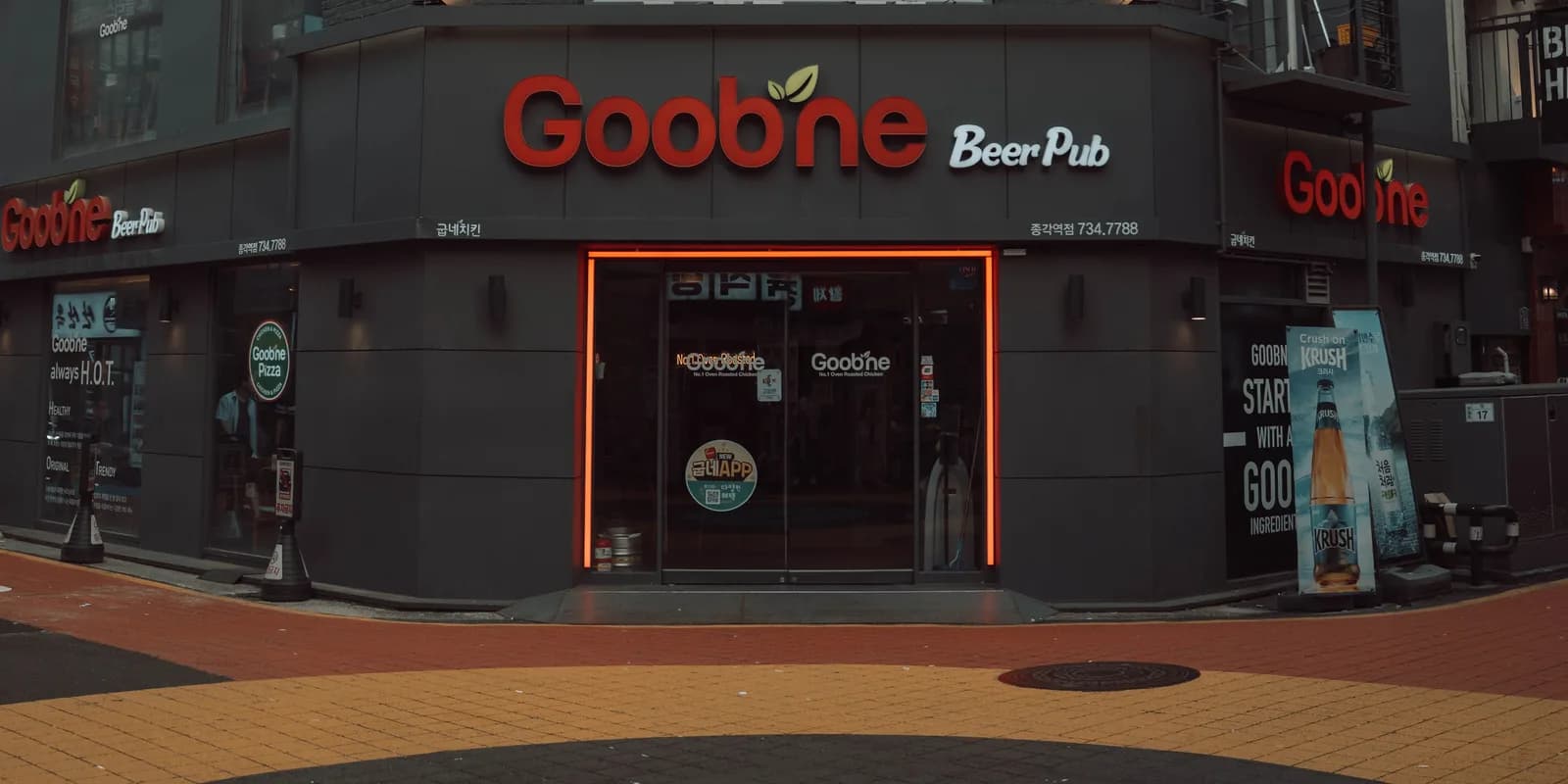
Photographs, all Pexels licence and cropped by us: 진미통닭, Haenggung-dong, Suwon, by Theodore Nguyen; 굽네치킨 trading as Goobne Beer Pub, Jonggak, Seoul, by Viridiana Rivera; 자담치킨 and neighbouring 호프 signage, Jongno, Seoul, by cityintake. The businesses pictured are shown because their signage illustrates the licence categories this article is about — 통닭 and 호프 — and are placed with the counting sections deliberately. Nothing in these images should be read as a claim about any pictured business's finances, and no endorsement or association is implied. Crops exclude an installer's mobile number and a third-party advertising poster; checked at native resolution.
Verified against primary and contemporaneous Korean sources: KB금융지주 경영연구소, 「KB 자영업 분석 보고서 ①」 (3 June 2019), including footnote 3 on page 9; 공정거래위원회, 「2025년 가맹사업 현황 통계」 (13 April 2026); 국가데이터처 「2024년 프랜차이즈 통계 결과」 (28 December 2025) and KOSIS 치킨전문점 series; 가맹사업거래의 공정화에 관한 법률 시행령 제9조, as amended 4 August 2026, via 국가법령정보센터; 고령자고용법 제19조; the 2026 고령층 부가조사; and 중소기업중앙회's 2025 survey of closed small businesses. McDonald's restaurant counts are taken directly from its Form 10-K filings with the SEC, and the segment figures sum to the reported totals. Deliberately omitted: a 2013 McDonald's figure we could source only at second hand; a survival rate attributed to the tax service whose period and definition we could not establish; a delivery-app cost figure whose basis we could not confirm; and the early history of Korean chicken franchising, for which we found no source meeting our standard.
Keep Reading
More Stories
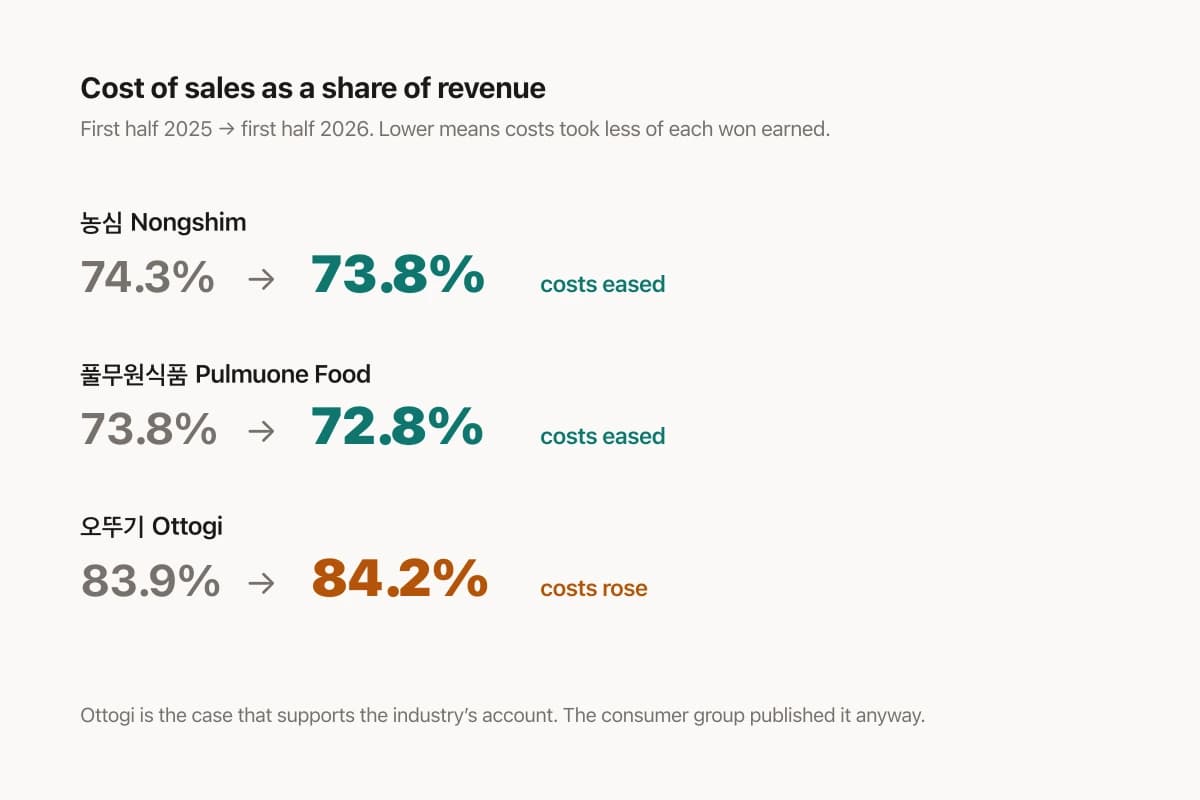
In April, Nongshim Cut Prices to Help With Inflation. In August It Raised Them, Using the Same Sentence.
Korea's biggest noodle company cut sixteen products in the spring, framed as joining the government's price-stability drive. Four months later it raised forty-three, framed as joining the government's price-stability drive. The products it cut are precisely the ones it left alone in August — and its own filings show the cost pressure it blames has not yet reached its margins. The awkward part is that the cost pressure is real.
Korea's Longest Apartment Name Is 25 Characters — Seven Longer Than the Joke
Everyone says the names got long so mothers-in-law couldn't find the address. Twenty years of Korean and English coverage repeat that, and not once does anyone say it in the first person. Here is what actually happened: a decoder ring for 센트럴 and 포레, a Swedish word from a company with no Swedish business, and a 2021 study showing the thing residents vote hardest for doesn't work.
Korea Has Spent 26 Years Deleting Its Corporate Ladder. It Keeps Rebuilding It.
CJ abolished job titles in 2000 and never went back — but the business cards still printed the rank. POSCO and Naver have each now demolished and restored the same hierarchy twice. A look at the 사원-대리-과장-차장-부장 ladder, why 'General Manager' is a mistranslation, and the survey number that everyone quotes backwards.
The Weekly Dispatch
Korea, curated. Every week.
The best of K-culture, straight from Seoul. Written by people who actually live here.
Free, no spam, unsubscribe whenever.