지옥고: Korea Has One Word for Its Worst Housing, and English Doesn't
반지하, 옥탑방, 고시원 — the semi-basement, the rooftop room and the tiny rented cell. English writes three separate articles about them. Korean has a single word that puns on the word for hell, and a body of reporting that gets the history right.
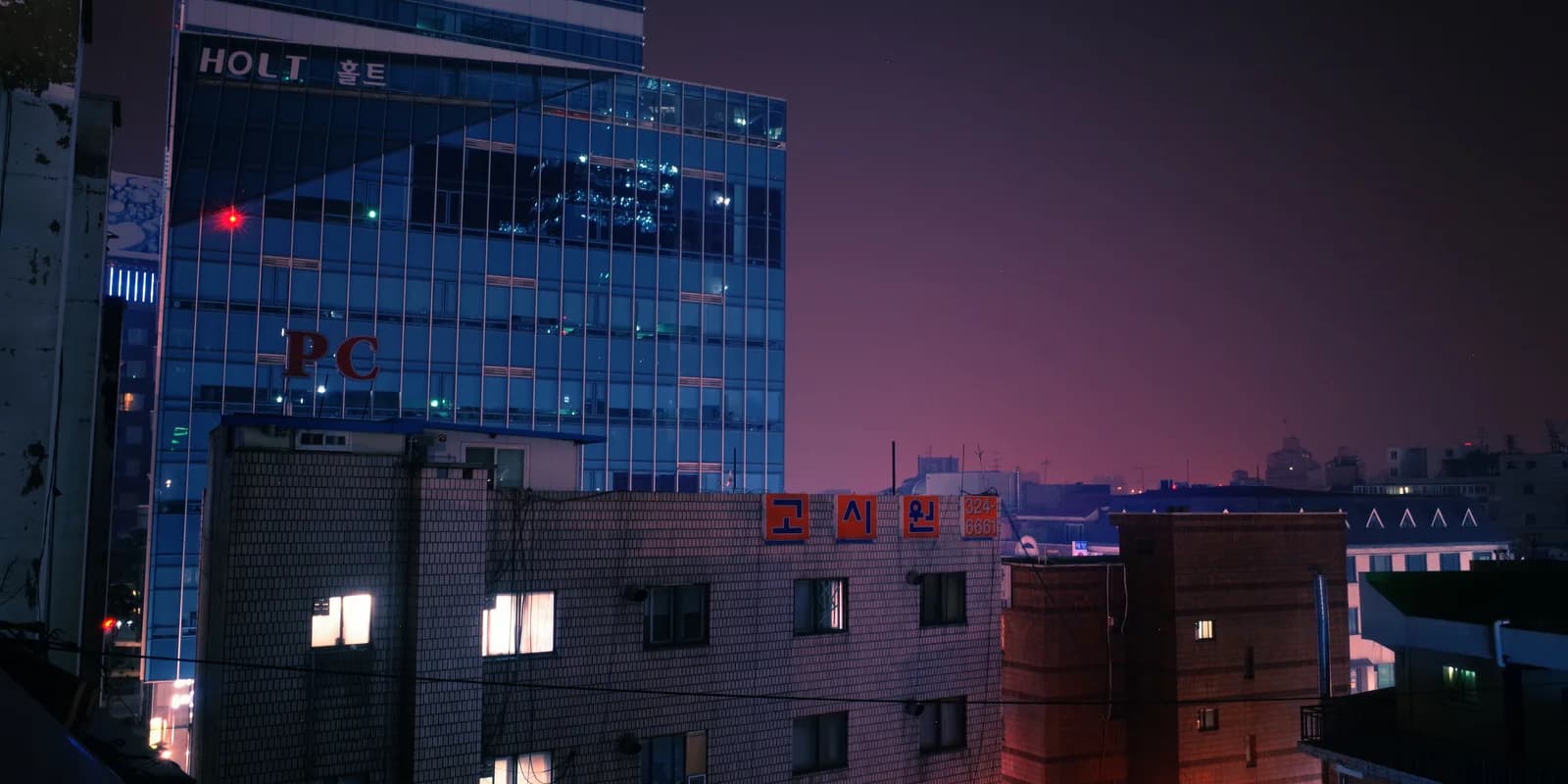
English-language writing about Korean housing has three separate genres. There is the Parasite article about the 반지하, the semi-basement flat. There is the quirky travel article about the 옥탑방, the rooftop room, usually filed under charming. And there is the practical article about the 고시원, the tiny rented room, usually written by an agency that would like to rent you one.
Korean treats them as one thing. The word is 지옥고 — built from 반지하 + 옥탑방 + 고시원, and landing, deliberately, on 지옥 (地獄): hell.
It is not obscure. Yonhap, Hankyoreh, Kyunghyang, Seoul Shinmun and EBS all use it in headlines and on air; it appears as a keyword in peer-reviewed Korean housing research. It is rare enough in English-language journalism to be effectively invisible — though not entirely absent; Hyundai's own English innovation platform has explained it. But if you have read a dozen English pieces about Korean housing and never encountered the word, that is why the three genres never connect: English is missing the noun that says they are one tier.
Here's the tier, and the history under it — including a date almost every English account gets wrong.
Where the Semi-Basement Actually Came From
The standard English origin story runs: the 반지하 began as 1970s civil-defence bunkers and was legalised as housing in 1984.
The first half is right. The second conflates two different amendments, and the wrong one.
The chain, from Korean reporting that traces the statute changes directly:
| Year | What changed |
|---|---|
| 1962 | The Building Act as enacted forbids habitable rooms in basements. |
| Jan 1968 | The 1·21 사태 — a North Korean commando raid on the Blue House. The security shock. |
| 1970 | The Act is amended so new low-rise housing must include a basement — explicitly as an air-raid shelter (방공호). |
| 1970s | Roughly 400,000 people a year arrive in Seoul; 30,000–50,000 homes a year get built. People rent the bunkers illegally. The state looks away. |
| Dec 1975 | The actual legalisation. The Act is amended to permit residential use of basements, subject to ventilation and sanitation. |
| 1984 | The depth rule is relaxed: previously two-thirds of the height had to be below grade, now one-half. This is what created the half-basement and made it ubiquitous. |
| 1999 | The mandatory-basement requirement is abolished. Numbers keep rising anyway. |
So: bunker in 1970, legal housing in 1975, half-above-ground in 1984. Both 1975 and 1984 are real dates doing real work. Only "legalised in 1984" is the error.
The more damning fact is the one that rarely appears at all. From 1975 until 2022, semi-basements were excluded from floor-area-ratio (용적률) calculations — the limit on how much building you may put on a plot. A 반지하 was, for forty-seven years, a floor that generated rent without counting against your density allowance. A free storey.
That is the engine. Not the bunkers, not the war scare — a line in the planning code that made building them irrational not to do.
Bong Joon-ho, whose film taught the world the word, has described the 반지하 as a space with a nuance particular to Korea. He is close to right in a narrow, literal sense: few rich countries formally recognise underground space as legal housing at this scale.
Nobody Counted Them Until 2024
If you have noticed English sources giving wildly different numbers for how many Koreans live in semi-basements, there is a clean reason.
Korea did not have a proper count until 2024.
Statistics Korea's 2024 census — reference date November 1, 2024, published July 2025 — was the first time 반지하 and 옥탑 were published as a full enumeration in the register-based census. Before that, they were, as one Korean weekly put it, not accurately reflected in government statistics at all. A single Seoul district ran the first comprehensive local survey in 2022; the city followed in 2023; the country in 2024.
What the first real count found:
| 2024 census | |
|---|---|
| Households in 반지하 | 398,325 — 1.8% of all households |
| Households in 옥탑 | 36,000 — 0.2% |
| Share of 반지하 dwellings in the capital region | 97.3% |
| Households in non-housing dwellings (오피스텔, 고시원, 고시텔 etc.) | 6.0% |
| Districts with the most 반지하 | 관악구, 강북구, 중랑구 |
And one number that tells you what kind of tier this is: 51.1% of semi-basement residents are on monthly rent (월세), against 22.4% of people living above ground. This is a renters' tier. The deposit-based ladder that governs the rest of Korean housing — which we mapped in what jeonse actually is — mostly doesn't reach down here.
A caution, because Korean sources are openly fighting about it. The 2020 figure was 327,320; the 2024 figure is 398,325. Several major papers ran that as a 22% increase — semi-basements growing three years after the government promised to abolish them. Seoul City issued a formal rebuttal, arguing the two surveys were collected differently and cannot be compared.
We're not going to adjudicate that. The honest statement is: Korea counted its semi-basements properly for the first time in 2024 and found about 398,000 households. Whether that represents growth or better arithmetic is disputed.
August 2022
On the night of 8 August 2022, Seoul had its heaviest rainfall in roughly eighty years.
In a semi-basement flat in 신림동, 관악구, three members of one family died — a 47-year-old woman with a developmental disability, her 48-year-old sister, and the younger woman's 13-year-old daughter. They called for help. Water pressure held the door. A separate resident died in a semi-basement in 동작구 the same day.
Two days later, Seoul's mayor announced that basement and semi-basement homes were a backward housing type that threatened vulnerable residents and should now disappear — a total ban on residential use, the 반지하 일몰제, or sunset policy. Roughly 240,000 homes, about 5% of Seoul households, became overnight the places nobody should live.
What happened next is section eight.
고시 Means the Bar Exam
The 고시원 is the most misunderstood of the three in English, and the misunderstanding is right there in the name.
고시 (考試) is the state examination — the bar exam, the higher civil-service exam, the foreign-service exam. 고시원 is "exam institute." It has never meant a student dormitory; that is 기숙사, and the older lodging-house is 하숙집.
The history is specific and quite short:
- 1975 — Seoul National University relocates to 신림동, 관악구. A 고시촌, an exam village, forms around it.
- Late 1970s — cram schools are pushed outside the old city walls; goshiwon proliferate in Sillim. Early ones are nicknamed 돼지막, pig pens: unlicensed lodging of about one 평 (3.3㎡), a desk, a chair, bedding, heated with wood.
- 1990s — the format widens from the three great exams to ordinary civil-service candidates and repeat university applicants.
- 2009 — law schools are introduced and the bar exam begins to be phased out. The exam-taker base collapses.
- Now — the buildings remain and have filled with people who need a room with no deposit. By 2018 an industry association counted 12,691 goshiwon nationally, up from around 4,000 a decade before, with 6,779 in Seoul and 1,055 in 관악구 alone.
The defining commercial feature is the absence of a deposit. Korean renting normally demands a lump sum — often tens of millions of won. A goshiwon asks for none. That is the entire proposition, and the reason people with no capital end up there.
For what the rooms are actually like, use the neutral sources rather than the listings. A Seoul city survey of five goshiwon, published in 2019, found actual floor areas of 4–9㎡, and in one building 74% of rooms had no window. A 2020 survey by a Korean urban research institute put the average Seoul goshiwon living area at 7.2㎡, with 53% under 7㎡.
But the single most eloquent number in this entire subject comes from a 2018 Hankyoreh profile of a student who had lived in all three tiers. At his goshiwon, a room with a window cost ₩50,000 a month more than one without.
Windowless rooms have their own slang: 먹방, an ink room, for the darkness. (No relation to the eating-broadcast 먹방, which is a different word entirely.)
The Fire, and What It Changed
On the morning of 9 November 2018, a fire broke out at the 국일고시원 in 관수동, 종로구, central Seoul. Seven people died and eleven were injured. The presumed cause was an overheating electric heater. The building had extinguishers and detectors but no sprinklers.
Most of the residents were day labourers. The head of the goshiwon association made a point at the time that is worth keeping: goshiwon are not where homeless people live — the rent is too high for that. They are where people with some income but no savings live.
The sprinkler gap was a grandfathering problem. A 2009 law had mandated sprinklers but exempted every goshiwon already operating — in Seoul, 18.2% of them, 1,071 buildings. After the fire, the rules were amended so that simplified sprinklers became mandatory for all goshiwon regardless of opening date.
Seoul went further on habitability. In March 2019 it published Korea's first goshiwon housing standard, and from July 2022 it became binding in the city's building ordinance: new or expanded goshiwon rooms must be at least 7㎡ (9㎡ with a private bathroom) and must have a window to outside air, at least 0.5m by 1.0m.
Note the limit carefully, because it is the whole catch: those rules bind new and expanded goshiwon, in Seoul only. The existing stock — the 4㎡ windowless rooms — is untouched.
The Rooftop Room Is the Least Bad One
K-drama has done the 옥탑방 a strange favour. Rooftop rooms read on screen as bohemian: cheap, a bit romantic, a view, a place for the broke-but-charming lead to live.
Statistically it is the smallest tier — 36,000 households, 0.2%. And structurally many, though not all, are illegal: unpermitted rooftop extensions recorded as 위반건축물 on the building register. A 2025 report counted 66,000 such violations nationally, with unauthorised rooftop rooms and room-splitting the two flagship types. The practical consequences for a tenant are no mortgage and sometimes no gas boiler. (Tenants are still protected by Korea's rental protection act even when the structure itself is unlawful.)
There is a detail here that is almost too neat. At the July 2025 census briefing, Statistics Korea's census chief noted that the agency does not use the word 옥탑방 at all — only "housing with a rooftop structure." The state declines to say the word out loud.
And yet: among the three, the rooftop room is the one people prefer. The student in that Hankyoreh profile — who did goshiwon in his first year, semi-basement in his second, rooftop in his third — ranked it first:
"제가 지옥고를 통달했는데, 제 경험으로는 옥탑방이 제일 나은 거 같아요. 바람도 잘 통하고, 사람 사는 곳 같아서." I've mastered jiokgo, and in my experience the rooftop room is the best of them. Good airflow, and it feels like somewhere a person lives.
His prices, in 2018: goshiwon, no deposit, ₩400,000 a month, plus ₩50,000 for a window. Semi-basement, ₩1m deposit, ₩300,000, heavy cockroaches. Rooftop, ₩5m deposit and ₩400,000 split four ways. He could not get a washing machine up the stairs, so he did laundry every three weeks at a coin laundry.
The rooftop room isn't the charming rung. It's the one where the air moves.
For what that room is like in August, see Korean summer — the heat is the reason people describe sleeping elsewhere.
Who Actually Lives There
English coverage frames this as a young person's problem. The Korean data says something more specific.
For youth, the anomaly is real and striking. Housing poverty among Seoul single-person households aged 20–34 ran 34.0% in 2005 → 36.3% in 2010 → 37.2% in 2015 — rising — while the rate across all households collapsed from 46.6% in 1995 to 12.0% in 2015. Korean analysts named this 역주행: reverse-driving. It is the one age group moving the wrong way.
But the residents skew differently from the rate. Among people in non-housing dwellings, roughly 41% are in goshiwon — and the age curve is U-shaped, not young: about 28% are 60 or over against about 24% under 30. Goshiwon residents specifically skew male and middle-aged, with a substantial population of casual day labourers living near central-city worksites.
There's a telling contrast in benefit take-up: 12.6% of goshiwon residents receive basic livelihood benefits, against 62.3% in 쪽방, the single-room slums. Goshiwon house the working poor; 쪽방 house the destitute.
Which is the last thing worth saying about the word. Korea's best-known investigation into 쪽방 is titled 「지옥고 아래 쪽방」 — below jiokgo, the jjokbang. This is the bottom tier of housing. It is not the bottom of the ladder.
Four Years On: 3.1%
Seoul declared semi-basement housing abolished in August 2022. Here is where that stands.
7,608 households have left 반지하 with government or city support since 2022 — 3.1% of Seoul's semi-basement households. Roughly 235,000 remain.
Meanwhile the money went the other way. Seoul's semi-basement budget: ₩536.8bn (2023) → ₩418.8bn (2024) → ₩208.5bn (2025), more than halved in two years, against a national backdrop of large cuts to public rental housing budgets. Seoul's own city council has criticised the sunset policy for poor delivery.
There is also a small, revealing failure. Of 9,440 Seoul semi-basement units without flood barriers, the most common stated reason — 4,738 units — is that the landlord doesn't want one. A flood barrier is a public admission that the property floods.
And then there is 성동구.
Seongdong district did the opposite of evicting. It ran Korea's first complete semi-basement survey in 2022, visiting all 6,321 units with architects and grading each one A to D against a purpose-built matrix — structural safety, accident prevention, physiological conditions, psychological conditions, public hygiene. Then, rather than clearing them, it repaired them, borrowing a handyperson scheme from England: bathroom repairs, stair rails, mould removal and re-papering, leak and condensation prevention, electrical fixes — bundled with a five-year rent freeze.
A university evaluation of the results found defect levels down 82%, accident risk down 78%, residents' housing stress down from 8.62 out of 10 to 3.30, and depression and anxiety measures down more than 60%. The report's closing line:
"이 사업은 집을 고치는 일이 아니라, 사람을 다시 세우는 일이었다." This was not repairing houses. It was putting people back on their feet.
The district head's argument against abolition-by-decree is practical rather than sentimental: if the long-term direction is exit, the short-term goal is safety, and the two do not conflict. Moving 200,000-plus households above ground at once would spike rents, destroy the cheap housing stock and sever people from their neighbourhoods.
The scoreboard, four years in: abolition by declaration moved 3.1%. Repair moved every measurable thing.
The Word Is the Point
One last piece of context. Korea's minimum housing standard is low by rich-country measure — England's minimum floor area is roughly 2.7 times Korea's, and even Japan's is about 1.8 times. A semi-basement can be fully legally compliant and still be substandard by international comparison.
Which brings it back to language. English has "semi-basement apartment," "rooftop room" and "tiny rented room" — three descriptions of three objects, filed in three genres, written by three different kinds of writer.
Korean has a noun for the category, and the noun is a joke about hell.
That difference isn't decorative. Naming the tier is what lets you count it, argue about it, and ask why a country whose apartments hold most of its household wealth — the story we told in Republic of Apartments — still has four hundred thousand households living below the pavement. The English-speaking world got the image from a film. It hasn't yet borrowed the word.
Naming a thing is what lets you count it — and Korea's other famous count, the one about chicken shops, shows what happens when four bodies name it four different ways.
Statutory history is traced from Korean reporting that follows the Building Act amendments directly: mandated as air-raid shelters in 1970, legalised for residential use in December 1975, and redefined at half-depth in 1984. We flag that the widely repeated English claim of "legalised in 1984" conflates the second and third of these. Household figures are from Statistics Korea's 2024 population and housing census, published July 2025, and we note explicitly that this was the first full enumeration of semi-basement and rooftop housing in the register-based census — the apparent increase from 2020 is disputed between Korean press reporting and a formal rebuttal from Seoul City, and we report the dispute rather than a growth figure. Goshiwon room sizes are from a Seoul city survey (2019) and a Korean urban research institute survey (2020) rather than from letting agencies, whose figures are marketing. Rents quoted are dated 2018 and labelled as such. The 2022 deaths and the 2018 fire are reported factually, without names and without detail of the manner of death. The claim that 지옥고 is absent from English is deliberately not made: the term is rare in English-language journalism but has been explained in English elsewhere, and we say so. A widely circulated line describing rooftop rooms as a "status symbol" is omitted here because its provenance is a 2018 government card-news quoting a private joke rather than reported journalism; the first-person testimony quoted instead is from a Hankyoreh profile. Relocation and budget figures for Seoul's sunset policy, and the Seongdong district evaluation results, are from Korean reporting dated 2025.
Keep Reading
More Stories
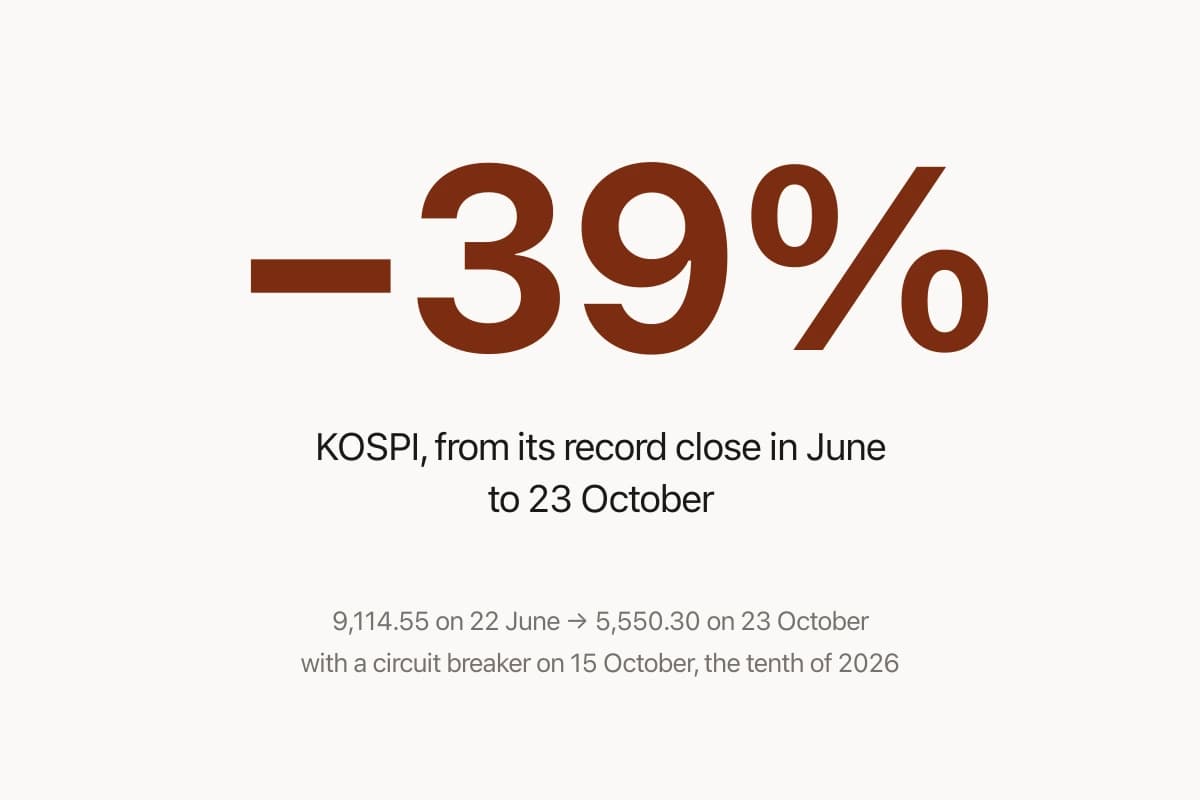
Korea's Stock Market Stopped for Twenty Minutes on 15 October. It Is Down 39% Since June
KOSPI fell 7.57% on 15 October and tripped its circuit breaker for the sixteenth time ever, and the tenth time this year. It was the seventh straight day of losses, and still not 2026's worst day. The index that closed above 9,000 in June has lost nearly two-fifths of its value. So far the government's answer has been a warning to brokers about lending.
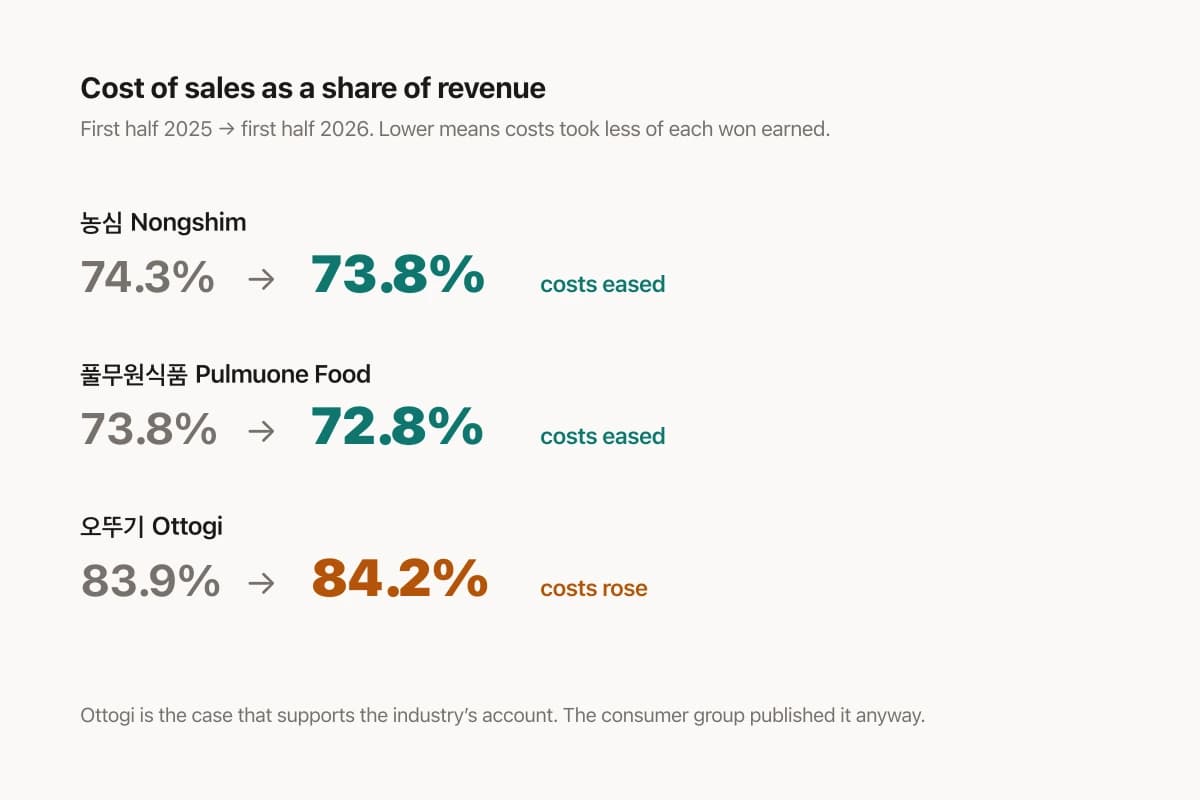
In April, Nongshim Cut Prices to Help With Inflation. In August It Raised Them, Using the Same Sentence.
Korea's biggest noodle company cut sixteen products in the spring, framed as joining the government's price-stability drive. Four months later it raised forty-three, framed as joining the government's price-stability drive. The products it cut are precisely the ones it left alone in August — and its own filings show the cost pressure it blames has not yet reached its margins. The awkward part is that the cost pressure is real.
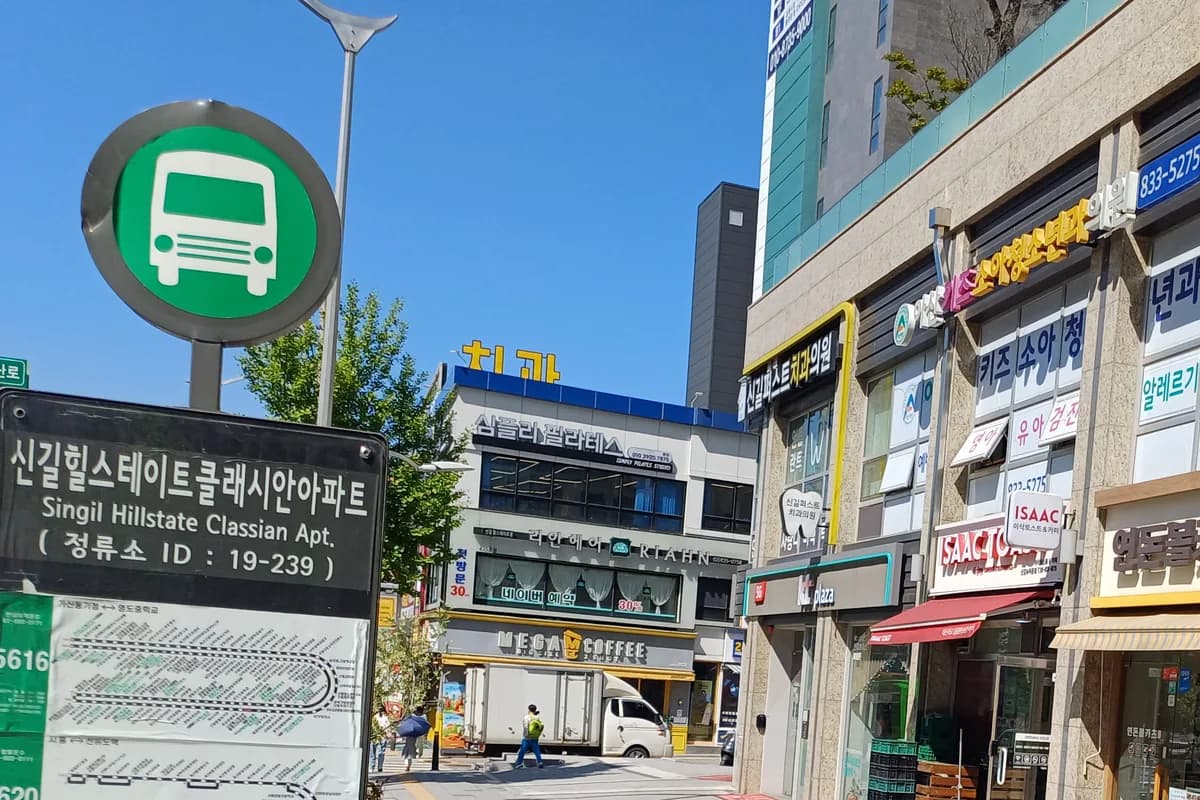
Korea's Longest Apartment Name Is 25 Characters — Seven Longer Than the Joke
Everyone says the names got long so mothers-in-law couldn't find the address. Twenty years of Korean and English coverage repeat that, and not once does anyone say it in the first person. Here is what actually happened: a decoder ring for 센트럴 and 포레, a Swedish word from a company with no Swedish business, and a 2021 study showing the thing residents vote hardest for doesn't work.
The Weekly Dispatch
Korea, curated. Every week.
The best of K-culture, straight from Seoul. Written by people who actually live here.
Free, no spam, unsubscribe whenever.