In April, Nongshim Cut Prices to Help With Inflation. In August It Raised Them, Using the Same Sentence.
Korea's biggest noodle company cut sixteen products in the spring, framed as joining the government's price-stability drive. Four months later it raised forty-three, framed as joining the government's price-stability drive. The products it cut are precisely the ones it left alone in August — and its own filings show the cost pressure it blames has not yet reached its margins. The awkward part is that the cost pressure is real.
In April 2026, 농심 (Nongshim) cut the price of sixteen products. Twelve were bagged noodles — including 안성탕면 — and four were snacks, coming down about 7 per cent on the noodles and 7.8 per cent on the snacks. The company said it was doing it to join the government's price-stability effort.
On 1 August 2026, Nongshim raised the price of forty-three brands by an average of 5.8 per cent. Cup noodles up 6.0, snacks up 5.5, drinks up 7.7. 육개장사발면 went from ₩1,100 to ₩1,200; a 90g bag of 새우깡 from ₩1,500 to ₩1,600. The company said it was minimising the burden on consumers and joining the government's price-stability effort.
Both statements are on the record. They are four months apart and they use close to the same words to explain opposite decisions.
And there is a detail underneath that makes the pairing sharper than mere awkwardness. The August rise excluded bagged ramyeon entirely — which is roughly 63 per cent of Nongshim's ramyeon sales, and includes 신라면. Those are the same products it had cut in April.
So the shelf works like this. The thing that got cheaper in the spring is frozen. The things that went up are the cup noodles and the snacks — which is, disproportionately, what people living alone and people in a hurry buy. A household that reads the headline "Nongshim cuts prices" in April and "Nongshim raises prices" in August has, in practice, experienced only the second one.
What the consumer group actually found
On 21 August, the 한국소비자단체협의회 (Korea Consumer Federation), through its 물가감시센터 price-monitoring unit, published an analysis of the half-year filings of three food companies: Nongshim, 오뚜기 (Ottogi) and 풀무원식품 (Pulmuone Food).
Its chair put the question directly:
"기업의 비용 부담이 앞으로 커질 가능성은 있지만 현재 가격 인상이 향후 원가 상승에 대비한 선제적 대응이나 수익성 확보를 위한 결정은 아니었는지 의문"
"Costs may well rise for these companies in future — but the question is whether these price increases were a pre-emptive move against costs not yet incurred, or a decision to protect profitability."
What the federation wanted was not a price freeze. It was disclosure: publish the cost basis, so that consumers can judge the increase for themselves.
Two true numbers about the same company
Here is where this story gets genuinely tricky, and where most coverage has flattened it.
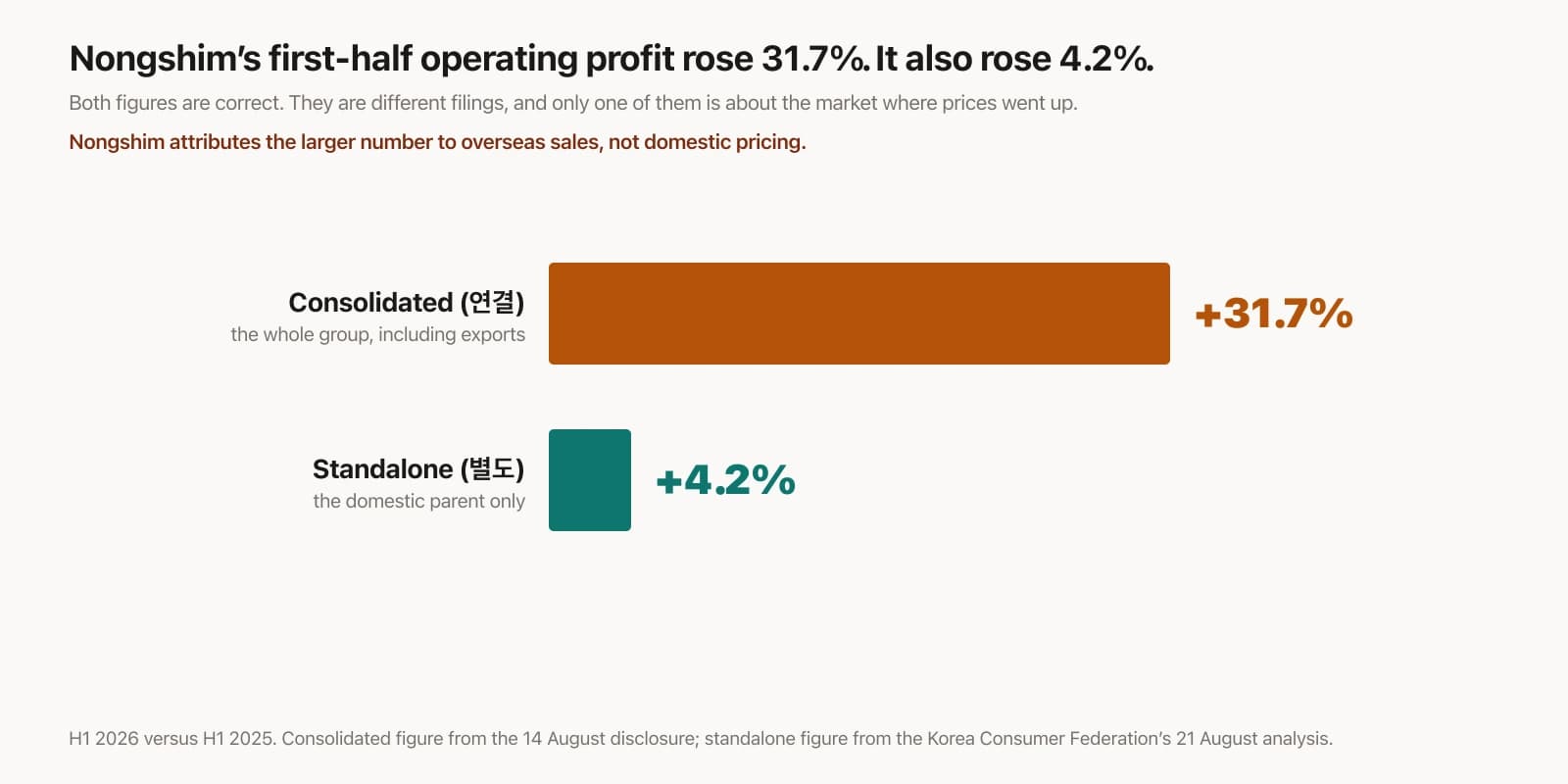
If you read the wires on 14 August you saw that Nongshim's first-half operating profit rose 31.7 per cent. Second-quarter operating profit rose 47.6 per cent. First-quarter operating margin hit 7.2 per cent, a five-year high. Those figures are correct.
If you read the federation's analysis a week later you saw that Nongshim's operating profit rose 4.2 per cent, on revenue up 6.4 per cent and cost of sales up 5.8. Those figures are also correct.
They are not in conflict. They are different filings. The 31.7 per cent is 연결 — consolidated, the whole group including overseas subsidiaries and exports. The 4.2 per cent is 별도 — the standalone domestic parent.
Nongshim itself explains the gap, and its explanation is the important part:
"해외사업(수출·해외법인)의 매출 성장과 수익성 개선이 전체 실적 상승을 견인했다"
"Growth and improved profitability in the overseas business — exports and foreign subsidiaries — drove the overall results."
In other words: the spectacular number is not domestic. It is 신라면 selling in America and Europe.
Which matters, because a domestic price rise is a domestic decision, and the ledger it should be argued against is the domestic one. On that narrower and far less flattering basis, Nongshim's cost-of-sales ratio still improved — from 74.3 per cent to 73.8 — and operating profit still rose. Modestly, but it rose. The cost pressure the company describes has not yet shown up as margin compression on the books that the price rise is supposed to be about.
Pulmuone Food is starker on the federation's numbers: cost-of-sales ratio down from 73.8 to 72.8 per cent, operating profit up 40.1 per cent, from ₩13.0bn to ₩18.2bn. (Its listed parent, a different filer, reported first-half operating profit up 41.9 per cent on a consolidated basis. Again: two entities, two numbers, both real.)
The company's case, put properly
It would be easy to stop there, and it would be unfair, because the input costs are not invented.
Nongshim's stated reasoning is "장기간 이어진 고환율·고유가 영향으로 자재 가격이 상승하면서 원가 부담이 계속 커졌다" — a long stretch of a weak won and expensive oil pushing up materials. It points at flour, cooking oil and packaging film. And when you go and look:
- Wheat futures ran from roughly $580 a bushel to a peak around $671.50 in late April.
- The FAO's oils index jumped 5.9 per cent in a single month in April, to its highest level since mid-2022, on reduced Malaysian palm output and an oil-price shock.
- Naphtha, which is what food packaging film is ultimately made from, went from about $583 a tonne a year earlier to $840 — a 44 per cent rise, and that figure is Nongshim's own. Separate reporting puts naphtha up 68 per cent and ethylene up 60.5 per cent over a comparable window.
Those are real, large, contemporaneous cost increases. Anyone writing this story as pure profiteering is not reading the same commodity data the company is.
And there is a control case sitting right there in the federation's own report. Ottogi's cost-of-sales ratio worsened, from 83.9 to 84.2 per cent, and its operating profit was essentially flat — up 0.3 per cent. Ottogi's numbers support the industry's account rather than undermining it. The federation named it anyway, which is a point in the federation's favour: it did not select only the companies where the argument works.
Where the defence does break
One strand of it does not survive contact with the data, and it is the exchange rate.
The won genuinely did weaken over 2024 and 2025 — from about ₩1,288 to ₩1,472.50 across 2024 alone, the largest annual move since the Asian financial crisis, and it flirted with ₩1,500 during the political turmoil late last year. As a description of the cost base a Korean manufacturer is still digesting, "고환율" is fair.
As a description of the moment the decision was announced, it is not. Through July and August the won was strengthening hard — from around ₩1,500 in early July to the ₩1,410s by early August, and to about ₩1,387 by 26 August. The currency was moving in the company's favour, quickly, in the very weeks the increase was announced and took effect.
We have some feeling for this one, because we nearly published an error of exactly the same shape ourselves. We had a standing note to update the dollar conversions across this site on the basis that the won had weakened to ₩1,415 — and when we finally went to do it, the rate was ₩1,386 and the note was more out of date than the figures it was meant to fix. An exchange rate is the one input that can quietly un-justify your argument while you are still making it.
This is not one company
Nongshim is the clearest case, not the only one. The same few weeks:
| Company | Items | Average rise | From |
|---|---|---|---|
| CJ제일제당 | 27 | +8.0% (햇반 +12%) | 30 July / 1 August |
| 뚜레쥬르 (CJ푸드빌) | 76 | +8.2% | 31 July |
| 농심 | 43 brands | +5.8% | 1 August |
| 던킨 (비알코리아) | 39 | +6.5% | 2 August |
| 파리바게뜨 | 86 bread, 41 cake | +5.0% | 25 August |
| 팔도 | 21 | +5.5–5.8% | 1 September |
Note the last row. 팔도 (Paldo) is doing the same thing Nongshim did — raising cup noodles and drinks from 1 September while leaving bagged ramyeon alone. Two of the country's major noodle makers have independently concluded that the bagged-ramyeon shelf is the one you do not touch.
That is not a coincidence about costs. It is a judgement about which price the public actually watches. 신라면 is a number Koreans carry in their heads the way a British shopper knows the price of a pint of milk. Cup noodles are not.
The number this piece deliberately does not use
August's consumer price index lands on Wednesday 2 September, from the agency now called 국가데이터처 — Statistics Korea was renamed and moved to report directly to the Prime Minister on 1 October 2025, which is worth knowing if you go looking for it under the old name. (Corrected 1 September: this originally said "the end of last year.")
We are publishing before it, on purpose, and we would not use it much even if we had it. July's processed-food inflation came in at 1.0 per cent year on year. Set that next to "43 brands up 5.8 per cent" and you would have a genuinely misleading juxtaposition in either direction — a reader could conclude the rises are trivial, or that the index is lying, and neither follows.
This is a company-level story that lives in company-level filings: cost ratios, entity boundaries, what was raised and what was frozen. The CPI answers a different question — whether price changes have shown up in a national aggregate yet — and answering it does not tell you whether these particular decisions were justified.
Update, 3 September. The print came in at 3.1 per cent, close to the 3.2 the forecasters expected. It was, as we suspected, a poor instrument for this argument in both directions: agricultural, livestock and fisheries prices actually fell — down 2.6 per cent year on year — while a large slice of the headline rise was an accounting artefact from last year's SK Telecom compensation discounts lapsing, worth some 0.6 to 0.7 percentage points on the government's own reckoning.
The one line in it that does bear on this piece: the processed food increase widened. That is the category these companies sell into, and it is the number to watch when September's print arrives.
We are being careful about this because we made the opposite mistake's twin recently. When we went through Korean grocery prices this month, the alarming number — spinach up 152 per cent — turned out to be misleading, and the reassuring underlying position, below the five-year normal, turned out to be true. This piece inverts it. Here the reassuring number is the incomplete one: the industry's account of cost pressure is accurate as far as it goes, and stops precisely where its own filings would start to complicate it.
What it says
Korean food companies are, right now, unusually good businesses. K-food is a genuine export success, the overseas margins are excellent, and Nongshim's consolidated numbers are the numbers of a company winning abroad.
The domestic market is a different room in the same house, and it is a room where price rises are politically fraught, where a government price-stability drive is running, and where the language of restraint is worth using — in April to advertise a cut, in August to soften a rise.
None of that makes the increases illegitimate. Costs did go up. What the filings establish is narrower and harder to argue with: at the point these decisions were taken, the pressure had not yet reached the margins, and the companies chose to move first. The consumer federation's request was that they say so plainly and show the arithmetic.
They have not. And 신라면 stays exactly where it is.
For the fresh-produce side of the same summer — and a scare number that turned out to be the misleading one — see what actually happened to Korean grocery prices this month.
Images. All three are charts we built ourselves: the April cut set against the August rise, with the same justification quoted under each; the two Nongshim profit figures that are both true and describe different companies; and the cost-of-sales ratios for all three firms in the federation's report, including the one that moved against the argument.
Reported from the Korea Consumer Federation's price-monitoring analysis published 21 August 2026, from Nongshim's and Pulmuone's half-year disclosures as reported on 14 August, and from Korean coverage of the price announcements between 24 July and 26 August. Commodity figures are as cited by the companies and by the FAO's food price index. A note on the numbers we did not print: we wanted a clean eight-quarter series for Nongshim and we do not have one. Figures circulating for several 2024 and 2025 quarters failed an arithmetic check — an implied margin that did not match the margin the same source stated, and in one case a set of numbers that were plainly the August 2026 filing relabelled as 2024 — so we have used only the quarters we could stand behind and left the gaps visible rather than filling them. Also flagged rather than asserted: the widely repeated claim that this was Nongshim's first rise in 17 months, which we could not tie to a specific prior increase; the exact item count for the 파리바게뜨 rise, which is given as 86 or 127 depending on the outlet; and a reported September rise from 삼립, which was still at announcement stage. The federation's Pulmuone figures are labelled by entity where the source made that clear and flagged where it did not. English-language coverage of this does exist — at least one outlet has already set the price rises beside the profit figures — and we say so rather than claiming otherwise; what appears not to have been written in English is the filings-level comparison: cost-of-sales ratios, the consolidated-versus-standalone distinction, and the April-to-August reversal.
Keep Reading
More Stories
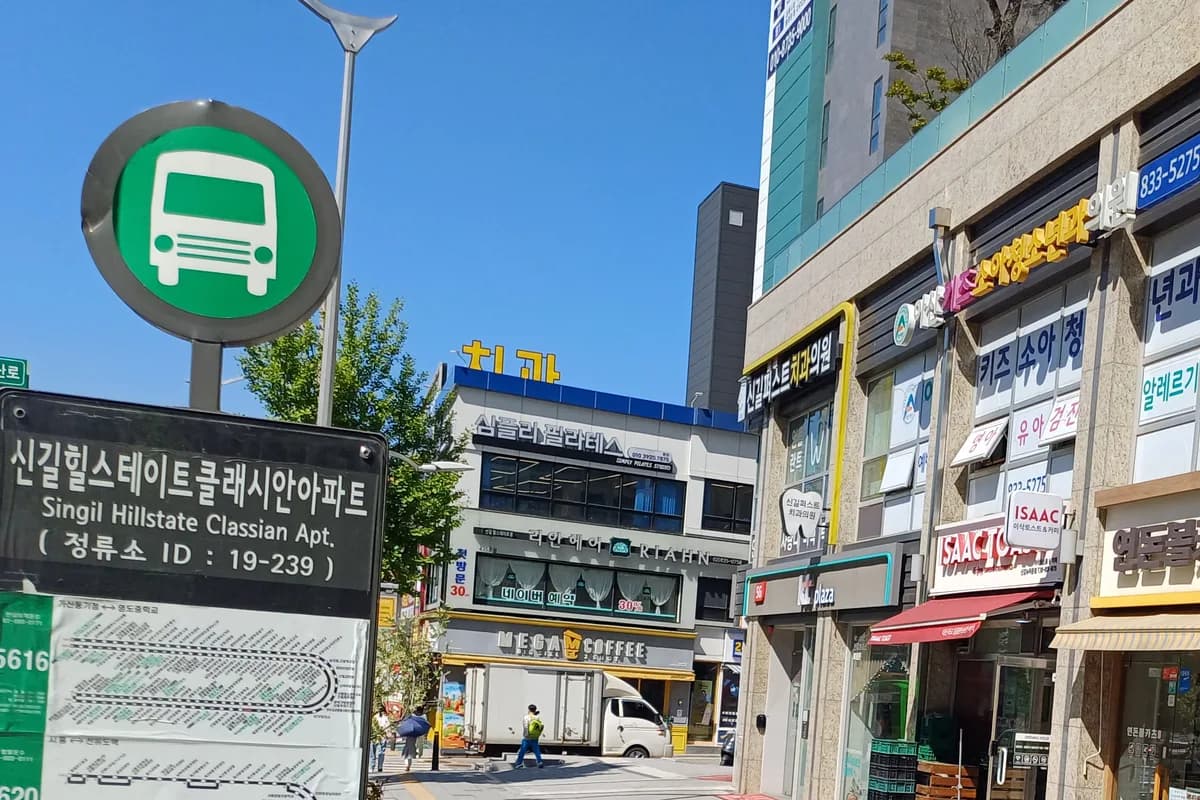
Korea's Longest Apartment Name Is 25 Characters — Seven Longer Than the Joke
Everyone says the names got long so mothers-in-law couldn't find the address. Twenty years of Korean and English coverage repeat that, and not once does anyone say it in the first person. Here is what actually happened: a decoder ring for 센트럴 and 포레, a Swedish word from a company with no Swedish business, and a 2021 study showing the thing residents vote hardest for doesn't work.
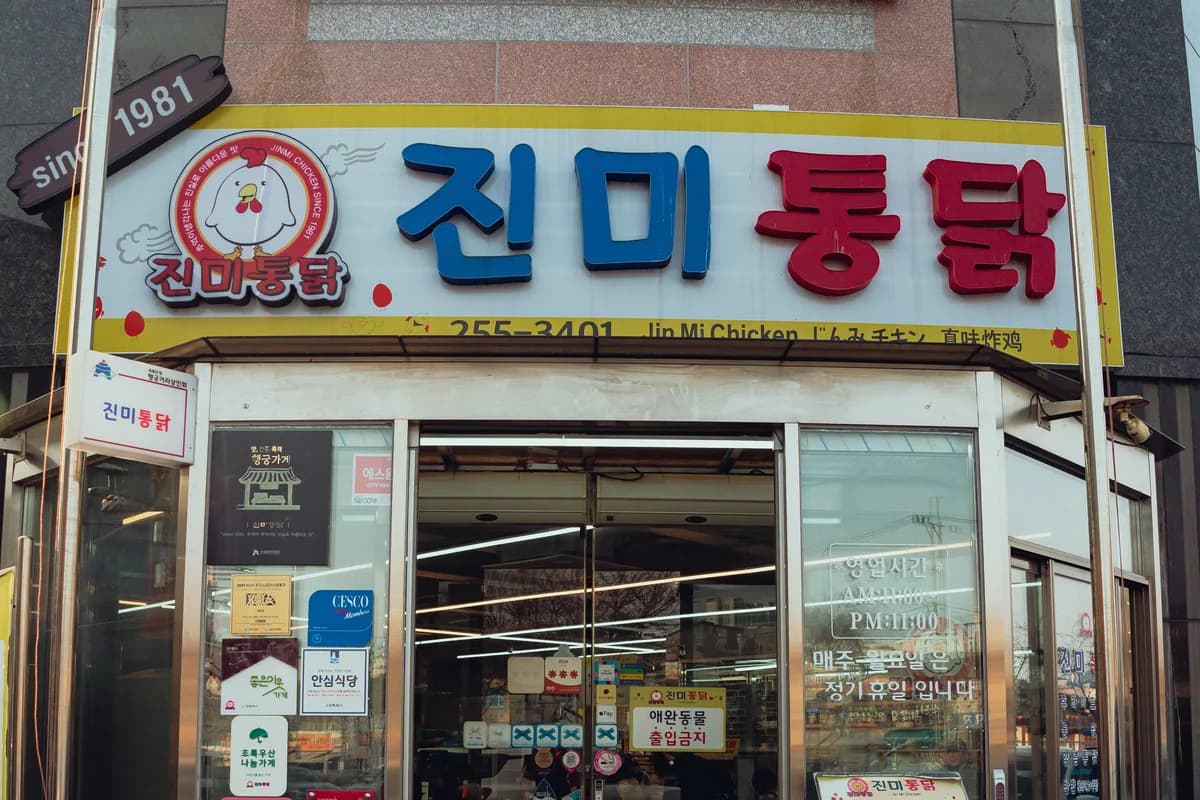
Korea Has Fewer Chicken Shops Than McDonald's Has Restaurants — the Famous Claim Was Counting Beer Halls
The number everyone quotes comes from a 2019 bank report whose own footnote says it includes 호프/통닭 licences and differs from the official count. On the like-for-like series the comparison is now the wrong way round. Four government bodies count Korean chicken shops four ways, two of them moving in opposite directions in the same year — and a decree amended last week finally requires the shops that closed to appear in the revenue forecast you're handed before you sign.
Korea Has Spent 26 Years Deleting Its Corporate Ladder. It Keeps Rebuilding It.
CJ abolished job titles in 2000 and never went back — but the business cards still printed the rank. POSCO and Naver have each now demolished and restored the same hierarchy twice. A look at the 사원-대리-과장-차장-부장 ladder, why 'General Manager' is a mistranslation, and the survey number that everyone quotes backwards.
The Weekly Dispatch
Korea, curated. Every week.
The best of K-culture, straight from Seoul. Written by people who actually live here.
Free, no spam, unsubscribe whenever.