Spinach Is Up 152% in a Month. It's Also Cheaper Than It Was Last August.
Korean vegetable prices produced a genuinely alarming number this month: spinach at ₩1,978 per 100g on 7 August, up from ₩784 four weeks earlier. Both figures are real and we pulled them ourselves. But spinach is currently 15% cheaper than it was a year ago and below the five-year normal — and the agriculture ministry has taken the unusual step of asking people to stop making the comparison that produced the headline.
On 7 July 2026, 100 grams of top-grade spinach cost ₩784 at Korean retail.
On 7 August, the same 100 grams cost ₩1,978.
That is +152.3% in four weeks, and it is the number that has been travelling through Korean media and social feeds since the second week of August. We pulled both figures ourselves from KAMIS, the agriculture ministry's price service, cell by cell. They are correct.
Here is the number that has not been travelling.
On 12 August, spinach was ₩2,038 — and that is 15.4% cheaper than the same day last year, and 5.8% below the five-year normal for early August. The wholesale series says the same thing: up 82.7% on the month, and still 8.7% below normal.
Both things are true at once, and the gap between them is the story.
What actually happened to July
The spike is real. It is also, to a significant degree, a measurement of how strange July was rather than how expensive August is.
Here is the daily series we pulled, for 100g of spinach at retail:
| Date | Price |
|---|---|
| 7 July | ₩784 |
| 10 July | ₩973 |
| 15 July | ₩1,165 |
| 23 July | ₩1,297 |
| 29 July | ₩1,331 |
| 30 July | ₩1,613 |
| 31 July | ₩1,701 |
| 6 August | ₩1,974 |
| 7 August | ₩1,978 |
| 12 August | ₩2,038 |
Note 30 July: a 21% rise in a single day. That was the week the heat broke records — Yangsan hit 42.5°C on 2 August, the highest temperature ever recorded in Korea on any measurement network, after the national record had already fallen twice in the preceding two days.
But now put the normal-year line on that chart. The five-year benchmark for early August is ₩2,162 — which sits above the peak of this entire surge. And on 15 July, spinach was 22.6% below that benchmark.
July was freakishly cheap. August is unremarkable. The percentage between them is enormous.
Why leaf vegetables and not everything
The mechanism is narrow and worth stating precisely, because it explains which shelves moved and which didn't.
Spinach, lettuce, 열무 and 얼갈이배추 are thin-leaved cool-season crops. Past roughly 35°C they lose water through the leaf faster than the root can replace it: leaves wilt, tips brown, and the crop stops being sellable rather than merely getting smaller. And unlike cabbage or radish, they have no storage organ — no head, no root, nothing to warehouse. A bad fortnight in the field is a bad fortnight on the shelf, with no buffer in between.
Which is also why the recovery is quick. Summer spinach runs 30 to 35 days from sowing to harvest. If the heat genuinely breaks in late August, new supply lands in the second half of September.
The basket
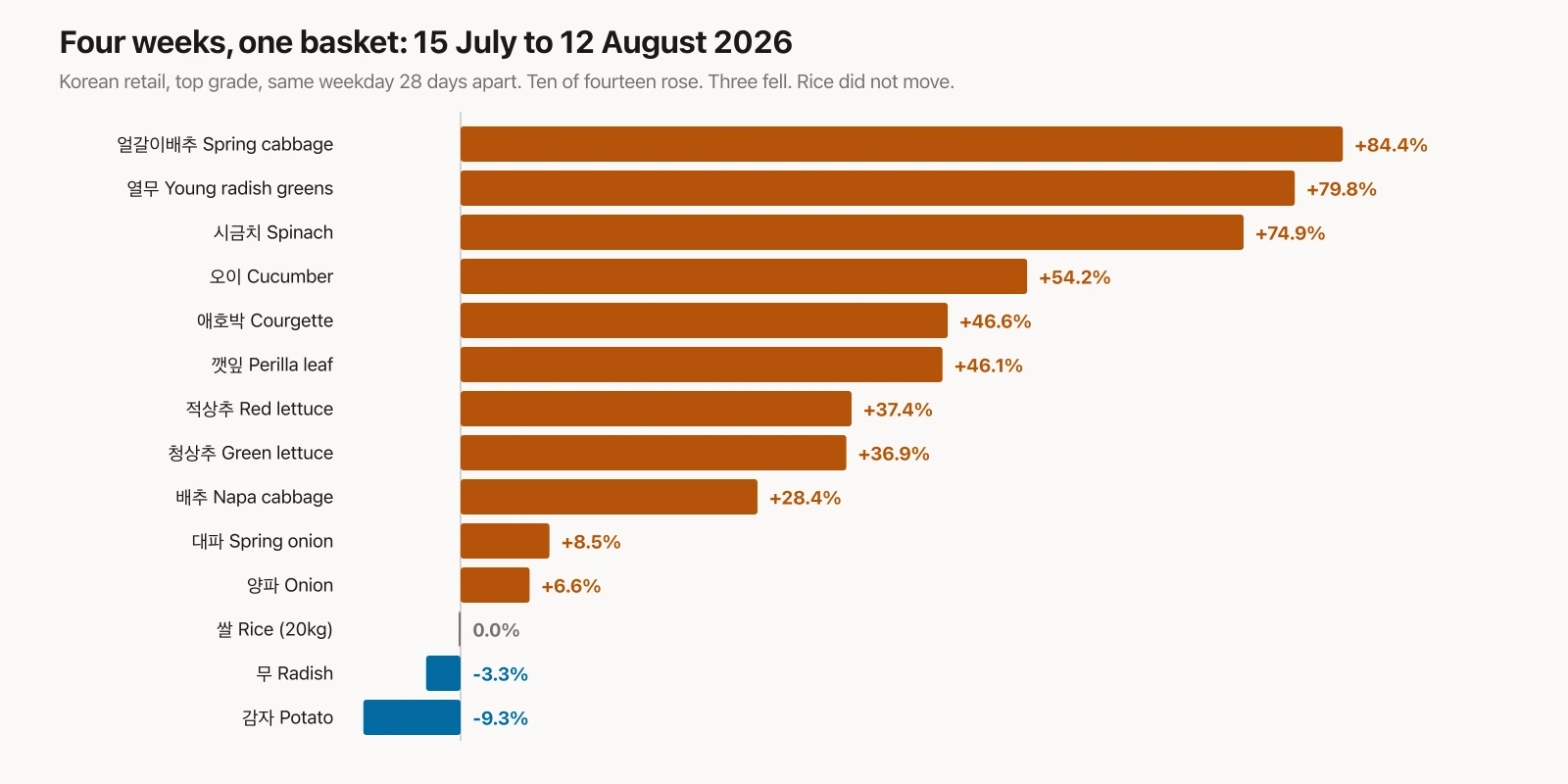
Percentages are easy to panic about and hard to feel. So we built a basket from the same price service — fourteen items an ordinary household actually buys, priced on Wednesday 15 July and Wednesday 12 August. Same weekday, exactly 28 days apart. Retail, top grade.
| Item | Unit | 15 Jul | 12 Aug | Change | vs last year |
|---|---|---|---|---|---|
| Spinach | 100g | ₩1,165 | ₩2,038 | +74.9% | −15.4% |
| 얼갈이배추 | 1kg | ₩2,094 | ₩3,862 | +84.4% | −2.0% |
| 열무 | 1kg | ₩2,421 | ₩4,354 | +79.8% | +4.6% |
| Cucumber (다다기) | 10 | ₩5,473 | ₩8,440 | +54.2% | −11.7% |
| Courgette | 1 | ₩1,024 | ₩1,501 | +46.6% | +17.8% |
| Perilla leaf | 50g | ₩954 | ₩1,394 | +46.1% | −9.4% |
| Red lettuce | 100g | ₩1,199 | ₩1,647 | +37.4% | +8.3% |
| Green lettuce | 100g | ₩1,231 | ₩1,685 | +36.9% | −5.9% |
| Napa cabbage | 1 head | ₩3,513 | ₩4,512 | +28.4% | −33.8% |
| Spring onion | 1kg | ₩2,881 | ₩3,125 | +8.5% | −3.9% |
| Onion | 1kg | ₩1,658 | ₩1,767 | +6.6% | −14.8% |
| Radish | 1 | ₩2,058 | ₩1,991 | −3.3% | −23.7% |
| Potato | 100g | ₩311 | ₩282 | −9.3% | −24.8% |
| Rice | 20kg | ₩61,364 | ₩61,350 | −0.0% | +4.5% |
Ten of the fourteen rose. Three fell. Rice did not move at all.
A realistic weekly vegetable shop for a family of four — spinach, lettuce, perilla, five cucumbers, two courgettes, a cabbage, a radish, spring onion, onion, potatoes — came to ₩22,195 on 15 July and ₩28,867 on 12 August.
Up ₩6,672, or 30.1%, in four weeks. At the 12 August exchange rate, about $15.70 to $20.40.
That is a real increase and nobody should pretend otherwise. It is also not the 152% that the headline implies, because a household does not eat only spinach.
The two cucumbers
While we were pulling the series, we found something that has been quietly corrupting the coverage.
Two figures have been circulating together: cucumbers up 54.8%, and cucumbers at ₩10,788 per ten. Several outlets printed them in the same sentence.
They are different vegetables.
- 다다기계통 cucumbers went ₩5,369 → ₩8,313. That is the +54.8%.
- 가시계통 cucumbers went ₩7,623 → ₩10,788. That is +41.5%.
Both figures are correct. Together they are wrong, and the pairing makes the increase look steeper and the price look higher than either variety actually managed.
Where the second spinach number came from
You will also see spinach reported as +132.2%, from a baseline of ₩852. We could not reproduce it, and the reason turns out to be instructive rather than damning.
KAMIS displays a "one month ago" column beside each price. That column is not a single day's price — the service's own footnote says it is a five-day moving average — and those cells get revised as later data lands. We watched the revision happen across other items: 열무's month-on-month figure has since moved from +73.9% to +85.5%, 얼갈이배추 from +63.5% to +80.2%, perilla from +23.0% to +26.3%.
So ₩852 was almost certainly what that averaged cell showed on 8 or 9 August. It was right when it was published and it is not reproducible now.
+152.3% is the figure that survives, because it compares two actual daily prices — ₩784 on 7 July, ₩1,978 on 7 August — and anybody can pull both.
The ministry is asking people to stop
Here is the part that makes this more than a price story.
On 11 August, the agriculture ministry published a statement on summer vegetable supply. Its position is that the major vegetables — cabbage, radish, spring cabbage — are at or below normal-year levels, and it pointedly suggested that comparing raw daily prices is the wrong method: better, it said, to weigh prices against the previous year, against the five-year normal, over comparable periods, and by specification.
The reason it gave is that simple day-to-day comparison can generate excessive public anxiety about inflation.
That is a government agriculture ministry publicly asking the press to change its arithmetic. And on the same day, coverage of that statement carried the headline figure that cabbage was down 32% — during the hottest summer in the country's recorded history.
Our own basket, pulled independently, has napa cabbage at −33.8% year-on-year.
The caveats, which are real
We are not going to tell you nothing is happening, because three things genuinely are.
First, the "below normal" claim does not cover everything. It holds for leaf-and-root vegetables. It does not hold across the board for fruiting vegetables — at wholesale, some cucumber and courgette varieties are up sharply year-on-year. Our retail figures show one cucumber variety down 11.7% on the year. Different variety, different market level, both true. Anyone quoting one against the other is comparing things that were never the same.
Second, two items in our basket are above the five-year normal: 열무 and perilla leaf. If you cook with those, the abstraction does not help you.
Third, the highland crops had a good year. Yields in the 고랭지 areas where much of the summer cabbage and radish grows are running 5–10% above normal — good weather in exactly the places that grow the storable crops. The heat hit the thin-leaved things, and the thin-leaved things are the ones with no buffer.
What happens next, and when
Prices were still climbing on 12 August, but decelerating — up 1.1% on the day, against that 21% single-day jump on 30 July.
The forecast we can actually stand behind is short: the weather agency's confirmed outlook ran only to 16 August at the time of writing, and we are not going to print late-August probabilities from secondary summaries. What we can say is the agronomy: 30 to 35 days from sowing, so if the heat breaks late this month, genuinely new spinach reaches shelves in the second half of September.
The government has put a ₩68.7 billion package behind the summer, is releasing stockpiles — 15,000 tonnes of cabbage, 6,000 of radish — and is running discounts of up to 40%.
And there is one hard date. August inflation figures land on 2 September. July's came in at +2.8% headline, with core at +2.6%, the highest in over two years. Several forecasters expect August to rebound above 3% — but note what they attribute it to. The central bank's stated reasoning points at oil and a telecoms base effect, not vegetables. The "above 3%" figure specifically comes from a single sell-side analyst, not the government.
Which is the same problem as the spinach, one level up: a real number, a dramatic frame, and a cause that isn't the one everybody assumes.
If you want the mechanism behind the weather doing this, Korean summer, explained covers the heat itself. For what these prices do to a restaurant meal, our Korean fried chicken piece has the cost structure.
Images: all three are charts we built ourselves from the KAMIS series in this article — no photograph, no licence, no third party. Listing card is the three-figure contrast; cover is the fourteen-item basket sorted by change, with the three fallers and rice in a second colour; hero is the daily spinach line from 7 July to 12 August with the five-year-normal and same-day-last-year reference lines drawn in — and the point of that chart is that both reference lines sit above the entire surge. We chose charts over photography deliberately here: a picture of a vegetable aisle would have illustrated the panic rather than the data, and the data is the argument.
All price figures in this article were pulled by us directly from KAMIS (농산물유통정보, kamis.or.kr) on 13 August 2026, item by item, and are retail, top grade (상품) unless labelled wholesale. Every percentage states both of its endpoint dates, because that is precisely where the reporting on this story has gone wrong. The +152.3% figure compares two actual daily prices and is reproducible by anyone; the +132.2% figure in circulation derives from KAMIS's five-day moving-average column, which is revised as later data lands, and is no longer reproducible — it was accurate when published. The basket is our own compilation, not lifted from any newspaper, and uses the same weekday 28 days apart. The agriculture ministry's 11 August statement and its caution against simple daily comparison are quoted from that release and independently corroborated by same-day coverage reporting cabbage down 32%, which matches our own basket within a point and a half. Deliberately omitted: individual shopkeeper and shopper quotes circulating in Korean coverage, which we could not independently verify at the time of writing; late-August weather probabilities, which we could source only to secondary summaries; and a widely repeated central-bank figure on heat-driven inflation, which comes from a paper published in September 2025 and is being reported as though it were new. We have also not used the vivid restaurant-surcharge details in circulation — the "₩2,000 for extra lettuce" signage and the per-person lettuce limits — because tracing them shows they date from 2021 and 2022, not this summer.
Keep Reading
More Stories
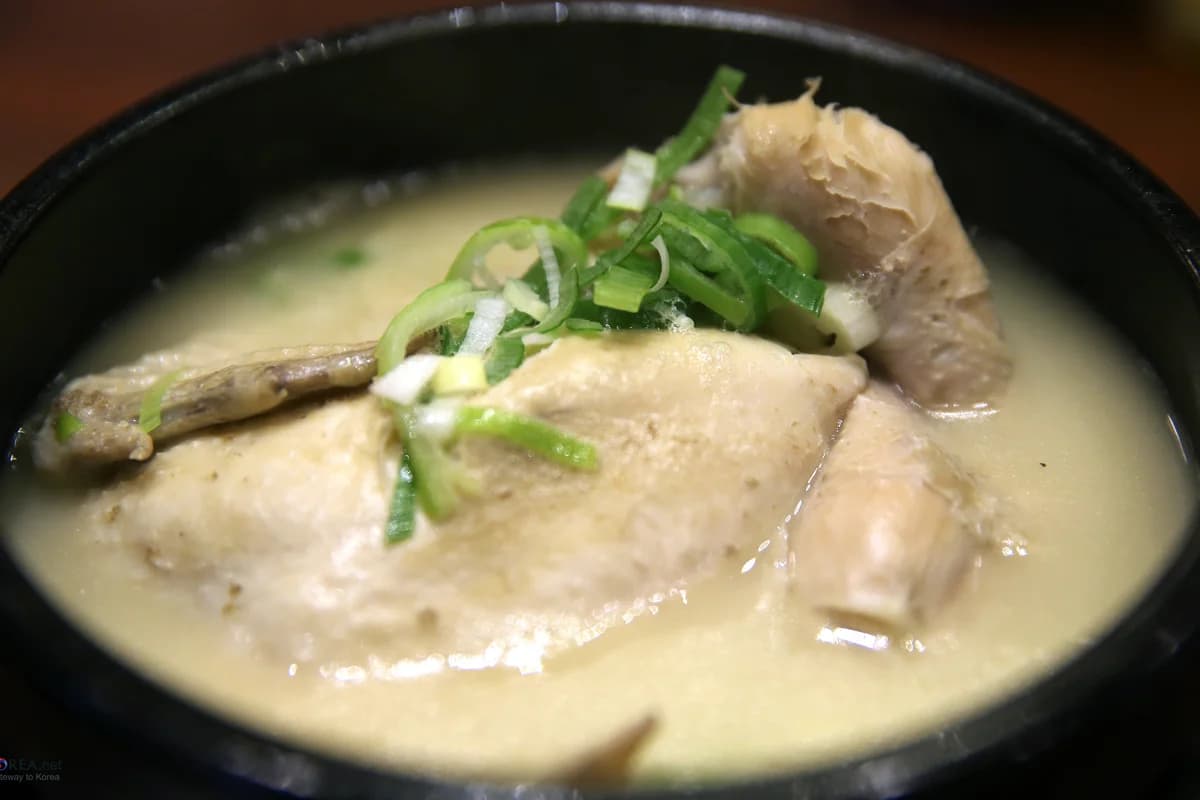
The ₩18,154 Bowl: How Korea's Hottest-Day Ritual Got Priced Out
On the hottest days of the year, Koreans queue for boiling chicken soup. But samgyetang now costs ₩18,154 in Seoul — while the same ingredients run ₩8,800 at a market. Jungbok falls on July 25. A guide to boknal, the logic of fighting heat with heat, and why the convenience-store version isn't the end of a tradition.

What Is Soju? Korea's Green-Bottle Spirit, Explained
It's the best-selling spirit brand on Earth, and most people outside Korea couldn't pick it out of a lineup. A field guide to soju: what's actually in the green bottle, how a 1965 rice ban created the modern version, why it's suddenly conquering export markets — and how to drink it like you know what you're doing.
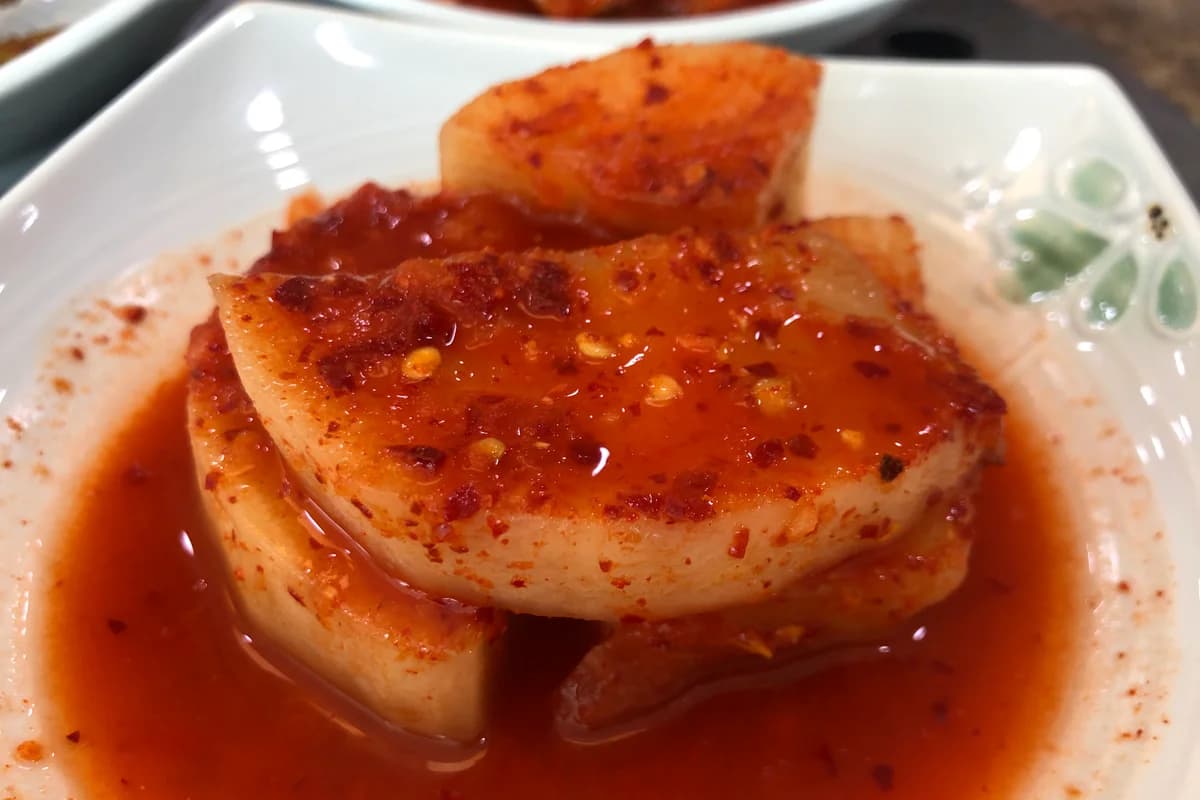
What Is Kimchi? Types, Taste, and How Koreans Actually Eat It
It's the little red side dish that appears at nearly every Korean meal — and it's a lot more than 'spicy cabbage.' A field guide to what kimchi actually is, the varieties beyond the famous one, why it gets funkier with age, and how Koreans really eat it.
The Weekly Dispatch
Korea, curated. Every week.
The best of K-culture, straight from Seoul. Written by people who actually live here.
Free, no spam, unsubscribe whenever.