The ₩18,154 Bowl: How Korea's Hottest-Day Ritual Got Priced Out
On the hottest days of the year, Koreans queue for boiling chicken soup. But samgyetang now costs ₩18,154 in Seoul — while the same ingredients run ₩8,800 at a market. Jungbok falls on July 25. A guide to boknal, the logic of fighting heat with heat, and why the convenience-store version isn't the end of a tradition.
Start with the arithmetic, because it's stranger than the anthropology.
A bowl of samgyetang — whole young chicken, glutinous rice, ginseng, simmered until the meat slides off — costs ₩18,154 on average in a Seoul restaurant as of May 2026 (Herald Economy, YTN, both 5 July 2026, citing the Korea Consumer Agency's 참가격 price portal). The ingredients to make the same dish, bought at a traditional market, work out to about ₩8,800 per serving (한국물가정보 survey via 파이낸셜뉴스, 8 July 2026).
That's a 2.06× markup, which is unremarkable for restaurant food. Here's the part that isn't: over the past year, the restaurant price rose 2.8% while the ingredient basket fell 2.8%. Chicken is up 20% over five years. The bowl is up 29%. The gap isn't chicken. It's rent, wages and electricity.
And Koreans will queue for it anyway, in direct sun, on the hottest days of the year. Jungbok (중복) — the middle of the three hottest days on the Korean calendar — falls on Saturday, July 25, 2026. Here's what that means, why the soup is boiling, and why the ₩4,700 convenience-store version is a much older story than it looks.
What Boknal Actually Is
복날 (boknal) are the three hottest days of the Korean year — not a forecast, but a calendar fixture. Collectively they're 삼복 (三伏, sambok): 초복 (初伏, chobok), 중복 (中伏, jungbok) and 말복 (末伏, malbok).
In 2026 they fall on:
| Date | Day | |
|---|---|---|
| 초복 Chobok | Wednesday, July 15 | 3rd 경일 after the solstice |
| 중복 Jungbok | Saturday, July 25 | 4th 경일 after the solstice |
| 말복 Malbok | Friday, August 14 | 1st 경일 on or after 입추 |
The rule comes from the Encyclopedia of Korean Culture: chobok is the third 경일 (庚日) after the summer solstice, jungbok the fourth, and malbok the first 경일 falling on or after 입추 (立秋), the calendrical start of autumn.
A 경일 is a day whose "heavenly stem" in the traditional sexagenary cycle is 庚 — the seventh of ten stems. Those recur every ten days, which is why chobok and jungbok are always exactly ten days apart.
So why is the gap to malbok twenty days this year instead of ten?
Because 2026 is a 월복 (越伏, wolbok) year — a "skipped bok." The solstice fell on 21 June and 입추 lands on 7 August. Counting 경일 days from the solstice gives 25 June, 5 July, 15 July (chobok), 25 July (jungbok), 4 August, 14 August. The fifth one, 4 August, arrives three days before 입추 — so it doesn't qualify. Malbok skips to the next one (Namu Wiki, 삼복).
Which is a satisfying thing to know: the three-week stretch between jungbok and malbok this year is a calendar artifact, not a weather forecast. The heat doesn't know about 경일 days.
Fighting Heat With Heat — and What That Phrase Gets Wrong
The principle everyone cites is 이열치열 (以熱治熱), "control heat with heat." The traditional reasoning: in summer your surface is hot but your core goes cold, partly because you're loading up on iced drinks and cold noodles. Hot food re-warms the interior and drives the cold out (전북일보).
Here's the nuance almost every English write-up misses. Korean-medicine practitioners say the phrase is usually misapplied. Dr. 한동하, a doctor of Korean medicine, told 헬스경향 that the correct classical term is 열인열용 (熱因熱用) — using heat for conditions caused by heat — and that it only applies to the specific pattern of a hot exterior masking a cold interior. For someone already carrying excess internal heat, he warns, samgyetang is "불난 곳에 기름을 붓는 꼴" — pouring oil on a fire.
In classical framing, cold noodles in summer is 정치 (正治), the normal treatment. Samgyetang is 반치 (反治), the counter-treatment — the exception, not the rule.
Does the science support it? Partly, and then it falls apart on the humidity.
There is a real published finding: Bain, Lesperance & Jay (2012), in Acta Physiologica, had nine cyclists ride for 75 minutes while drinking water at various temperatures. Hot fluid produced lower net body heat storage, apparently because a thermoreceptor in the gut triggers a disproportionate sweat response — you sweat more than the hot drink added, and come out ahead.
The catch: it only works if the sweat can evaporate. Those trials ran at 23% relative humidity. A Korean July night is the precise opposite — humid enough that sweat sits on your skin doing nothing. The researchers' own framing, echoed in Discover, is that the effect holds only when the weather is dry.
So: a real mechanism, demonstrated in dry air, during exercise, in nine men, with plain water — not with a fatty ginseng broth, and not in a Korean summer. Anyone telling you science proves samgyetang cools you down is skipping the part that matters.
The Myth: Samgyetang Is Not an Ancient Dish
This is the fact that reframes everything else, so it's worth being blunt about it.
Samgyetang does not appear in any Joseon-era document. 경향신문 puts it plainly: "삼계탕에 대한 기록은 조선 시대 문헌에서조차 찾을 수 없으며, 우리 조상들이 삼계탕을 즐기지는 않았다" — there is no record of samgyetang even in Joseon-era texts, and our ancestors did not eat it.
The actual chronology (Korean Wikipedia, 삼계탕):
- Japanese colonial period — wealthy households start adding powdered ginseng to 닭백숙 (plain boiled chicken).
- Late 1940s — restaurants begin selling it.
- Around 1950 — it settles into a distinct dish called 계삼탕 (鷄蔘湯) — note the order: chicken-ginseng-soup.
- 1960s onward — refrigeration makes it possible to store whole ginseng root long-term, so the dried root replaces the powder. This is when the dish as you'd recognise it appears.
- 1970s onward — it becomes popular.
Then the name flipped. As ginseng came to be seen as the more precious ingredient, 계삼탕 became 삼계탕 (蔘鷄湯) — ginseng first. The dish renamed itself around its status ingredient.
So what did Koreans actually eat on boknal? The documented commoner dish was 개장국 — dog-meat soup, classical name 구장 (狗醬) — recorded in the 1849 almanac 『동국세시기』 and other Joseon texts (Encyclopedia of Korean Culture). The stated logic was the same one: eat it, sweat, drive out the heat. The same sources list 팥죽 (red-bean porridge), 민어 (croaker, the elite choice) and the chilled 임자수탕 — a court dish of sesame and chicken served cold, a useful corrective to the idea that boknal was ever uniformly about hot food.
Dog meat is now being phased out by law. The Special Act on Ending the Breeding, Slaughter and Distribution of Dogs for Consumption passed the National Assembly on 9 January 2024 — 208 in favour, none against — and was promulgated in February 2024. The full prohibition takes effect 7 February 2027, after a three-year grace period (서울신문). Worth stating precisely, because it's widely misreported: the statute penalises breeding, slaughter, distribution and sale. It does not create a penalty for eating.
Put the timeline together and the picture changes completely. Korea's "timeless" summer ritual has already swapped its central dish once inside living memory. Which makes the next section much less alarming than it sounds.
The 2026 Price Story
Here's the Seoul restaurant average for samgyetang, every May, from the Korea Consumer Agency's 참가격 portal:
| May | Seoul average |
|---|---|
| 2021 | ₩14,077 |
| 2022 | ₩14,577 |
| 2023 | ₩16,423 |
| 2024 | ₩16,885 |
| 2025 | ₩17,654 |
| 2026 | ₩18,154 |
That's +2.8% year on year and +29.0% over five years — confirmed identically across Herald Economy, YTN and 오피니언뉴스, all published 5–6 July 2026.
The inputs did rise. Broiler chicken went from ₩5,433/kg (May 2021) to ₩6,518/kg (May 2026) — +20.0%. Around chobok this year, 한국일보 reported fresh ginseng up 24.7% year on year and glutinous rice at ₩4,668/kg, 6.3% above a normal year. The heat is hitting supply directly: 27,276 cumulative poultry deaths this heatwave, with roughly 1,400 on 13 July alone. Chickens have no functional sweat glands and start dying above 32°C.
But chicken rose 20% and the bowl rose 29%. The dish outran its main ingredient.
Restaurants say so themselves. 머니투데이 quotes the industry pointing at 인건비와 임차료 — labour and rent — plus utilities, as the compounding costs. And the traditional-market survey makes it starker: a four-person samgyetang ingredient basket cost ₩35,260 in July 2026, down 2.8% year on year, with glutinous rice down 23.3%.
Ingredients got cheaper. The bowl got dearer. That spread is the story.
It isn't a story about greedy restaurants, either. 경북도민일보 quotes owners saying this year is hard to call the usual boknal bump, and one who has held his price for years despite ingredient costs. The customer is squeezed and the owner is squeezed. The margin is going to the landlord and the utility company.
Where Everyone Actually Went
They went to the convenience store, and the numbers are not subtle.
GS25 analysed its boknal-season tonic-food sales and found that in 2025, 61.2% of them were something other than samgyetang — up 7.7 percentage points year on year and 29.3 points versus 2023 (뉴스웨이). CU's summer tonic-food category has grown 28.5% (2023), 25.1% (2024), 19.8% (2025) — three straight years of double-digit growth.
The 2026 boknal menu at Korean convenience stores, with chains explicitly competing under ₩10,000 (Korea JoongAng Daily, 15 July 2026):
| Retailer | Item | Price |
|---|---|---|
| CU | Samgyetang rice ball (삼각김밥) | ₩2,000 |
| CU | Samgyetang burger | ₩4,700 |
| CU | Eel-and-samgyetang rice bowl | ₩5,500 |
| Emart24 | Freshwater eel gimbap | ₩6,500 |
| GS25 | Boknal lunch box (eel, duck, Hamburg steak) | ₩6,900 |
| Emart24 | Eel chirashi sushi box | ₩9,900 |
An industry official's summary in the same piece: boknal "has become a day to eat whatever nourishing food you want — chicken, eel, abalone or anything else."
Meanwhile the supermarkets and delivery platforms pivoted hard into eel, abalone and duck, and GS25 launched its boknal range about three weeks earlier than in previous years. The drivers cited are exactly what you'd expect: restaurant inflation, more single-person households, and demand for ready meals.
A note on what's "traditional" here. Eel and abalone get marketed as ancestral boknal food. They're not, quite. Eel appears in Joseon records as an elite item — 정약전's 『자산어보』 lists it as rich and beneficial, and it was a royal tribute good — but it was never a commoner's boknal staple. Duck shows up in the historical record for boknal essentially not at all; it's a modern retail substitution. Of the things being sold to you this July as time-honoured, the genuinely documented ones are 개장국, 팥죽, 민어 and 임자수탕.
The Queue Is Still There
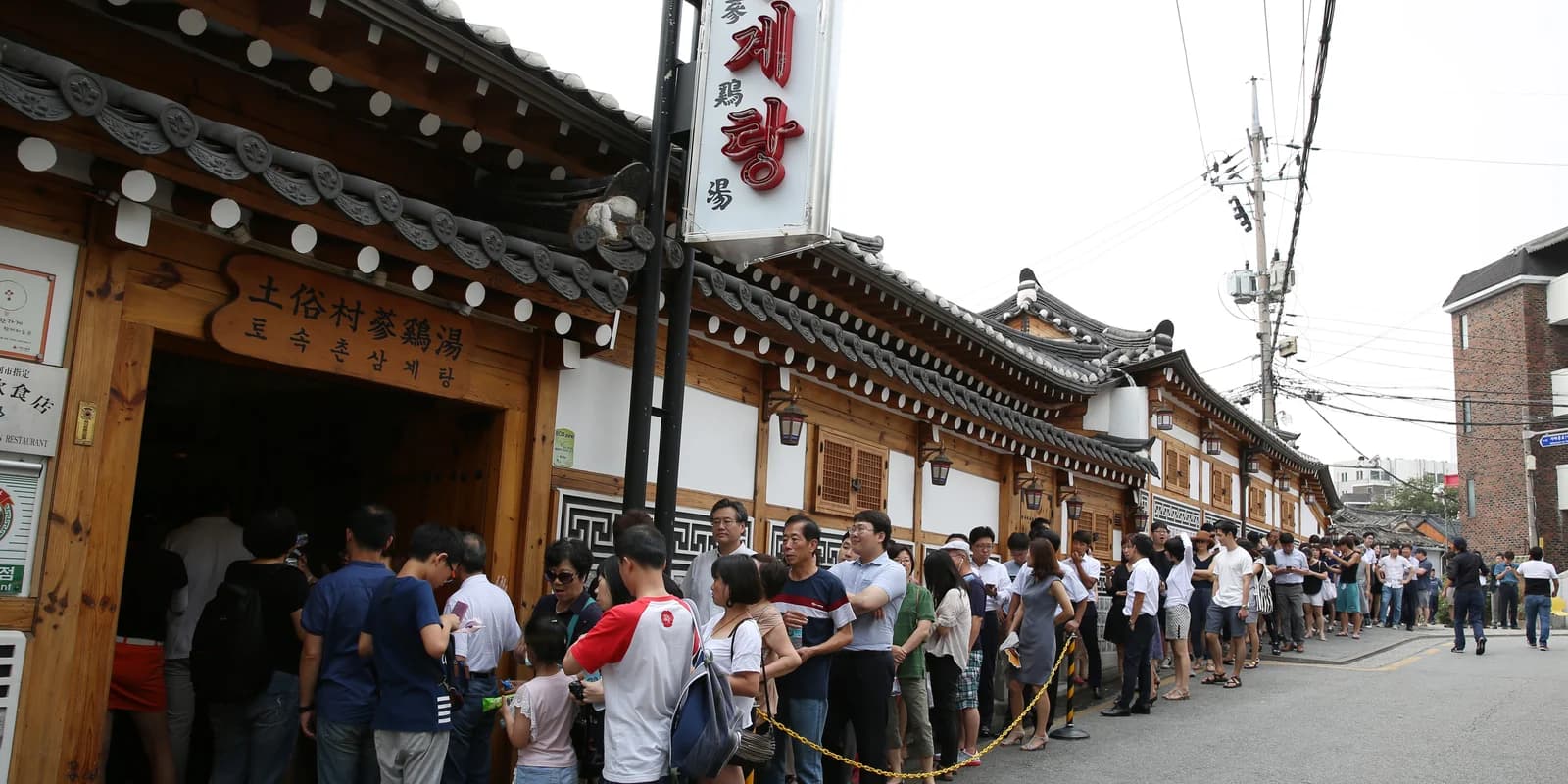
None of this has killed the ritual at the top end. On chobok this year — 15 July 2026 — 뉴스핌 filed wire photos of the line outside 토속촌 (Tosokchon) in Seochon, just west of Gyeongbokgung, captioned: "초복인 15일 서울 종로구 서촌 토속촌을 찾은 시민과 관광객들이 삼계탕을 먹기 위해 대기하고 있다."
Note the phrase 시민과 관광객들 — citizens and tourists. That's the honest shape of it. The queue outside the famous specialist is sustained partly by visitors, while a lot of ordinary Koreans trade down to a ₩4,700 burger. Both things are true on the same afternoon.
Tosokchon sits at 서울 종로구 자하문로5길 5, a few minutes from Gyeongbokgung Station Exit 2, in a hanok, open roughly from mid-morning to evening. If you want the full version — the queue, the stone pot, the whole bird — that's where the photographs get taken. (For the everyday version of this question, see where locals actually eat in Seoul.) Prices at the famous specialists run above the city average; 오피니언뉴스 notes some now exceed ₩20,000 a bowl, though it names no restaurant, and we haven't verified Tosokchon's current menu directly.
About This Summer's Heat
Two records worth knowing, both locked in and dated.
On 13 July 2026, Seoul and Incheon each recorded a daily minimum of 27.6°C — the highest mid-July overnight low in either city since observations began, which for Seoul means October 1907 and for Incheon August 1904 (세계일보, 경인일보). Tropical nights ran across Seoul, Incheon, Gangneung, Daejeon, Gwangju, Daegu, Pohang, Busan and Jeju.
And on 12 July 2026, Korea issued its first-ever Emergency Heatwave Warning, for Gyeongsan and Pohang in North Gyeongsang (The Korea Times). It's a new top tier added around June 2026 — the first change to the advisory system in roughly 18 years — triggered when a region already at a perceived 35°C for two straight days is forecast to hit a perceived 38°C or an actual 39°C. Gyeongsan had hit 37.9°C, with 39.9°C in Hayang-eup. The mechanism was a foehn effect: southerly winds heating as they came down off the mountains.
What we won't tell you is what the weather is doing on the day you read this. Conditions across the peninsula in late July are mixed and move fast. The fixed thing is the date: jungbok, Saturday 25 July.
The Point
The story that writes itself here is tradition dies, convenience store wins. It's the wrong story.
Samgyetang isn't the ancient dish being displaced. It's the replacement — a colonial-era improvisation that only became today's dish after refrigerators reached Korea in the 1960s, and which itself displaced a soup that's now being legislated out of existence. The boknal slot has held at least three different dishes in about a century and a half.
So the ₩2,000 samgyetang rice ball isn't the end of anything. It's the third occupant of the same slot, doing exactly what the second one did: showing up when the previous option got impractical, and being cheap enough that people actually eat it on the day.
What's persisted through all of it isn't the chicken. It's the idea that the hottest day of the year is a day you're supposed to eat something restorative, on purpose, with intent — and that this is worth marking on a calendar with a rule involving the solstice and a ten-day cycle of stem-days.
That part has survived a dynasty, a colonisation, a war, refrigeration and a 29% price rise. It'll survive the burger.
Jungbok is Saturday, July 25. Malbok is Friday, August 14 — twenty days later, because the fifth 경일 arrived three days too early. Eat something hot. Or don't, and have the cold sesame soup instead; that's traditional too.
Boknal dates are derived from the rule given by the Encyclopedia of Korean Culture and cross-checked against 2026 reporting. All prices are dated in-text and drawn from the linked sources; the Seoul samgyetang series is the Korea Consumer Agency's 참가격 portal as reported by three independent outlets. Regional price figures are omitted because our sources conflict. Tosokchon's current menu prices and opening hours are described in general terms because we could not verify them from the restaurant directly. No calorie or protein figures are given, because we found none from a recognised nutrition database. Images: samgyetang at Tosokchon and the Tosokchon queue on malbok, photographed by Jeon Han for Korea.net / Korean Culture and Information Service, CC BY-SA 2.0 via Wikimedia Commons (cropped); listing card — samgyetang, Korea.net / KOCIS (Jeon Han), CC BY-SA 2.0 via Wikimedia Commons (cropped).
Keep Reading
More Stories
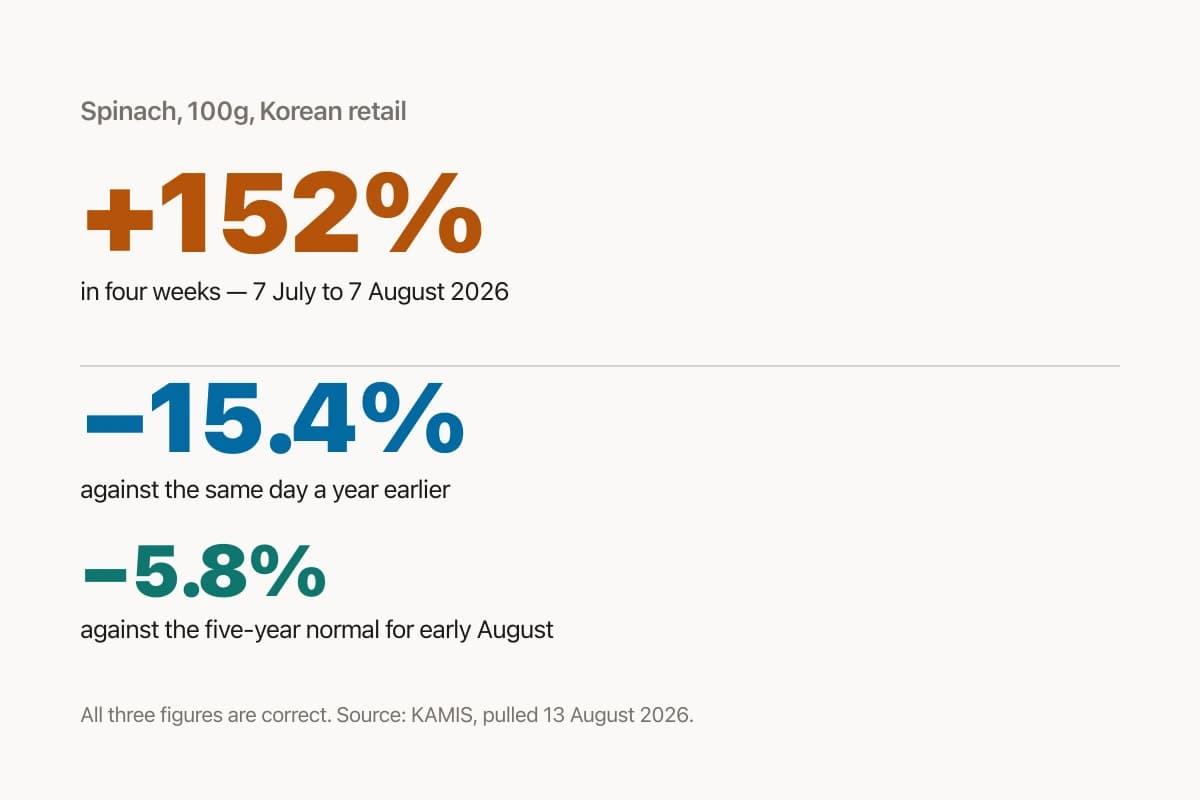
Spinach Is Up 152% in a Month. It's Also Cheaper Than It Was Last August.
Korean vegetable prices produced a genuinely alarming number this month: spinach at ₩1,978 per 100g on 7 August, up from ₩784 four weeks earlier. Both figures are real and we pulled them ourselves. But spinach is currently 15% cheaper than it was a year ago and below the five-year normal — and the agriculture ministry has taken the unusual step of asking people to stop making the comparison that produced the headline.
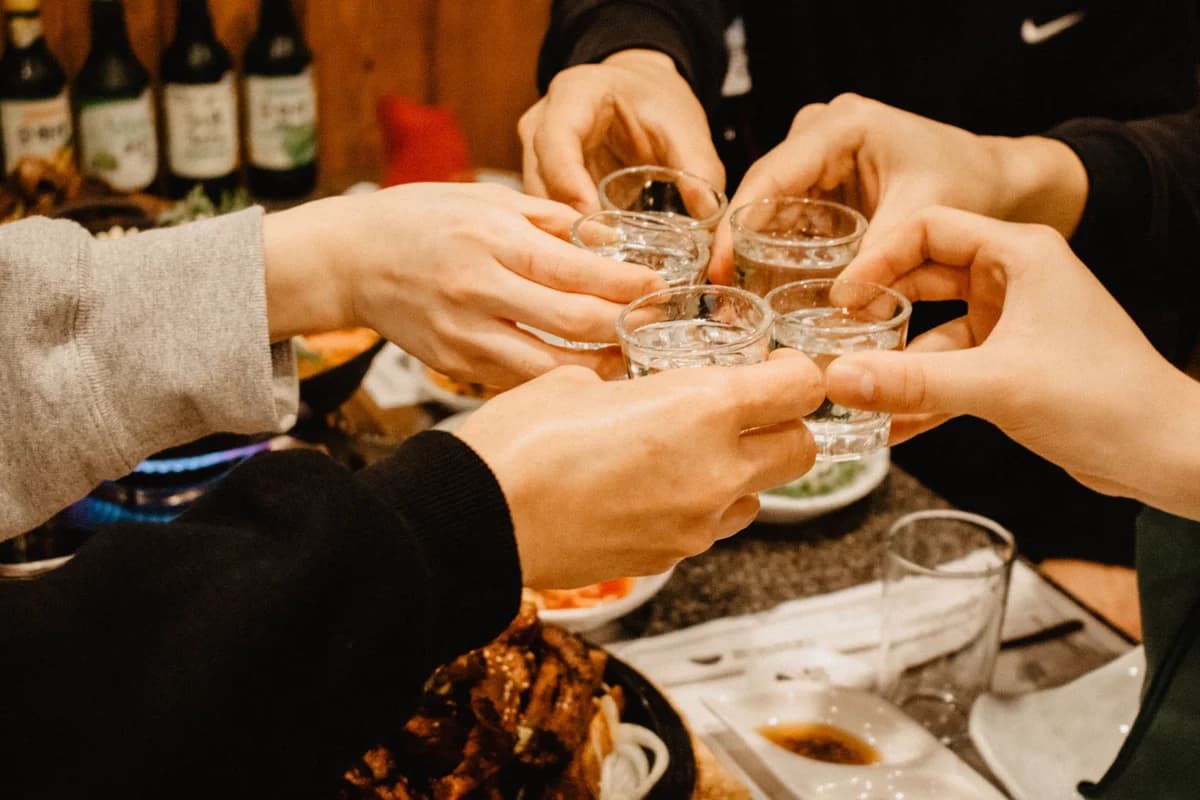
What Is Soju? Korea's Green-Bottle Spirit, Explained
It's the best-selling spirit brand on Earth, and most people outside Korea couldn't pick it out of a lineup. A field guide to soju: what's actually in the green bottle, how a 1965 rice ban created the modern version, why it's suddenly conquering export markets — and how to drink it like you know what you're doing.
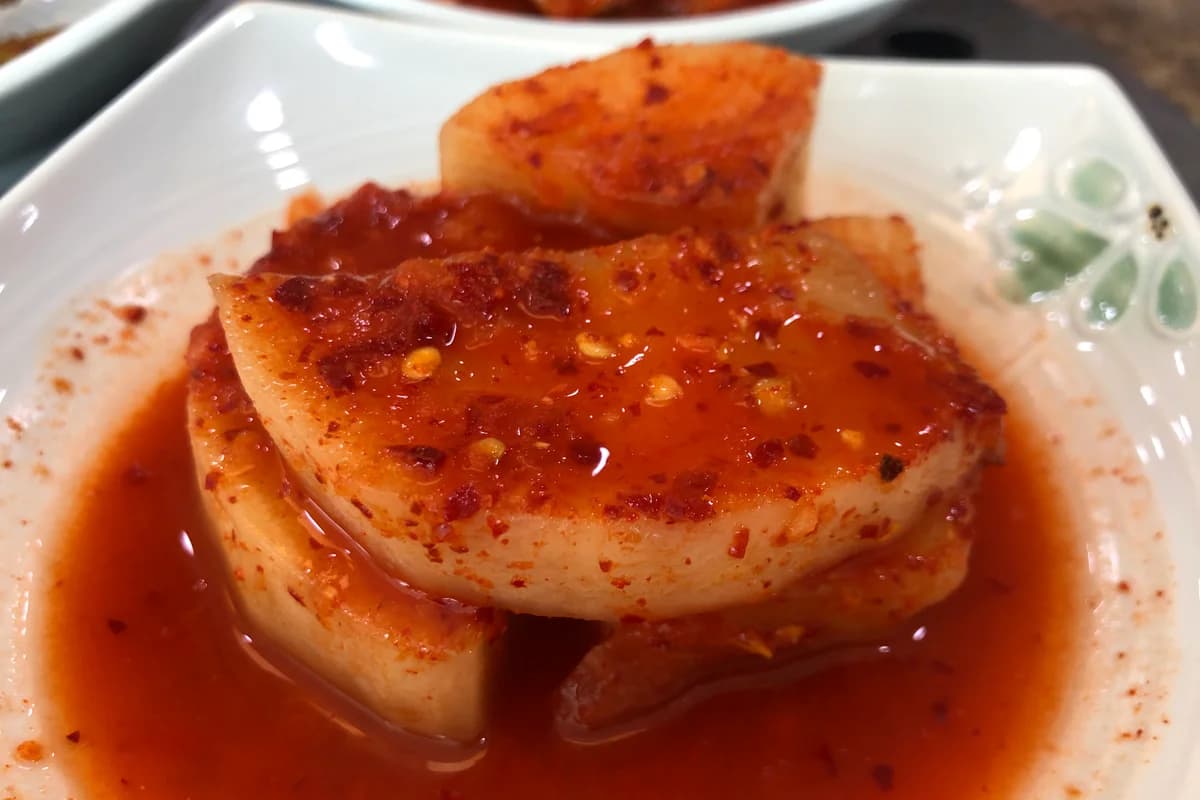
What Is Kimchi? Types, Taste, and How Koreans Actually Eat It
It's the little red side dish that appears at nearly every Korean meal — and it's a lot more than 'spicy cabbage.' A field guide to what kimchi actually is, the varieties beyond the famous one, why it gets funkier with age, and how Koreans really eat it.
The Weekly Dispatch
Korea, curated. Every week.
The best of K-culture, straight from Seoul. Written by people who actually live here.
Free, no spam, unsubscribe whenever.