Korean Fried Chicken, Honestly — The Chains, the Styles, and What's Actually Worth It (2026)
Every Korea food guide says the same three words — try fried chicken — and then leaves you standing on a street with eleven chicken signs and no idea which one. Here's the honest version: how chimaek actually works, what the big chains are each good at, the styles you should actually order, and why the best chicken in the neighborhood usually isn't the famous one.
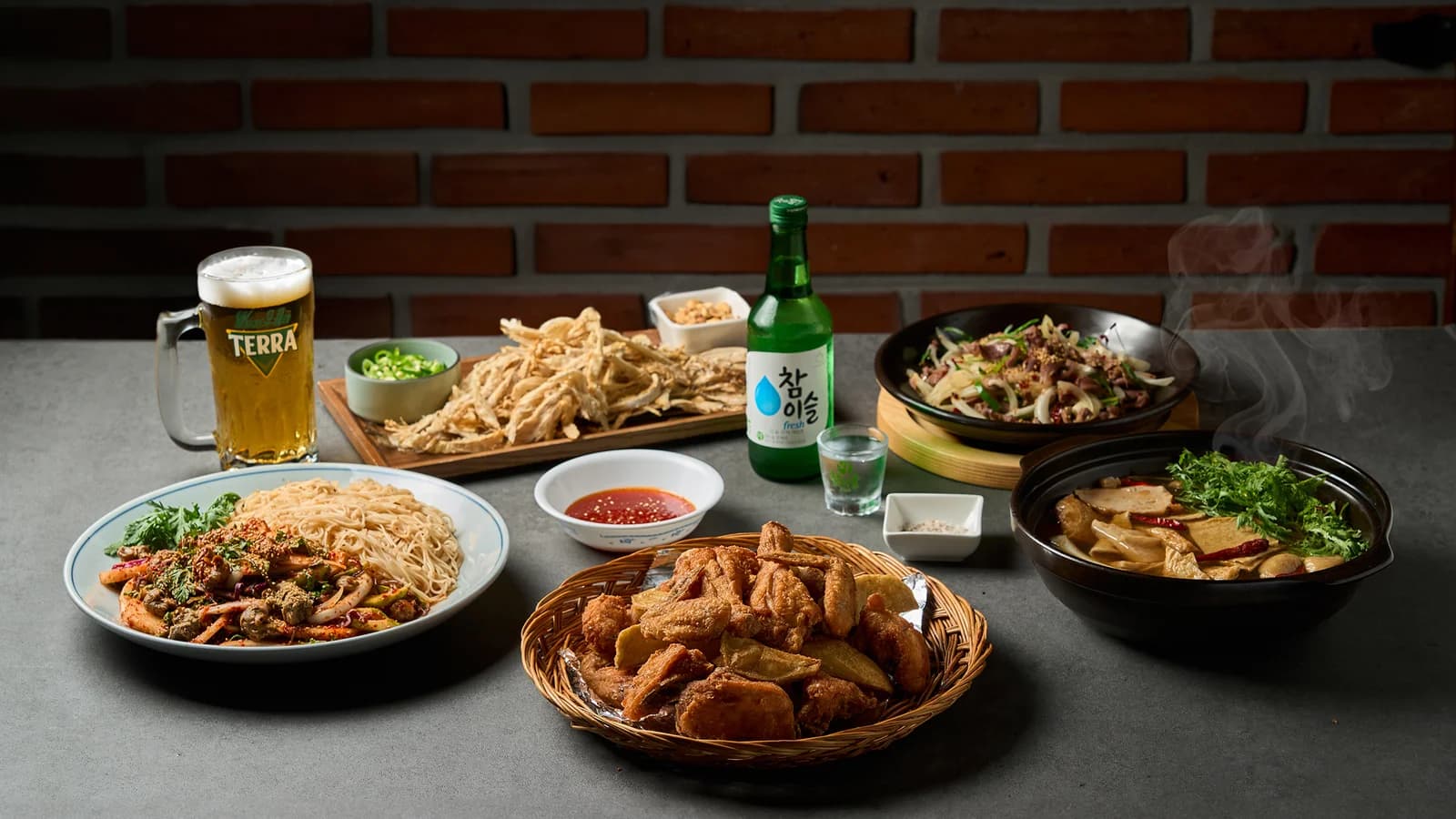
Here is the advice every English-language Korea guide gives about fried chicken: "You have to try Korean fried chicken. It's not like American fried chicken. Get the chimaek — chicken and beer."
All true. All useless the moment you're standing on an actual Korean street, because there are eleven chicken signs within sight, four of them are national chains you've never heard of, two are franchises pretending to be the famous one, and one — the half-empty place with the flickering sign and three middle-aged men drinking beer in the corner — is quietly the best of the lot.
Korea is, by an often-cited count, home to more fried-chicken outlets than there are McDonald's in the entire world. That is not a figure of speech. Chicken is less a meal here than a piece of national infrastructure. So "try Korean fried chicken" is roughly as helpful as telling someone visiting the US to "try a sandwich."
This is the honest version: what makes it different, the styles you actually order, what each big chain is genuinely good at, the one rule for finding great chicken anywhere, and the price reality nobody mentions.
First, what chimaek actually is
Chimaek (치맥) is a portmanteau: chi(cken) + maek(ju), maekju being beer. It is not a dish. It's a ritual — fried chicken eaten as anju (food you order specifically to drink alongside), usually at night, usually shared, usually with cold lager in a frosted glass. The chicken is the anchor; the beer is the point.
The fried chicken itself is genuinely different from the American version, and the difference is technique, not seasoning. Korean fried chicken is typically double-fried — fried once at a lower temperature to cook it through, rested, then fried again hot to set the crust. The result is the thing the whole cuisine is built around: a shatter-thin, glassy crust that stays crisp even after it's been tossed in sauce or sat in a delivery box for twenty minutes. American fried chicken aims for craggy and substantial. Korean aims for thin, dry, and loud.
The form took off around 1970, when cooking oil got cheap enough for frying to go mainstream, and then exploded in the 1980s and '90s when chicken "hofs" — beer-and-chicken pubs — opened on what felt like every corner. There's a melancholy reason for the density: chicken franchises were sold as turnkey businesses to the wave of mid-level managers that Korea's conglomerates pushed into early retirement. A salaryman in his fifties with a severance check and no job opened a chicken shop. Millions did. The country has been over-supplied with, and spoiled by, fried chicken ever since.
The styles you actually order
Walk in and you'll be asked to choose a flavor before anything else. The ones that matter:
- 후라이드 (huraideu) — plain fried. Just the chicken and the crust, no sauce. This is the connoisseur's order and the truest test of a place. If a shop's huraideu is good, everything else will be.
- 양념 (yangnyeom) — "seasoned." The famous one: a sweet, sticky, garlicky, mildly spicy red glaze. Yangnyeom literally just means "seasoning," but in chicken terms it means this specific sauce. It is the flavor most Westerners picture.
- 간장 (ganjang) — soy-garlic. Savory, glossy, a little sweet, deeply addictive. For a lot of Koreans this has quietly overtaken yangnyeom as the default.
- 마늘 (maneul) — garlic. A Seoul invention, reportedly born in 1997 in the working-class neighborhood near Daerim Station: garlic stewed all day, then the fried chicken bathed in it. Polarizing. Beloved.
- The cheese-powder genre. A more recent, more divisive lane — fried chicken dusted in a sweet-savory cheese-onion powder. bhc's Bburinkle is the one that started the avalanche (more on it below).
And the single most useful word at any chicken counter: 반반 (banban) — "half and half." You don't have to pick. Order half plain (or soy-garlic) and half yangnyeom and stop agonizing. Nobody will think less of you. It's the most-ordered thing in the country for a reason.
The big chains, honestly
The franchises are reliable, consistent, and — this is the honest part — rarely the best chicken you'll eat in Korea. They're the McDonald's tier: you know exactly what you're getting, it's good, it travels well, and a great independent will beat it. Here's what each is actually for.
Kyochon (교촌)
The one most foreigners have already heard of, and the most distinctive technique of the majors. Kyochon batters its chicken — a thin, garlicky, slightly sweet batter — where most rivals roll the chicken in flour or starch. The crust shatters and, crucially, stays crisp a long time. Its calling card is 간장 (soy-garlic), painted on piece by piece. It's the premium-priced chain and tastes like it. Fair warning: the batter seals the chicken so well that the first bite tends to release a small geyser of hot juice. Bib up.
bb.q (비비큐)
Pronounced bee-bee-kyoo, not "barbecue." The acronym stands for "best of the best quality", which tells you everything about the brand's confidence level. bb.q's pitch is that it fries in olive oil (the "Golden Olive" line), and its flavor is genuinely its own — you can smell a bb.q from down the block. It's arguably the most globally aggressive of the chains, with storefronts across the US, Southeast Asia, and beyond.
bhc (비에이치씨)
The acronym has officially meant a few different things over the years, which is its own kind of honesty. bhc is the dependable, family-style chain — but its real cultural contribution is Bburinkle (뿌링클), crispy fried chicken buried under a sweet-savory cheese-and-onion powder. It sounds wrong. It is, against all reason, a national obsession, and it single-handedly spawned the entire powder-chicken genre. Its soy-garlic is also legitimately good.
Goobne (굽네)
The asterisk on this whole list: Goobne oven-bakes rather than fries. It markets itself as the healthier choice, which in the context of "I am eating a whole chicken with beer at midnight" is a wonderfully Korean kind of self-deception. Order honestly: it's not crispier-than-fried, but the meat comes out clean and not greasy, and the picked-to-the-bone evidence suggests people don't actually mind.
Pelicana (페리카나) and the old guard
Worth knowing that Pelicana is one of the genre's true elders — it predates bb.q by more than a decade and was among the first to put sweet-spicy sauce on Korean chicken at all. It's less fashionable now, but it's a reminder that the chains you see today were built on a generation of pioneers most tourists never hear about.
The honest secret: the best chicken usually isn't a chain
Here is the thing the guides won't tell you, because it's hard to put on a map: the best fried chicken in any Korean neighborhood is frequently the independent hof, not the franchise. The classic-style joints — small, unfashionable, often decades old — fry smaller, more flavorful birds in a thinner, more aromatic crust that the big chains long ago standardized away.
The Seoul food writer Joe McPherson (ZenKimchi) has a diagnostic rule we're fond of: look at who's inside. "If it's full of beautiful young women taking selfies, it likely isn't good chicken. If it's full of middle-aged men who look like life has kicked them in the teeth — great chicken." It is funnier than it has any right to be and more reliable than most review apps.
One independent style genuinely worth hunting down right now is 누룽지통닭 (nureungji tongdalk) — "scorched-rice whole chicken." Originally from Gangwon Province and spreading through the Seoul metro, it's a whole chicken spit-roasted over wood and served on a sizzling bed of crispy rice. You'll know the shops by the rotisserie birds in the window, the stacked oak logs out front, and a smell that does most of the marketing.
The price reality nobody mentions
Chimaek is no longer cheap, and Koreans are loudly unhappy about it. A whole fried chicken from a major chain now routinely lands at or above 20,000 won (roughly US$15) — and once you add delivery fees, a soda or beer, and the near-mandatory sides, a single order can clear 30,000 won. The "20,000-won chicken" has become genuine national grievance, the kind of thing that makes the news. For reference, CNN clocked one chain's signature item at 18,000 won a couple of years back; it has only gone up.
None of this should stop you. But adjust expectations: in 2026, chimaek is a mid-priced treat, not a budget meal.
The cultural moment that made it global
Two events turned chimaek from a domestic habit into a Korean export. The first was the 2002 World Cup, co-hosted by Korea, when the entire country watched matches in the streets and in hofs with chicken and beer — fixing the pairing as the national way to celebrate.
The second was a single TV scene. In the 2014 megahit My Love from the Star (별에서 온 그대), the heroine — played by Jun Ji-hyun — declares that the perfect snack on a snowy day is chicken and beer. The line set off a chimaek frenzy across China so intense that Korean chicken franchises accelerated their overseas expansion to chase it. If you want the longer story of why one actress could move an entire industry with a single craving, that's Jun Ji-hyun, explained.
How to order like you know what you're doing
- Default to 반반 (banban, half-and-half) unless you have a strong opinion. Plain-or-soy-garlic + yangnyeom covers all bases.
- Get the beer cold and the chicken hot, in that order. The whole appeal is the contrast.
- Don't skip the 치킨무 (chicken-mu) — the cube of sweet pickled radish that comes with every order. It's there to cut the grease, and it works.
- For delivery, the chicken survives the trip better than almost any fried food on earth — that shatter-crust is built for it. Korea runs on chicken delivery for a reason.
- Late night is the move. Chimaek is a night food. If you want the full picture of what Korea actually eats after midnight, we mapped it here.
The honest bottom line
Korean fried chicken deserves every bit of its reputation — the technique is real, the crust is genuinely better-engineered than its Western cousin, and the ritual around it is half the pleasure. But "try Korean fried chicken" is the start of a decision, not the end of one.
Order plain at least once to judge a place honestly. Use banban when you can't decide. Trust the half-empty hof full of tired men over the glossy franchise when you can find it. And go in knowing it'll cost more than the guidebooks implied. Do that, and you'll eat better chicken than most visitors ever find — and you'll understand why a country with more chicken shops than the world has McDonald's still can't get enough of it.
—The Editors
Sources: chimaek history, frying styles, the garlic-chicken origin, the "look who's inside" rule, and nureungji tongdalk via ZenKimchi; chain signatures from bb.q Chicken and bhc; the "more outlets than McDonald's" figure via the Korea Herald; the My Love from the Star chimaek craze via The Wall Street Journal and Korea.net; pricing reference via CNN. Korean terms verified against primary sources.
Cover photo: a classic chimaek spread at 계열사, via CatchTable. Card photo: scallion yangnyeom chicken, via CatchTable.
Keep Reading
More Stories
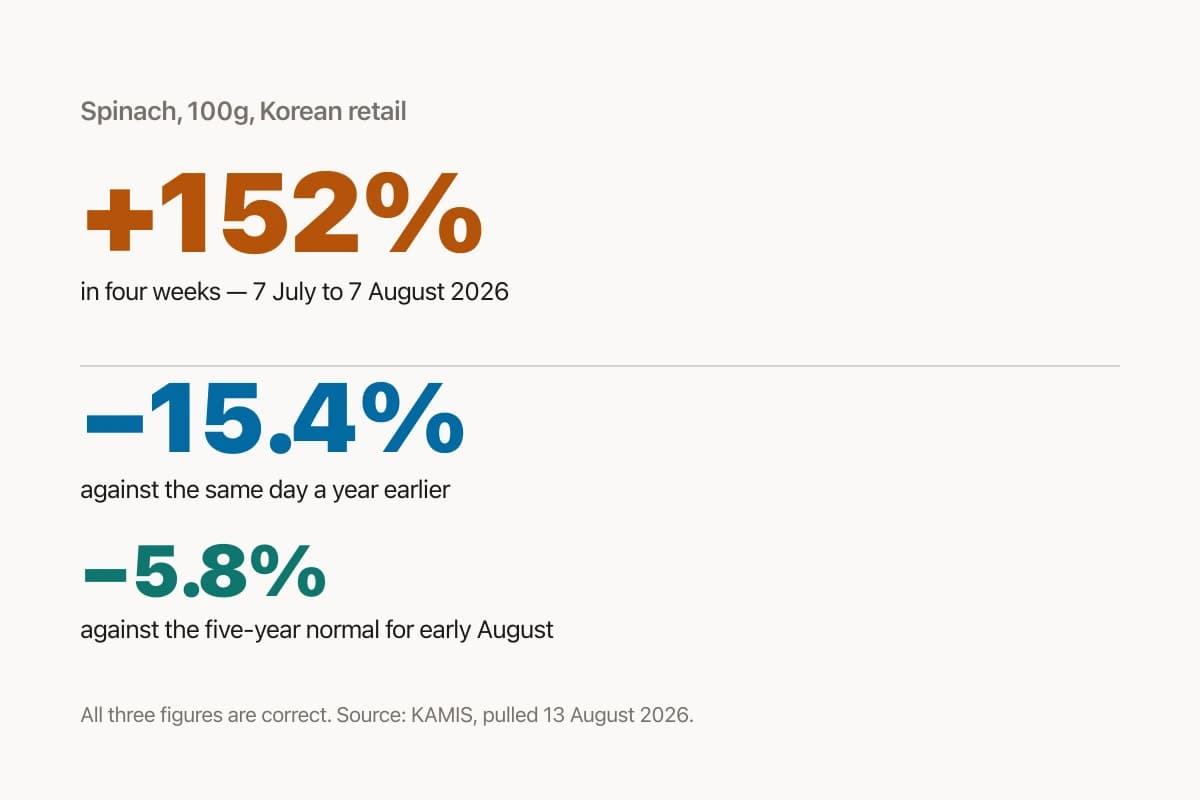
Spinach Is Up 152% in a Month. It's Also Cheaper Than It Was Last August.
Korean vegetable prices produced a genuinely alarming number this month: spinach at ₩1,978 per 100g on 7 August, up from ₩784 four weeks earlier. Both figures are real and we pulled them ourselves. But spinach is currently 15% cheaper than it was a year ago and below the five-year normal — and the agriculture ministry has taken the unusual step of asking people to stop making the comparison that produced the headline.
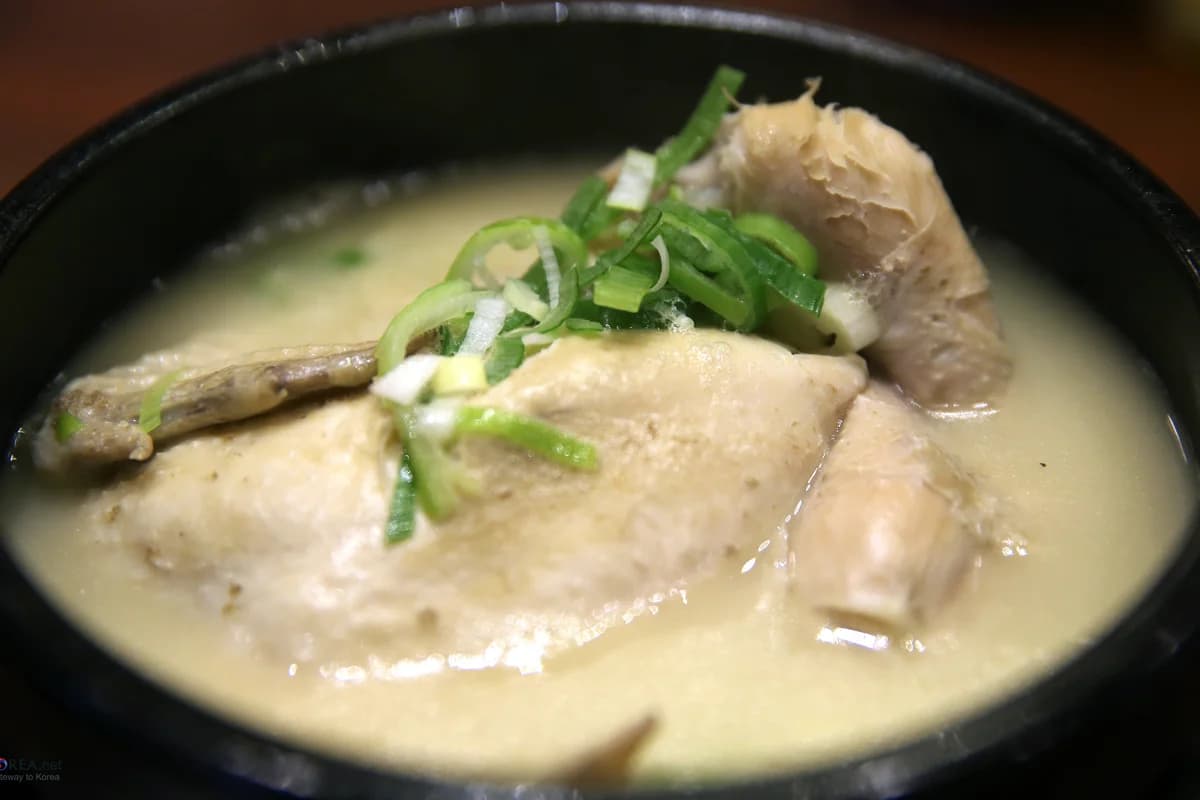
The ₩18,154 Bowl: How Korea's Hottest-Day Ritual Got Priced Out
On the hottest days of the year, Koreans queue for boiling chicken soup. But samgyetang now costs ₩18,154 in Seoul — while the same ingredients run ₩8,800 at a market. Jungbok falls on July 25. A guide to boknal, the logic of fighting heat with heat, and why the convenience-store version isn't the end of a tradition.
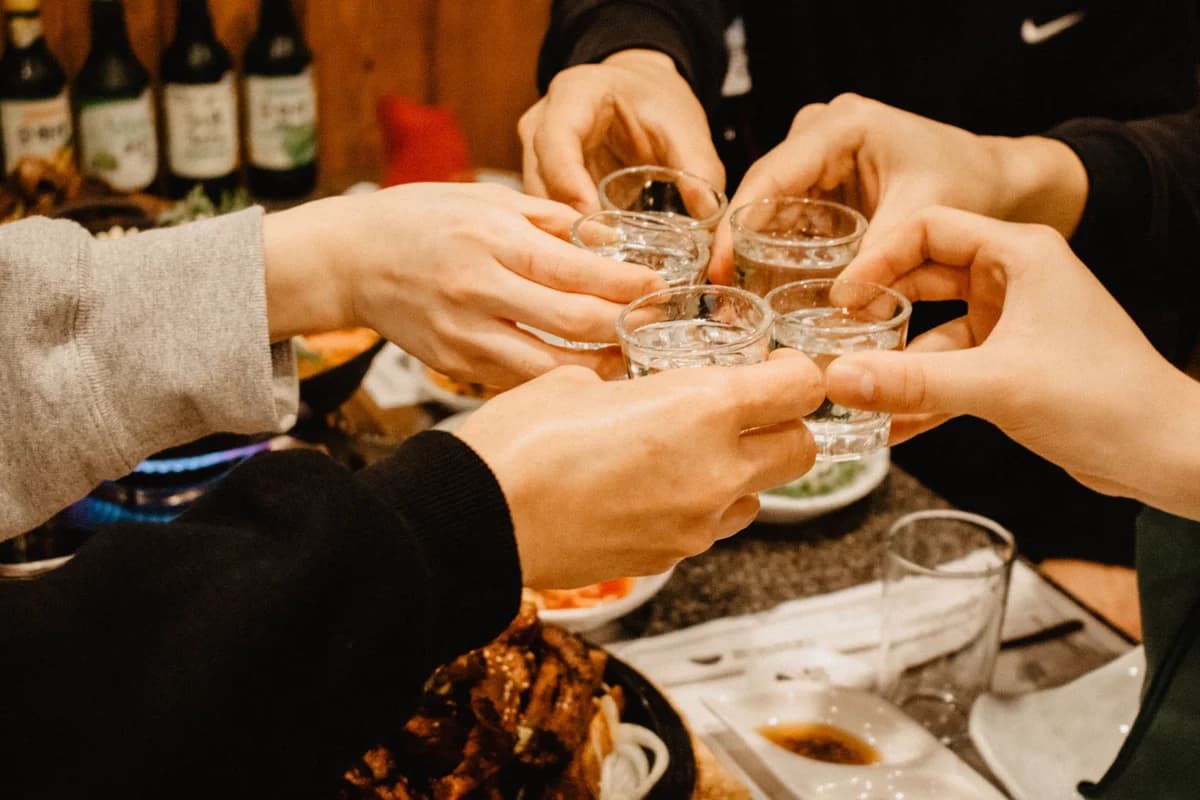
What Is Soju? Korea's Green-Bottle Spirit, Explained
It's the best-selling spirit brand on Earth, and most people outside Korea couldn't pick it out of a lineup. A field guide to soju: what's actually in the green bottle, how a 1965 rice ban created the modern version, why it's suddenly conquering export markets — and how to drink it like you know what you're doing.
The Weekly Dispatch
Korea, curated. Every week.
The best of K-culture, straight from Seoul. Written by people who actually live here.
Free, no spam, unsubscribe whenever.