The Government's Giant K-pop Festival Has a Name. Half of It Belongs to JYP — and the Contract Was Too Secret for the Committee Chair to See
FANOMENON is meant to be Korea's state-backed answer to the world's pop festivals, planned for December 2027 by a presidential committee co-chaired by 박진영. His company filed the trademark first. On 7 October, at the National Assembly, a lawmaker put the contract on the big screen, the chair halted the audit, and 박진영 conceded that the way the name was taken was 'not normal'.
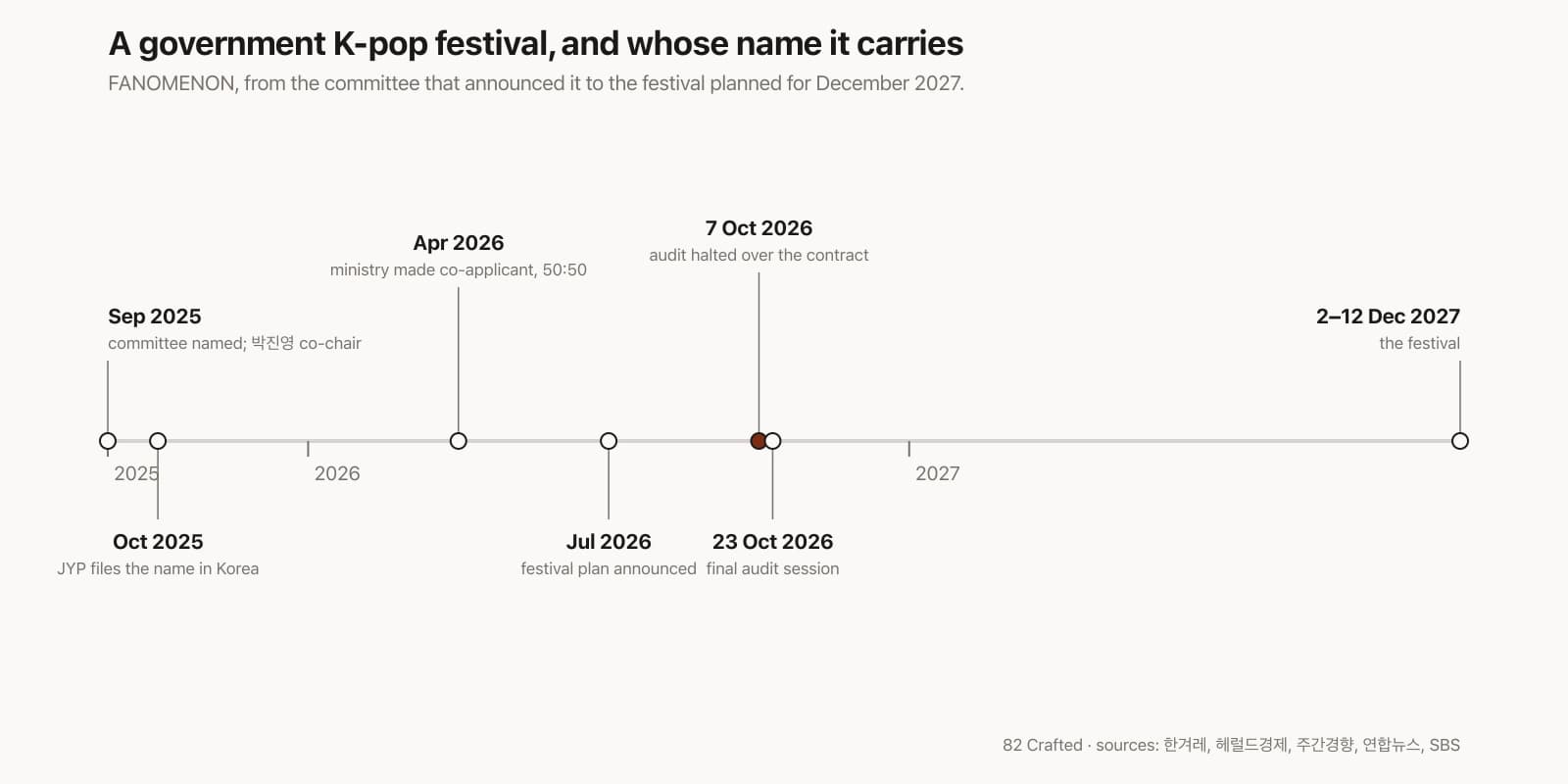
During the Assembly's audit of the culture ministry on 7 October, 배현진, a People Power Party lawmaker, put a document on the committee room's big screen. It was part of a contract between a presidential committee and JYP Entertainment — the company whose largest shareholder, 박진영, also co-chairs the committee — covering the trademark and rights to the name of the government's planned K-pop festival.
The chair of the culture committee, 이재정 of the Democratic Party, stopped the audit. The reason given was not that a confidential document was on screen. It was that the chair had never been allowed to see it. "저도 한번 보자고 했더니 비밀에 부쳐서 못 봤다… 위원장이 시쳇말로 바보가 됐다" — I asked to see it too and couldn't, because it was kept secret; the chair, as people say, was made a fool of.
The festival is called FANOMENON. This is how its name came to be owned.
What FANOMENON is
The name joins fan and phenomenon. The event, as announced at the National Museum of Modern and Contemporary Art in July, is a festival of K-pop concerts, exhibitions and an awards show in which, unusually, the prizes go to fans rather than singers. It is planned for 2–12 December 2027 at Seoul Arena in Changdong and KINTEX in Goyang, with a touring version opening in Los Angeles in May 2028. A state research institute forecast 520,000 visitors and an economic effect of about ₩1 trillion.
It is the flagship of the 대중문화교류위원회, the presidential committee for popular-culture exchange, set up in the autumn of 2025 and launched at KINTEX on 1 October that year with President 이재명 in attendance. The committee has two co-chairs: the culture minister, 최휘영, and 박진영, JYP's chief creative officer and largest shareholder, in a post with the rank of a minister. The festival itself is to be planned and run by a joint venture of the four big agencies — HYBE, SM, JYP and YG — with equal capital and equal votes. The state's job, the government says, is visas, customs and safety.
How the name was taken
In October 2025, just after the committee launched, JYP filed the name 패노메논 — FANOMENON — as a trademark in Korea, in its own name. The same month it filed 팬더모니엄, Fandemonium, the name of the awards' top prize.
It did not stop at Korea:
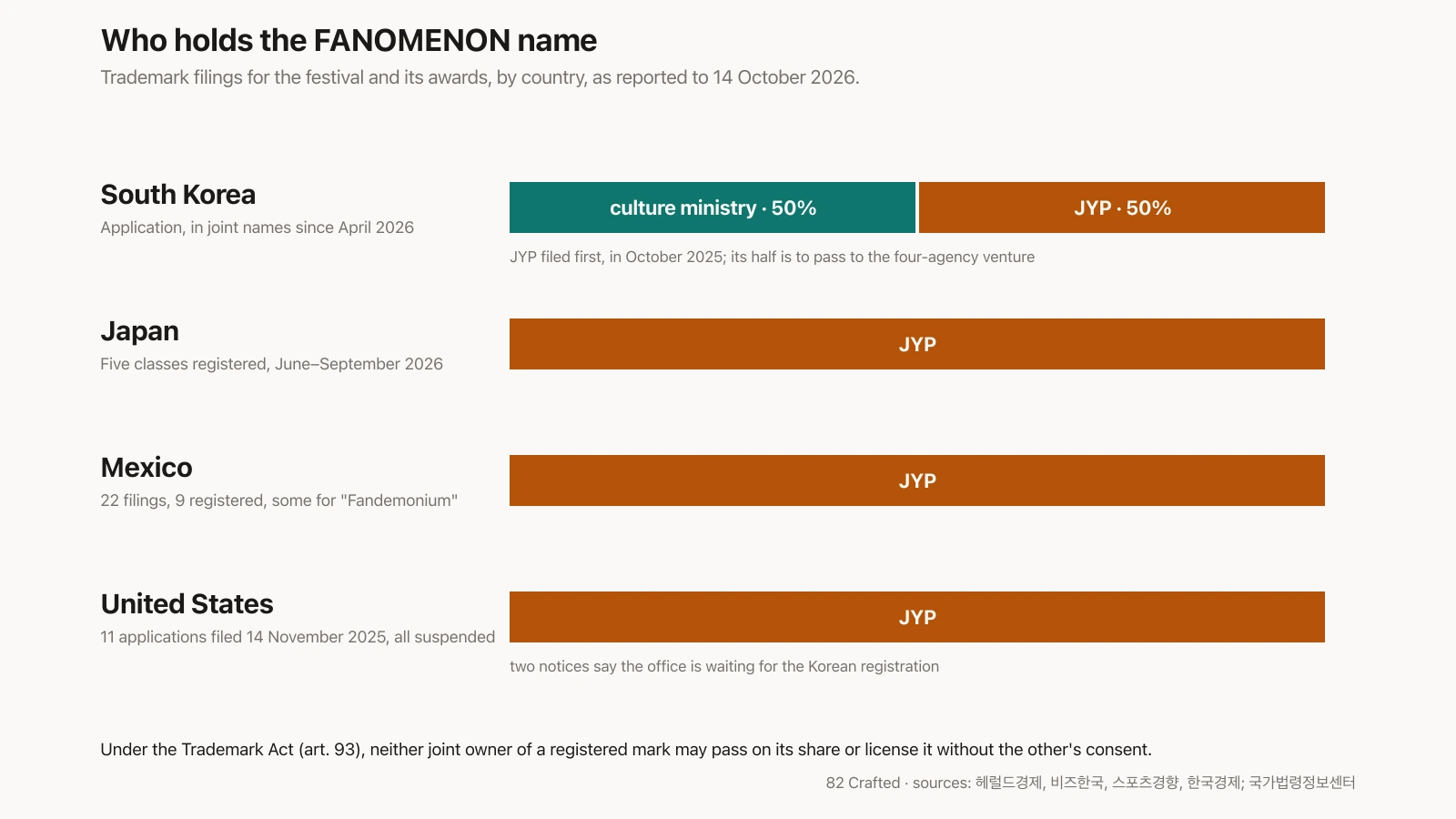
- United States: eleven applications, filed on 14 November 2025, all now suspended. Two of the notices say the trademark office is waiting for the Korean registration.
- Japan: five classes registered to JYP between June and September 2026.
- Mexico: twenty-two filings, covering both FANOMENON and Fandemonium. Nine are registered.
In April 2026 the Korean application was changed so that the culture ministry became a co-applicant, with half each. JYP's half, the minister has said, is to pass to the four-agency venture. Abroad, until any transfer, the name is JYP's.
Why the split matters is written in the Trademark Act. Article 93 says that when a registered mark is jointly owned, no co-owner may pass on its share, or license the mark, "다른 공유자 모두의 동의를 받지 아니하면" — without the consent of all the other co-owners. Each half, once the Korean mark is registered, is a veto over the other.
The admission
박진영 asked to appear before the committee as a sworn witness, and did. The defence was haste and good intentions: JYP already had a team that handled trademarks, the name might have been taken by someone else, and so the company filed first, meaning to hand it to the government. But on the method, the concession was plain. As 주간경향 recorded it:
"JYP라는 회사가 이미 전담팀이 있으니까 미리 상표권을 출원해 놓고 정부에 넘긴다든지 이런 식의 방법을 취한 게 분명히 정상적이지 않은 면은 있다."
Filing in advance because JYP already had a team, then handing it on to the government — that method clearly has something abnormal about it.
On favouritism, the answer was the opposite. Getting the rival agencies to join had meant begging: "YG에 빌고 SM에 빌고 하이브에 빌었다… 당장 몇백억원대의 손해가 일어날 일" — begging YG, SM and HYBE, for something that would cost tens of billions of won straight away. To call it favouritism, 박진영 said, "좀 그렇다" — was a bit much. And the name, the committee was told, "저희 회사(JYP엔터테인먼트)에 남을 일은 없다" — will not stay with our company.
The minister, asked what the government could do if JYP refused to hand over its rights, gave the answer 배현진 had been looking for. As 데일리안 reported it: "말씀대로 '상표권' JYP가 거절하면 어쩔 수 없는 구조" — as you say, if JYP refuses on the trademark, the structure leaves us no choice. 최휘영 promised to "다시 정리해 보고하겠다" — sort it out and report back.
The contract nobody could see
The document on the screen was the committee's trademark and rights-transfer contract with JYP. 배현진's point, from the part displayed, was that JYP would not be in breach even if it never transferred the rights to the state. The contract says the rights "돌려줄 수 있다", 배현진 said on radio afterwards — may be returned — with no obligation to do so.
How the lawmaker came to have it was its own row. The minister said a committee official had let 배현진's aides read the contract on 11 September and make a copy, and then taken both back. The PPP's whip, 조은희, answered that "국회의원이 공개하지 못할 내용은 없다" — there is nothing a lawmaker cannot disclose. The audit resumed with the chair allowing questions about the contract's contents but not the document itself on screen.
None of the clauses has been published. Every account of what the contract says, including the one above, is 배현진's reading of a document we have not seen.
Whose money
Two claims about money have been circulating, and they are not, it turns out, in conflict.
The government's line is that the festival takes no state budget. The minister wrote on 1 October that it will be held "전적으로 순수 민간 재원으로" — entirely with private money: tickets, sponsorship, broadcast rights and booth sales. When newspapers have reported that the event involves no direct state money, they have been reporting the government's account.
배현진's figures, given at the audit, were that ₩3.7 billion went to the committee itself this year and that ₩15 billion is planned for next year. 주간경향's fact-check, citing the ministry, explains the second: the ₩15 billion in the 2027 budget proposal is spending linked to FANOMENON — tourism promotion, support for small firms exhibiting at booths — not money to stage the show. 박진영 said the same on radio. So both can be true: public money is going in around the festival, not into putting it on. 배현진 has since gone further, telling CBS that "매년 무기한으로 예산은 수백억원씩" will go in — tens of billions of won a year, indefinitely — which is more than the ₩15 billion in next year's budget proposal.
There is also the matter of the co-chair's expenses. 배현진's data show about ₩2 million a month paid to 박진영 between November 2025 and August 2026, more than ₩20 million in all. On radio, 박진영 said: "일단 받는 줄 몰랐다" — I didn't even know I was being paid — and explained keeping it so that a successor would not be asked why they took money that 박진영 had not.
The apology, and the remark
The day before the audit, the President posted on X. "박진영 위원장님에게 죄송하네요… 보수도 없이 시간 내고 자비 지출해가며 대한민국 문화 수출을 위해 그렇게 애쓰고 계신데, 합당한 예우를 해 드리지 못해 못내 안타깝고 미안합니다." I'm sorry to Chairman 박진영 … working so hard for Korea's cultural exports, giving time and personal money without pay, and we have failed to give the respect deserved; I deeply regret it. It was an apology for the treatment of the co-chair in the row over pay and the summons, not for anything in particular.
And at the audit itself, the PPP's 김승수 reached for a comparison that started a second row: "과거 전두환 정권 시절 '국풍81'이라고 (하는 행사를) 했다. '광주사태' 1년 후에 민심을 좀 무마하기 위해서… 28년도 선거 몇 달 전에 한다. 대통령의 지지율을 올리기 위해서 하는 것 아닌가." Under Chun Doo-hwan there was 국풍81, a year after the "Gwangju incident", to calm the public; this is months before the 2028 election — isn't it to lift the President's ratings? 조국혁신당's spokesman called the words "광주사태", used for the 1980 uprising officially named the 5·18 민주화운동, "명백한 폄훼이자 모욕" — a clear disparagement and insult — and demanded an apology. We have found none.
박진영's answer to the electioneering charge: "대통령이 아니라 대통령 위의 위의 분이 오셔도… 우리나라를 위한 일이 아니면 안 한다" — even if someone two levels above the President came, it would not be done unless it was for the country.
What happens next
배현진 repeated the central charge on SBS radio on 12 October and on CBS on 14 October: "이 계약서에서는 이 상표권들을 국가가 사용하고자 해도 JYP의 허락을 받아야만 쓸 수 있게끔 돼 있다" — under this contract, even if the state wants to use these marks, it needs JYP's permission. According to 배현진, the minister has promised a reworked contract by the committee's final audit session on 23 October. The ministry has not said so publicly, and JYP has made no statement on the claims.
What it comes down to
Nobody has shown that anyone has made money from this, and the people involved say nobody will: the name, they say, is on its way to a venture the four agencies own equally, and the festival will be paid for by its audience. That may well be how it ends.
But a government festival's name was filed first by the company of the man co-chairing the committee that runs it; abroad it is still that company's; at home the state holds half an application it cannot pass on without that company's consent; and the minister has conceded at the Assembly that if JYP said no, there would be nothing to be done. The fix, if it comes, is a contract. The problem was that nobody — not even the chair of the committee meant to scrutinise it — had been allowed to read the first one.
Images. All three are ours: who holds the FANOMENON name in each country, from 헤럴드경제, 비즈한국, 스포츠경향 and 한국경제; the timeline from the committee's announcement to the festival; and the 50:50 split of the Korean application. The Trademark Act is quoted from 국가법령정보센터. We found no openly licensed photograph of the committee or of 박진영 in the role, and have used none.
Sources. The 7 October audit is from 연합뉴스, 한국경제, 주간경향, 머니투데이, 더팩트, 데일리안, inews24 and wikitree; 김승수 and the response from 한겨레 and 미디어오늘. The trademark filings are from 헤럴드경제 (including the minister's account of 1 October), 비즈한국, 스포츠경향 and 한국경제. The festival plan is from 주간경향, 디지털데일리 and korea.kr. The President's post is quoted as reported by wikitree. 박진영's radio remarks of 6 October are from 헤럴드경제; 배현진's of 12 and 14 October from SBS's transcript and 한국경제. The money from 더팩트 and 주간경향's fact-check.
Stated rather than smoothed. We have not read the contract, and nor has anyone outside the committee and 배현진's office; every description of its terms is 배현진's. The Korean trademark registry was unreachable from here, so we cannot give the application's number, classes or exact status — only that it is an application, in joint names. Article 93 applies to registered marks. 박진영's admission is worded differently by each outlet; we have used 주간경향's, the fullest. The monthly payment is described by some outlets as 직책수행경비 and by others as 업무추진비, and we have not settled which. 박진영 has said the four-agency venture has been set up; the minister said on 1 October that it was being incorporated that month; we have not confirmed which is current. The link to the 2028 election is the lawmaker's own framing.
Keep Reading
More Stories
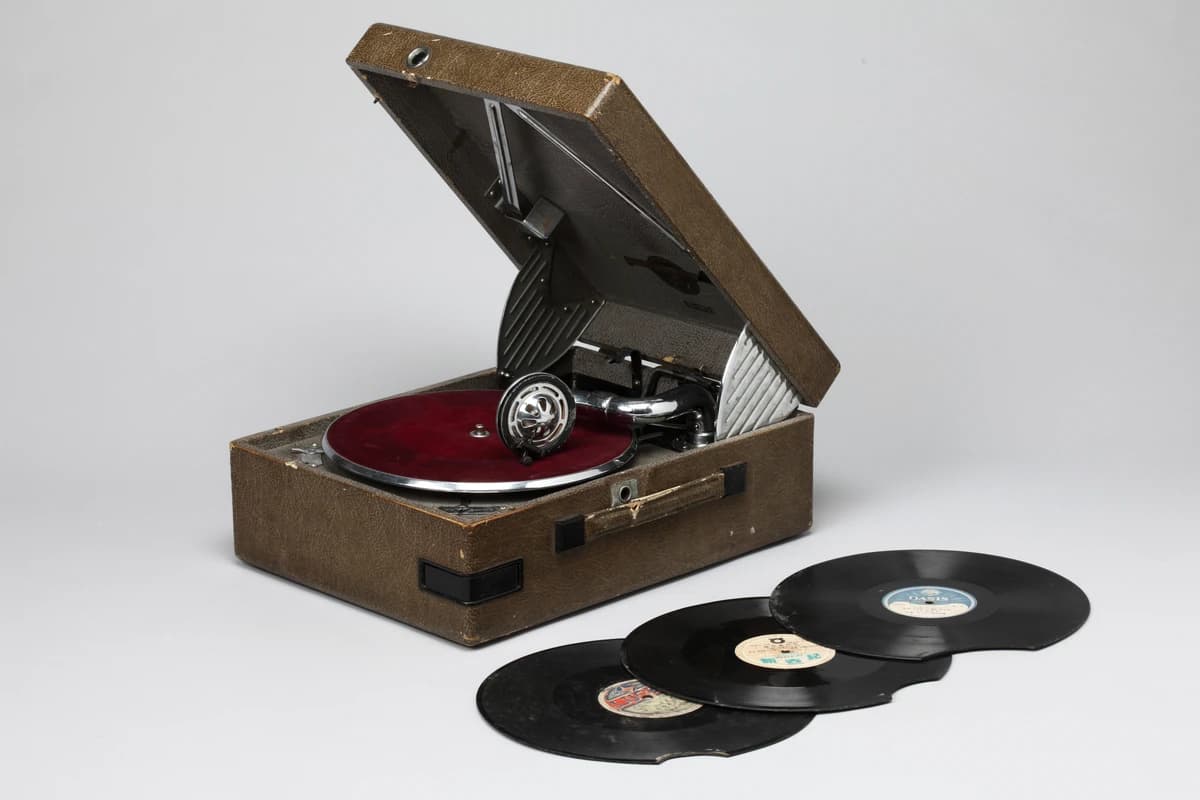
Korea's Most-Streamed Artist Sings a Genre the Country Banned for Two Decades
In 1935 a Korean record company slipped an anti-Japanese line past the colonial censors by submitting it as nonsense that sounded identical when sung. Thirty years later the Korean state banned the same genre for sounding Japanese — using a broadcasters' agreement, a ministry policy measure and three committees, but never once a law. The genre is called trot, and English writing about Korean music has essentially never mentioned it.
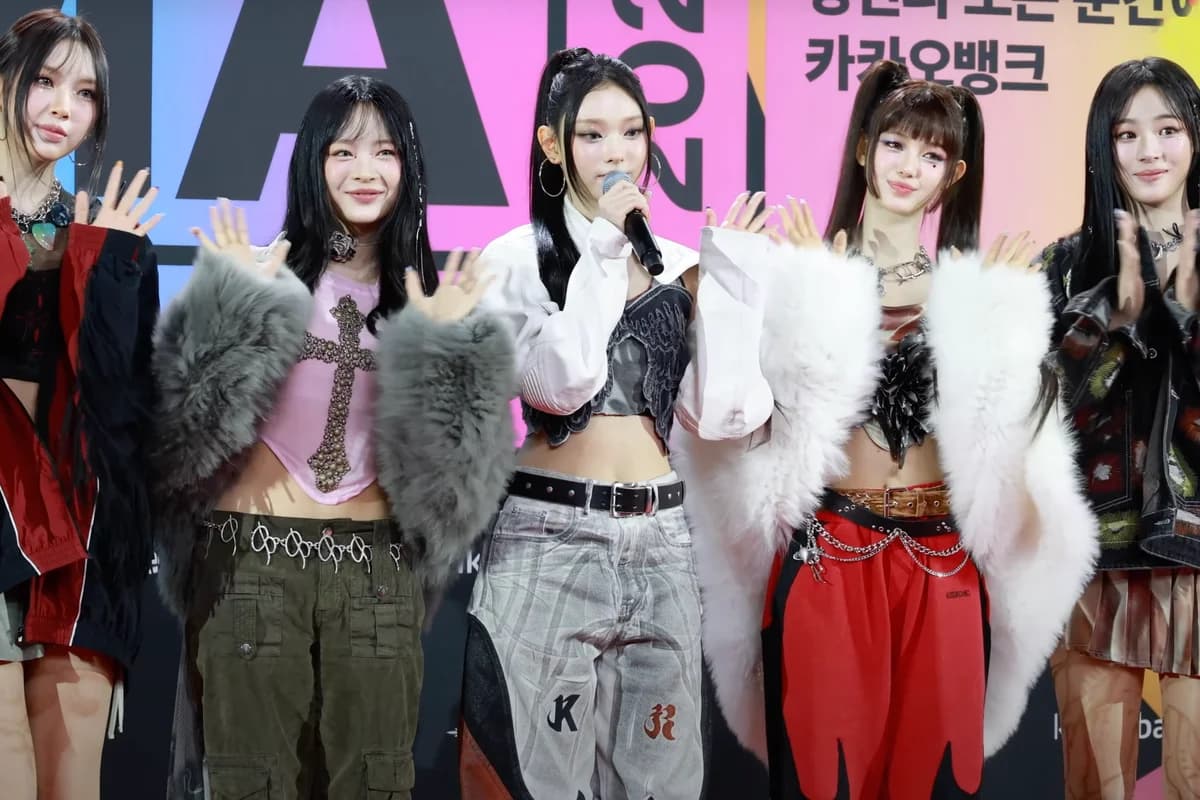
NewJeans Is Back — as Four. The Whole ADOR Saga, Explained.
On their fourth anniversary, NewJeans returned in a teaser — as a four-member group, at the very label they spent a year trying to leave, and without founding member Danielle. It's not a victory lap. It's the end of K-pop's biggest idol-versus-agency war, decided by a court. Here's the whole fight, and why the law made it end this way.
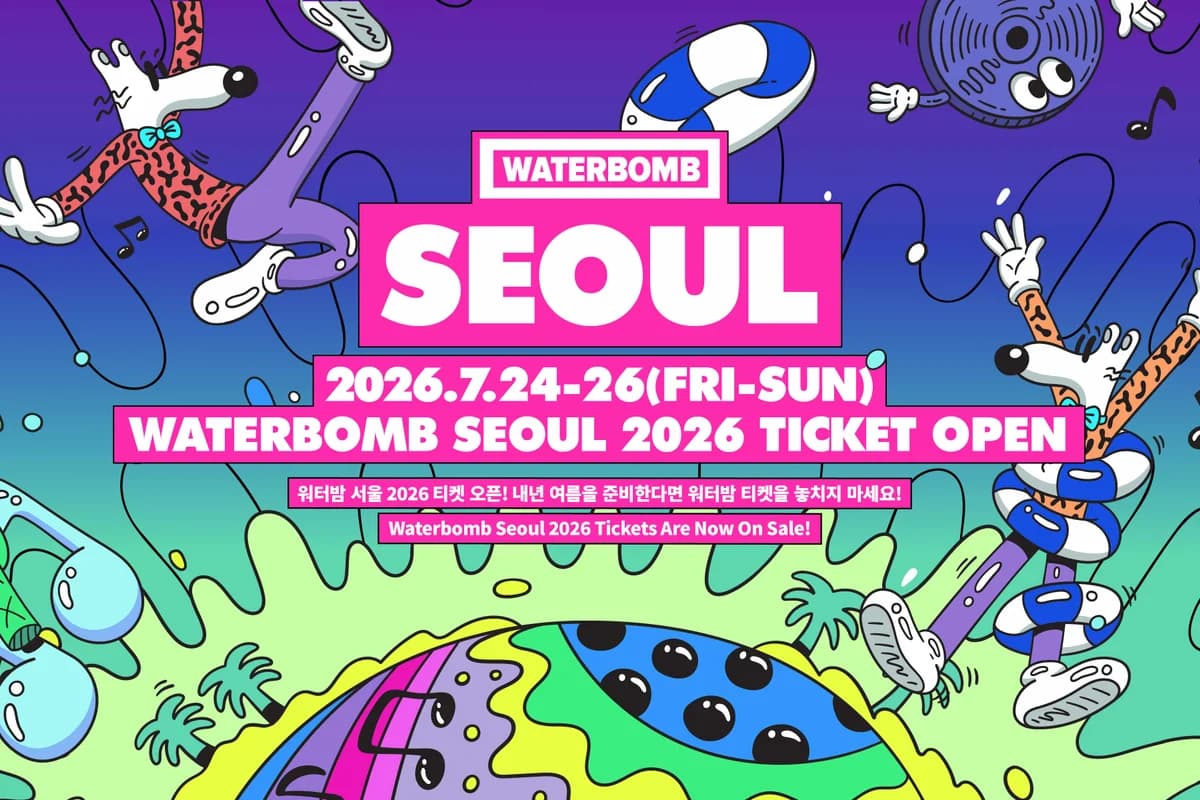
Waterbomb: Korea's Least Modest Party, and the Argument It Starts Every July
Waterbomb Seoul runs July 24–26 — nine hours a day of K-pop, EDM and 30,000 people shooting each other with water guns. It's also the subject of an annual Korean debate about bodies, water and who gets scrutinised. A guide to what actually happens, what it costs, and the 300-ton statistic that isn't true.
The Weekly Dispatch
Korea, curated. Every week.
The best of K-culture, straight from Seoul. Written by people who actually live here.
Free, no spam, unsubscribe whenever.