Korea's Most-Streamed Artist Sings a Genre the Country Banned for Two Decades
In 1935 a Korean record company slipped an anti-Japanese line past the colonial censors by submitting it as nonsense that sounded identical when sung. Thirty years later the Korean state banned the same genre for sounding Japanese — using a broadcasters' agreement, a ministry policy measure and three committees, but never once a law. The genre is called trot, and English writing about Korean music has essentially never mentioned it.
In September 1935, a record company in Seoul pressed a shellac disc with a printed lyric sheet that made no sense.
The song was 「목포의 눈물」 — Tears of Mokpo — and its second verse referred to 노적봉, the rock outcrop where Yi Sun-sin had fought the Japanese navy in the 1590s, as holding 삼백년 원한 — three hundred years of resentment. The Japanese Government-General was not going to pass that.
So, as the account has come down, 오케레코드 submitted the line to the censors as 삼백연 원안풍. Which means nothing at all. And which, sung, is indistinguishable from what the singer was actually singing.
The record passed. Play a 1935 pressing and you hear the original.
Thirty years later, the Korean state that inherited those censors' filing cabinets banned this entire genre for sounding Japanese.
The genre is 트로트. Its biggest living star is, by one measure, the most-streamed artist in the history of Korea's chart-setting music platform. And if you have read a great deal in English about Korean music, there is a fair chance you have never encountered his name — because English-language writing treats "Korean popular music" as a synonym for K-pop, and Korean sources have never done that.
The decade nobody had a name for
Korea's recording industry arrived fast. 빅타 in 1928, 콜럼비아 in 1929, 시에론 in 1931, then 포리돌, 태평 and 오케 all in 1932. Korean writing about the period calls it the war of the six labels, the flood of records, the golden age of the recording artist.
The output was industrial. Columbia's Korean catalogue ran to roughly 1,470 record types; 오케's to about 1,297; 빅타's to around 1,000; 태평 about 680, 포리돌 649, 시에론 277. The labels were putting out close to fifty new titles a month. The object itself was shellac, seventy-eight revolutions a minute, ten to twelve inches across, and — after 1915 — recorded on both sides.
The songs from those pressings are still known in Korea by heart. 「황성의 적」 (1932, 빅타, 이애리수) sold some fifty thousand copies. 「타향」 (1934, 오케, 고복수). 「목포의 눈물」 (1935, 오케, 이난영) — which, incidentally, was a competition entry: 조선일보 and 오케 ran a contest for a regional folk-style lyric, an unknown poet in his twenties named 문일석 submitted it under the title Love of Mokpo, and 오케's president renamed it. 「애수의 소야곡」 (1938, 오케, 남인수). 「나그네 설움」 (백년설, 태평) reportedly past a hundred thousand.
Here is the thing about all of that music: nobody called it trot. It was 유행가, or 가요곡 — popular song. The genre did not have its modern name, because its modern name had not been invented yet, and when it was invented it came from somewhere nobody expects.
The name is American, and that may be the entire point
트로트 is a contraction of "foxtrot" — the American ballroom dance that swept the world in the early twentieth century.
And it entered Korean as a rhythm label before it was ever a genre label. Mid-century Korean songbooks catalogue tempos the way a dance-band leader would: 발라드, 블루스, 볼레로, 차차차, 폭스 트로트, 폴카, 룸바, 탱고, 스윙, 왈츠. It was one entry on a list of foreign rhythms. Only in the 1960s and 70s did 트로트 harden into the name of a genre.
The Japanese word 엔카 followed exactly the same path in exactly the same decades.
This matters more than it looks, and to explain why we have to take on the question the subject cannot avoid.
Is trot Japanese?
The honest answer is that the question is probably mis-posed, and the most useful scholarship says so.
Our main source here is a comparative paper by 고바야시 다카유키 (小林孝行), emeritus professor at Okayama University, published in Korean in the journal 『아시아문화연구』 — a Japanese sociologist writing for a Korean readership, which is a useful place to stand on this particular argument.
What nobody disputes is the overlap. Both traditions lean on the 요나누키 pentatonic scale — the five-note scale you get by removing the fourth and seventh degrees. Both use the same two-beat pattern, the one Korean writing renders onomatopoeically as 뽕짝뽕짝. And both grew inside a single colonial recording industry: the same capital, the same pressing plants, the same catalogue numbering.
The nationalist positions were argued out in public in Korea in 1990, under the title Tradition or Japanese Taint? The composer 최창권 held that trot shows unmistakable enka influence — the scales, the nasal vocal production where Korean tradition sings open-throated as in pansori, the guitar imitating shamisen. The composer 박춘석 held the reverse: that the pentatonic scale is common across East Asia, so the resemblance is a misreading, that trot's roots are in Korean shamanic and Buddhist music, and that if anything the influence ran from Korea to Japan.
And then there is the position we would actually build on, because it undercuts both.
The Japanese ethnomusicologist 고이즈미 후미오 (小泉文夫), writing in 1984, argued that the minor form of the 요나누키 scale is not simply the old Japanese 미야코부시 scale revived — the scale structures differ. That is worth reading twice. The technical charge that grounded the whole Korean case against trot, that scale is a Japanese scale, is contested by a Japanese musicologist.
And 와지마 유스케 (輪島裕介) has argued that enka itself was a new genre of the 1960s and 70s that authorised itself by projecting an air of antiquity — a modern invention wearing Meiji costume. If that holds, "trot derives from enka" collapses as a chronology, because neither genre existed under those names when the 1930s records were cut. They are siblings that were christened separately, decades later, and then told they were parent and child.
There is an object in the National Folk Museum of Korea that makes this concrete better than any argument can, and it is the image at the top of this article. Accession 081322: a 25-centimetre shellac disc pressed by Columbia in 1932. The A side is 「アリランの唄」 — an Arirang, the most Korean song there is, sung in Japanese, with a Meiji University mandolin orchestra on the accompaniment. The disc is stamped MADE IN JAPAN.
And the arranger's name on the label is 古賀政男. Koga Masao's signature style — the melancholy manner Japanese writing still calls the Koga melody — was built on the 요나누키 scale, the same scale that would later get Korean songs banned. Through 1960s covers, his catalogue came to be regarded as the origin of enka.
Sit with the chronology there. The object is from 1932. The genre it is supposedly the ancestor of acquired its name, and its claim to antiquity, thirty years later. The disc is older than the tradition it is said to descend from — which is exactly 와지마's point, pressed into shellac.
Which brings us back to the name — and to a hypothesis that Kobayashi offers with a scholar's hedge, but which is the best sentence in this whole subject. Korean popular song in the 1960s was being attacked as 왜색, Japanese-tinted. Might the industry, he wonders, have reached for 트로트 — a word pointing firmly at American dance music — precisely to escape that accusation?
The genre may have been named after a foxtrot in order not to be called Japanese.
His own summary of the wider fight is the line to end on: the origin dispute flared in the 1980s, but nationalist ideology crowded out the argument before it could be had properly. Korea, he notes, managed to avoid the charge of being Japanese. It did not manage to avoid being American — the name says so.
(One small, exact joke, which requires precision to be funny at all: the major form of the 요나누키 scale is common in Scottish folk song, which is why it also gets called the Scottish scale — and it is the scale of the Korean national anthem's melody. The 왜색 charge was about the minor form. Same family, different member.)
The ban that was never a law
On which: in 1964, a film called 「동백아가씨」 — Camellia Lady — opened in Korea, and its theme song, sung by a young 이미자, became the defining hit of the decade.
Every Korean source will tell you it held number one for thirty-five weeks and sold a quarter of a million records. Those two figures appear in the same words across encyclopaedias, wikis and newspapers, and not one of them names the chart, the station, the programme, or who counted the records. There was no national record chart in Korea in 1964 — 「가요톱10」 does not begin until 1981 — and no independent sales audit. The numbers are almost certainly the label's, repeated for sixty years until they set.
We mention this not to debunk a beloved song but because it is the same reflex the rest of this article is about: a figure enters circulation, nobody asks who produced it, and it becomes a fact.
What happened next is documented, and it is the part that matters. 「동백아가씨」 was prohibited in Korea for roughly two decades, and no statute ever did it. The prohibition was assembled out of four instruments, none of which was a law, running on two separate tracks.
On the broadcast track:
- In 1965, five broadcasters agreed among themselves to keep 왜색 songs off the air. That is a voluntary resolution by the stations. Not a ministry order. Not legislation.
- In February 1968 came a formal broadcast ban on 왜색 grounds — a designation by the broadcasting-ethics apparatus of the day, which maintained an advisory committee to review popular music and list banned songs. (We have the body, its function and the date; we could not find a source explicitly naming it as the author of this particular designation, so we say the ban was designated and leave the attribution alone.)
- On 5 September 1987, the broadcast ban was lifted by a deliberation committee, which released 500 of 832 banned domestic songs in one go — 17 for plagiarism, 251 for 왜색, 199 for vulgarity or decadence, 33 as otherwise unsuitable. 「동백아가씨」 was named, alongside 김민기's 「아침이슬」.
On the record track:
- In June 1975, under the 「공연활동의 정화대책」 — a ministry policy measure, issued in the Emergency Measure No. 9 era — an arts-and-culture ethics committee designated 294 domestic songs banned. This is where 「동백아가씨」 became a banned recording.
- On 18 August 1987, a ministry guideline sent the list back for re-review. Of 382 banned domestic songs, 88 were excluded because their writers had gone north; the remaining 294 were reconsidered and 186 released. 「동백아가씨」 was among them.
A broadcasters' handshake, a committee designation, a ministry policy measure, and two committee rulings to undo it. Twenty-two years of prohibition, and not one line of legislation. (Twenty-two if you count from the 1965 handshake. Nineteen and a half from the 1968 designation. Twelve from the record ban. Whoever tells you "22 years" is starting the clock at the handshake, which is worth knowing.)
The only statute-level event in the entire story arrives long afterwards, in October 1996, when Korea's Constitutional Court struck down the pre-screening regime for records as unconstitutional censorship.
Why that song
The obvious answer is nationalism, and the obvious answer is not sufficient — because the state had been running an anti-왜색 campaign since at least 1956, when the education ministry co-hosted public lectures on rejecting Japanese-tinted song. Nine years of lectures. No bans.
The better answer is an anomaly Kobayashi points out himself. The three great trot songs of the Korean War — 「굳세어라 금순아」, 「이별의 부산 정거장」, 「단장의 미아리 고개」 — are the same musical idiom, were enormous, and were never banned at all. His explanation: their form continues pre-liberation popular song, but their subject is the war, a shared national catastrophe. 「동백아가씨」's subject is a woman waiting.
Form was never really the test. Subject matter was.
And the timing is documented rather than merely suggestive. 1965 is the year Korea normalised relations with Japan — the basic treaty signed in June, ratified in August by the ruling party sitting alone, in force in December. The year the country was arguing most bitterly about how much to concede to Tokyo is the year its broadcasters agreed to purge Japanese-sounding songs from the air, and the biggest hit in the country was the one that got named.
The show that could not say who won
Skip to 2019. TV조선, a Korean general-programming cable channel, launches an audition show called 「내일은 미스트롯」 — a trot contest for women. More than twelve thousand apply. It peaks at 18.1%, the highest entertainment rating any Korean general-programming channel had managed that year.
So they make one for men. 「내일은 미스터트롯」 runs twelve episodes from 2 January to 14 March 2020, and its ratings do something television almost never does: they climb every single week without one dip. Episode one averages 10.3%. Episode eleven, the final, averages 34.9%, with its second hour reaching 35.7% — the highest figure Nielsen Korea has recorded on its paid-platform series since that series began in 1995.
(A caution, since Korean ratings are a minefield: that 35.7% is measured on cable, satellite and IPTV households. The much-repeated line that this makes it Korea's second-biggest variety broadcast ever compares it to a nationwide figure for a terrestrial show — different universes, not rankable. And the nationwide figure it gets compared to is itself reported as both 39.3% and 43.3% depending on which measurement firm you ask. We are not going to pretend that ranking is real.)
Then the finale did something better than winning.
The result was decided by live text vote. 7,731,781 calls came in. The server failed. And Korea's highest-rated paid-platform broadcast ever ended without announcing its winner.
The result had to be delivered in a special programme two days later. That programme drew 28.7% — a number most Korean shows will never see in their lifetimes. The consolation broadcast for a technical failure would have been the year's biggest hit.
The winner was 임영웅.
The number, and the absence
Six years on, here is the fact that ought to be in every English-language survey of Korean music and is in none of them.
On 18 July 2026, 임영웅 passed 14.2 billion cumulative streams on Melon — first among all artists on the platform, solo or group.
Some care about what that means. It is a cumulative-since-debut count, on one platform, inside Melon's own hall-of-fame service. It is not an annual figure and it is not a ranking of Korean music history — 이미자 and 남인수 cannot appear on it, because the scoreboard began long after they did.
And Melon is not Korea's largest streaming service any more. One measurement firm puts YouTube Music at 9.5 million monthly users against Melon's 5.9 million, with Spotify in between; another puts Melon second. They agree only that YouTube Music leads. So what 임영웅 tops is the legacy authority — the chart the Korean industry still treats as the domestic benchmark — rather than the biggest audience in the country. Which is arguably the more interesting scoreboard to top. (Why Korean streaming charts disagree with each other is its own subject.)
The record he broke had stood for over a decade, and he broke it by nothing at all. On 9 March 2026 he passed BTS by 1.79 million streams — on figures of 13.5 billion. That is a margin of 0.013%, roughly a third of one day's listening.
A few other numbers, since none of them are in English either: 1.79 million YouTube subscribers and over three billion views. 134 trophies. A first-week album figure of 1.14 million. Cumulative concert attendance past 910,000. He debuted on 8 August 2016 with a song called 「미워요」, and passed his tenth anniversary three days before we published this.
One thing he is not is evidence that trot got young. His own Melon listeners skew to Koreans in their thirties and forties, and split evenly by gender. But across Melon users listening to trot as a genre, the under-forties were 12%. In 2020, seven in ten of the audition show's television viewers were over fifty. He crossed over. The genre didn't — though the people selling it now are young, averaging about thirty across the biggest-selling trot releases of 2025, one of them nineteen.
And the genre's commercial recovery is real in a way that is hard to argue with: total album sales by trot artists went from around thirteen thousand copies in 2015 to roughly 1.35 million in 2025. Something close to a hundredfold, in ten years, in the format everyone had declared dead.
The photograph that does not exist
There is a reason this article is illustrated with objects.
There is no licence-clean photograph of 임영웅 available to a publication like ours. Every usable image is agency or press. Which is a small, accidental illustration of the argument: the English-language machinery for looking at Korean music — the wire photos, the syndication, the press-kit pipeline — was built around an export product, and trot was never an export.
So the genre's visual record is shellac and paper. A 1932 label. A gramophone. A monthly release sheet from a company that put out fifty songs at a time in a colony. And then, in 2026, the biggest thing in it is a number on a screen that no camera was ever pointed at.
Korea has spent a century arguing about whether this music is really its own — banning it, unbanning it, renaming it after an American dance to get the Japanese accusation off its back. It resolved none of that. It just kept listening, at a scale nobody outside the country bothered to measure.
For what happens when a Korean artist's absence from the English-language frame reverses — and the machinery that manufactures a return — see Korean celebrity comeback culture.
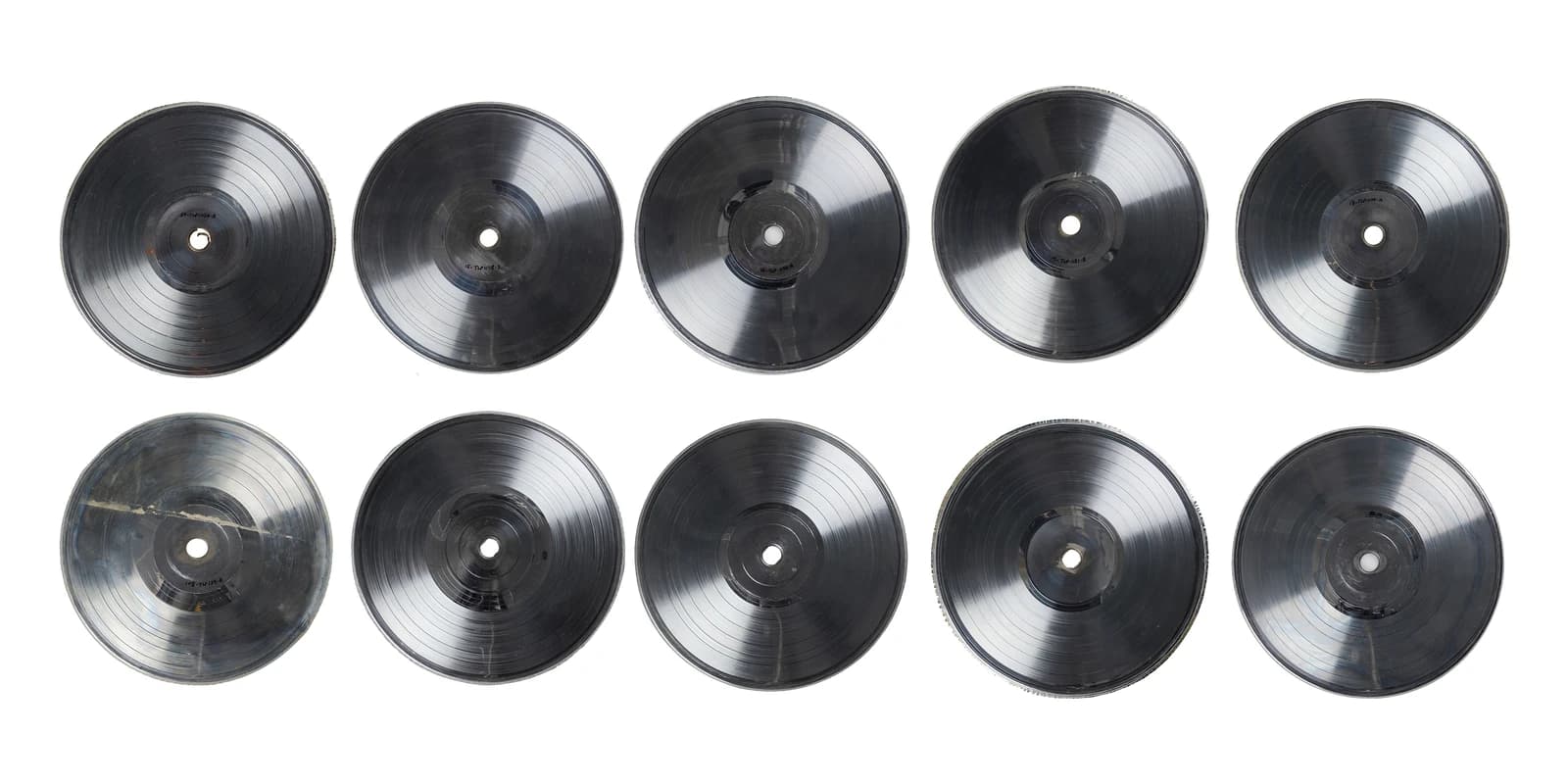
Images, cropped by us — three objects from the National Folk Museum of Korea, all 공공누리 제1유형 (KOGL Type 1), which requires attribution and permits commercial use and modification. Hero — 「아리랑 SP음반」, accession 081322, photographed by Park Min Gu, 2019: the 1932 Columbia disc described above, beside its sleeve. Cover — 「레코드 스탬퍼」, accession 099827: ten metal stampers, the nickel negatives a factory presses records from. They are LP-era tools, not the 1930s shellac plant — what they show is the industry, not any one song. Listing card — 「축음기」, accession 047396: a wind-up Columbia Grafonola portable with three Korean-pressed 78s beside it, whose Oasis and Lucky labels are post-1945 pressings, not colonial ones. A disc, a manufacturing tool, and a machine — no people in any of them, which is the point made at the end of the article.
Two things we corrected against the museum's own catalogue while reading the object, and one we refused to repeat. The record for accession 081322 describes it as an "LP음반." It is a 1932 shellac SP; the LP was still sixteen years away. The same record gives the singer as 長谷川一朗; the label itself reads 長谷川一郎, one character different. And the sleeve is not from 1932 — the museum presumes it a later replacement, and the Korean note handwritten on it lists both sides as the same Arirang by one singer, which the labels contradict: side A is a duet and side B is a different song altogether. So we caption the disc and not the sleeve, and we do not repeat the sleeve's track listing or its identification of the singer, which is an annotator's claim rather than the museum's. Both label transcriptions above were read directly off the object at magnification, not inferred.
One image was rejected for a subtler reason than licence, and it is worth naming: a photograph of 「목포의 눈물」's original 1935 pressing, tagged KOGL Type 1 on Wikimedia Commons, credits its author as an aggregator portal rather than a holding institution, and its source link is a keyword search with no object ID — so the rights holder cannot be identified and a valid KOGL attribution cannot be constructed. Not laundering; a provenance failure, which is the quieter version of the same problem. Also unused: the actual banned record, 「동백아가씨」, exists in the same museum (accession 095754), but its jacket carries photographs of the 1964 film's actors and a portrait of the lyricist — identifiable people under a separate photographic copyright.
Honest gaps: no 1930s monthly release sheet, no period sheet music, and no 시에론 or 태평 label object could be found under an acceptable licence, so three of the six object leads we started with produced nothing. And the National Museum of Korea's aggregate catalogue returned server errors throughout, so that entire route went unsearched.
Verified against Korean-language and Japanese-language scholarship. The 1930s label chronology, catalogue counts and monthly release rate are from Korean popular-music archival sources and the 한국민족문화대백과사전. The comparative musicology — the shared 요나누키 scale and two-beat rhythm, the shared colonial recording industry, 고이즈미 후미오's 1984 argument that the minor 요나누키 is not a revived 미야코부시, 와지마 유스케 on enka as a 1960s invention, and the 1990 최창권 / 박춘석 exchange — is from 고바야시 다카유키, 「일본 '엔카'와 한국 '트로트' 비교를 위한 기초적 관점」, 『아시아문화연구』. His suggestion that the genre may have been named "trot" to deflect the 왜색 charge is explicitly a hypothesis in his own text, and we present it as one. Christine Yano's Tears of Longing (Harvard University Press, 2002) is the English-language anchor for enka. The ban chronology is from 국가기록원 and the 한국민족문화대백과사전, with the 1987 broadcast release from MBC's own news archive of 5 September 1987 — and the four figures in that release sum exactly to the 500 songs announced. The single most important thing in this article is that no statute ever banned the song: a broadcasters' voluntary resolution, an ethics designation, a ministry policy measure and two committee rulings. We name the instrument at each step because the distinction between a law, a directive and a committee's decision is exactly what gets lost in retelling, and we have published a correction before for getting it wrong. Deliberately flagged rather than smoothed: the famous "35 weeks at number one, 250,000 records" pair is untraceable — no source names a chart, station or auditor, and no national chart or sales audit existed in 1964; the "22 years" figure depends entirely on which of three bans you start from; and the 35.7% rating cannot be ranked against terrestrial figures, one of which is itself reported two different ways. Melon's figure is stated as cumulative-since-debut on one platform, and we say plainly that Melon is no longer Korea's largest service by users. Deliberately omitted: an anecdote about a head of state privately enjoying the banned song, which rests on a single wiki source; a disputed attribution for 「애수의 소야곡」's lyricist, where two credible sources give different pen names; and anything at all about the personal lives, characters or fandom disputes of 임영웅, 이미자 or any 미스터트롯 cast member — every figure here is a chart position, an award count, a ticket total or a date.
Keep Reading
More Stories
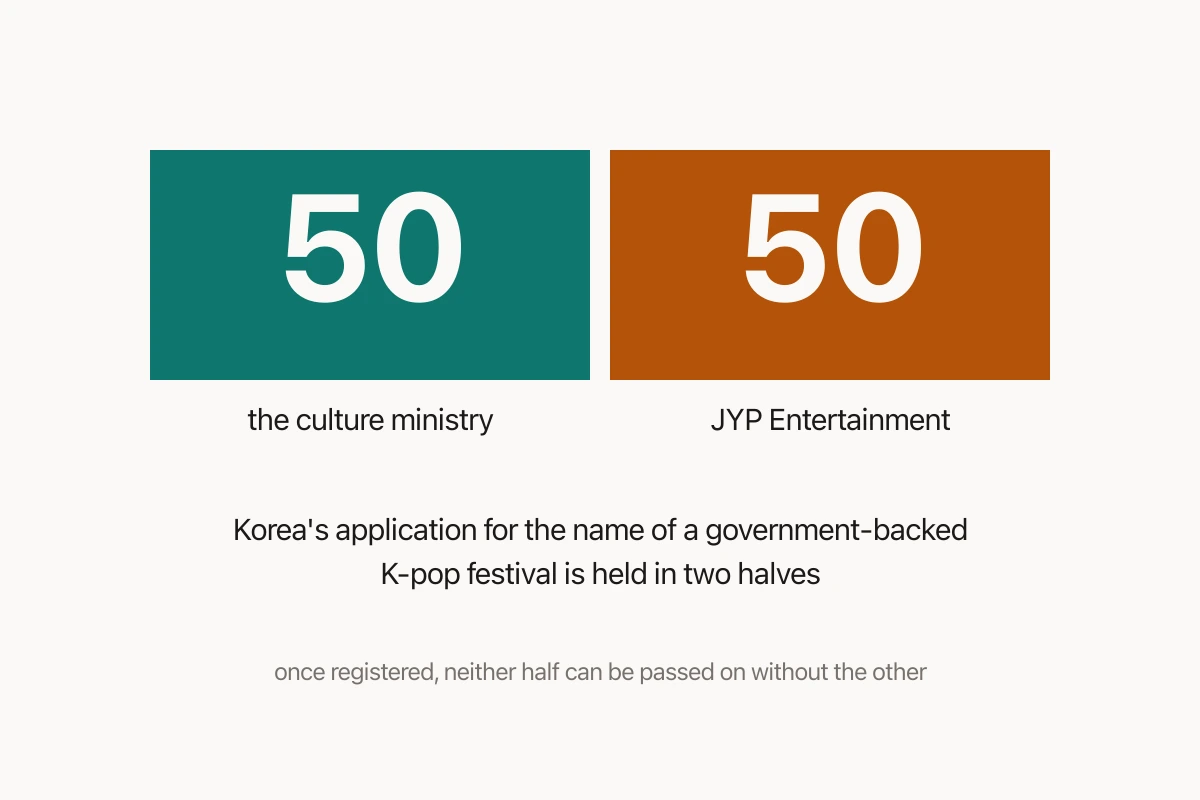
The Government's Giant K-pop Festival Has a Name. Half of It Belongs to JYP — and the Contract Was Too Secret for the Committee Chair to See
FANOMENON is meant to be Korea's state-backed answer to the world's pop festivals, planned for December 2027 by a presidential committee co-chaired by 박진영. His company filed the trademark first. On 7 October, at the National Assembly, a lawmaker put the contract on the big screen, the chair halted the audit, and 박진영 conceded that the way the name was taken was 'not normal'.

NewJeans Is Back — as Four. The Whole ADOR Saga, Explained.
On their fourth anniversary, NewJeans returned in a teaser — as a four-member group, at the very label they spent a year trying to leave, and without founding member Danielle. It's not a victory lap. It's the end of K-pop's biggest idol-versus-agency war, decided by a court. Here's the whole fight, and why the law made it end this way.
Waterbomb: Korea's Least Modest Party, and the Argument It Starts Every July
Waterbomb Seoul runs July 24–26 — nine hours a day of K-pop, EDM and 30,000 people shooting each other with water guns. It's also the subject of an annual Korean debate about bodies, water and who gets scrutinised. A guide to what actually happens, what it costs, and the 300-ton statistic that isn't true.
The Weekly Dispatch
Korea, curated. Every week.
The best of K-culture, straight from Seoul. Written by people who actually live here.
Free, no spam, unsubscribe whenever.