Korean Dialects, Explained: Why Busan Sounds So Different from Seoul (and What the Other 6 Regions Sound Like)
There's the Korean you learn from textbooks — and then there's the Korean you actually hear in Busan, Gwangju, Daejeon, Jeju, and the North. Eight regional dialects, the K-dramas that use each one, and one critically endangered language UNESCO says will be gone in 50 years.
A Threads post we saw this morning, from someone clearly stuck mid-thought:
"Korean curiosity: I know Busan dialect sounds different from Seoul Korean. Is it the same in other Korean cities too?"
The short answer is yes — every region. The long answer is one of the most interesting things about the Korean language. Korea has seven major regional dialects (사투리, saturi) beyond the Seoul-area speech that became the standard, at least three of which are immediately recognizable even to first-week Korean learners, one of which is so distinct UNESCO classifies it as a critically endangered language in its own right, and one of which the entire 1980s-90s Korean entertainment industry tried unsuccessfully to flatten into TV-friendly Seoul speech. (If you're still at the textbook stage, the standardized Seoul Korean every app teaches comes first — here's which Korean-learning apps are actually worth your time.)
So here is the honest version, with sourced examples, the K-dramas that use each accent, and the one dialect Koreans politely warn each other about.
Standard Korean is younger than you think
Before we get to the regional dialects, the thing to know is that 표준어 (pyojuneo, "standard Korean") is a relatively recent construction. Per Wikipedia's overview of Korean dialects, today's Standard Korean is based on the Gyeonggi dialect — the speech of Seoul and its surrounding province — and was institutionalized through schooling, broadcast radio, and television over roughly the past 70 years. Before that, every Korean spoke the dialect of their region. Standard Korean is essentially the version of Korean that won the broadcasting wars.
The reason Korean has such distinct regional dialects despite the peninsula being relatively small (about the size of Great Britain) is geographic. Korea is mountainous, and the dialect boundaries follow the mountain ranges almost perfectly — see Practice Korean's dialect overview for the boundary maps. Pre-modern travel between provinces was hard. Each region got its own ~700 years of independent linguistic evolution. Then radio came.
1. 경상도 (Gyeongsang) — Busan, Daegu, Ulsan
If you've heard one Korean dialect that isn't Seoul speech, it's almost certainly 경상도 사투리 — the speech of the southeast, anchored by Busan in the south and Daegu in the north.
What makes it instantly recognizable:
- It has a pitch accent. Standard Seoul Korean is essentially flat-toned; Gyeongsang has rising and falling tones on words, almost a musical staccato. Per the Creatrip Gyeongsang dialect guide, the dialect is "marked by shorter sentences and harsher intonation," and native Koreans often describe it as sounding "direct" or "rude" even when speakers are just talking normally.
- Vowels merge. ㅟ (wi) typically becomes ㅣ (i), and ㅚ (oe) becomes ㅔ (e). Eric Kim's Busan dialect overview shows that 음식 (eumsik, "food") gets pronounced 엄식, and 왜 (wae, "why") sounds closer to 애.
- Word-final endings shift dramatically. The Seoul question "뭐라고 했어요?" (mwoorago haesseoyo, "what did you say?") becomes "뭐라카노?" (mwo-ra-ka-no?) in Gyeongsang.
K-drama example. Reply 1997 (tvN, 2012) is the canonical Gyeongsang showcase — the entire drama is set in Busan, and the leads (Seo In-guk and A-Pink's Eunji) are both Gyeongsang natives. Per the koreandrama.site saturi guide, the show "restored respect and nostalgia for the dialect" after decades of TV portraying Gyeongsang speakers as comic-relief gangsters.
BTS-trivia bonus. Four of seven BTS members are from the Gyeongsang region: SUGA and V are from Daegu, Jimin and Jungkook are from Busan. All four speak Gyeongsang natively. If you've ever watched a BTS variety appearance and heard the moments where their accents slip, that's why.
2. 전라도 (Jeolla) — Gwangju, Jeonju
If Gyeongsang sounds direct, 전라도 사투리 sounds warm. The Jeolla dialect — spoken in the southwestern Honam region anchored by Gwangju and Jeonju — is the dialect K-drama writers reach for when they want a character to feel kind, grounded, or wise.
What makes it recognizable:
- Long, drawn-out vowels. Per the Gwangju News overview, vowels get stretched in a way Seoul speech never does.
- The famous ~잉 (ing) sentence ender. Especially when asking a favor: "그라죠
잉" (geurajyoing, the Jeolla rendering of Seoul's 그렇죠, "right, isn't it"). Per the 90daykorean saturi guide, this is "the most defining characteristic" of Jeolla speech — and notice the Seoul ㅓ has shifted to ㅏ even in the stem. - Verb-ending swaps. Where Seoul Korean uses ~세요 (-seyo) or ~습니다 (-seumnida), southern Jeolla often uses ~라우 (-rau) or ~지라우 (-jirau).
- Vowel shifts. ㅣ becomes ㅡ, ㅔ becomes ㅣ. 거짓말 (geojitmal, "lie") becomes 그짓말; 베개 (begae, "pillow") becomes 비개.
- Two iconic exclamations: 아따 (atta) and 오메 (ome) — both standalone expressions of surprise or amazement, the Jeolla equivalent of "oh my gosh!" or "wow."
Sample phrase. Seoul "밥 먹었어?" (bap meogeosseo?, "have you eaten?") becomes Jeolla "밥 먹었냐?" (bap meogeonnya?) — and this is the single most reliable tell between Korea's two southern dialects. Jeolla keeps the standard 먹다. Gyeongsang replaces it with 묵다, so the same question in Busan is "밥 묵었나?". One verb, and you know which half of the south you're in.
K-drama example. When the Camellia Blooms (KBS2, 2019, starring Gong Hyo-jin and Kang Ha-neul) is set in a fictional Jeolla town and is the modern Jeolla-dialect classic. The koreandrama.site guide notes that "writers frequently assign this dialect to kind-hearted rural characters, wise elders, or emotionally grounded leads."
BTS-trivia bonus. J-Hope (Jung Hoseok) is from Gwangju — Jeolla's largest city. If you've heard him slip into ~잉 endings in interviews, that's his native accent surfacing.
3. 충청도 (Chungcheong) — Daejeon, Cheonan
The single funniest thing about 충청도 사투리 is its speed. There is a running joke in Korea, captured well by the LingoDeer dialect guide, that people from Chungcheong talk so slowly you forget what they were saying by the time they finish. Whether or not it's actually true, every Korean knows the joke, and Chungcheong speakers tend to embrace it.
What makes it recognizable:
- Pronounced slow pace. Stretched syllables, deliberate pauses. The KoreanClass101 dialect overview calls it "one of the kindest-sounding" precisely because it sounds unhurried.
- The ㅛ → ㅠ shift. The most famous specific change: the polite ending ~요 (-yo) becomes ~유 (-yu) or ~슈 (-syu).
- 됐어 → 됐슈. This is the textbook example. In Seoul, "dwaesseo" can be a curt "it's done" or "forget it." In Chungcheong, "됐슈" (dwaessyu) is a much softer "it's alright" or "that's fine," delivered with deliberate calm.
- Grammar swaps. ~겠다 (-getda) becomes ~것다 (-geotda); 그런데 (geureonde) becomes 근디 (geundi).
Sample phrase. Seoul "왜 그래? 뭐 화나는 일 있어?" (wae geurae? mwo hwananeun il isseo?, "what's the matter? something wrong?") becomes Chungcheong "왜 그랴? 뭐 씅깔나는 일 있어?" (wae geurya? mwo sseung-kkal-naneun il isseo?) — same meaning, different rhythm entirely.
K-drama example. When the Camellia Blooms again, this time for Kang Ha-neul's character, whose Chungcheong dialect was widely praised as a scene-stealer — per the HanCinema review, Kang Ha-neul "captivated the television screen with his savory Chungcheong dialect and pure charm in the series."
4. 강원도 (Gangwon) — The east-coast mountain dialect
강원도 사투리 is the dialect of Korea's eastern spine — the mountainous east coast running from Sokcho down through Gangneung and Pyeongchang. Per Joy of Korean's dialect overview, it shares some features with Gyeongsang (its southern neighbor) but has its own rougher consonants and a slower cadence.
It's the smallest of the South Korean dialects by speaker count, and modern Standard-Korean dominance has thinned out its everyday use in urban Gangwon. You'll hear traces of it in older speakers, particularly inland — but Gangwon dialect doesn't get the K-drama showcase treatment that Gyeongsang and Jeolla do, partly because the dialect itself sits in a quieter spot between its louder neighbors.
If you visited Pyeongchang for the 2018 Winter Olympics or have been to Sokcho or Gangneung, the locals' speech was carrying traces of Gangwon dialect even if the underlying conversation was mostly standardized.
5. 제주어 (Jeju) — The almost-separate language
This one is different. 제주어 (Jejueo, "Jeju language") isn't quite a dialect of Korean. According to the Wikipedia article on the Jeju language and a Day Translations linguistic overview, Jeju is not mutually intelligible with mainland Korean dialects — a mainland Korean speaker visiting Jeju and trying to understand a native Jejueo conversation has roughly the experience an English speaker has trying to understand Dutch.
The history is dramatic. Jejueo had already diverged from Seoul Korean by the 15th century. By the 16th century, mainland Korean visitors couldn't understand it. It retains the lost vowel ㆍ (arae-a) — a vowel that disappeared from standard Korean centuries ago but is still pronounced in Jeju.
UNESCO classified Jeju as a critically endangered language in 2010 — the most severe non-extinct classification. Per the Korea Times 2020 coverage, Jejueo has only 5,000-10,000 fluent speakers, nearly all elderly, and UNESCO projects extinction in fewer than 50 years unless preservation efforts accelerate. The Jeju provincial government allocated ₩685,000,000 (about $565,000 USD at 2016 rates) to revitalization programs starting in 2016.
What it sounds like, briefly:
- Different verb endings entirely from standard Korean
- Vowel system includes the arae-a that mainland Korean lost
- Sentence structures that look superficially Korean but parse differently
Sample phrase. Seoul "뭐 해요?" (mwo haeyo?, "what are you doing?") becomes Jeju "뭐 허멘?" (mwo heomen?). Mainland Koreans visiting Jeju often switch to English faster than they switch to Jejueo, because the latter would mean learning a language.
Traveler note. Tourists visiting Jeju in 2026 will hear standard Korean from almost every business, taxi driver, and hotel staff member. The dialect-as-language version of Jejueo lives in older neighborhoods, grandmother conversations, and the gradually-shrinking pool of native speakers preserved on Jeju's cultural archives. It's a piece of Korean linguistic history actively disappearing in real time.
6 & 7. 함경도 (Hamgyong) + 평안도 (Pyongan) — The North Korean dialects
The two northern dialects most South Koreans encounter today, primarily through defectors and Korean-Chinese (조선족) speakers.
함경도 (Hamgyong) — the northeast, including Chongjin and Hamhung — is the dialect most often associated with North Korean defectors arriving in South Korea, simply because more defectors come from the northeast. Per the Wikipedia entry on Hamgyong dialect, the dialect has a distinctive "sing-song" quality, a pitch accent system aligned to Middle Korean tones (similar in pattern to Gyeongsang's pitch accent), extensive palatalization, and an unusual grammatical feature where negative particles intervene between auxiliary and main verbs.
평안도 (Pyongan) — the northwest, including Pyongyang and Sinuiju — is the dialect base of the North Korean Standard Language used by Pyongyang state media. Per the Pyongan dialect article, it has simpler intonation than Seoul Korean and lacks the melodic features of Jeolla and Gyeongsang. A speaker from Sinuiju (on the Chinese border) and a speaker from Hamhung (on the east coast) sound very different from each other — the two northern dialects are themselves quite distinct.
In present-day South Korea, neither dialect is heard much in everyday public life. Both surface in news coverage of defectors, in inter-Korean diplomatic broadcasts, and in the speech of older diaspora communities.
"What are you doing?" — across the dialects
The single most fun thing to do with this knowledge is take one phrase and watch it transform region to region. Here's "what are you doing?" (the everyday casual register):
| Region | Phrase | Source |
|---|---|---|
| Seoul (Standard) | 뭐 해요? (mwo haeyo?) | Standard textbook form |
| Gyeongsang (Busan) | 뭐 하노? (mwo hano?) | The iconic Gyeongsang ~노 question ender — heard constantly across Reply 1997 |
| Jeju | 뭐 허멘? (mwo heomen?) | Directly attested in the Joy of Korean dialect overview |
Jeolla and Chungcheong have their own questioning patterns — Jeolla speakers will reach for ~잉 endings (per the dialect's signature) or ~ㄴ다요 declarative-with-요 forms, and a Chungcheong speaker will most often deliver "뭐 해요?" as "뭐 하슈?" or "뭐 해유?" with the verified ㅛ → ㅠ shift. We're skipping the table row for these two because we haven't seen a single canonical Korean-language source agree on one phrasing — the dialects' richness is exactly that they admit several acceptable forms for the same idea.
Native Korean ears identify the speaker's home region in under a second from any of these — it's the most reliable place-of-origin cue in the language.
Will Westerners hearing Korean actually notice?
Honest answer: at the beginner level, no. Korean's standard sound system is what every textbook teaches and what every K-pop song uses, and your ear will need months of exposure to start picking up regional cues.
But these are the cues that will start clicking:
- The musical lift in Gyeongsang sentences. The pitch rises and falls in a way Seoul speech doesn't. Once you hear it, you can't unhear it.
- The drawn-out ~잉 ending in Jeolla. The most diagnostic single sound in any Korean dialect — if you hear it, you're listening to a Jeolla speaker.
- The unhurried pace of Chungcheong. Especially the soft 됐슈 in casual conversation.
- A complete failure to understand someone in Jeju. That's not your beginner Korean — that's literally a different language.
K-dramas are the easiest place to start. Watch Reply 1997 with the original audio: you'll catch Gyeongsang within an episode. Watch When the Camellia Blooms: Jeolla and Chungcheong layer on top of each other across the cast.
Why dialects survive in 2026
Despite seven decades of standard-Korean dominance — radio, then television, then K-pop's global standardization — dialects have not died in South Korea. They've contracted, and some (like Jeju) are critically endangered. But Gyeongsang, Jeolla, and Chungcheong are alive enough that millions of South Koreans speak them daily, switch between them and standard Korean depending on context, and view them as proud regional markers.
What keeps them going:
- K-dramas treat them as serious craft. Per the koreandrama.site overview, when a role requires authentic saturi, actors work with dialect coaches extensively — it's considered a significant acting skill. Lee Sun-kyun, Gong Hyo-jin, Kang Ha-neul, and the cast of every Reply series have all done this work publicly.
- Regional pride. A Busan-born Korean meeting another Busan-born Korean abroad will switch to Gyeongsang immediately. It's not just an accent — it's a passport.
- Generational transmission persists. Children raised by grandparents in Daejeon or Gwangju absorb the local dialect even if their schoolteachers enforce standard speech.
- The internet, perversely. YouTube dialect-learning channels (Go Billy Korean's Busan dialect special is the canonical Western entry point) and Threads creators posting in their native dialects have given regional Korean a digital second life that 1990s broadcast culture didn't allow.
The mindset shift
The reason Korean dialects are worth caring about, even if you'll never speak one, is that they're the part of the language that resisted the broadcast era. Korea spent 70 years trying to standardize its speech for television. Eight dialects survived anyway. The thing every English-speaking K-learner thinks of as "Korean" is really one of those eight — the one that won the standardization war, but didn't manage to erase its siblings.
Watch Reply 1997. Listen to your favorite Gyeongsang-native BTS member let his accent slip in an interview. Try to follow a Jeju grandmother's conversation and feel your brain hit the wall a fifteenth-century mainland Korean visitor hit before you. The eight dialects are, collectively, the part of Korean that television couldn't make uniform.
Worth learning the first few. The rest will reveal themselves the longer you listen.
This article cross-references the Wikipedia article on Korean dialects, the Wikipedia article on the Jeju language, Gwangju News's Jeolla dialect overview, Creatrip's Gyeongsang dialect guide, the Korea Times 2020 Jejueo coverage, and the koreandrama.site saturi-in-K-drama overview. Every dialect phrase cited has a primary source linked inline.
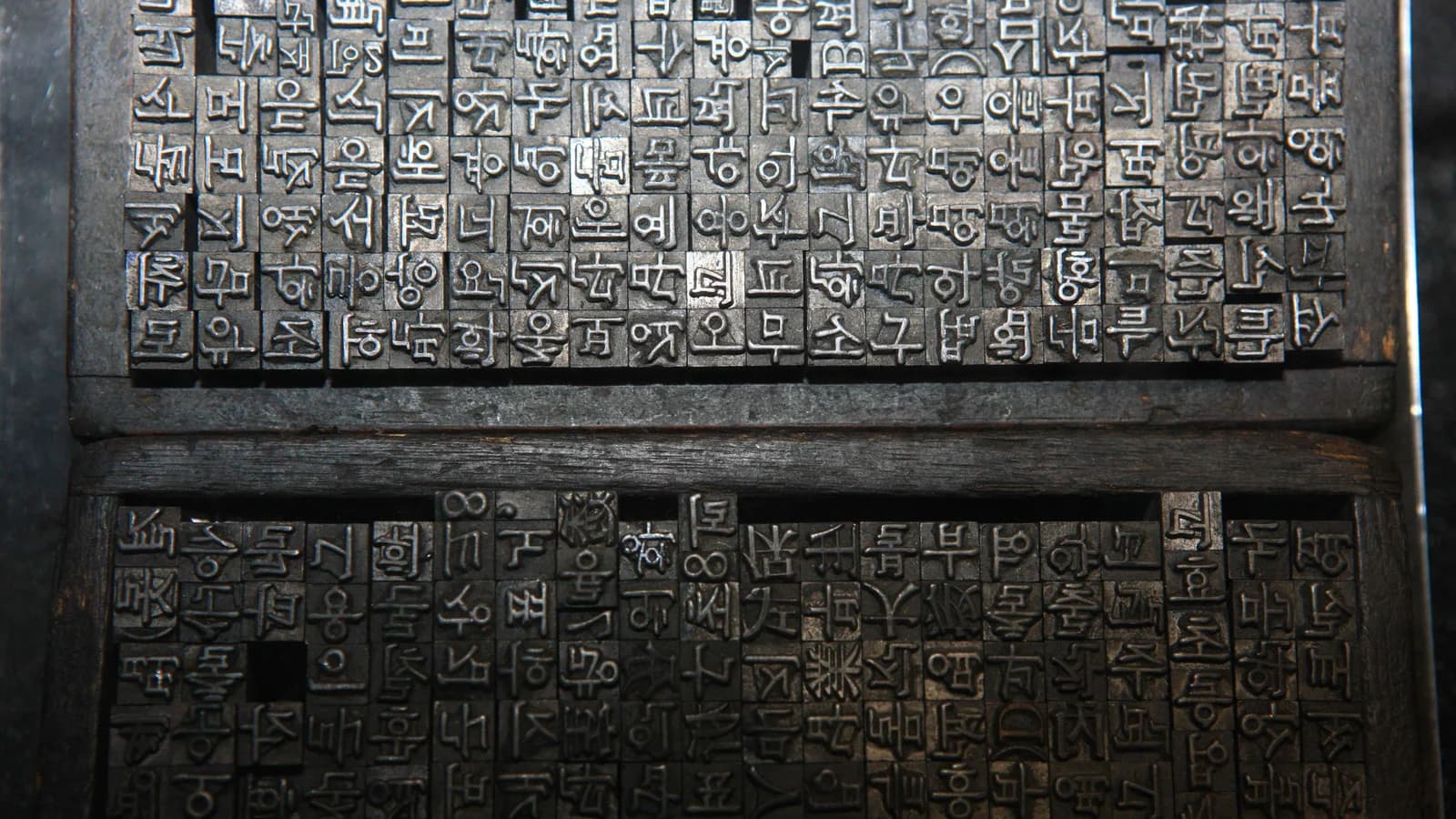
Cover photo: Carved wooden Hangul movable-type blocks at the Tium Hangeul Museum, Korea. ⓒ Korea Tourism Organization Photo korea. Licensed under KOGL Type 1.
Keep Reading
More Stories
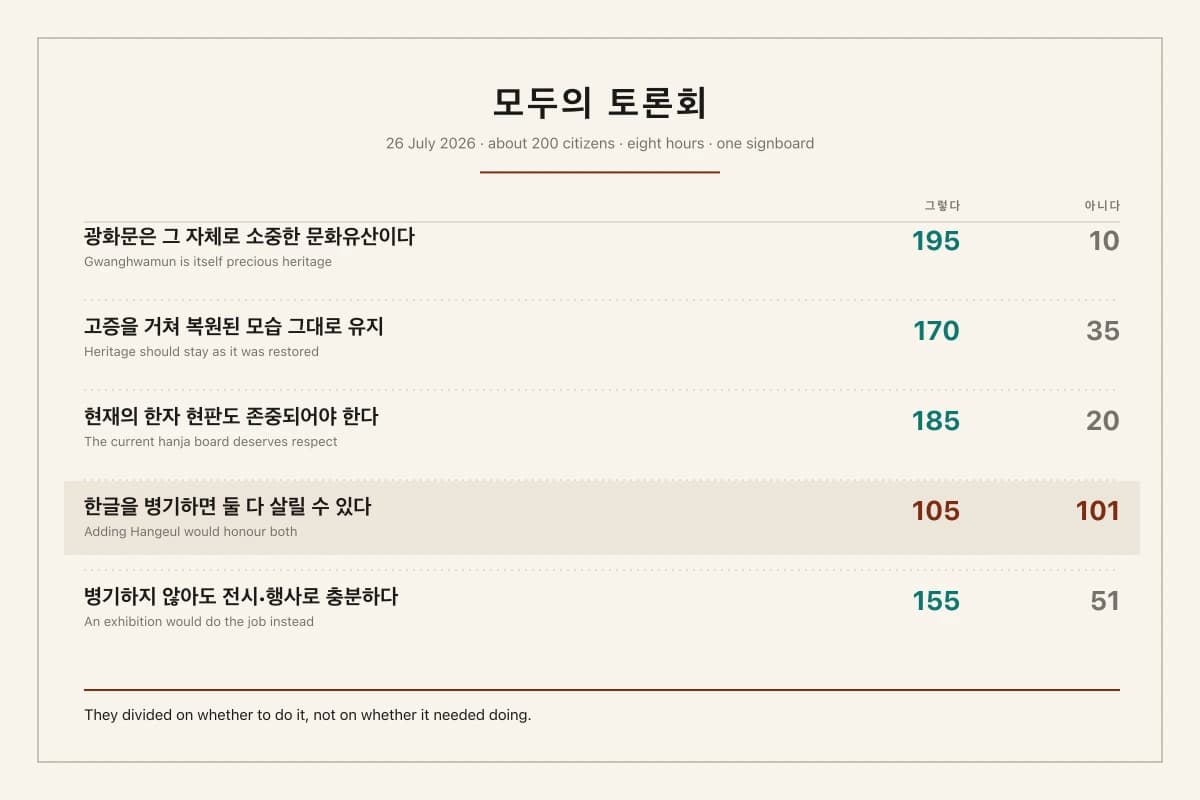
Korea Asked 200 Citizens Whether to Put a Hangeul Sign on Gwanghwamun. They Split 105–101, Then Voted 155–51 That It Is Not Needed.
The government convened its first-ever citizens' deliberation and spent eight hours on a signboard. The panel divided almost exactly in half on whether adding a Hangeul plaque would honour both the heritage and the alphabet — and then, overwhelmingly, said an exhibition would do the job instead. Both answers are coherent, which is the interesting part. The plaque they were arguing about is three years old, and the one before the one before it was in Park Chung-hee's handwriting.
Koreans Have a Word for a Rule Everyone Follows. It Only Ever Gets Used for Rules Not Everyone Follows.
국룰 — gungnul — is Korean internet slang for an unwritten national consensus: the thing everybody does that nobody ever agreed to. It comes from a 2007 shooting game whose players had to invent their own duelling rules because the game had none. And the tell is in which things get called it. Nobody says murder is against 국룰. People say it about which sauce goes with pork belly, and then argue.
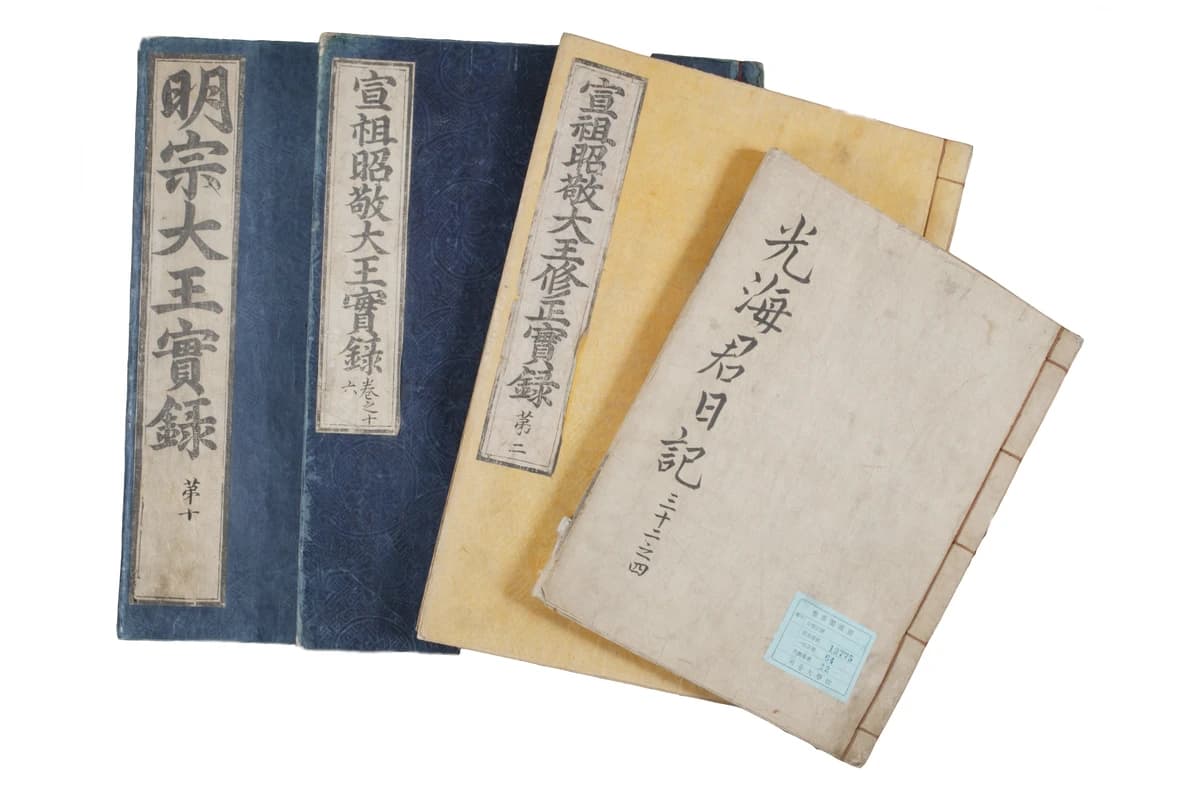
Hangul Day Exists Because a Book Turned Up in 1940. Nobody Can Find the Other Copy.
The date of Korea's alphabet holiday moved four times before a single physical book settled it — and that book arrived missing its first four pages, including King Sejong's own preface, which a calligrapher reconstructed by hand with a typo still in it. A second copy has been in a private house since 2008. The prosecution's own appraisers valued it at over a trillion won. Nobody has seen it since a fire in 2015.
The Weekly Dispatch
Korea, curated. Every week.
The best of K-culture, straight from Seoul. Written by people who actually live here.
Free, no spam, unsubscribe whenever.