The Fisherman Hid It Under His Floorboards. The Reward He Eventually Got Set Off a Decade of Looting.
Korea marked fifty years of underwater archaeology in Mokpo in September 2026. The official story starts with a net and a report. The documented one starts with six pieces of Chinese porcelain given away as presents, a schoolteacher brother who had to get them all back, and officials who did not want the paperwork. Then the state paid a reward, a diver worked out how much of it went in tax, and for the next ten years people stole the wreck faster than the government could raise it — until the navy's own divers could not find the ship, and the excavation hired the looters.
From 14 to 19 September 2026, in Mokpo, the Korea Heritage Service marked fifty years of underwater archaeology in Korea. There was an opening ceremony on the 14th, a special exhibition, and two days of conferences on the 16th and 17th with papers from Korean, Chinese and Japanese researchers.
The thing being commemorated is the excavation of the 신안선 — the Sinan ship — a Chinese trading vessel that sank off the Jeolla coast in the 1320s and was raised between 1976 and 1984. It is the founding event of an entire discipline in Korea, and the official English announcement describes Jeungdo as "the birthplace of underwater archaeology in Korea."
The announcement contains no dates and no numbers. That turns out to be a mercy, because almost everything interesting about this story is in the parts nobody puts in a press release.
The find, as it actually happened
In August 1975, a fisherman named Choi, working off 방축리 on 증도, pulled up six pieces of Chinese ceramic in his net.
He did not report them.
He took the celadon vase home, cleaned the oyster shells off it, and put it under his floorboards. The other five he gave away as presents.
Months passed. Nothing happened. What eventually happened was his younger brother — 최평호, a primary school teacher in Muan — heard about it, understood that it mattered, and set out to have it reported properly. Which meant, first, going round and getting all five gifts back.
Then he ran into the second obstacle, which was the state. As 오마이뉴스 puts it, drawing on the account of 이광표 of Seowon University:
"일부 공무원들의 소극적인 태도로 인해 유물 신고 접수는 쉽지 않았다."
"Because some officials were unenthusiastic, getting the report accepted was not easy."
The report was finally filed in February 1976 — roughly six months after the net came up.
So the founding artefact of Korean underwater archaeology spent half a year under a floor, and the discipline exists because a schoolteacher was more persistent than his brother was curious and than the local administration was interested.
A small note on what is being celebrated
The programme in Mokpo is the fiftieth anniversary of the excavation, which began in 1976. The Korea Heritage Service says so plainly in its own materials, dating the starting point of Korean underwater archaeology to 신안선 발굴 (1976년).
Which means the fiftieth anniversary of the find — the net, the vase, the floorboards — passed in August 2025 with no programme at all.
That is not a scandal. Excavations are what institutions do and finds are what happens to fishermen. But it is worth noticing that the anniversary Korea is marking is the one where the state arrives.
The reward, and what it taught everybody
News of the discovery broke on 9 January 1976. The brothers were paid a reward: one million won for the vase and two hundred thousand for the other five.
In a country where a sack of rice cost about ten thousand won, this was an enormous and highly public sum. The Korea Heritage Service's own magazine describes the effect without much euphemism:
"도굴꾼들에게도 귀가 번쩍 뜨이는 소식이었다."
"It was news that made looters' ears prick up too."
But the detail that actually set things off was not the size of the reward. It was the tax.
A diver surnamed 정, testifying later, explained why he had stopped intending to hand his finds in:
"본래 인양 유물을 신고하려 했으나 1월 청자를 건진 최○○ 씨가 당국으로부터 받은 보상금 100만 원 중 60만 원을 세금으로 냈다는 사실을 알고 암거래키로 했다."
"I had meant to report what I brought up, but I learned that Mr Choi, who raised the celadon in January, paid six hundred thousand of his one-million-won reward in tax — so I decided to deal on the black market instead."
Forty per cent of a reward is a bad advertisement for honesty. From that point the seabed off Jeungdo was, in effect, a public auction with no reserve.
Ten years of theft, in the record
What follows is from the Korea Heritage Service's own magazine and the National Archives of Korea, which draws on the national police history and the coast guard's own fiftieth-anniversary volume.
September 1976. A 50-year-old local surnamed 조 and about ten others rent a three-tonne boat, the 정우호, for 120,000 won. They loot in broad daylight, because nobody is watching. A hundred and seventeen pieces across five outings, sold for two to three million won each.
13 October 1976. The first case surfaces: eight men had raised 122 pieces between 1 and 22 September. Three arrested, five wanted.
October to December 1976. The Supreme Prosecutors' special investigation division charges thirteen people across three rings and recovers 311 artefacts. One dealer had sold twenty-seven pieces to a Busan businessman for 12.4 million won. The prosecutor on the case was 박희태.
November 1976. The state responds with a two-kilometre no-navigation zone, 14.3 million won for two watchposts, four guards and a twelve-tonne patrol boat.
July 1978. Six detained. Separately, police catch a ring run by the head of Sinan County's own industry division, a 40-year-old surnamed 최, who had recruited former UDT divers from Yeosu and Busan. About two hundred pieces.
June 1981. Seven detained for about a hundred pieces — and two of the government watchmen had taken a 200,000-won bribe and thirty artefacts to look the other way.
October 1983. Four looters, about a hundred pieces. This time the patrol boat's own captain and bosun had accepted five celadon dishes.
5 February 1987. The largest case: thirty people referred to prosecutors, six professional rings plus smugglers including a Japanese national. Around a thousand artefacts, valued at roughly five billion won, moved to Japan. Seventeen detained, 605 recovered. They had been looting in 1985 — after the official excavation had finished.
About three hundred people were caught over the decade. Antique shops in Tokyo were still openly selling goods labelled 신안해저 출토유물 — "excavated from the Sinan seabed" — into the mid-1990s. Which is why Korean accounts carry an estimate that ought to stop you: the volume stolen may rival the volume officially excavated.
It did not end cleanly either. In 2019, a 63-year-old who had been sitting on looted Sinan ceramics since the early 1980s tried to sell them to Japan. Fifty-seven pieces were recovered. He had miscalculated the statute of limitations, which runs from discovery — March 2019 — and not from the theft.
The part that is almost too good
Here is the fact that reorganises the whole story.
The navy's SSU divers — the Special Salvage Unit, the elite — could not find the wreck.
So the excavation team went and got the people who could. 이호관, later director of the Jeonju National Museum and present from the first dig, described it plainly:
"해군 잠수사들이 유물 위치를 찾지 못해 고심 끝에 도굴 경험이 있는 잠수사 등을 현장으로 데려와 정확한 위치를 파악했다."
"The navy divers could not locate the artefacts, so after much deliberation we brought divers with looting experience to the site and established the exact position."
The arrested ringleader 조 and the diver 정 — the one who had done the arithmetic on the tax — joined the official excavation team, alongside three men from 방축리 who knew the water.
Korean underwater archaeology was founded, in the most literal operational sense, on the expertise of the people stealing from the site.
The ship itself
It is worth knowing what they were all fighting over.
The ship was built in Quanzhou, in Fujian — a V-bottomed hull, not the flat-bottomed Korean kind. A bronze weight aboard is inscribed 경원로 (慶元路), the administrative name for Ningbo. It was bound for Hakata, in Japan.
The dating is unusually precise, because the cargo was labelled. The wreck held 364 wooden cargo tags — 목간, effectively delivery slips. One reads 지치삼년 (至治三年): 1323. Others carry dates through late April, May and early June.
Some of the tags name 東福寺 — Tōfuku-ji, in Kyoto.
Tōfuku-ji burned down in 1319 and was rebuilt from 1325 with help from the Kamakura shogunate. So a ship sailing in 1323 with cargo consigned to Tōfuku-ji was, very plausibly, financing the reconstruction of a temple — a trading voyage with a building project behind it.
The rest is texture, and it is good texture. A bronze mirror set into the joint at the bow. Coins laid at the stern in the pattern of the Big Dipper. Korean bronze spoons among the cargo, meaning Goryeo people were aboard a Chinese ship bound for Japan.
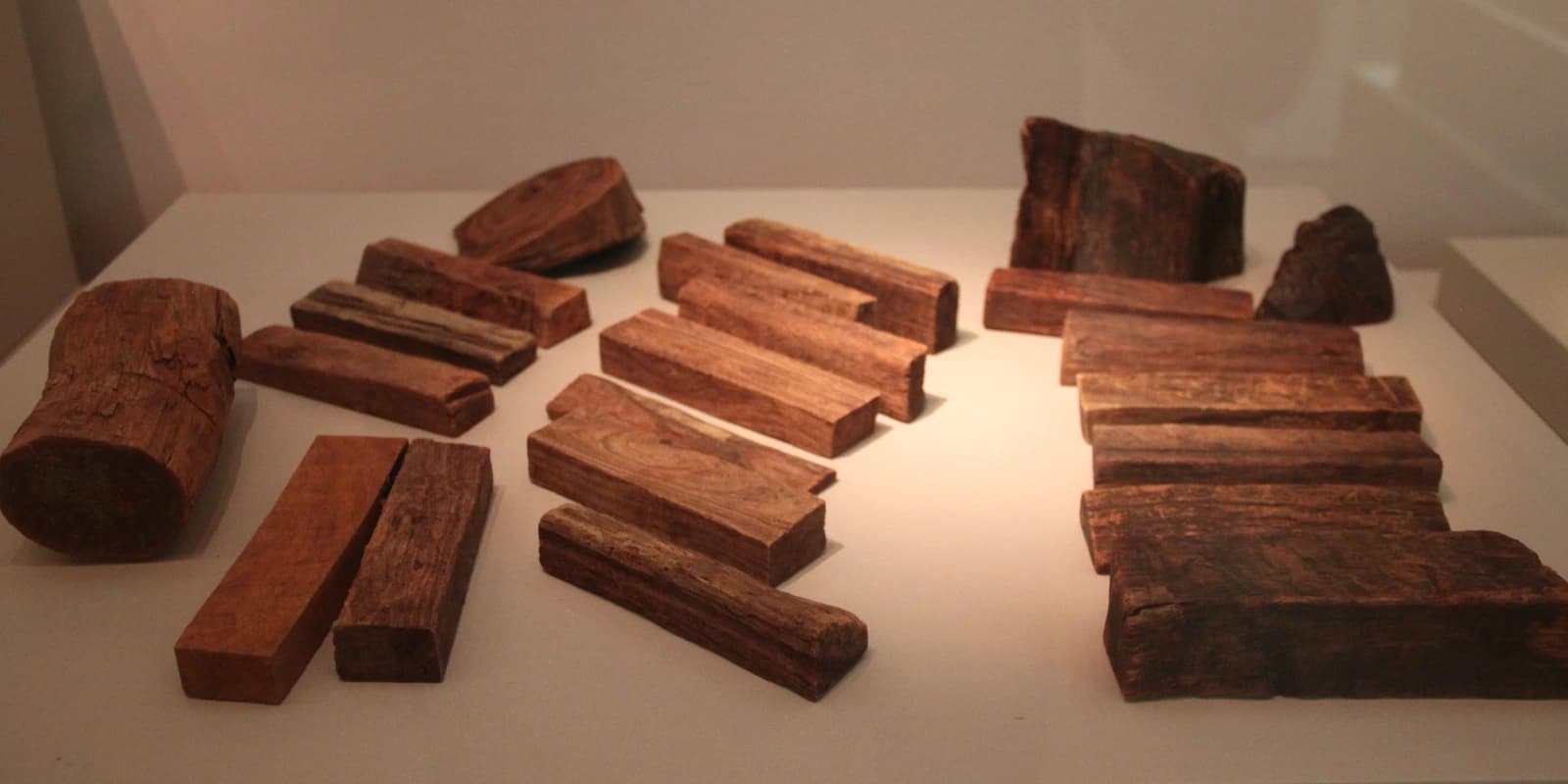
By the institute's own current count the excavation produced about 27,600 objects — ceramics, metalwork, stoneware, and also spices and medicinal materials — plus around 1,100 rosewood logs and 28 tonnes of Chinese coins. The coins sat on top of the timber; the ceramics sat on top of the coins, packed ten to twenty in a wooden crate and tied.
Why this year's exhibition is about the wood
The special exhibition is not about the porcelain. It is called, in the institute's own English, "Rosewood: Timber That Crossed the Sea."
The argument is that more than five hundred of the logs carry script and marks — including Phags-pa script and family crests — which makes them individually contracted goods, not ballast. 이종숙 of the institute puts the shift this way: this is the moment you start reading the cargo "수량이 아니라 의미로" — by meaning rather than by quantity.
Which is a quietly radical thing for a wreck famous for its tonnage to say about itself.
What fifty years actually built
In 1975 Korea had no underwater archaeologists, no equipment and no method. The heritage administration borrowed the navy. Roughly two hundred SSU divers logged 3,474 hours over nine years. The first team of about thirty was led by 조명기 of Seoul National University. Grid recording — the basic discipline of knowing where a thing was found — only began with the third campaign, in 1977.
What exists now is the 국립해양유산연구소 in Mokpo, and its lineage runs directly back to this wreck: a conservation facility opened in 1981 specifically to treat the Sinan finds, became a maritime museum in 1994, a national research institute in 2009, and took its present name in May 2024.
It has a fleet. 씨뮤즈호 (2006) was the first purpose-built survey vessel. 누리안호, launched in 2012, is 40 metres and 290 tonnes, carries thirty-five people for about twenty days, has a decompression chamber and can put eight divers in the water at once — the first ship in Asia purpose-built for underwater heritage excavation. 새나루호 followed in 2019.
By the 2010s the institute had surveyed twenty-two sites, raised sixteen wrecks and recovered around 110,000 artefacts.
That is the before and after. A borrowed navy and a schoolteacher's persistence, to a research institute with its own ships.
One more thing, and it explains why you may half-know this
If the looting story rings faintly familiar, it is probably because you have watched it.
《파인: 촌뜨기들》, released internationally on Disney+ as Low Life, is an eleven-episode series that premiered on 16 July 2025, directed by Kang Yoon-sung and starring Ryu Seung-ryong, Lim Soo-jung and Yang Se-jong. It is adapted from Yoon Tae-ho's webtoon 파인, and it dramatises exactly this: the wreck, the divers, the rings, the decade.
So an English-speaking audience has already been served a fictional version of the Sinan looting. What it has not been served is the documented one. Which brings us to the last thing worth saying.
What the English-language record gets wrong
We looked for English coverage of this month's programme and found three items: the Korea Heritage Service's own bilingual release of 7 September, and two pickups on the 8th.
Both pickups say the wreck was discovered in 1976. It was not; it was found in August 1975 and reported in February 1976. The date being repeated in English is the date the state arrived — the same substitution the anniversary itself makes.
And in the English-language material on the Sinan ship as a whole — including the fullest previous piece, a 2016 Korea Times feature — we found no mention of the looting at all. Not the three hundred arrests, not the bribed watchmen, not the Tokyo shops, not the divers who were charged and then hired.
Korean sources do not hide any of this. The Korea Heritage Service publishes it in its own magazine. It simply has not crossed over.
Images — and for once there are photographs. The lead is a South Korean government photograph taken on 15 November 1976, showing the salvage in progress: divers' tanks on the deck, and a piece of Chinese ceramic being handed up. Author 대한민국 정부, published by the state's own ehistory archive, and tagged public domain on Wikimedia Commons — we checked the licence twice, in the API metadata and again in the raw file-page wikitext, and we are relying on Commons' assessment of a 1976 government work. The rosewood — the subject of this month's exhibition — and the celadon bowl are both CC0, photographed by Gary Todd in the Sinan Shipwreck Gallery at the National Museum of Korea. CC0 asks for nothing; we credit him anyway.
What we could not get: a clean photograph of the hull itself. The only free one shows the conserved ship with museum scaffolding, ceiling and railings in frame, and a photograph of a display placard is not a photograph of a ship. We also could not use 국립해양유산연구소's own excavation photographs: its copyright policy states that 공공누리 Type 1 applies only to material carrying the badge, and its excavation pages carry none — so by the institute's own rule those need prior permission, which we did not have time to seek. Nothing from 국가유산청's digital portal was usable either: it renders licence information in JavaScript, so no licence type is readable from the page source at all.
Sources. The find and the brothers are from 경향신문 (이기환) and 오마이뉴스 (이광표, 서원대), which agree on the sequence and on 최평호's role. The looting chronology, the reward figures and the tax testimony are from the Korea Heritage Service's own magazine feature 「신안 보물선 끝나지 않은 도굴 이야기」 (29 May 2020) and from the National Archives of Korea, which cites 경찰청 『한국경찰사Ⅳ』 (1994) and 해양경찰청 『해양경찰50년사』 (2003). The 2019 case is from 한국일보. The ship, the cargo tags, the Ningbo weight and the Tōfuku-ji consignment are from 김병근 of the institute, writing in 서울신문 and reprinted by the heritage service; the rosewood argument is from 이종숙 of the institute. Vessel specifications, the excavation hours and the institutional lineage are from 국립해양유산연구소's own pages. The September programme is from the heritage service's bilingual release of 7 September 2026.
Stated rather than smoothed. We give the find as August 1975 with no day, because sources disagree — 경향 says the 20th, English Wikipedia the 25th, and the National Archives says May. We have not given the number of excavation campaigns: the institute's own report series says ten, the National Archives and most reporting say eleven, and no source we read explains the difference, which we suspect turns on whether an emergency salvage in October 1976 is counted. We name the brother, 최평호, but not the fisherman, whose given name traces to a single outlet while the National Archives anonymises him — so he is "a fisherman named Choi" here. The 27,600 figure is the institute's current count and excludes the rosewood and the coins; an older registered tally of 23,502 excluding coins is also in circulation and counts different things. We have not written that the looting changed the law: the documented responses are administrative — the exclusion zone, the watchposts, the patrol boat — plus the 1981 designation of the seabed as a protected site. And we have not said whether Korea has ratified the 2001 UNESCO convention on underwater cultural heritage, because we could not confirm it from UNESCO's own list.
One correction to our own brief. We began calling 자단목 "sandalwood." It is rosewood, and the institute's own English title says so.
Keep Reading
More Stories
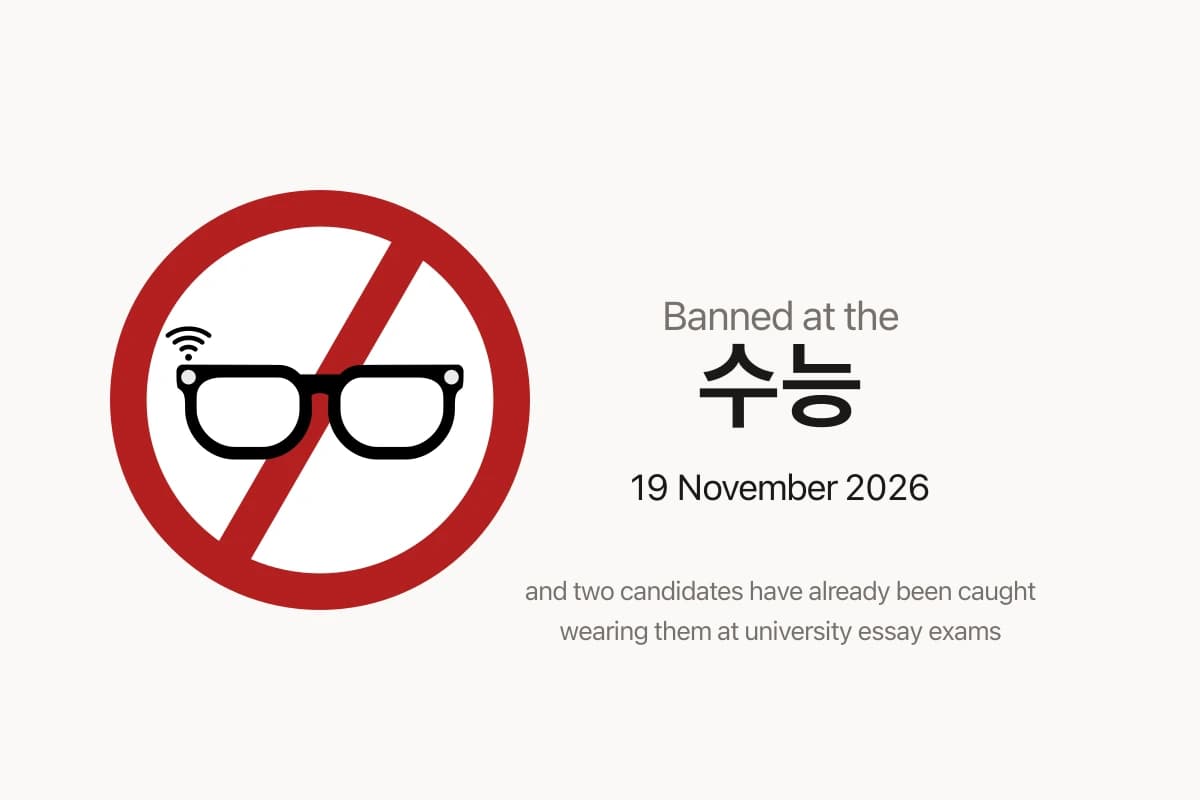
Two Candidates Wore AI Glasses Into Korean University Exams This Month. Five Weeks Later, 550,000 People Sit the 수능
At the University of Seoul on 3 October and at Yonsei a week later, proctors spotted AI smart glasses on candidates sitting essay exams for admission. Both had passed the glasses check in ordinary frames and switched once the exam began. The 수능 on 19 November already bans the devices; the question is whether anyone can see them.
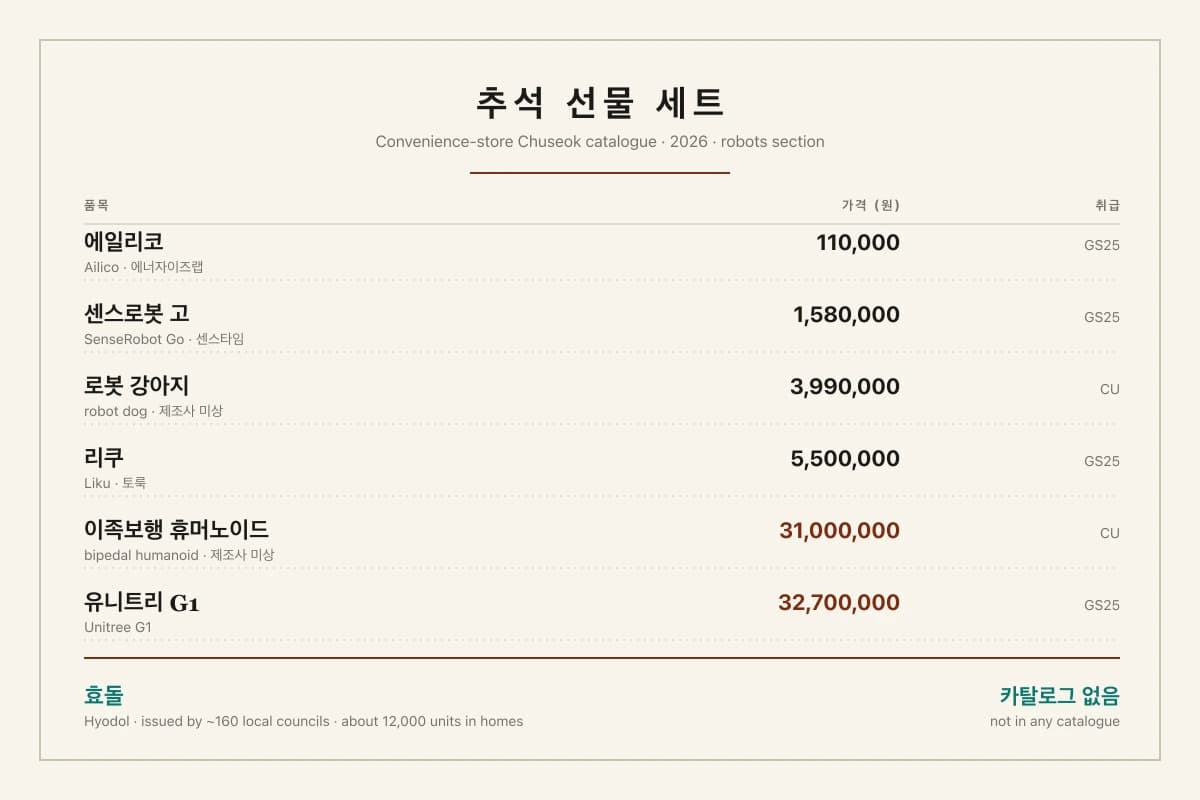
Korea's Convenience Stores Are Selling Humanoid Robots for Chuseok. Neither Chain Expects to Sell One, and Both Have Said So.
CU's holiday catalogue has a bipedal humanoid at ₩31 million, next to the beef and the gold bars. GS25 has an AI companion robot at ₩5.5 million and a keyring that talks back at ₩110,000. We assumed the pitch was companionship for parents you won't be visiting. It isn't — the retailers say plainly these are there to be noticed, not bought. Meanwhile about twelve thousand robots are already in Korean homes, asking elderly residents whether they've taken their medicine, and nobody put those in a catalogue.
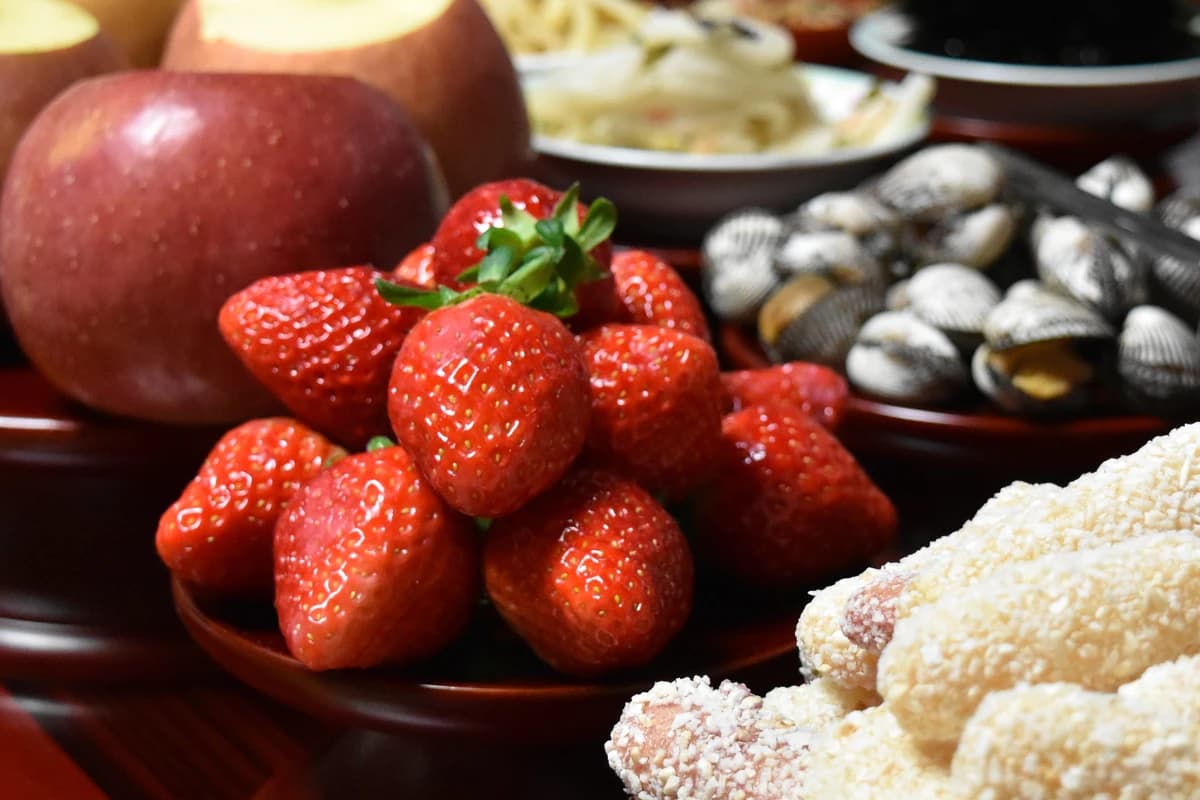
The Chuseok Table Rules Your Family Argues About First Appear in Print in 1920 — as an Insult
Red fruit east, white fruit west. Jujube, chestnut, pear, persimmon, in that order. Korean families treat these as ancient Confucian law and fight about them every Chuseok. Scholars who have gone through the ritual classics cannot find them in any of them. What they can find is a 1920 newspaper column using the phrase to mock people who quote rules to seem learned — and a sixteenth-century master who laid his own family's table with six things on it.
The Weekly Dispatch
Korea, curated. Every week.
The best of K-culture, straight from Seoul. Written by people who actually live here.
Free, no spam, unsubscribe whenever.