Korea's Convenience Stores Are Selling Humanoid Robots for Chuseok. Neither Chain Expects to Sell One, and Both Have Said So.
CU's holiday catalogue has a bipedal humanoid at ₩31 million, next to the beef and the gold bars. GS25 has an AI companion robot at ₩5.5 million and a keyring that talks back at ₩110,000. We assumed the pitch was companionship for parents you won't be visiting. It isn't — the retailers say plainly these are there to be noticed, not bought. Meanwhile about twelve thousand robots are already in Korean homes, asking elderly residents whether they've taken their medicine, and nobody put those in a catalogue.
The Chuseok gift catalogue is a genre. Fruit in a fitted box. Korean beef, graded and ribboned. Dried seaweed. Ginseng. Shampoo sets, for some reason. And, famously, Spam.
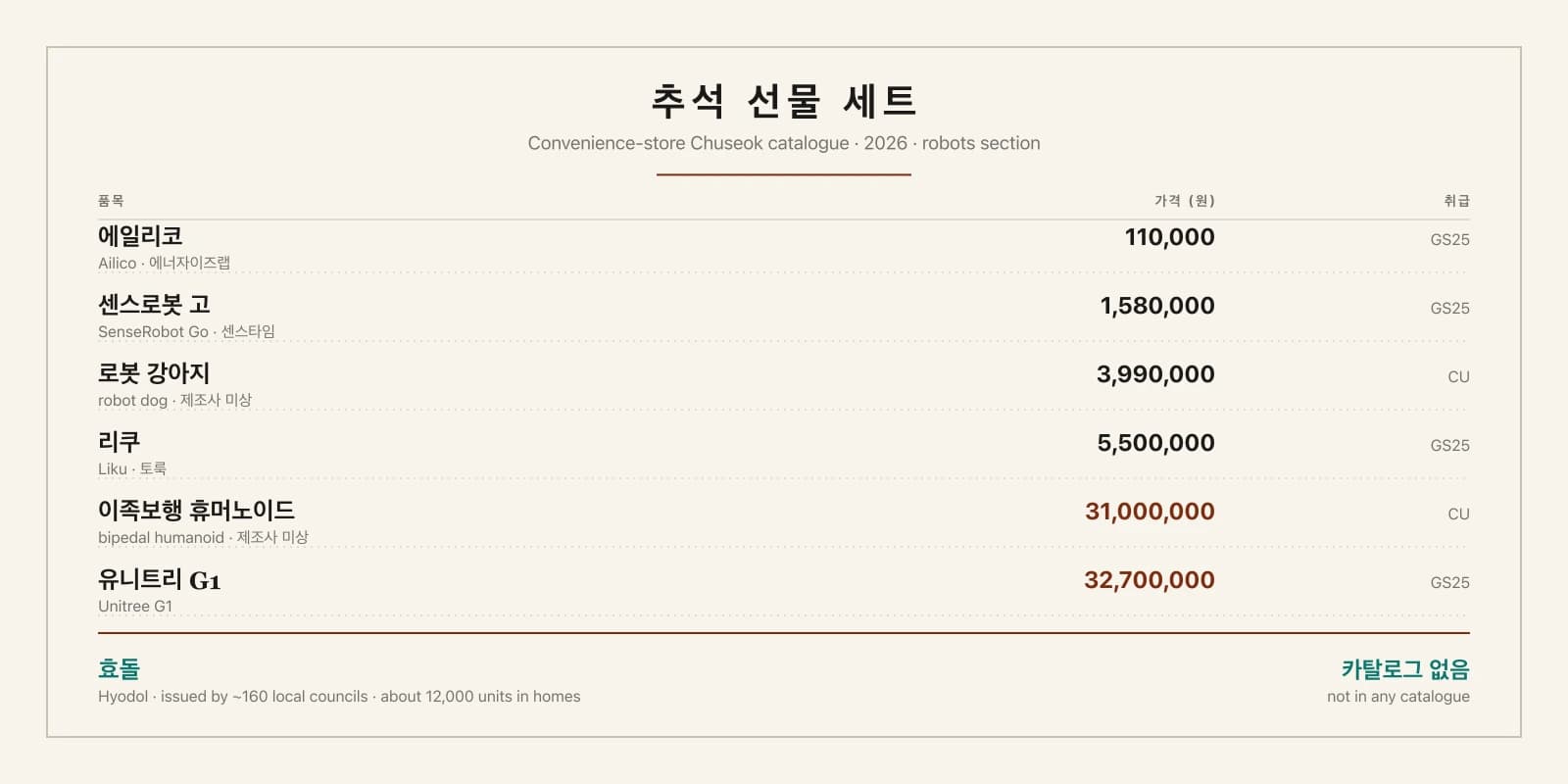
This year, in CU's catalogue of roughly 710 items, there is a bipedal humanoid robot for ₩31 million.
GS25's runs to about 600 items and includes 리쿠 (Liku), an AI companion robot, at ₩5.5 million; 센스로봇 고, a robotic arm that plays baduk against you on a real board, at ₩1.58 million; and 에일리코 (Ailico), a keyring-sized robot that holds a conversation, at ₩110,000.
We came to this expecting a particular story: that a companion robot sold as a Chuseok gift is a machine you give someone precisely because you are not going to be there. It is a good line. It is not what is happening, and the companies say so themselves.
What the retailers actually said
Asked about the ₩31 million robot, a CU official was disarmingly straightforward:
"고가의 로봇이 당장 실제 판매로 연결되지 않더라도, 기존 명절 선물의 틀을 깨는 이색 상품을 통해 편의점만의 뛰어난 상품 소싱과 큐레이션 역량을 보여줄 수 있다."
"Even if an expensive robot doesn't translate into actual sales right away, an unusual product that breaks the mould of the conventional holiday gift lets us show off a convenience store's sourcing and curation."
GS Retail was equally plain about which of its robots is a real product and which is a display:
"10만원대 키링 로봇은 판매가 많이 일어날 것으로 예상하고 있고, 더 높은 스펙의 로봇은 소비자 문의를 받으면서 실제 수요를 체크하고 데이터를 쌓을 수 있다."
"We expect the ₩100,000-range keyring robot to sell in volume. The higher-spec robots let us field customer enquiries, check whether there's real demand, and gather data."
So the ₩31 million humanoid is not a product. It is an advertisement for the shop's ability to source a ₩31 million humanoid.
And the correction goes further, because the mental image does not survive contact either. Nobody is putting a humanoid robot on a shelf between the triangle kimbap and the cup noodles. GS25's flagship robots are ordered through its 우리동네GS app and delivered to an address. It is a convenience-store catalogue selling a robot, which is a smaller and more ordinary fact than a convenience-store aisle selling one.
This is a four-year-old trick
The robots are new. The move is not.
Korean convenience stores have been dropping one absurd item into the Chuseok catalogue for years, specifically to be written about. In 2022 the same chains offered a bottle of Romanée-Conti at ₩79 million, a mobile home, and a Nintendo Switch. The robot is this year's Romanée-Conti.
Which is worth knowing before treating it as a sign of anything. It is a sign that convenience-store merchandisers understand the news cycle, and they are right — here we are.
What Chuseok gifts actually are
The genre is worth explaining, because the robot only reads as strange against it.
Chuseok gifting is substantially a corporate and obligation exercise. Companies give to staff, firms give to clients, families give to families. The conventional range for an employer's gift to an employee runs about ₩30,000 to ₩50,000 a head, which is not a coincidence: Korea's anti-graft law sets its threshold for gifts in professional contexts at around ₩50,000, and the market has arranged itself neatly beneath it.
The arc of what people give tracks the country's whole postwar economic history. In the 1950s it was eggs and flour, because those were what you needed. In the 1960s and 70s it was manufactured goods — instant noodles, soap, and instant coffee, which was genuinely coveted. From the 1980s it became department-store luxury: beef, ginseng, honey, vouchers. Then electronics, then health supplements, and now mobile gifting through KakaoTalk.
And then there is Spam, which deserves its reputation. CJ CheilJedang says roughly 60 per cent of its annual Spam sales happen during the two holiday gift seasons. Around forty different gift-set configurations are produced each season, up through premium tiers with gold labelling. Cumulative sales are reported at 1.9 billion cans.
The reason is a good one. Spam became a gift in the aftermath of the 1997 financial crisis, when it was a way to give meat without spending like it was meat. What made it stay is packaging. Boxed, tiered, ribboned, it stopped being cheap protein and became a legitimate thing to hand your aunt. It is premium because of the box.
Into that catalogue, this year, somebody has dropped a humanoid.
The robots that are actually in Korean homes
Here is the part that makes the convenience-store story feel thin, and it is a different story entirely.
효돌 (Hyodol) is a Korean company that makes a small companion robot, shaped like a child in a hanbok, distributed to elderly residents by local governments. It has been rolled out through roughly 160 municipalities, with reported deployments of around 10,000 units, and more recent figures putting it past 12,000 across councils, public bodies and medical facilities — including some 2,000 units across Seoul's twenty-five districts.
It is not a toy and it is not a gift. It asks whether you have eaten. It reminds you to sleep. It asks "약은 드셨어요?" — have you taken your medicine? It plays trot. It holds a conversation. It has sensors through its body, so it knows if it has been picked up, and it builds a weekly report from that: whether you moved today, whether you responded, whether anything changed. If nothing happens for long enough, it tells a monitoring centre.
There are published evaluations, and they need labelling honestly. A Kangwon National University medical-school study reported depression-scale scores among users falling from 5.76 to 4.69. A larger evaluation run with the psychiatry department at Yongin Severance Hospital, covering around 1,230 users, reported the high-risk-for-depression group down 35.7 per cent, social-isolation risk down 24.7 per cent, and medication adherence up 27 per cent. That second evaluation was organised by Hyodol itself, with hospital clinicians doing the clinical measurement — company-supported, not independent, and we would rather say so than let the numbers stand unqualified.
The company won a GLOMO award at Mobile World Congress in Barcelona in February 2024, the first Korean startup to do so.
The two stories are not the same story
Put them beside each other.
One robot costs ₩31 million, sits in a holiday catalogue, is admitted by the retailer to be there for attention rather than sale, and will in all likelihood be bought by nobody.
The other costs a municipal welfare budget, is already in twelve thousand homes, and spends its day asking someone whether they have eaten.
The interesting thing is not that Korea sells companion robots at Chuseok. It is that Korea already deployed companion robots, at scale, through local government, for a problem that is real — and that this happened without a catalogue, a price tag, or a single news cycle in English.
For the scale of that problem, one figure is enough. In the 2025 Social Survey from 국가데이터처, 42.2 per cent of Koreans aged 60 and over reported feeling lonely — the highest of any age band. Among one-person households of any age it was 48.9 per cent. And one-person households are now 36.1 per cent of all Korean households, with the over-seventies the largest single group within them, having overtaken people in their twenties.
That is the context in which a robot that asks about your medication is a public-health instrument rather than a novelty.
What it says
We were ready to write that Korean retailers are selling companionship to people who feel guilty about not visiting. That would have been a good piece and it would have been wrong, and the thing that stopped it was reading what the companies actually said instead of what we expected them to say.
What they said is that the robot is a poster. Fine — it worked.
The genuinely striking fact is quieter and sits one layer down. The country that is putting a humanoid in a holiday catalogue as a stunt has, separately and unremarkably, already put twelve thousand small talking robots into the homes of elderly people through ordinary municipal budgets, because there is a real gap there and someone had to fill it.
One of those is a Chuseok gift. The other one is a Tuesday.
For what Chuseok is actually for, and why the state's own documents describe two different holidays, see Chuseok is filed under two different months. And for the ritual table everyone argues about, the rules that first appear in print in 1920 as an insult.
Images. There are none of the actual subject, and we should say why. GS Retail's own terms of use explicitly prohibit reproduction or distribution of its material without prior consent, so its press photographs are not ours to run, and publication is not permission. Wikimedia Commons has essentially nothing: two CU logo files, a category of GS25 storefronts we cannot use because Wikimedia Commons treats South Korea as a no-freedom-of-panorama country, (Corrected 11 September: we had written that Korea has no freedom of panorama at all. It has one — 저작권법 제35조②, which lets works permanently displayed in streets, parks and on building exteriors be reproduced "by any method whatsoever" — but it carves out reproduction for the purpose of sale, and that carve-out is why Wikimedia Commons, which requires commercial reuse, treats Korea as a no-FoP country and will not host such photographs. Our sourcing decision is unchanged; the reason we gave for it was wrong.), and one genuinely clean CC0 photograph of a Unitree G1 humanoid taken at a trade show in 2024 — a picture of the right machine in the wrong country doing nothing to do with this story. So the artwork is a mock gift catalogue page we set ourselves, listing real products at their real prices, because the joke is entirely in the juxtaposition and a catalogue is the honest form for it.
Reported from Korean coverage of the two chains' Chuseok ranges published between 17 and 27 August 2026 — 이데일리, 머니투데이, 이투데이, 중부일보 and 팝콘뉴스 — from the April launch coverage in 한국경제, ZDNet Korea and 전자신문, from CJ CheilJedang's own newsroom on Spam, from 로봇신문 and korea.kr on 효돌, and from 국가데이터처's 2025 Social Survey.
Corrections to our own brief, and one number we did not use. We came to this with the theory that retailers were selling these as companionship for absent family. They are not, on their own account, and the piece says so. We also expected a robot on a shelf; GS25's are ordered in an app and delivered. And we were carrying a figure of "45 per cent loneliness among elderly Koreans living alone," attributed to the Korea Institute for Health and Social Affairs. We could not confirm it from any search, and have used the closest properly sourced figure instead — 42.2 per cent of over-sixties, from a different agency and a different survey. There is a separate 45 per cent in circulation that is easy to confuse with it: 45.0 per cent of Korea's 3,924 solitary deaths in 2024 were people aged between forty and sixty. That measures the age composition of those deaths, not a rate of loneliness, and it is not about elderly people. We mention it because half-remembering it would produce exactly the sentence we nearly wrote.
Also stated rather than smoothed: nobody has named the model or maker of CU's ₩31 million humanoid — every Korean source calls it only 이족보행 휴머노이드 로봇. It sits in the same range as the Unitree G1, which sells in Korea at ₩32.7 million and is stocked not only by GS25 but by E-Mart's Electromart and Lotte On — which tells you this is a general retail-novelty category rather than anything Chuseok invented, and which is suggestive without being evidence. So we do not name CU's machine. The same goes for CU's ₩3.99 million robot dog. And we could not confirm that either chain has actually sold one of the high-end units to anybody.
Keep Reading
More Stories
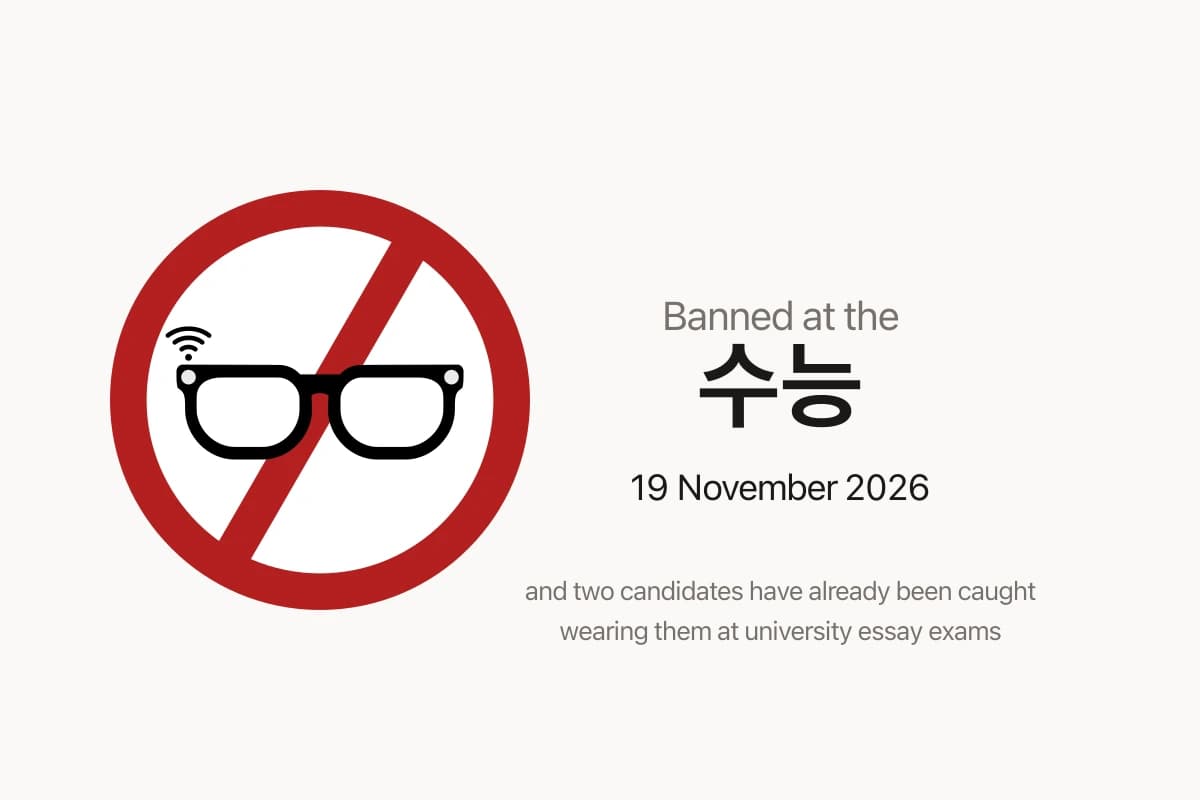
Two Candidates Wore AI Glasses Into Korean University Exams This Month. Five Weeks Later, 550,000 People Sit the 수능
At the University of Seoul on 3 October and at Yonsei a week later, proctors spotted AI smart glasses on candidates sitting essay exams for admission. Both had passed the glasses check in ordinary frames and switched once the exam began. The 수능 on 19 November already bans the devices; the question is whether anyone can see them.
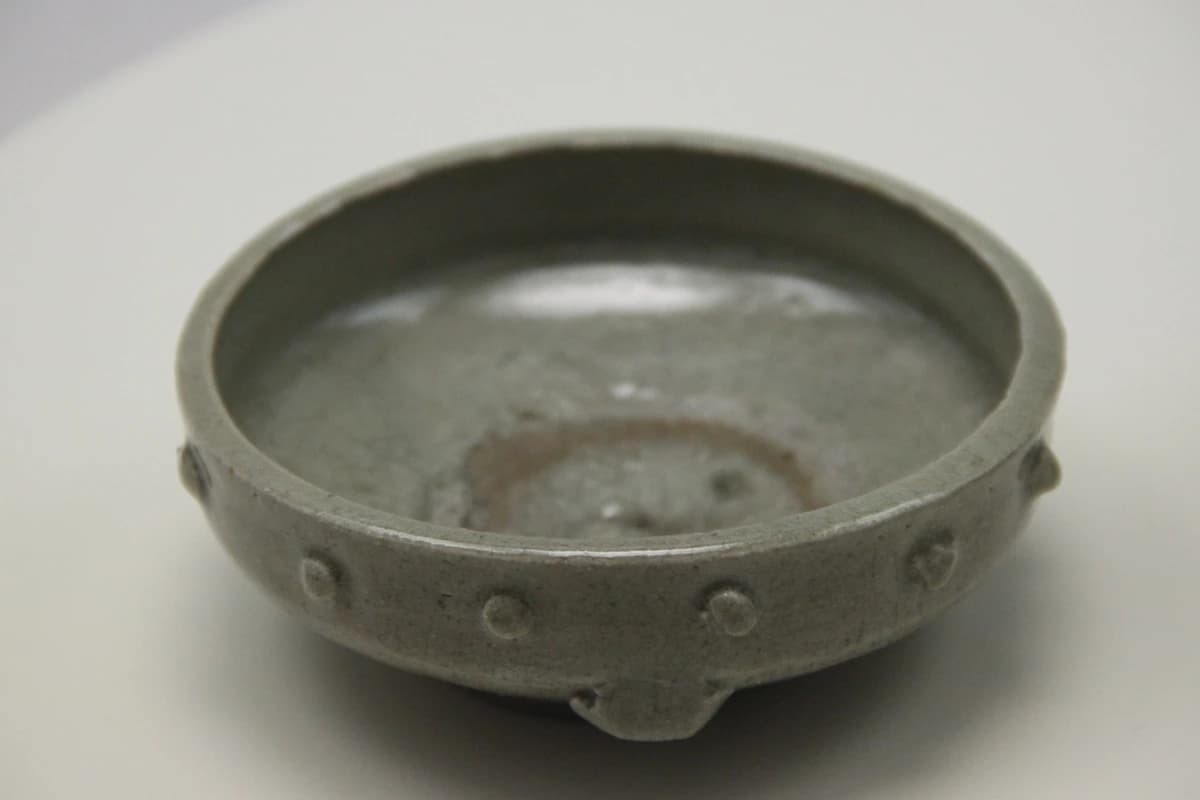
The Fisherman Hid It Under His Floorboards. The Reward He Eventually Got Set Off a Decade of Looting.
Korea marked fifty years of underwater archaeology in Mokpo in September 2026. The official story starts with a net and a report. The documented one starts with six pieces of Chinese porcelain given away as presents, a schoolteacher brother who had to get them all back, and officials who did not want the paperwork. Then the state paid a reward, a diver worked out how much of it went in tax, and for the next ten years people stole the wreck faster than the government could raise it — until the navy's own divers could not find the ship, and the excavation hired the looters.
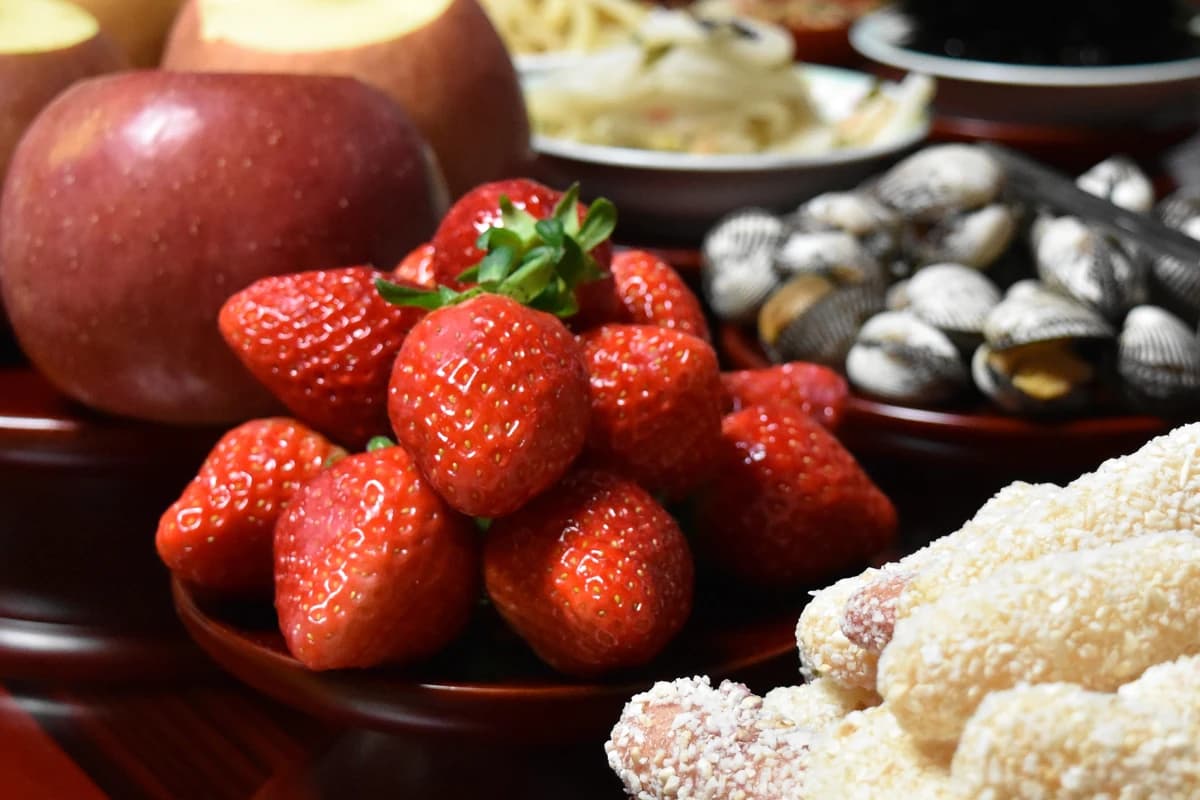
The Chuseok Table Rules Your Family Argues About First Appear in Print in 1920 — as an Insult
Red fruit east, white fruit west. Jujube, chestnut, pear, persimmon, in that order. Korean families treat these as ancient Confucian law and fight about them every Chuseok. Scholars who have gone through the ritual classics cannot find them in any of them. What they can find is a 1920 newspaper column using the phrase to mock people who quote rules to seem learned — and a sixteenth-century master who laid his own family's table with six things on it.
The Weekly Dispatch
Korea, curated. Every week.
The best of K-culture, straight from Seoul. Written by people who actually live here.
Free, no spam, unsubscribe whenever.