Korea's National Museum Showed a Patriot's Calligraphy. It Was a Collaborator's — and It Belonged to the Director
This summer the National Museum of Korea showed a scroll signed 韓人 朴源根 as the work of an independence activist killed in 1950. Seven advisers traced it to 박중양, one of the best-known collaborators of the colonial era. In October the Assembly learned whose scroll it was: the museum's director, 유홍준, had bought it online in 2019 for ₩50,000. Two days after the audit, the director resigned.
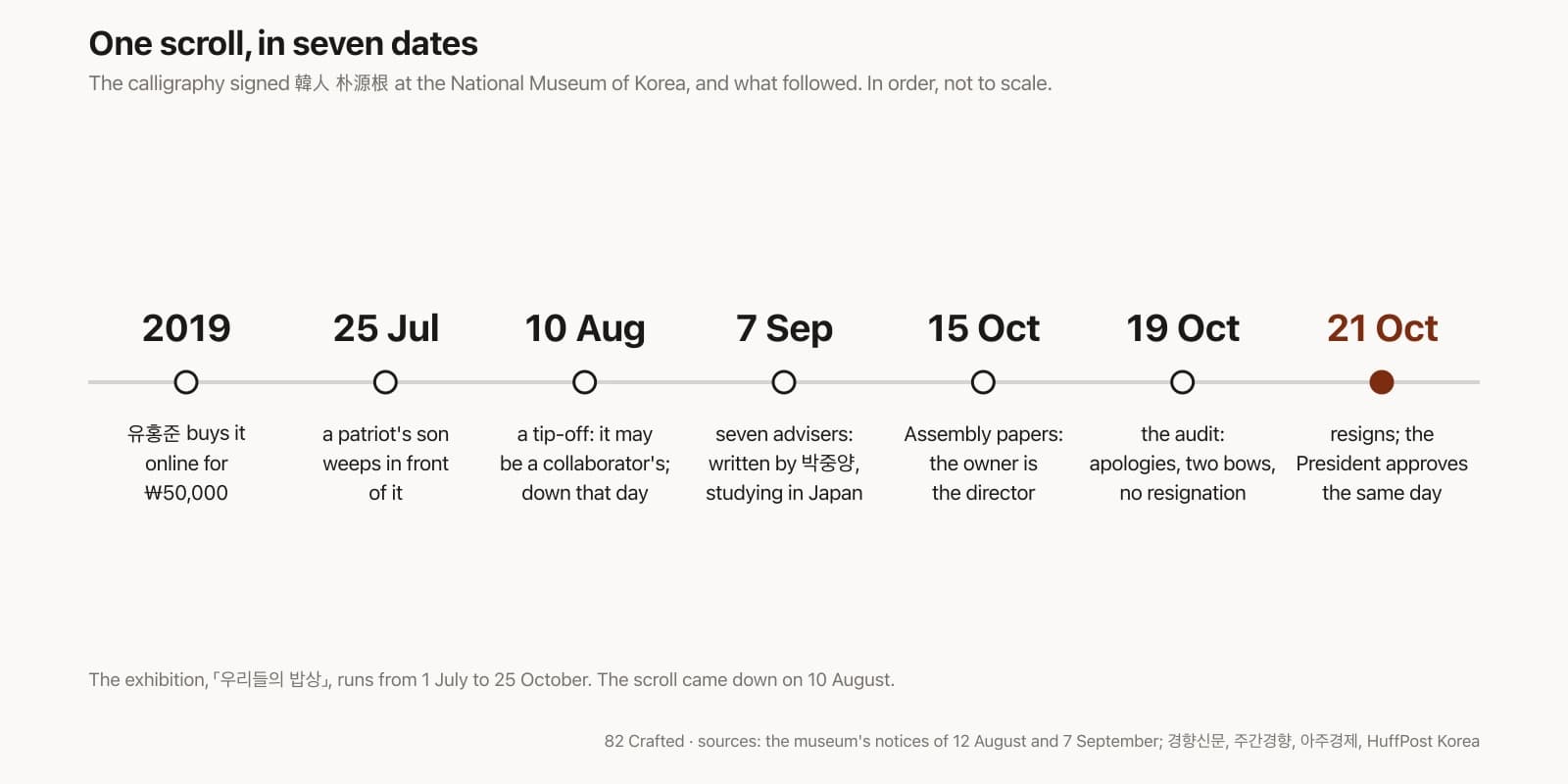
On 25 July, at the National Museum of Korea in Seoul, a man named 박용현 stood in front of a hanging scroll and wept.
The scroll was part of 「우리들의 밥상」 — The Korean Table — the museum's exhibition about the Korean table, which opened on 1 July with 684 objects in 488 entries, lent by 51 institutions. It carried five characters in running script, 一飯是國恩, which the museum glossed as "한 그릇의 밥도 다 나라의 은혜다" — even one bowl of rice is the nation's grace. The words are credited to 영규, a Buddhist monk the museum calls "임진왜란 최초의 의승병장", the first warrior-monk commander of the Japanese invasions of the 1590s. The museum chose the scroll, it says, for the historical value of that phrase.
Beside the text was a signature, 韓人 朴源根 — "Park Won-geun, a Korean". The museum was showing the scroll as the calligraphy of 박원근, an independence activist killed in 1950, and 박용현 is 박원근's son.
It was not 박원근's.
The tip-off
On Monday 10 August a tip-off reached the museum from outside. It came from 주은철, who heads a local news outlet, 제천뉴스저널, and it said that the name on the scroll was probably another name of 박중양. The museum took the scroll down the same day.
On 12 August the museum posted an apology online in the director's name, and on the 13th the director, 유홍준, apologised again at the start of a lecture. The written apology said the scroll had been sold in 2019 "애국지사 박원근의 유묵으로" — as the calligraphy of the patriot 박원근.
It did not say who had bought it. The museum has since cited the Personal Information Protection Act and the ICOM code of museum ethics for keeping the owner's name private.
One name, two men
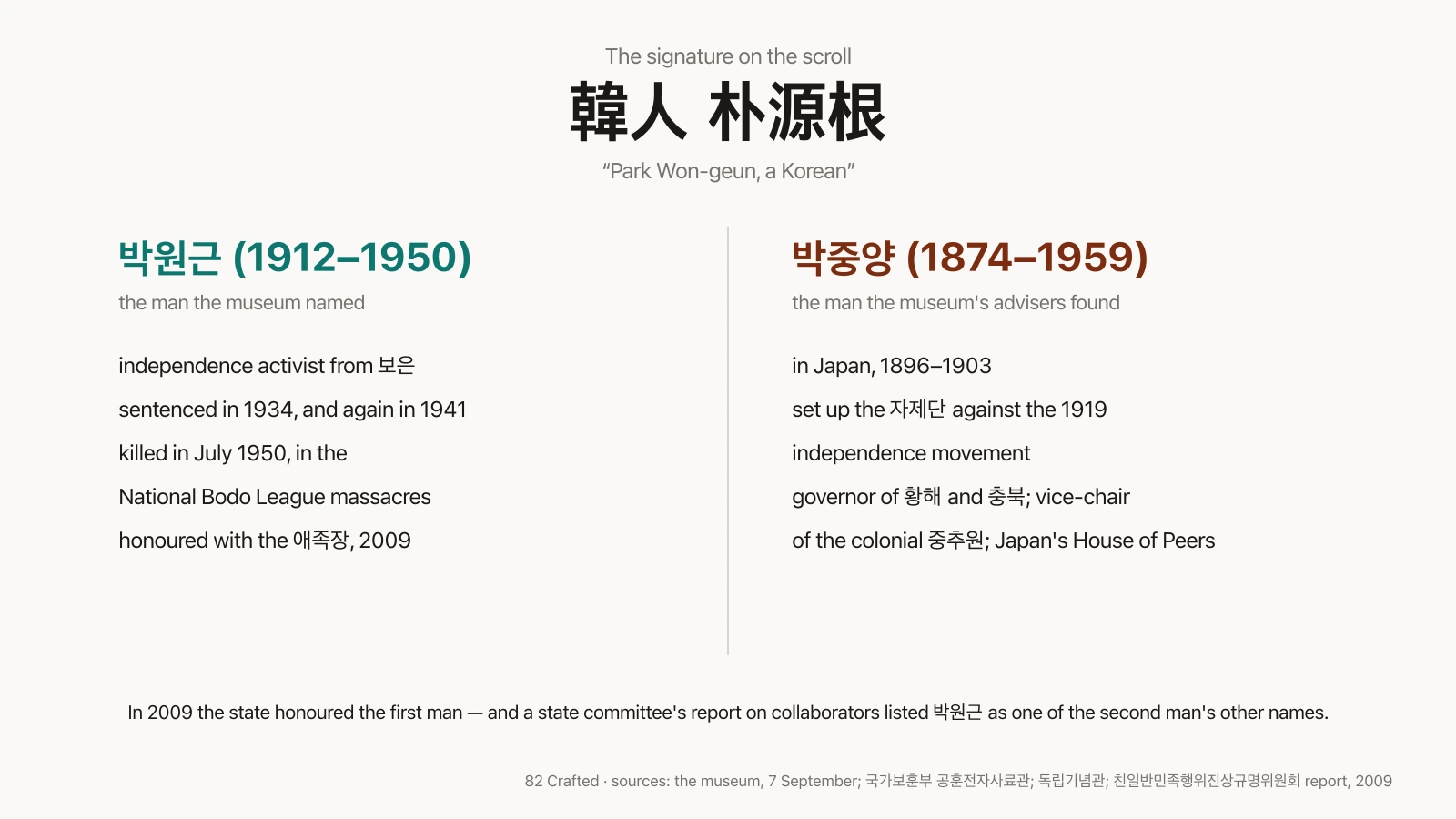
박원근 was born in 1912 in 보은, in North Chungcheong, and also went by 박적운. The veterans ministry's records show the activist sentenced in November 1934 to a year and six months, as a member of a socialist-line group called the 삼인회, and sentenced again in October 1941, to two years. In July 1950, in the first weeks of the Korean War, 박원근 was killed in the massacres of the 국민보도연맹, the National Bodo League — mass killings by South Korean forces of people the state had registered as suspected leftists. In 2009 the state awarded 박원근, posthumously, the 건국훈장 애족장, one of its orders of merit for the independence movement. The grave is in Daejeon National Cemetery.
박중양 was born in 1874 and was in Japan from 1896 to 1903. What followed was a career in government under Japanese control: acting governor of North Gyeongsang in 1906, then governor of South Chungcheong, of Hwanghae in 1921 and of North Chungcheong in 1923; councillor, adviser and, from 1943, vice-chair of the 중추원, the colonial government's advisory council; and, in April 1945, a seat in Japan's House of Peers. In 1919, when the 3·1 independence movement spread across the country, 박중양 set up the 자제단, a group formed to suppress it. In 1949 the anti-collaborator committee, 반민특위, had 박중양 arrested, and then released on bail. In 2009 a presidential committee named 박중양 among 705 collaborators, 친일반민족행위자, and the name is also in the 친일인명사전, the encyclopedia of collaborators compiled by the Center for Historical Truth and Justice.
The same committee's 2009 report listed 박원근 as one of 박중양's other names. In the same year, the state honoured one man by that name and recorded that the other had used it.
What the advisers found
The museum appointed seven advisers — in calligraphy, modern history, old documents and conservation science — and on 7 September announced their conclusion. The scroll was 박중양's, written under the name 朴源根 during the years in Japan. Their names were not published. The museum's reasons were:
- the brushwork, which matches 박중양's;
- the seal at the head of the scroll, whose words, 圭玷尙可磨 言玷不可爲, match a seal the calligrapher 김태석 carved for 박중양 in late 1932;
- 韓人, "a Korean", which the museum describes as the way Korean students in Japan styled themselves in the years of the Korean Empire;
- other pieces signed 朴源根, on sale through overseas auction sites, some of them written for Japanese recipients;
- the 2009 report, with 박원근 among 박중양's names.
The mount is in a Japanese style, and the museum dates it to the nineteenth or early twentieth century. One detail sits less neatly: the scroll's other seal, giving an art name, reads 玉東, and the art name 박중양 is known by is 海岳.
At another lecture, on 10 September, the director apologised again, calling it "역량 부족이자 실수" — a lack of capability, and a mistake.
Whose scroll
By then the attribution was settled. What was not public was where the scroll had come from. On 15 October 경향신문 reported it, from papers the museum had given the office of the People Power lawmaker 정연욱: the owner was the director.
The papers gave the history. In 2019 유홍준 had bought the scroll at an online auction, with an opening bid of ₩10,000, for ₩50,000 — about US$38. According to the papers, the listing named the writer as 박덕원, a member of one of the Joseon embassies to Japan, the 조선통신사. That is not how the museum's own August apology described the sale, which said it was sold as 박원근's. We cannot say which is right, so we report both.
The papers also explained the label. The museum told the Assembly it had attributed the scroll to 박원근 for two reasons: there is no surviving work by 박원근 to compare it with, and "소장자의 전언" — what the owner said.
The owner was the director, an art historian.
19 October
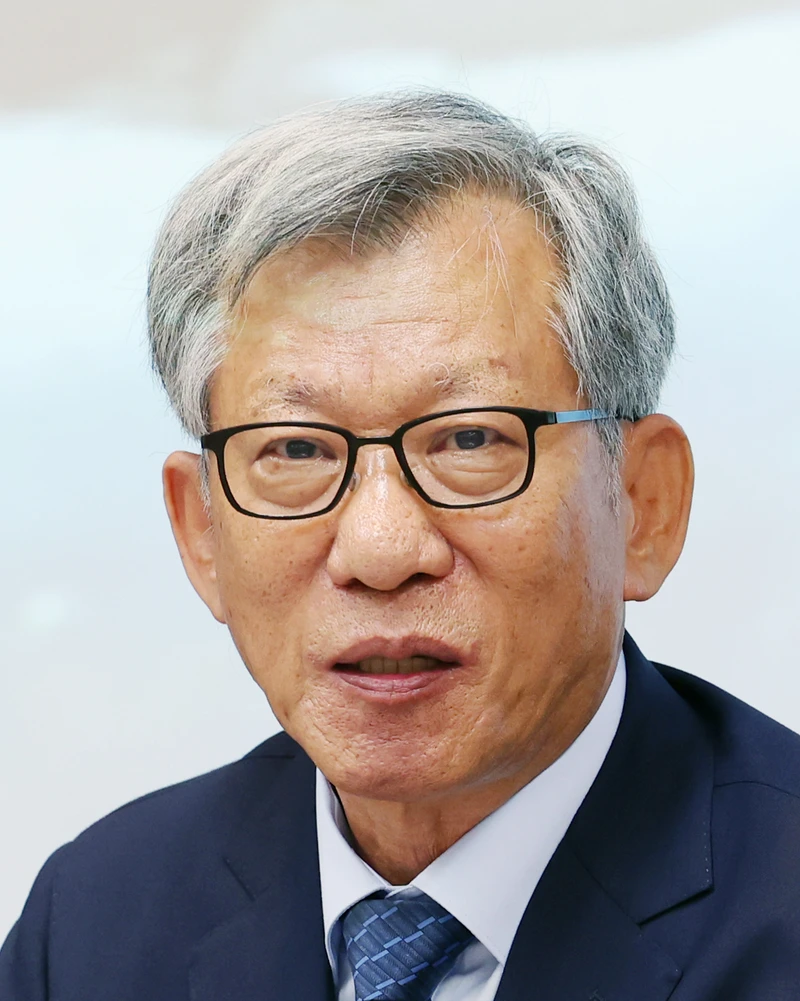
At the National Assembly's culture committee audit on 19 October — the same audit season in which the Chief Justice refused the oath — 유홍준 apologised and bowed twice. Before the director's report to the committee came this:
"…박물관 직원들의 노력으로 쌓아 올린 가치가 저의 중대한 불찰로 한순간에 무너졌다."
The value built up by the museum staff's efforts collapsed in a moment, through my grave lapse.
And: "그 어떤 학술적 취지나 설명도 국민들이 느끼실 실망감 앞에서는 핑계가 될 수 없다" — no scholarly purpose or explanation can be an excuse before the disappointment the public feels.
The committee wanted to know two things. The first was why the director had said nothing in August. The Democrat 최민희 put it directly: "그때 왜 소장자가 본인임을 밝히지 않았나" — why didn't you say then that you were the owner? The director's own account of that silence was the most unguarded thing said all day:
"한 사람의 미술사가로서 좀 부끄러운 마음이 있어서 그냥 지나가 줬으면 하는 그런 아주 참 솔직하지 못한 생각이 있었다."
As an art historian, I was somewhat ashamed, and I had a very, truly dishonest thought — that I wished it would just pass.
The second was why nobody had checked. Asked by the People Power lawmaker 김승수 whether the scroll had been appraised, 유홍준 said: "저 자신이 서예사의 전공자이기 때문에 제가 그렇게 확신을 했던 겁니다" — I was sure because I myself am a specialist in the history of calligraphy. 김승수 also argued that lending the piece breached the museum's ethics rules and the conflict-of-interest rules for public officials. That is the lawmaker's claim.
The People Power Party's lead member on the committee, 조은희, said: "사퇴해야 할 기관장으로부터 업무 보고를 받을 수 없다" — I cannot take a report from an agency head who should resign. 김석기, of the same party, called it "80년 국립중앙박물관 역사에 오점을 남긴 것" — leaving a stain on the National Museum's eighty-year history.
SBS recorded this exchange. 유홍준: "다시는 이런 실수를 하지 않을…." — never again to make such a mistake… The People Power lawmaker 윤용근: "그 정도면 책임을 다한 겁니까?" — is that enough to have taken responsibility? 유홍준: "시스템을 다시 재정비해야 한다고 생각합니다" — I think the system needs to be overhauled.
The director did not offer to resign.
21 October
Two days later, on the morning of 21 October, 유홍준 did. The statement said:
"실추된 박물관의 명예를 바로 세우기 위해서는 제가 관장직에서 물러나는 것이 옳다는 결론에 이르렀다."
To restore the museum's damaged honour, I came to the conclusion that it is right for me to step down as director.
It also said "그간의 모든 비판은 전적으로 저의 책임" — all the criticism until now is entirely my responsibility. President 이재명 approved the resignation the same day; the chief spokesperson, 강유정, announced it.
유홍준, born in 1949, is the author of 『나의 문화유산답사기』, and was head of the Cultural Heritage Administration, the 문화재청, from September 2004 to February 2008. The museum appointment came in July 2025. It lasted fifteen months.
23 October
At the committee's final session on 23 October, the culture minister, 최휘영, answering 정연욱, said that "국립중앙박물관이 오랫동안 쌓아온 명예와 국민에 대한 신뢰가 훼손됐다고 생각한다" — I think the honour the National Museum has built up over a long time, and the public's trust in it, have been damaged. The ministry, the minister said, would not audit only the former director's use of office: "이번에 문제가 된 전시품 관리·검증 모든 절차에 대해서 다 감사를 하겠다" — we will audit every procedure for managing and verifying exhibits that is at issue here.
The museum, for its part, says it is drawing up a check for privately owned pieces that have never been published before they go on show. We have not found a start date for the ministry's audit, or a name for the acting director.
What it says
An auction house can be wrong about a ₩50,000 scroll and few people will mind. A national museum is a different kind of authority. When it puts a name on a label, the state is telling the public who made a thing, and in this case who counted as a patriot. 「우리들의 밥상」 told its visitors that an independence activist had written that every bowl of rice is owed to the nation. One of those visitors was the activist's son.
That label rested, by the museum's own account, on what the owner said. The owner was running the museum, and told the Assembly it had not been checked because the owner was sure. There was no second pair of eyes because the first pair belonged to the director.
The error itself came down on the day a local journalist flagged it. What took two months to come out was whose scroll it was. In that time the owner's name was withheld under privacy rules, while the apology went out in the same owner's name. The director's own word for the wish behind that silence was "솔직하지 못한" — dishonest. It is the part of this that a better checking procedure will not fix.
The exhibition closes on 25 October. The scroll cost ₩50,000. What the minister said it cost was the museum's "오랫동안 쌓아온 명예와 국민에 대한 신뢰" — honour built up over a long time, and the public's trust.
Images. The portrait of 유홍준 is a photograph by 이정우 for the Ministry of Culture, Sports and Tourism, taken on 24 July 2025 and published on Korea.net: Republic of Korea / Lee Jeong-woo (MCST), CC BY-SA 4.0, via Wikimedia Commons, resized and not cropped. The three graphics are ours. We have used no photograph of the scroll, because the museum's images of it are under KOGL Type 4, which forbids changes, and none of the museum building, because South Korea's freedom of panorama does not cover this use.
Sources. The object, the seven advisers' finding and the exhibition's dates are from the museum's press release of 7 September; the tip-off, the removal on 10 August and the "patriot" sale description from its apology of 12 August. 박원근's record is from the veterans ministry's 공훈전자사료관 and the Independence Hall of Korea; 박중양's from 주간경향 (14 August and 2 October) and the 2009 report of the Presidential Committee for the Inspection of Collaborations as cited by the museum. The visit of 25 July is from HuffPost Korea and 주간경향. The ownership, the auction and the museum's reasons are from 경향신문 (15 October), from papers given to 정연욱's office, and 주간경향 (19 October). The audit is from 주간경향, SBS and 연합뉴스; the resignation from 아주경제 and 주간경향 (21 October); the minister from 서울신문 and 아주경제 (23 October). The exhibition's size is from 연합뉴스's report of the press preview on 30 June. The dollar figure uses the won's close of ₩1,324.6 on 23 October.
Stated rather than smoothed. The museum's two documents disagree on how the scroll was listed at auction in 2019 — as 박덕원's in the papers given to the Assembly, as 박원근's in the August apology — and we report both. 박원근's date of death is 7 July 1950 in the veterans ministry's record and 10 July in the Independence Hall's dictionary, so we have said July. Some sources give 박중양's birth year as 1872; we have used the museum's 1874. Reports differ on a second object the director lent to the exhibition, and on which institution in Buyeo the scroll was to be given to, so we have left both out. A figure for the scroll's insurance value and a claim about how the loan form was signed come from a single opinion column, and we have not used them. 김승수's argument that the loan broke ethics and conflict-of-interest rules is the lawmaker's, not a finding. The advisers were appointed by the museum itself, and their names have not been published.
Keep Reading
More Stories
Korea's President Answered the Critics With a Chatbot. The Answer Got the Rule Wrong
On 21 October 이재명 posted a block of text on X under the heading 〈제미나이에게 물어봤습니다〉 — I asked Gemini. It argued that the head of the new Serious Crimes Investigation Agency belongs at the cabinet table. The opposition had a field day. The President said the point was to show how elementary the critics' case was. The rules do allow it, but not for the reasons the post gave.
A Portmanteau Walks into a Party: In Defence of the Koreaboo
The word 'koreaboo' travels fast and lands hard — but nobody can define it, nobody who matters invented it, and it applies, with suspicious consistency, almost only to East Asian cultures. Drawing on the Francophile, the Anglophile, and a 1,555-day Duolingo streak, a guest essay on the double standard that calls Western cultural enthusiasm personality and Korean cultural enthusiasm a phase.
Summoned to Testify, Korea's Chief Justice Came, Refused the Oath, Answered Anyway — and Left at Lunch
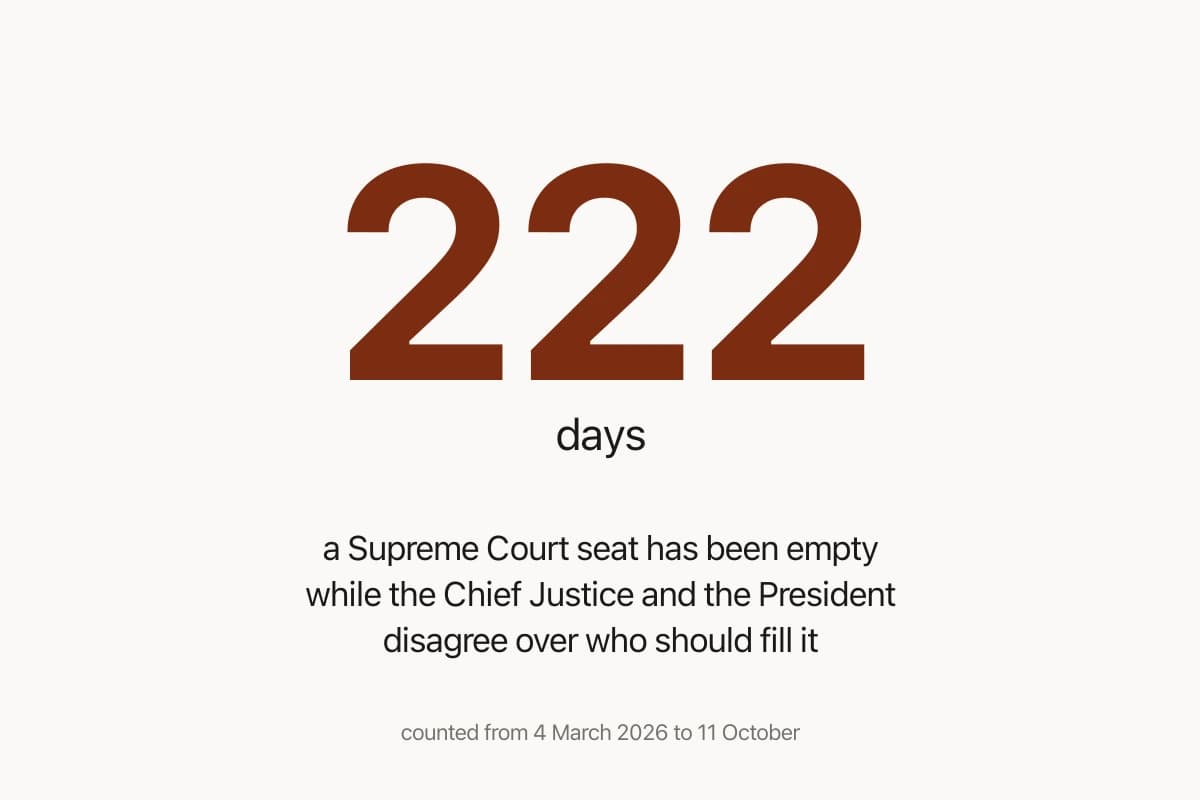
On 6 October 조희대 sat before the National Assembly's judiciary committee for two and a half hours, unsworn, defending a refusal to put forward a second name for a Supreme Court seat that has been empty since March. Then the Chief Justice went, and came back at ten to eleven at night to give closing remarks. Nobody voted to compel a return, and the seat is still empty.
The Weekly Dispatch
Korea, curated. Every week.
The best of K-culture, straight from Seoul. Written by people who actually live here.
Free, no spam, unsubscribe whenever.