Korea's President Answered the Critics With a Chatbot. The Answer Got the Rule Wrong
On 21 October 이재명 posted a block of text on X under the heading 〈제미나이에게 물어봤습니다〉 — I asked Gemini. It argued that the head of the new Serious Crimes Investigation Agency belongs at the cabinet table. The opposition had a field day. The President said the point was to show how elementary the critics' case was. The rules do allow it, but not for the reasons the post gave.
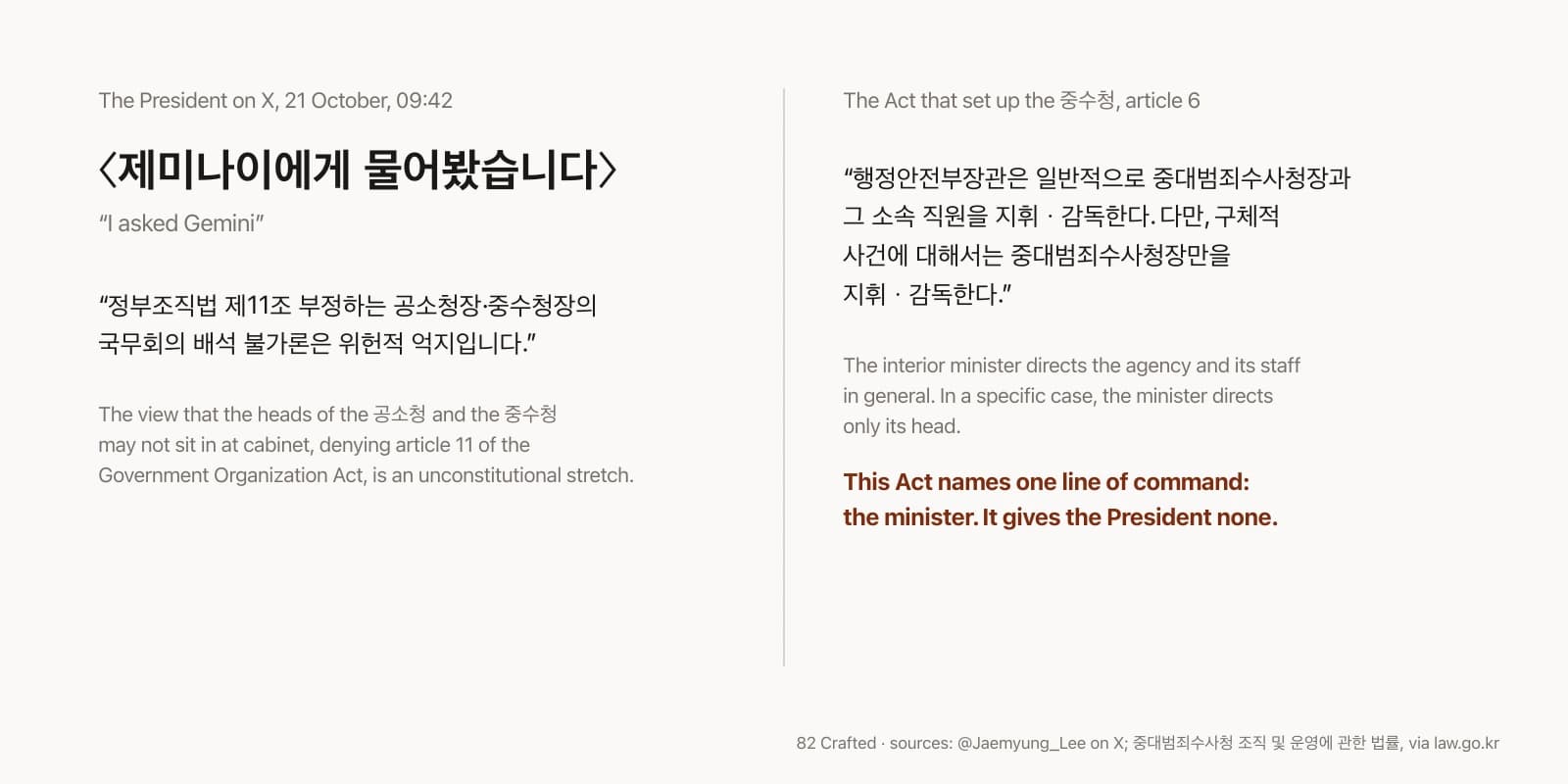
At 09:42 on Wednesday 21 October, the President's account on X, @Jaemyung_Lee, posted a block of text under a heading in angle brackets: 〈제미나이에게 물어봤습니다〉 — I asked Gemini.
What followed reads as a chatbot's answer, and an emphatic one. It began: "정부조직법 제11조 부정하는 공소청장·중수청장의 국무회의 배석 불가론은 위헌적 억지입니다." That is, the view that the heads of the 공소청 and the 중수청 may not sit in at cabinet meetings denies article 11 of the Government Organization Act, and is an unconstitutional stretch. It called that view "대통령의 행정감독권과 정부 통솔 구조를 정면으로 부정하는 궤변" — sophistry that flatly denies the President's power to supervise the administration and the structure of command in government. It cited article 66(4) of the Constitution, four articles of the Government Organization Act and article 8 of the cabinet's rules. It ended by calling the opposing view "수사·기소 기구를 민주적 통제 밖의 '밀실 속 치외법권 성역'으로 두겠다는 위험한 발상": a dangerous idea, one that would put the bodies that investigate and prosecute beyond democratic control, in "an extraterritorial sanctuary behind closed doors".
The post did not say what Gemini had been asked.
What the argument is about
The 중수청, the 중대범죄수사청 or Serious Crimes Investigation Agency, is one of the two bodies that took over from the prosecution service at the start of October. The other is the 공소청, which charges and tries cases. The question of whether their heads belong at cabinet is older than the agencies.
At the cabinet meeting of 30 December 2025, the President told the government's agencies to attend: "각 부처뿐만 아니라 부처 소속 외청도 국무회의에 참석하라" — not only the ministries, but the agencies under them too. Since 20 January, the acting heads of the prosecution service and the police have done so. That was new. Yonhap noted that "최근 수 십년간 검찰총장·경찰청장은 국무회의에 고정적으로 참석하지 않았다" — for recent decades, the prosecutor general and the police chief had not regularly attended.
The 중수청 opened on 2 October with an acting head, its deputy 전종민, who sat in at cabinet on 6 and 13 October. On the 13th the President answered the criticism at the meeting itself: "동의하기 어렵다… 정부조직법상, 그리고 헌법에 의해 당연한 일" — hard to agree; it is a matter of course under the Government Organization Act and the Constitution.
On 15 October the civic group 참여연대, which campaigned for years for the prosecution reform, published a statement against regular attendance. It said: "대통령에게 행정기관에 대한 지휘·감독 권한이 있다는 사실이 수사·공소기관의 장들을 국무회의에 직접 참석시키는 것의 적절성까지 담보하는 것은 아니다." The President's power to direct the administration, in other words, does not by itself make it appropriate to seat the heads of the investigating and prosecuting agencies in cabinet. And it said: "국무회의 정례 참석은 당연하게도 수사·공소기관의 공정성의 외관을 훼손한다" — regular attendance naturally damages the appearance of their fairness.
The same day, the President approved the appointment of the agency's first permanent head, 김지용. On 19 October, handing over the certificate of appointment, the President told 김지용, according to the spokesperson 강유정, "네 편과 내 편을 가리지 말고 원칙에 따라 국민적 의구심이 있는 사안을 잘 처리해달라": don't sort people into your side and mine; handle the matters the public has doubts about according to principle. That morning, asked on the way in whether the agency head would attend cabinet, 김지용 said: "법령과 관계기관 협의를 통해 결정하겠다" — I will decide after looking at the law and consulting the bodies concerned.
The next morning, 20 October, 김지용 attended the 45th cabinet meeting, alongside 이정현, acting head of the 공소청, and 김종철, the acting police commissioner. By Yonhap's account, 김지용 was the first of the three agencies' heads to attend who was not acting. The President told the meeting: "중대범죄에 대해 네 편 내 편을 가르지 말고 성역 없이 수사력을 총동원해 엄단함으로써 중수청의 존재 의미와 필요성을 국민께 증명해달라". In other words: on serious crime, don't divide people into sides; use every investigative resource, with no one off limits, crack down hard, and so prove to the public why the agency exists and why it is needed. 김지용 was formally inaugurated the same day.
The post went up at 09:42 the following morning.
And then two more
At 10:01 the President added a follow-up: "중수청도 공소청도 대통령, 국무총리, 장관의 지휘를 받는 청장의 하나일 뿐입니다. 장관들에게 구체적 인허가 지시도 하지 않는 것처럼 구체적 사건수사 지휘는 하지 않을 테니 걱정 않으셔도 됩니다." Both agencies, it said, are just agencies under the direction of the President, the Prime Minister and their ministers. In the same way the President does not tell ministers to grant particular permits, there will be no direction of particular investigations, so there is no need to worry.
At 11:21, replying to another user: "검사는 대통령에게 충성할 필요도 없고, 또 그렇게 만들 필요도 없으며 그래서도 안 됩니다" — prosecutors need not be loyal to the President, there is no need to make them so, and they must not be.
The opposition, 21 October
The People Power Party's 나경원 wrote on Facebook of "편향된 질문으로 편향된 답변을 제미나이에서 받아놓고, 그걸 X에 올리는 대통령의 처참한 수준": a President who asks Gemini a biased question, gets a biased answer and posts it on X, a pitiful standard. 나경원 then posted a Gemini answer of the lawmaker's own. It said that justifying attendance "수사·기소 기관의 '준사법적 성격'과 '정치적 중립성'이라는 민주사회의 핵심 헌법 가치를 심각하게 훼손할 위험이 있다" — risks seriously damaging the core constitutional values of a democratic society, the "quasi-judicial character" and "political neutrality" of the bodies that investigate and prosecute. And 나경원 made the attack the opposition keeps returning to, calling the President "5개의 재판을 받고 있는 피의자", a suspect on trial in five cases, and saying that "받아쓰기의 끝은 대통령 본인 사건의 공소 취소다": the end of all this note-taking is the dropping of the President's own charges.
이준석 of 개혁신당 went for the joke: "대통령이 제미나이에게 물어봐서 통치할 거면 그냥 대통령을 제미나이로 바꾸면 되지 않냐" — if the President is going to govern by asking Gemini, why not just replace the President with Gemini? Gemini, 이준석 added, has "사법리스크도 없고, 전과도 없고, 욕도 안하고, 근저당도 안 잡는다. 모든 게 상위호환". No legal risk, no criminal record, no swearing, no mortgages: an upgrade on every count.
한동훈, now an independent, wrote that "'제미나이 할애비'를 데려와도 대통령이 수사 지휘, 기소 지휘하면 안 된다" — even if you brought in Gemini's grandfather, a President must not direct investigations or prosecutions. 한동훈 also offered a pun, and spelt it out. The 중수청's future, the post said, was "'특정범죄 하명수사청', 줄여서 '하수청'" — an agency for investigating particular crimes on orders from above, 하명, or 하수청 for short. 한동훈 also called the 공소청 the "공작청", the scheming agency.
The party's chief spokesman, 박충권, asked: "헌법재판소와 법제처보다 제미나이에 의존해서야 되겠냐" — should the President be relying on Gemini rather than the Constitutional Court and the government's legislation ministry? A spokesman, 조용술, asked "언제부터 AI 답변이 국정 운영의 정당성을 대신하게 된 거냐" — since when has an AI's answer stood in for legitimacy in running the country? It was, the spokesman said, "깃털처럼 가벼울 따름": as light as a feather.
The Democratic Party defended the attendance as lawful for an agency under the interior ministry.
22 October
At 13:09 the next day, the President posted again: "중수청에 대한 지휘감독을 포기하는 것은 헌법과 정부조직법 위반으로 탄핵사유입니다. 직무유기로 형사처벌받을 범죄입니다." That is, to give up directing and supervising the 중수청 would breach the Constitution and the Government Organization Act, and would be grounds for impeachment. It would be a crime of dereliction of duty, punishable under criminal law.
And, on the chatbot: "몰라서 제미나이를 인용한 것이 아니라 그 주장이 얼마나 초보적 논리와 팩트에 어긋나고 수준낮은 것인지를 느껴보라고 한 것입니다." I did not cite Gemini because I didn't know. I did it so that people could feel how elementary that argument is, how it goes against logic and fact, how low its standard is.
It did not calm things. The People Power Party's leader, 장동혁, wrote that "행정기관에 대한 지휘·감독권과 수사기관의 정치적 중립은 전혀 별개의 문제다" — the power to direct the administration and the political neutrality of investigators are entirely separate matters. 박정훈 asked whether that meant "검찰총장을 국무회의에 배석시키지 않았던 김대중·노무현·문재인 대통령도 탄핵됐어야 한다는 소리냐": should Presidents 김대중, 노무현 and 문재인, who did not seat their prosecutors general at cabinet, have been impeached too? 안철수 suggested that, if state material had gone into a foreign company's AI, it might be "공무상비밀누설 현행범" — a leak of official secrets caught in the act. At the party's leadership meeting, 김재원 played a recorded voice conversation with Gemini. On SBS radio, 나경원 said: "처참하다. 그동안 국정을 제미나이한테 물어봤나" — pitiful; has the President been asking Gemini about running the country all along? And 한동훈 predicted "조만간 국무회의에서 대통령이 직접 자기 사건 공소취소 지시하는 초현실적인 장면을 보게 될 것": soon, the surreal sight of a President at cabinet ordering the charges in the President's own cases dropped.
We found no further explanation from the presidential office after the posts, and no comment from Google. Nor did we find a Korean case of a president or minister resting an official argument on a chatbot's answer. That is a search that came up empty, not proof that it has never happened. Abroad, Sweden's prime minister, Ulf Kristersson, was criticised in August 2025 for using chatbots for a "second opinion". The President had said before, meeting Demis Hassabis of Google DeepMind in April, that Gemini was in frequent use.
What the rules say
There are three texts that matter, and they are short.
The Act that set up the agency, the 중수청법, places it under the interior minister (article 3). Article 6 sets out who directs it: "행정안전부장관은 일반적으로 중대범죄수사청장과 그 소속 직원을 지휘ㆍ감독한다. 다만, 구체적 사건에 대해서는 중대범죄수사청장만을 지휘ㆍ감독한다." The minister directs the agency and its staff in general, but in a specific case directs only its head. The Act names that one channel, the minister, and gives the President no line of its own. Its staff must keep "공정ㆍ중립", fairness and neutrality (article 5). Article 7(5) lets the Assembly impeach the agency's head for breaking the Constitution or the law.
The Government Organization Act, article 11(1): "대통령은 정부의 수반으로서 법령에 따라 모든 중앙행정기관의 장을 지휘ㆍ감독한다." The President, as head of government, directs and supervises the heads of all central government agencies, in accordance with law.
And the cabinet's own rules, the 국무회의 규정, which are a presidential decree. Article 8(1) says: "의장이 필요하다고 인정하는 경우에는 중앙행정기관인 청(廳)의 장 … 을 배석하게 할 수 있다." Where the chair deems it necessary, the chair may have the heads of agencies sit in.
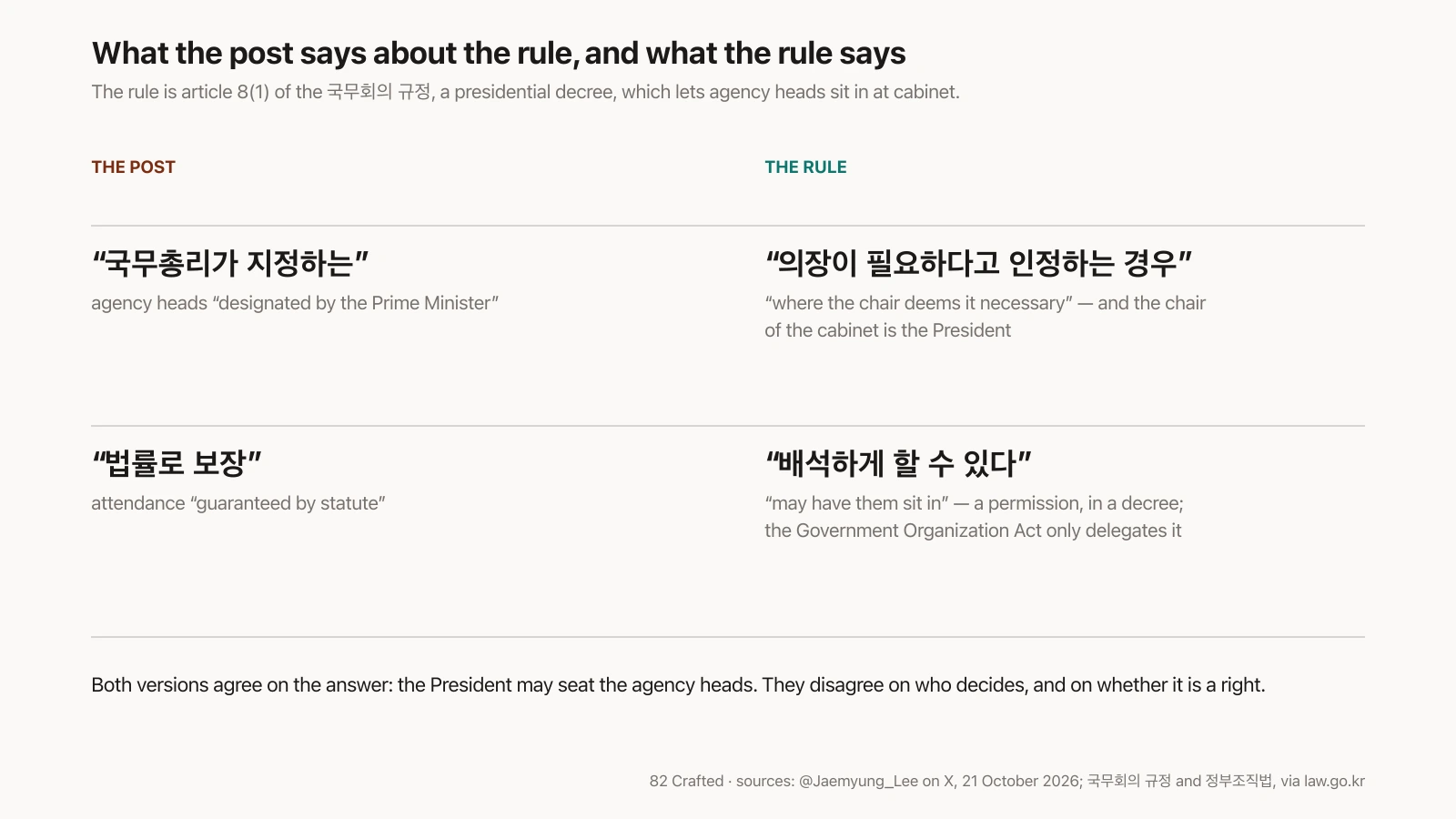
So the answer to the narrow question is yes. The President may seat the agency heads at cabinet, at the President's own discretion. A lawyer, 양홍석, put it to Yonhap like this: "익숙하지 않은 것은 맞지만 법적으로 안 되는 일은 아니다" — it is certainly unfamiliar, but it is not legally impossible.
But the post got the rule it cited wrong in two places. It said the agency heads who sit in are "국무총리가 지정하는", designated by the Prime Minister. The rule says the chair decides, and the chair of the cabinet is the President. It also said attendance is "법률로 보장", guaranteed by statute. Article 12(4) of the Government Organization Act only hands the matter to a decree, and the decree does not guarantee anything. It says 할 수 있다: may.
"Grounds for impeachment" is the President's own legal opinion. No law we have read ties attendance at cabinet to the duty to supervise. The only impeachment the 중수청 Act provides for is that of the agency's head. And 참여연대's 유승익 objected to the President bypassing what 유승익 called "대통령-행안부장관-중수청장으로 흐르는 엄연한 지시 라인": the clear line of command, running from the President to the interior minister to the head of the agency.
What it says
On the narrow question, the President is right, and did not need a chatbot to be. One line of a decree settles it.
The trouble with the post was everything around that line. It carried the authority of the head of state, and it called the other side's view sophistry and unconstitutional. Yet it got the cabinet's own rule wrong twice: on who decides, and on whether attendance is a right or a permission. The next day the President said Gemini had been cited to show how elementary the critics' argument was. That leaves the most elementary errors in the exchange in the post itself.
The critics' question was never really whether the President may. 참여연대 said as much in its statement: the power to direct does not make it appropriate. Their question was whether the head of an agency that investigates serious crime should sit at the President's table as a matter of routine. The law that created that agency routes its direction through the interior minister, and in specific cases to the agency's head alone. Article 6 writes that limit down for the minister. What the President offered at 10:01, "걱정 않으셔도 됩니다" (there is no need to worry), was a promise.
Whether the President may seat the head of the 중수청 is a question the rules answer, in one line. Whether it is wise is a question they leave open. That one is for the person who chairs the cabinet, and it is not one that can be handed to Gemini.
Images. All three graphics are ours. They are set in type from the President's posts on X and from the statutes as published on law.go.kr. We have used no photograph. The government's photographs of the 20 October cabinet meeting are not under a licence we can use, and the freely licensed cabinet photographs on Wikimedia Commons are from other meetings.
Sources. The four posts were read on X: 21 October at 09:42, 10:01 and 11:21, and 22 October at 13:09 (KST). The statutes are quoted from law.go.kr. The 30 December instruction, the attendance since January and the 13 October remarks are from 매일신문. 전종민's attendance, the 20 October meeting, the precedent and the inauguration are from 연합뉴스. The appointment is from YTN, and the 19 October certificate and briefing from 청와대's written briefing as reported. 참여연대's statement is from its own site. The reactions are from 연합뉴스, 뉴스토마토, 허프포스트코리아, 한국일보, 경향신문 and 메트로신문, and the Democratic Party's position from YTN. The experts are from 연합뉴스. The Hassabis meeting is from 아주경제, and Sweden from PC Gamer.
Stated rather than smoothed. We do not know what question the President put to Gemini, and the post does not say. It reads as the chatbot's answer posted as text, but we cannot confirm that it is unedited, or whether an image went with it. One report, 연합뉴스's, said the post went up the day before; X shows 21 October. In the 22 October post, the President typed 느꺼보라고 for 느껴보라고, and we have quoted the corrected form, as 경향신문 did. 참여연대 quotes the December instruction a little differently, as "barring special circumstances, agencies should all attend". 박충권's claim that only China seats the heads of investigative agencies in cabinet, and 나경원's that no government had ever done this, we could not confirm. The record supports only "not regularly". 이준석 is described by different outlets as a lawmaker and as the party's former leader. The five trials are 나경원's description, quoted as such.
Keep Reading
More Stories
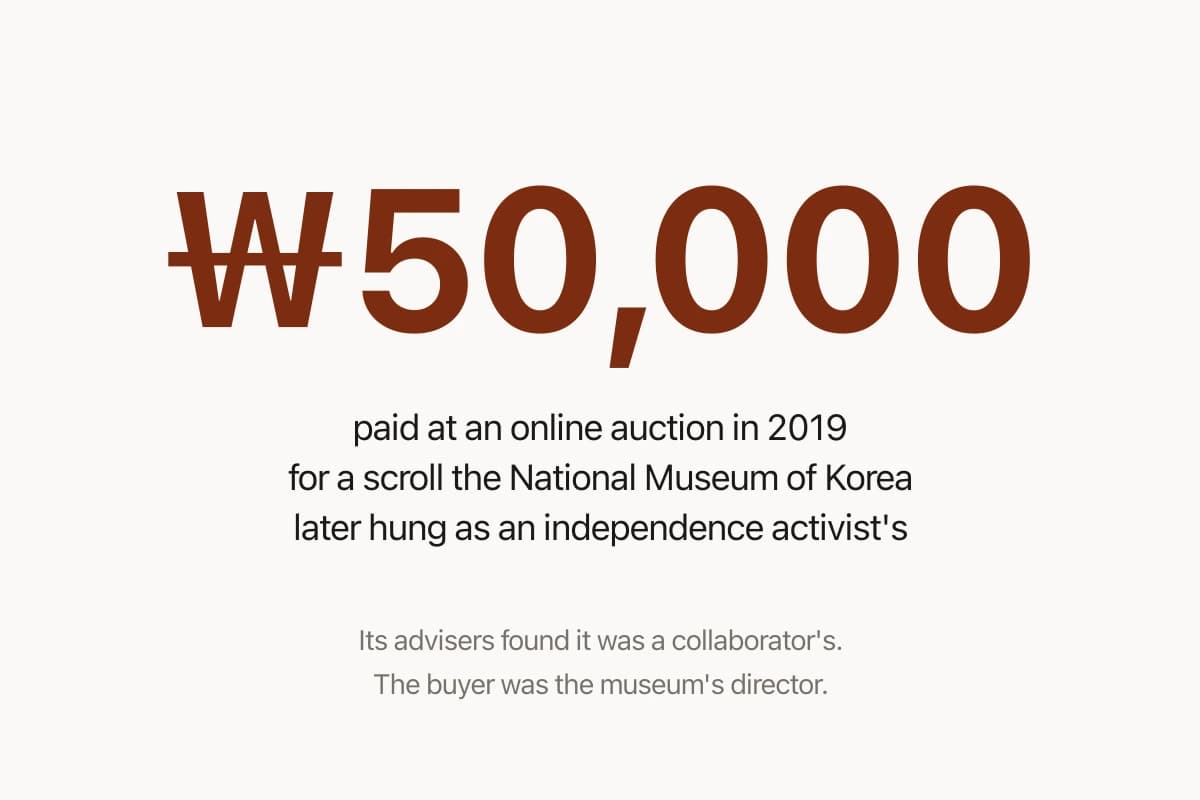
Korea's National Museum Showed a Patriot's Calligraphy. It Was a Collaborator's — and It Belonged to the Director
This summer the National Museum of Korea showed a scroll signed 韓人 朴源根 as the work of an independence activist killed in 1950. Seven advisers traced it to 박중양, one of the best-known collaborators of the colonial era. In October the Assembly learned whose scroll it was: the museum's director, 유홍준, had bought it online in 2019 for ₩50,000. Two days after the audit, the director resigned.

A Portmanteau Walks into a Party: In Defence of the Koreaboo
The word 'koreaboo' travels fast and lands hard — but nobody can define it, nobody who matters invented it, and it applies, with suspicious consistency, almost only to East Asian cultures. Drawing on the Francophile, the Anglophile, and a 1,555-day Duolingo streak, a guest essay on the double standard that calls Western cultural enthusiasm personality and Korean cultural enthusiasm a phase.
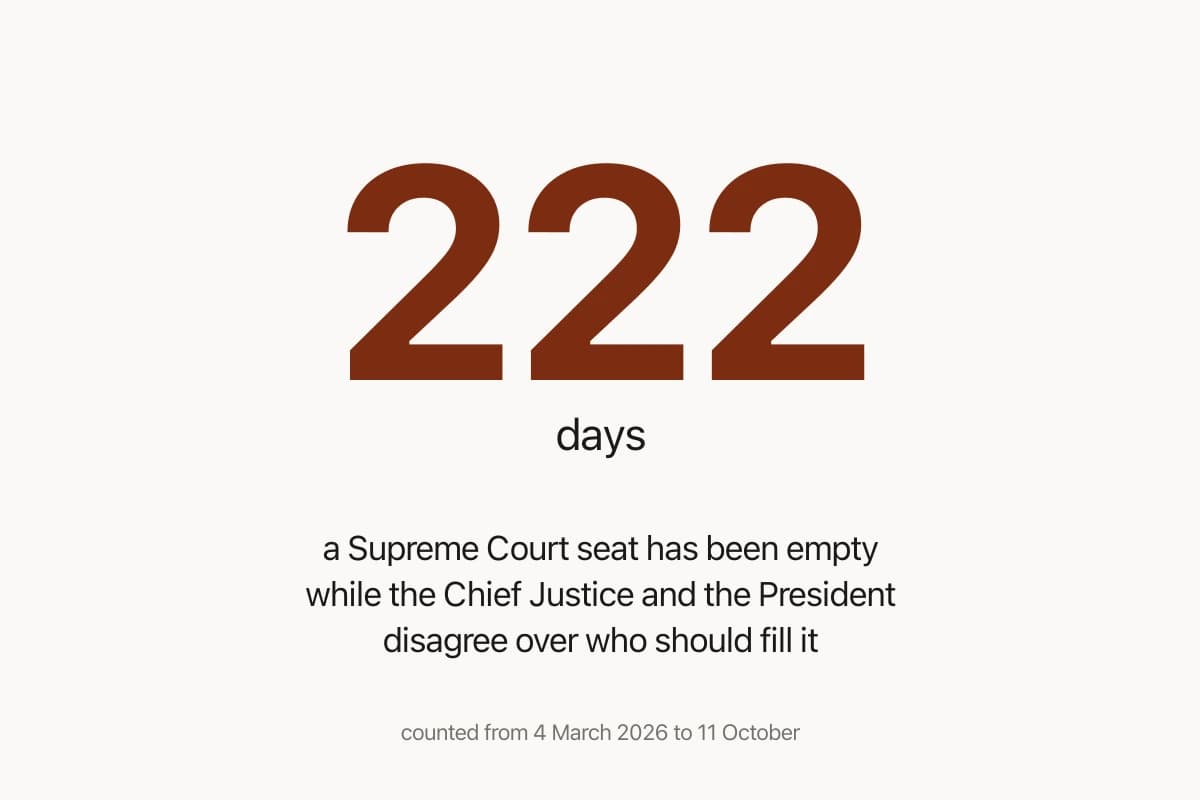
Summoned to Testify, Korea's Chief Justice Came, Refused the Oath, Answered Anyway — and Left at Lunch
On 6 October 조희대 sat before the National Assembly's judiciary committee for two and a half hours, unsworn, defending a refusal to put forward a second name for a Supreme Court seat that has been empty since March. Then the Chief Justice went, and came back at ten to eleven at night to give closing remarks. Nobody voted to compel a return, and the seat is still empty.
The Weekly Dispatch
Korea, curated. Every week.
The best of K-culture, straight from Seoul. Written by people who actually live here.
Free, no spam, unsubscribe whenever.