Korea Has Won 32 of Archery's 50 Olympic Golds — and Once Banned Four of Its Champions for Saying No
In August 2001 Korea's top four male archers walked out of a training camp after a single day, and the federation barred them from the World Championships. The system chose itself over its champions and kept winning. What Korean archery actually is — including the part where it is overwhelmingly women, and the village school that produced Kim Woo-jin is down to 33 children.
The camp ran from 7 to 10 August 2001, at a navy base in Jinhae, five weeks before the World Championships in Beijing.
The archers cleaned city sewage. They stayed awake through the night. They were taken to a crematorium and told to look at the bodies. They carried a 176-pound rubber dinghy up a mountain, and swam until their body temperature dropped.
Korea's top four male archers — all of them Olympic medallists, among them Kim Bo-ram, then 28, who had won team silver at Atlanta 1996 — quit after one day.
The Korea Archery Association banned them from the World Championships and barred them from national-team selection for up to five years.
Four female archers finished the camp. One of them was Park Sung-hyun, who was 18. Asked about it afterwards she said there had been some side effects, but that she felt good. Three years later she won two gold medals in Athens.
English-language coverage of Korean archery has been retelling pieces of that camp for twenty-five years — the snakes, the corpses, the haunted house. It has almost entirely dropped the part where four Olympic medallists refused, and the institution chose the training over the champions.
That choice is the most useful thing to know about Korean archery, because the system still makes it.
What the Record Actually Says
Archery returned to the Olympic programme in 1972. Since then, 50 gold medals have been awarded. South Korea has won 32 of them. Every other nation on earth has won 18.
Be careful with any comparison you see. Korea's own total is safe, but the numbers usually set against it are not: Belgium's eleven archery golds were all won in 1900 and 1920, and at least one widely-read article compares Korea's post-1984 haul against American and Belgian all-time counts inside a single paragraph. Those are different series. Don't mix them.
The breakdown is where it gets interesting:
| Event | Korean golds | Not won by Korea |
|---|---|---|
| Women's team | 10 of 10 | — |
| Women's individual | 10 of 14 | 1972, 1976, 1980, 2008 |
| Men's team | 7 of 10 | 1992, 1996, 2012 |
| Men's individual | 3 of 14 | eleven others |
| Mixed team | 2 of 2 | — |
| Total | 32 of 50 | 18 |
Cut to the era Korea has actually competed in — it debuted in archery at Los Angeles 1984 — and it is starker still: Korean women have won ten of the eleven individual titles they have contested, and every team title ever awarded. Korean men have won three of the eleven they contested.
"Korea dominates archery" is, to a first approximation, a statement about Korean women plus a Korean men's team. Almost nothing written in English makes that distinction, and the distinction is most of the phenomenon.
The women's team streak now runs ten consecutive Games, Seoul 1988 to Paris 2024 — every edition since the event existed. It nearly ended in Paris: the final against China went to a shoot-off, tied at 27, and turned on a judges' ruling in which two arrows scored as 9 were both ruled 10.
The Machine Is Public, Which Is Unusual
Most stories about how a country manufactures excellence have to be assembled from interviews and inference. This one doesn't. The Korea Archery Association publishes its selection rules as versioned, dated PDFs. The prospectus for the 2027 national-team trials is version 1.4, dated 2 July 2026, and anybody can read it.
What it describes is five competitive stages, not the three usually reported.
The first round is 288 arrows over two days — 36 arrows, eight times — scored cumulatively, shot on a 180-second simultaneous clock. Roughly 96 qualified entrants per gender go in; 61 come out. Ties are broken by a cascade nine steps deep: gold count, then X-ring count, then the eighth round's score, then the seventh, and so on backwards to the first, and only then a shoot-off.
To be in that field at all you must already have finished top-three in the individual event at one of eleven named national championships, or first as a third-year middle schooler, or met a record standard at 70 metres.
From 61 the field goes to 64, then to 16, then through two final evaluation rounds to the three who actually shoot. Somewhere around one in thirty-two — counting only archers who had already podiumed nationally to get through the door.
One correction to the version of this you have probably read. English coverage says reigning Olympic champions get no exemption of any kind. The prospectus says otherwise: the three archers who represented Korea at the 2026 Asian Games skip the first round and enter at the second. The arithmetic confirms it — 61 advancing plus 3 exempt is 64, which is exactly the published second-round entry list.
The accurate version is narrower and more interesting: past results earn nothing; a bye exists for current representation. Korea also abolished a top-eight seeding in 2021 specifically on fairness grounds, so the trend is toward fewer exemptions rather than none.
It Is Aimed at the Winners
The thing that makes this system unusual is not that it is hard on unknowns. Every elite pipeline is hard on unknowns. It is that the machine's characteristic act is pointed at the people who have already won.
An San won three gold medals in Tokyo. On 11 March 2024, at the third selection round in Gwangju, she finished 21st on 14.5 points and missed the top sixteen. She did not go to Paris.
A year later she made the team back — and Jeon Hun-young, who had just won the tenth consecutive women's team gold in Paris, was eliminated.
Take either story alone and it reads as a punishment machine. Together they describe something more accurate: churn, running in both directions, every year.
Oh Jin-hyek, who won team gold in Tokyo, described his own failure to reach Paris on CBS radio without complaint: he had shot the same trials as everyone else, the younger archers simply shot better, and so he fell away naturally.
The same logic is applied to the staff. Korea re-advertises its national-team coaching jobs by public competition every year — recurve, compound and reserve-squad postings, with a formal appeals process for unsuccessful applicants. After Korea swept all four events at Rio 2016, the federation replaced the entire coaching staff by open competition, to prevent factions forming.
And when Tokyo 2020 slipped to 2021, Korea re-ran the whole selection rather than carry over the squad it had already picked, on the stated principle that the country should be represented by whoever is best at the moment the Olympics happen. By the end of the third round, not one woman from the Rio team was left.
The Training Stories, Sorted
Four claims circulate in English. They are not equally true, and one of them is better than its reputation.
The snakes are real, with a hedge from the coach herself. After Korea's women won a fourth straight Asian Games team title in Guangzhou in 2010, head coach Cho Eun-sin was asked about the snake-handling ritual and replied that the story was "about 80 percent true", and that yes, there is special training to build courage. The same report notes that Chinese archers preparing for those Games were required to touch a tiger's rear at the zoo. Strange training is not a Korean trait.
The stadium noise training is real, current, and not always baseball. It is documented across at least five preparations. In September 2010 the teams shot at Jamsil during an LG Twins home game, with the crowd instructed to jeer, whistle and use vuvuzelas. Before Paris 2024 they shot at Jeonju World Cup Stadium about forty minutes before a football match. Oh Jin-hyek explained the mechanics: at baseball games it happens after the fifth innings during the ground-cleaning break, by prior arrangement with the club — targets go out, fifteen or twenty minutes, men's and women's teams shooting a team match. The purpose is to feel the pressure in advance so it isn't new on the day.
The venue replication is real and more elaborate than reported. For Paris, Korea built a replica of the Invalides range at its national training centre, ran mock competitions matched to Paris sound and broadcast conditions, practised in river wind on the Namhan River at Yeoju because Invalides sits beside the Seine, rented an entire sports club about ten kilometres from the venue as a Korea-only range, kept a rest facility with a treatment room some 300 metres from the field, and travelled with both a sports psychologist and a psychiatrist.
And the best detail in the whole subject has never appeared in English. Oh Jin-hyek describes archers setting out one at a time, at 200-metre intervals, to walk alone along the Han River — time, as he puts it, to be alone with your own thoughts and with what you have to do next. In deep winter it doubles as cold endurance. He describes the point as deliberately working the body hard enough to make room to organise your thinking.
A solitary dawn walk is a stranger and more revealing thing than a bucket of snakes, and it is the one nobody abroad has bothered to report.
Is the fear training still running? Everything documented about the Paris preparation is sports science — noise, wind, replicas, a shooting robot, psychologists. No snakes, no crematoria. The corpse-and-sewer regime is documented from 1988 into the 2000s. We could find no source stating when or whether it formally ended, and we are not going to invent one.
The Myth Is Imported
There is a standing explanation for all of this: ancestry. Goguryeo horseback archers, the founding-king legend of Jumong, the old Chinese term 동이 (東夷) glossed as "people of the great bow."
On CBS radio the host put this to Oh Jin-hyek directly — weren't Koreans always a people who rode and shot? Isn't it in the DNA?
His answer: "외국 친구들은 그런 얘기를 하긴 하더라고요." Foreign friends are the ones who say that. He allowed it might be true and said archers don't think about it.
The host then dismantled it herself, unprompted: every other country rode horses and shot bows too. It wasn't only us.
That is the correction, and it runs the opposite way to the one you'd expect. This is not a national myth we are debunking for a foreign audience. It is a foreign explanation that Korea's own champions attribute back to foreigners, and that Korean broadcasters take apart on air.
The etymology doesn't survive either. The reading of 夷 as "great bow" comes from the Han-dynasty Chinese dictionary 說文解字 and is repeated by Jeong Yak-yong. But 동이 was a Chinese exonym for eastern barbarians generally — the canonical list of "nine 夷" explicitly includes the Japanese — and the 《성종실록》, Korea's own dynastic record, uses 東夷 to mean Japan. The "people of the great bow" label, in Korea's own annals, is applied to somebody else.
Nor is the folk-genetic account confined to bows. A chopstick-dexterity theory has circulated in English for over a decade, and dies on its own data: chopsticks are used across East Asia, and China has won exactly one Olympic archery gold in history while Japan has never won one.
What makes the ancestry story worth a section rather than a footnote is what it was used for. In 2001, Raoul Theeuws, then Belgian vice-president of archery's world federation, told the Associated Press that the Korean system worked on Asian archers because it suited their social context — and that it could never work in Western countries.
A quarter of a century later, the transfer mechanism turned out to be entirely mundane. Korea exported its coaches, and standards rose. Oh Jin-hyek says the rise surprised the Koreans themselves. The West explained Korean dominance with culture so it would not have to explain it with administration, and then hired the administrators.
Where the Machine Doesn't Win
Korea's dominance has a shape, and the parts outside that shape are not decoration.
Compound archery has never been an Olympic event. Korea's supremacy is a recurve supremacy — which is why Western observers long used the phrase 반쪽짜리 강국, a half-strength power. Korea's compound record is good rather than crushing: two golds at the 2013 Shanghai World Cup, two golds and two silvers at the 2014 Incheon Asian Games, a bronze in the women's team event at the 2023 Berlin World Championships.
That stops being an asterisk in 2028. The IOC added the compound mixed team to the LA 2028 programme on 9 April 2025 — the first new bowstyle since archery came back in 1972. And in the same cycle, the recurve team event is being cut from twelve teams per gender to eight, with world-ranking allocation removed, on the stated grounds of protecting the competition's universality. Korea is now a governance problem the sport is legislating around.
The failures are real too. At London 2012 the Korean men shot 2087 in the ranking round — a world record that still stands — then lost the semi-final to Italy by two points and took bronze. Best qualifying performance in the history of the event; third place.
The sharpest recent wobble was Berlin 2023. The women's team qualified first and lost to Indonesia. An San, Kang Chae-young and Lim Si-hyeon all went out in the individual quarter-finals. Korea's women came home from a World Championships without a medal for the first time in twelve years.
And at the 2018 Asian Games, not one Korean woman reached the recurve individual final. The line that circulated afterwards was that the top student in the school had not scored full marks in a single subject.
Oh Jin-hyek's own read on the trend, in 2024: on the men's side, "어느 나라가 우승을 해도 이상하지 않습니다" — it would not be strange if any country won.
Forty Years, One Family
The money behind all of this has been in place since 1985 — the longest single-sport federation sponsorship in Korea. It is Hyundai's, and it comes with a governance arrangement that ought to sit awkwardly with everything above.
Chung Mong-koo became president of the Korea Archery Association in 1985. Chung Euisun has held it since 2005. He was also president of World Archery Asia — the continental federation, not the global body — for five terms across twenty years, standing down in Dhaka on 8 November 2025 and being made its honorary president, the second in his family to hold that title. At that same assembly, four Koreans were elected to WAA committees, a single-assembly record.
The stated principle is "지원하되 개입하지 않는다": fund decisively, do not touch selection or administration, insist only on transparency and fairness.
What the money buys is a graded pipeline with a name at every step — 유소년대표 for primary-school children, 청소년대표 at under-16, 후보선수 at under-19, 대표상비군 at under-21, then the national team — plus free equipment for primary and some middle schools, a youth squad established in 2013, and the largest domestic tournament. It also buys engineering: brainwave measurement for psychological state, 3D CT scanning of bows to find invisible internal cracks, a training robot that corrects aim against wind and temperature sensors, 3D-scanned custom grips, contactless heart-rate measurement by camera, and a shooting machine that fires arrows at 30 metres to cull defective shafts so athletes compete on a uniform batch.
No monetary figure has ever been published, in Korean or English, including by Hyundai. We are not going to estimate one.
The tension is worth stating plainly rather than resolving. A single family has controlled the national federation for forty years, and the thing that federation is admired for is refusing to let anybody's past count for anything. Korean coverage argues that the first makes the second possible — that stable money removes the financial motive for the politicking that deforms other Korean sports federations. That may well be right. It is still an unusual foundation for a meritocracy.
The School With 33 Children
We went looking for the Korean-language critique of all this — the burnout stories, the washed-out athletes, the human cost. There is remarkably little. Korean coverage of archery is admiring, and the 2001 walkout is the only documented athlete refusal we found, now twenty-five years old. Writing that Koreans criticise the system for burning athletes out would be inventing a debate.
What Korean media actually worries about is that the machine is running out of children.
이원초등학교 in Okcheon County, North Chungcheong, started its archery club in 1980. It produced Park Kyung-mo, who won team gold in Athens and Beijing, and Kim Woo-jin, the most decorated male archer Korea has ever had. It sits in a township of about three thousand people, and its edge was a five-year integrated programme with the middle school next door, sharing a range.
The school now has 33 pupils in total. The archery club has nine members, five of them reserves picked in June. Three children enrolled in the first grade this year. The middle school is down to one archer per year group; its coach says they can barely field the three-person minimum, and that if one is absent they cannot enter at all. On a visit to his old school, Kim Woo-jin worried aloud that the club would die.
Suwon's 효원고등학교 tells a version of the same story from the other end. Its archery club, founded in 1989, went from seven members to five to four to three across four years, and then received no applications at all — three had been expected, and all went elsewhere once it was clear the dormitory could not run. The causes given by the school are entirely administrative: a 52-hour working week that stops non-teaching coaches supervising athletes after hours, a minimum academic standard that cuts training time, and parents therefore choosing sports-specialist high schools over general ones.
There is a related fact that quietly undercuts the whole national-character story: archery is not part of Korea's school curriculum, and most Koreans go through life without ever touching a bow. Hyundai and the federation are currently pushing to get it into school PE — which is to say, they are trying to build the grassroots the myth already assumes exists.
The selection system's brutality rests on an assumption: that there will always be another child in another village school, and that cutting a three-time Olympic champion costs the country nothing because someone better is coming. That assumption held for forty years. Korean demographics are now testing it, in Kim Woo-jin's old classroom, three first-graders at a time.
We've written before about how Korea builds excellence deliberately rather than finding it — in the K-pop trainee system and in Faker and the making of esports. Archery inverts the pattern those pieces describe. Its problem was never too many hopefuls competing for too few places. It is that the queue is getting shorter.
For the opposite case again — a Korean traditional sport that was once enormous, collapsed almost entirely, and is now rebuilding itself by deliberately getting lighter — see ssireum, the only thing North and South Korea own together.
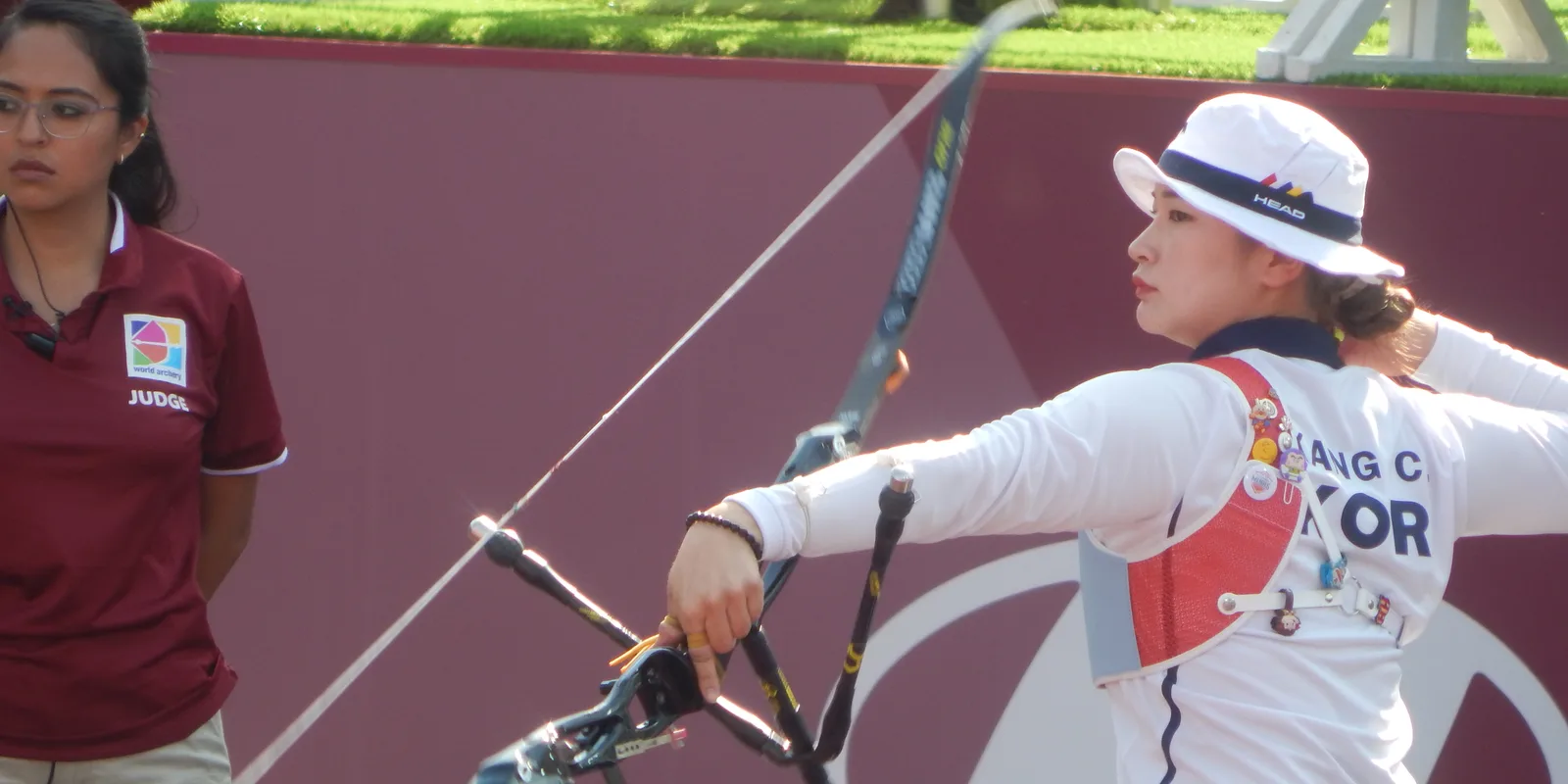
Photographs: Korean women's team member at London 2012 — Korea.net / Korean Culture and Information Service (Korean Olympic Committee), CC BY-SA 2.0; Kang Chae-young at the Archery World Cup Final by Voltmetro, CC0; Lim Si-hyeon at the 2025 정몽구배 전국양궁대회 by Trainholic, CC BY-SA 4.0 — via Wikimedia Commons, cropped by us and re-shared under the same licences. Every image was confirmed to show recurve equipment, not compound; a large, licence-clean, Korea-shot set from the 2014 Incheon Asian Games was rejected because it is entirely compound and would have contradicted this article's own argument. The London 2012 frame is not attributed to a named archer by its source, so we do not name her.
Verified from primary and contemporaneous sources: the Korea Archery Association's own published trial prospectuses (2027년도 1차 선발전 요강 v1.4, 2026-07-02) and competition regulations, obtained from the federation's own document system; Associated Press reporting of August 2001 on the Jinhae camp; China Daily's November 2010 interview with coach Cho Eun-sin; CBS radio's interview with Oh Jin-hyek; Hankookilbo's August 2024 account of the Paris preparation; Yonhap on Iwon Elementary; World Archery and IOC announcements on the LA 2028 programme; and Olympic results databases. The 32-of-50 figure was independently reconstructed event-by-event and reconciled against a mid-Games 2024 medal count. We have deliberately omitted several vivid claims we could not confirm to two sources — including a widely repeated annual arrow count, a 700-page coaching manual, a claim about soldiers being mobilised for noise training that traces to an anonymous online post, and a 2001 medal tally that does not reconcile with the event record. No monetary value is given for Hyundai's sponsorship because none has been published.
Keep Reading
More Stories
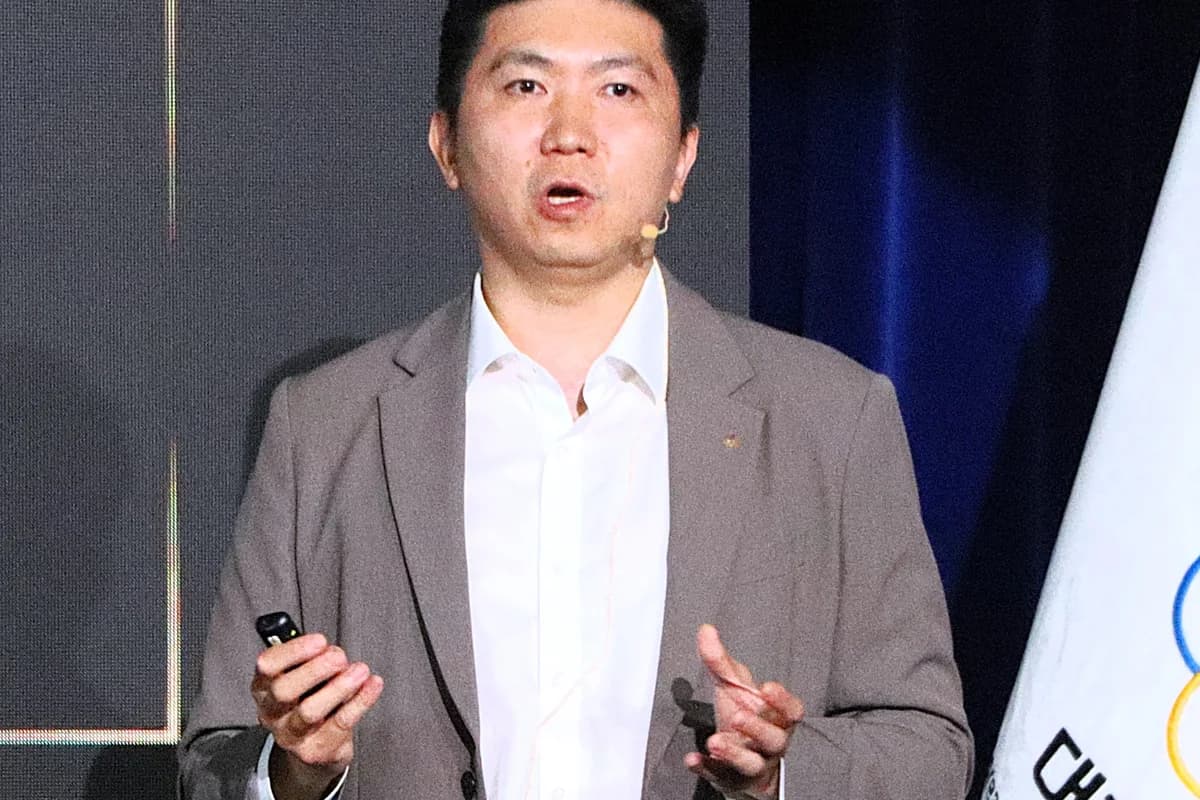
Korea's Sports Chief Gave Japan's Asian Games an F. Then the Organisers Apologised — to Japanese Spectators — for a Sign Saying the Rising Sun Flag Was Banned
The hosts of Aichi–Nagoya 2026 played North Korea's anthem for South Korea's hockey team, introduced Korea as the Republic of China at a medal ceremony, put Hideyoshi on the welcome stage, lost the basketball team's bus before the final, and housed athletes in leaking containers. Then a ballpark sign listed the Rising Sun flag among banned items, and the organising committee said sorry — in Japanese only, to its own crowd — because the flag was 'naturally' allowed. Its own rulebook bans flags that suggest political claims. It chose not to read it.
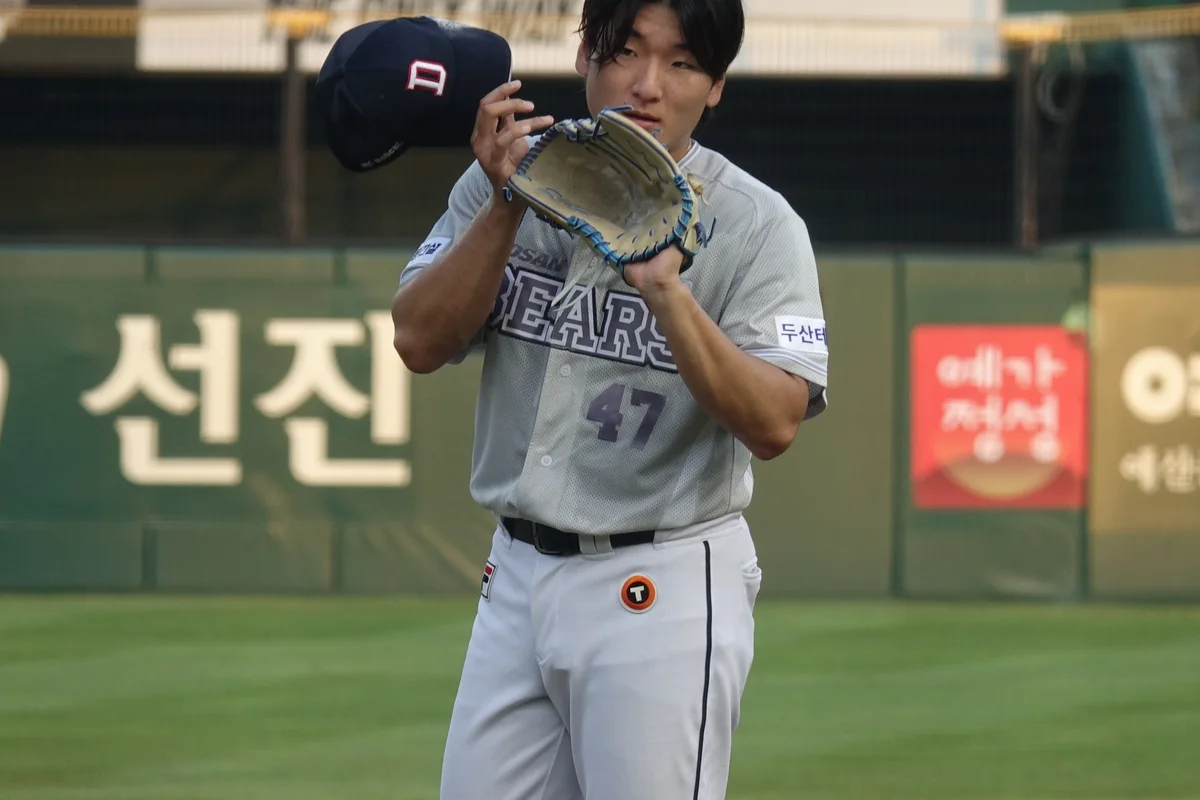
Korea's Pros Lost 0–5 to Japan's Company-League Players, Then Beat Them 3–1 in the Rain for a Fifth Straight Asian Games Gold
Two days before the final, Korea's all-professional squad was shut out by a Japanese side of corporate-league employees, its first Asian Games loss to Japan in twenty years. Then it rained on Toyohashi with no reserve day, Gwak Bin threw 111 pitches through it, and Kim Do-young — a week after breaking his nose, hitting .250 for the tournament — chopped an infield single off the third baseman's glove in the eighth. Sixteen players walked off the field with their military service converted into 34 months of baseball. Korean coverage calls that an exemption. It isn't, and a former defence-committee lawmaker spent Monday arguing it shouldn't exist at all.
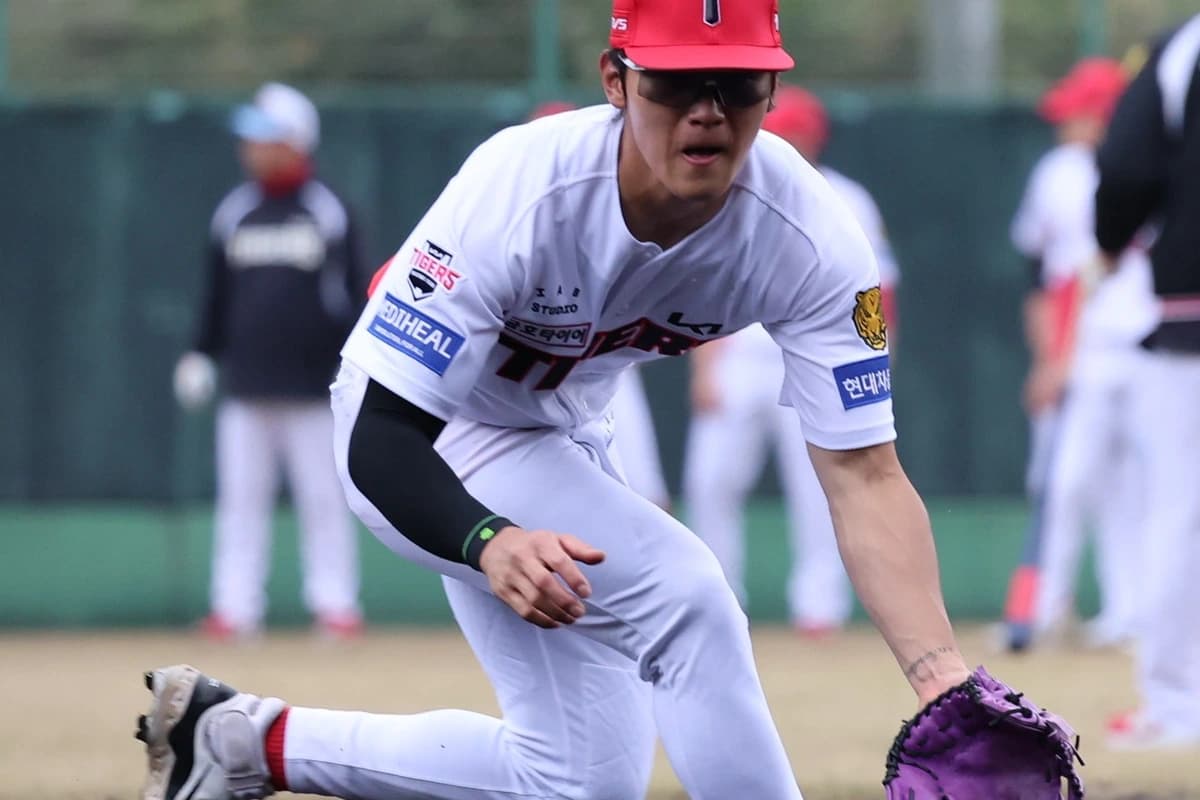
Kim Do-young Missed One Record by a Day and Set Another by Nine, With a Broken Nose in Between
He hit his fortieth home run on 8 September — one day after the window to become the youngest ever had closed. The next night his own bunt attempt broke his nose. He had surgery that night, came back four days later wearing a face guard, and drove in his hundredth run to become the youngest player in Korean baseball history to a 40–100–100 season, beating a 1999 mark by nine days. Then he reported to the national team. The league he leaves in fourth place does not stop while he is gone.
The Weekly Dispatch
Korea, curated. Every week.
The best of K-culture, straight from Seoul. Written by people who actually live here.
Free, no spam, unsubscribe whenever.