Sovereign AI, Explained: Why Korea Wants Its Own ChatGPT
Nvidia's Jensen Huang flew into Korea after fifteen years away, handed the country a quarter of a million chips, and called it 'a perfect example of sovereign AI.' So why does a nation that already has ChatGPT insist on building its own? The same reason it once bet everything on memory chips: intelligence, Korea has decided, is too important to rent.
In late October 2025, Nvidia's chief executive Jensen Huang walked onto a stage in Gyeongju, on his first visit to Korea in about fifteen years, and announced that his company would ship more than 260,000 of its AI chips to the country — spread across Samsung, SK Group, Hyundai, Naver and the Korean government. "This," he said, "is a perfect example of sovereign AI," adding that just as Korea's factories had given the world ships, cars and chips, "the nation can now produce intelligence as a new export" (NVIDIA Newsroom, Korea Times).
It's a strange thing to celebrate, if you think about it. Koreans can already use ChatGPT, Gemini and Claude. So why is the country pouring billions into building its own large language models — HyperCLOVA, EXAONE, Gauss, and a state-funded contest to crown a national champion? The answer is a word that has quietly become policy in Seoul: sovereignty. Korea has decided that a nation cannot outsource its own intelligence — and it is reaching for AI with the exact same intensity that once turned a war-poor country into the world's memory-chip powerhouse.
What "Sovereign AI" Even Means
"Sovereign AI" is the idea that a country should be able to build and run artificial intelligence on its own infrastructure, with its own data, in its own language — rather than depend entirely on models built by a handful of American companies (NVIDIA). The argument runs on three fears: that foreign models don't truly understand Korean language and culture; that sending national data through Silicon Valley is a security risk; and that renting your intelligence forever is a kind of dependence no serious country should accept.
It is, not coincidentally, also a fantastic sales pitch for the company that makes the chips everyone needs. Huang has spent the last two years touring the world telling governments that "every country needs to own the production of their own intelligence" — and Nvidia sells the shovels for that particular gold rush (NVIDIA). Korea, for its own reasons, was already a believer.
Korea's Models, Decoded
Korea doesn't have one national AI. It has a crowd of them, most from names you'll recognize from every other corner of Korean life:
- Naver — HyperCLOVA. Unveiled in May 2021, HyperCLOVA was billed as Korea's first hyperscale, Korean-optimized language model, trained on vastly more Korean text than GPT-3 and built at a scale of more than 200 billion parameters (VentureBeat). Its successor, HyperCLOVA X (2023), powers Naver's CLOVA X assistant and leans hard into Korean language, law and culture. (Naver has not disclosed HyperCLOVA X's size — anyone quoting a specific parameter count for X is guessing.)
- LG — EXAONE. LG's model line has moved fastest into the open. EXAONE 3.0 (2024) was Korea's first open-weights model, and EXAONE 4.0 (July 2025) a reasoning-capable "hybrid" model that landed around 11th on an independent global benchmark, the Artificial Analysis Intelligence Index — one of only two Korean models to make it (Bloomberg, The Investor).
- Samsung — Gauss, unveiled in November 2023 and named for the mathematician, with text, code and image modules (TechCrunch).
- KT — Mi:dm (믿음, "faith"), open-sourced in 2025 and pitched explicitly as "Korean-style AI" (Korea Times).
- Kakao — Kanana, and SK Telecom and the startup Upstage (whose Solar model is the other Korean entry on that global index). Nearly every Korean tech giant, in other words, is building one (KED Global).
The Government Bet
What makes Korea distinctive isn't the companies — it's the state standing behind them, playing the same role it played in the chip and shipbuilding eras.
In August 2025, the science ministry launched a "Sovereign AI Foundation Model" project: it selected five consortia — Naver Cloud, LG AI Research, SK Telecom, NC AI and Upstage — and put roughly 530 billion won (about $383 million) behind them, mostly in the form of scarce GPU computing power. The plan was a tournament, winnowing toward two national finalists by 2027, with an explicit goal of reaching at least 95% of the performance of frontier models like ChatGPT (KED Global, Computer Weekly).
The first cut has since happened, and it produced an upset. On 15 January 2026 the ministry announced that only three teams had advanced — LG AI Research, SK Telecom and Upstage. Naver Cloud and NC AI were both eliminated. NC AI went out on model performance. Naver went out on a definition: the ministry counted a model as genuinely independent only if it had been trained from re-initialised weights on the team's own data, and Naver Cloud's entry — fine-tuned from an overseas open-source base — was classified as a 파생형 모델, a derivative. Korea's loudest advocate of sovereign AI was dropped from the sovereign-AI programme for not being sovereign enough. Because that left fewer teams than the four planned, the ministry ran an extra round and added Motif Technologies in February 2026 (경향신문, ZDNet Korea).
That sits inside an even bigger ambition. The Lee Jae-myung administration has branded a national AI vision — reported around 100 trillion won — with the stated goal of making Korea one of the world's top three AI powers ("AI G3") within the decade (Korea Times, The Diplomat). (That headline figure is a multi-year policy vision, not money already spent — treat it as ambition, not a ledger entry.)
The Chips-to-AI Argument
Here is where Korea's bet stops looking like national vanity and starts looking shrewd. Korea makes the memory that the AI era runs on. Samsung and SK Hynix dominate the world's DRAM, and especially the high-bandwidth memory (HBM) stacked alongside Nvidia's GPUs inside every AI data center — the story we told in why Korea makes the world's memory chips.
That gives Korea an argument almost no other country can make: it doesn't just want to run AI, it makes the physical hardware AI depends on. The pitch is a full stack — Korean chips, Korean data centers, Korean models — a country that owns the whole ladder rather than renting the top rung. It's the same instinct that built the chip industry: if the future runs on a critical component, don't buy it, make it.
The Tech-Nationalism Throughline
Step back and the sovereign-AI push rhymes, almost eerily, with Korea's entire economic history. A resource-poor country, anxious about depending on bigger powers, picks a strategic technology, throws the state and its biggest conglomerates at it together, and treats catching up as a matter of national pride bordering on survival. That's the playbook that built the chaebol and the "Miracle on the Han." Sovereign AI is that developmental-state instinct, pointed at a new frontier — the same national character that insists on building the homegrown version of everything, from search engines to messengers to its own encryption standard and certificate system to, now, machine intelligence.
Can Korea Actually Compete?
Here's where honesty matters, because the gap is real.
Korea's models are small by frontier standards. Where the leading American and Chinese models run into the hundreds of billions — even trillions — of parameters, most Korean models sit in the tens of billions. The government's own target says the quiet part out loud: aiming for 95% of frontier performance is an admission that you expect to trail, not lead (The Investor).
There's also a usage problem. Even a genuinely strong model like EXAONE has, by domestic accounts, made little impact on the general public — benchmark rankings are not the same as people actually using the thing (The Investor). And some analysts openly doubt whether "AI G3" is realistic at all, given how much more the United States and China are spending (ASPI).
But there's a real bright spot, and it's a very Korean one: efficiency. Korean models punch above their parameter count, and EXAONE 4.0 cracking the global top-15 on an independent index is a genuine, citable achievement, not a home-crowd benchmark. Korea may never build the biggest model. It has a real shot at building an unusually efficient one — which, in a world worried about the cost and power draw of AI, might matter more than raw size.
What It Says About Korea
Sovereign AI is, in the end, less a technology story than a psychology one. It's a mid-sized country that has spent seventy years terrified of dependence — on aid, on Japan, on American security guarantees, on foreign technology — deciding that intelligence itself is one more thing it refuses to import wholesale. The insecurity and the ambition are the same feeling, and they've driven Korea's biggest bets before.
Whether the models win or lose, the instinct is the tell: when the world reorganizes itself around a new critical technology, Korea's reflex is not to buy in but to build its own — and to treat the attempt as a matter of national dignity. It looked reckless with chips in 1983. It's the same wager now, aimed at the machines that think.
Model details, parameter counts, funding figures and benchmark rankings are 2021–2026 snapshots that move fast; where a Korean model's size is undisclosed (notably HyperCLOVA X), no figure is stated. National-program budgets are described as announced policy, not verified expenditure.
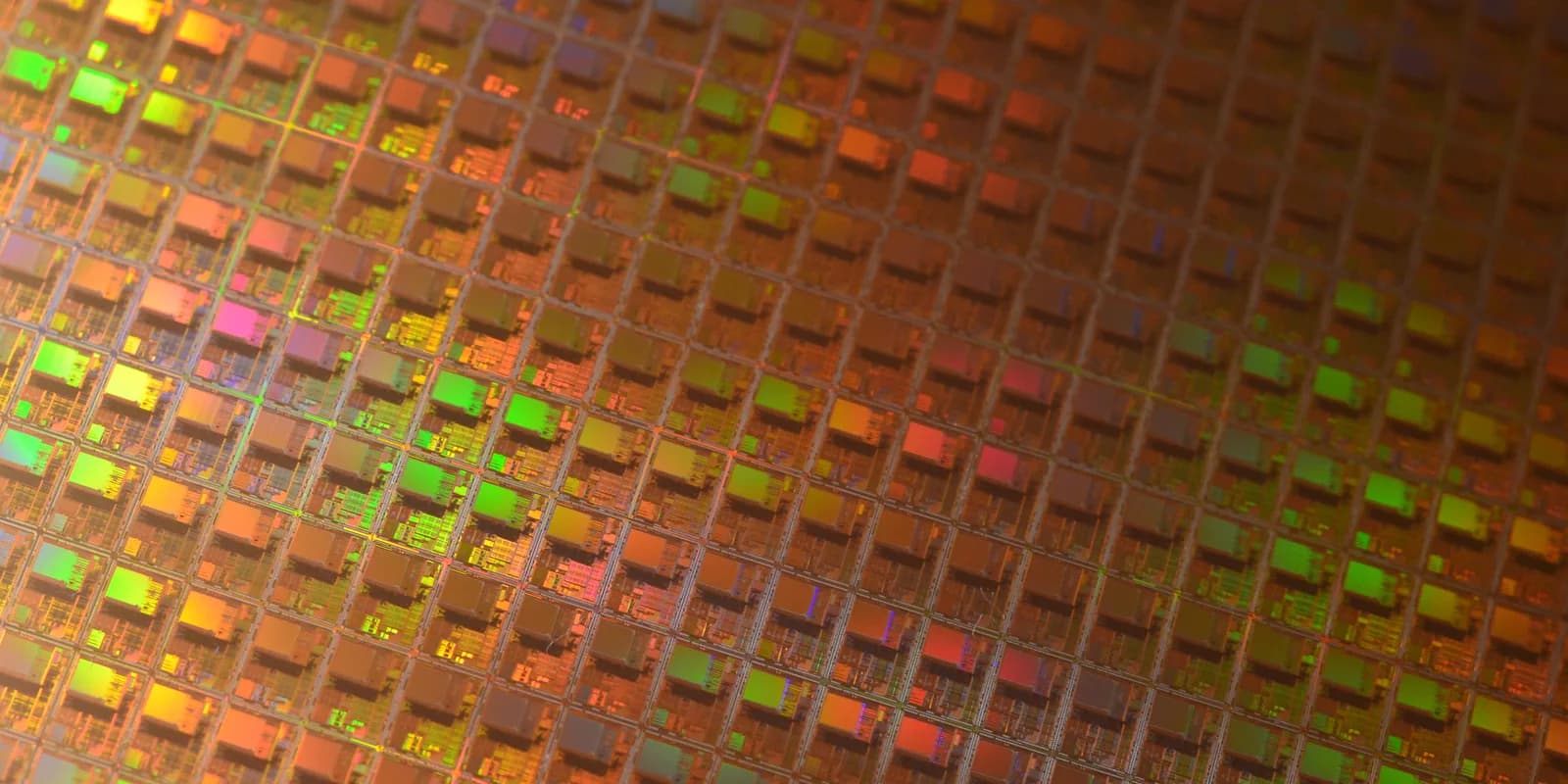
Cover: a semiconductor wafer — photo by Santi, Wikimedia Commons, CC BY-SA 2.0. Listing card: Nvidia CEO Jensen Huang — photo by the Office of the President, Republic of China (Taiwan), Wikimedia Commons, CC BY 2.0. Homepage/hero: data-center server racks — photo by Carl Lender, Wikimedia Commons, CC BY 2.0.


.jpg)
Keep Reading
More Stories
Korea Now Scans Every Image Uploaded to Its Big Forums. The Man Running One of Them Can't Tell You If It Has Ever Worked.
Since 1 July, Korean platforms above a size threshold must run every uploaded image through an AI filter that checks it against a government database of illegal recordings and blocks it before it posts. One operator published his own logs. Over a full year of the earlier video version, 1,615 blocks resolved down to about 33 that might have been real — and he cannot tell you whether any of them were, because keeping the files in order to check them would break a different law.
A 23-Year-Old Built an App That Routes You Through Shadows. It Hit No. 1 in a Week.
Yoo Min-jun made it because his walk to campus was unbearable. It calculates the sun's angle and the shadows thrown by buildings and street trees for the minute you'll actually be walking, and tells you which side of the bus to sit on. It cost him about ₩2 million of his own money. Meanwhile the state has 93,375 cooling shelters — and on the hottest Sunday of the summer, four in five of Seoul's were locked.
Korea Has Until December to Uninstall Twenty Years of Its Own Banking Software
In October 2025 the government finally ordered the security programs off your computer, and banks have until year-end to comply. Along the way: a cipher whose famous justification expired before it shipped, a mandate that was never in the law everyone blames, and a bank page that still uses a legal term abolished five and a half years ago.
The Weekly Dispatch
Korea, curated. Every week.
The best of K-culture, straight from Seoul. Written by people who actually live here.
Free, no spam, unsubscribe whenever.