Korea Asked 200 Citizens Whether to Put a Hangeul Sign on Gwanghwamun. They Split 105–101, Then Voted 155–51 That It Is Not Needed.
The government convened its first-ever citizens' deliberation and spent eight hours on a signboard. The panel divided almost exactly in half on whether adding a Hangeul plaque would honour both the heritage and the alphabet — and then, overwhelmingly, said an exhibition would do the job instead. Both answers are coherent, which is the interesting part. The plaque they were arguing about is three years old, and the one before the one before it was in Park Chung-hee's handwriting.
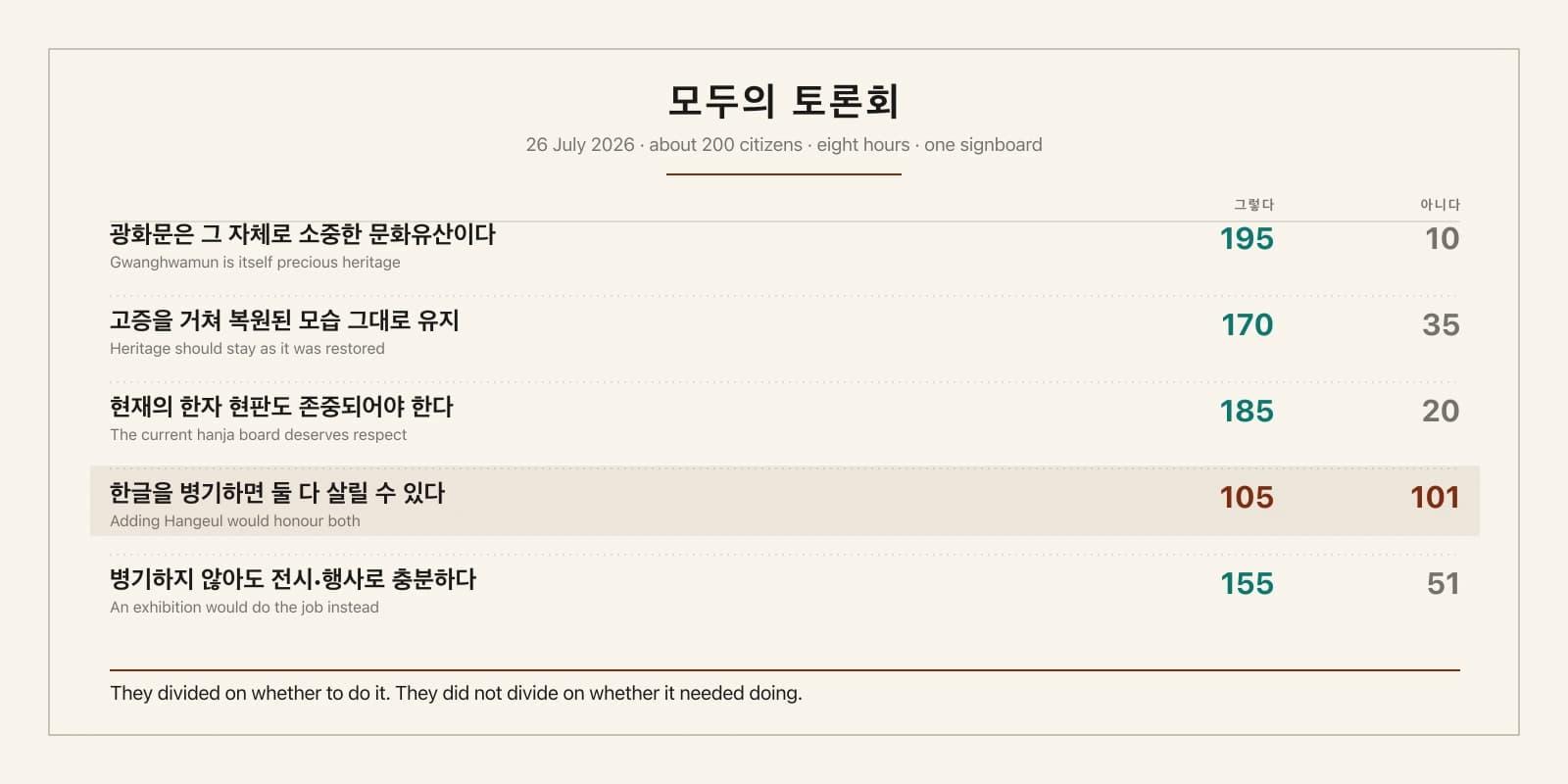
On 26 July 2026, in a hall at Yonsei University, the Korean government sat about two hundred citizens down for roughly eight hours to settle a question: should a Hangeul signboard be added to Gwanghwamun, the main gate of Gyeongbokgung?
They were shown experts arguing both sides. They broke into small groups. Then they filled in an eight-item survey, and the results are the most interesting thing to come out of a Korean public consultation in some time — because the panel gave two answers that look contradictory, are not, and together say something the yes/no framing could not have captured.
The two questions
The first proposition put to them:
"한자 현판을 그대로 두고 한글을 함께 표기한다면, 문화유산의 가치와 한글의 상징성을 함께 살릴 수 있다."
"If we leave the hanja signboard as it is and display Hangeul alongside it, we can honour both the value of the cultural heritage and the symbolism of Hangeul."
Agreed: 105. (55 strongly, 50 somewhat.) Disagreed: 101. (54 strongly, 47 somewhat.)
A four-vote gap on a panel of roughly two hundred. As close to a dead heat as a real vote gets.
The second:
"한글 현판을 병기하지 않아도, 광화문에서의 전시·행사·디지털 콘텐츠 등으로 한글의 가치를 알리는 것으로 충분하다."
"Even without adding a Hangeul signboard, it is enough to convey the value of Hangeul through exhibitions, events and digital content at Gwanghwamun."
Agreed: 155. (104 strongly, 51 somewhat.) Disagreed: 51. (14 strongly, 37 somewhat.)
Three to one, and the "strongly agree" count alone — 104 — is larger than the entire opposing side.
Why that is not a contradiction
The obvious reading is that the panel contradicted itself: half of them said a plaque would work, and then three-quarters said don't bother.
But read the propositions again. The first asks whether adding Hangeul would achieve something good. The second asks whether the same good can be achieved without touching the gate.
You can answer yes to both without any inconsistency at all. A plaque would honour the alphabet and an exhibition would honour it and one of those options involves altering a piece of restored heritage while the other does not. Given a free choice between two routes to the same destination, most people took the one that leaves the building alone.
Which is a real finding, and it is not the finding the question "should we add a Hangeul plaque?" was built to produce. The panel was near-evenly divided on the merits and lopsidedly agreed on the alternative. What they delivered was not a vote. It was a preference ordering, and it only exists because someone asked more than one question.
They were near-unanimous on the premises underneath, too. That Gwanghwamun is itself a precious piece of heritage as the main gate of Gyeongbokgung: 195 to 10. That the current hanja signboard deserves respect as the outcome of a historical restoration: 185 to 20.
And between those two, the general principle: that heritage is best kept exactly as it was restored following historical verification — 170 to 35.
That third one is the load-bearing number. Almost everyone in the room accepted the hanja plaque as legitimate specifically as a restoration. From there, "and therefore leave it alone" is a short walk.
The reporting from inside the room also caught the mood, which was less about reverence than about not poking things. Attendees kept returning to the worry that adding a plaque would be 긁어 부스럼 — scratching an itch until it becomes a boil, making a problem where there wasn't one. And one participant made the sharpest observation of the day, which is that the case for the plaque eats itself:
"어떤 사람은 '한글 현판'을 달아 세계에 'K컬처'를 알리자고 하는데 이는 논리적으로 모순이 있다."
"Some people say we should hang a Hangeul signboard to show K-culture to the world — but there's a logical contradiction in that."
Which there is. If the argument for altering a restored heritage object is that it will demonstrate Korean culture to visitors, you have to explain why the restored heritage object is not already doing that.
The thing being argued about is three years old
Here is the context that makes the whole debate stranger and better.
The hanja signboard on Gwanghwamun that the panel voted to respect as a historical restoration was installed in October 2023.
It is a serious piece of work. It was produced after researchers located the 경복궁영건일기, the construction diary of the palace rebuild, in Japan, and combined it with a 3D scan of an 1893 photograph held by the Smithsonian — black lettering on a white ground, as against the white-on-black that had hung there before.
It replaced a hanja plaque installed in 2010, which cracked within about three months.
And that one replaced a Hangeul signboard that hung on the gate from 1968, written in Park Chung-hee's own handwriting.
So the gate has, within living memory, carried a Hangeul plaque; then a hanja plaque that split; then a second hanja plaque built from a diary found abroad and an American photograph. The question in front of the citizens' panel was whether to add Hangeul back — and a plurality of them declined on heritage grounds, in favour of a board that is younger than most smartphones.
We are not saying that is wrong. The 2023 plaque is a better-evidenced object than the 1968 one, and "restored accurately" is a defensible thing to protect regardless of the restoration's date. But it is worth noticing that "the historical signboard" and "the signboard that has been there a long time" are not the same claim, and only the first is true.
What the two sides actually argued
For the addition, 박현모 of the Sejong National Leadership Institute:
"세종대왕 시기 한글이 창제된 역사적 의미와 국가 정체성을 반영해 한글 현판을 병기하는 것이 바람직하다."
"Reflecting the historical significance of Hangeul's creation under King Sejong and our national identity, it is desirable to display a Hangeul signboard alongside."
He was joined by 정재환, co-chair of the Hangeul Culture Solidarity.
Against, 김현경 of the Korea National University of Cultural Heritage:
"새로운 의미를 더하고 싶다는 취지가 문화유산의 형상을 변경할 충분한 근거가 될 수 없다."
"A wish to add new meaning is not sufficient grounds for altering the form of a cultural heritage object."
Her alternative was the one the panel then endorsed three to one: exhibitions, interpretation, education. She was joined by 배웅규 of Chung-Ang University.
Note what the argument was not about. Nobody was arguing that Hangeul does not matter, or that hanja is preferable. Both sides took the value of the alphabet as given. The disagreement was entirely about whether a heritage object is an appropriate place to make the point — which is a much more interesting argument than the one the English-language framing of "hanja versus Hangeul" would lead you to expect.
Why this is happening now
9 October 2026 is Hangeul Day, and this one is not ordinary. It is the 100th anniversary of the holiday's founding — the first 가갸날 was marked in 1926 — and 580 years since the promulgation of the 훈민정음. The year has been designated 한글의 해, the Year of Hangeul.
The plaque proposal was announced against that backdrop on 20 January 2026 by the culture minister 최휘영, with the backing of the head of the Korea Heritage Service, 허민. The proposal was always 병기 — alongside, not instead: a Hangeul board in 훈민정음체 added below the existing hanja one, with the hanja plaque untouched.
And the government has still not decided. The culture ministry's 문화정책관, 명수현, said afterwards that the ministry would review what was said and the opinions submitted and reflect them in policy. That is a sentence that commits to nothing, which is fair enough — the point of a deliberation is to inform a decision, not to be one.
The format is itself new
One more thing worth recording. This was the first ever 모두의 토론회 — "everyone's debate" — a deliberative format created by the Ministry of the Interior and Safety to feed public opinion into policy decisions, run here jointly with the culture ministry. Both ministers turned up in person — 최휘영 for culture and 윤호중 for the interior — which for a session about a signboard is a statement about the format rather than about the signboard.
The panel was not a self-selected crowd. Applicants registered in advance and roughly two hundred were then selected to match the resident-registration population statistics by sex, age and region. The survey ran to eight items across three themes: whether to add the plaque, what conditions should apply if it were added, and what the alternatives are if it is not.
For a first outing, the design did the one thing that matters: it asked enough questions to let the answer be more complicated than the headline.
What it says
We are not the first to notice this. 서울경제's write-up drew the same conclusion in a line — "질문을 어떻게 하느냐에 따라 대답도 달라진 것으로 해석된다", the answers changed according to how you asked — and it is the right reading. What has not travelled into English is the reading, or the numbers it rests on.
There is a version of this story where Korea's government held a big public consultation and got a muddle. That is roughly how a single-question poll would have made it look — 105 to 101 is a coin toss, and a coin toss tells a minister nothing.
What actually happened is that a representative panel, given eight hours and a proper survey, produced a coherent and slightly surprising position: adding Hangeul to Gwanghwamun would be a fine thing to do, the gate as it stands deserves to be left alone, and if you want to celebrate the alphabet at Gwanghwamun there are ways to do it that do not involve a screwdriver.
That is not indecision. It is a group of people declining the binary they were offered, and it took a survey with more than one question to find out.
Whether the ministry does anything with it is another matter, and the centenary is in October.
Related: what Hangeul Day actually commemorates, and why the date moved — and 야민정음, the writing system Koreans broke on purpose.
*Sources. The survey figures, the propositions in full, the speakers and the quotations are from 한국일보's report of 26 July 2026 by 인현우, whose figures we preferred for one reason: it publishes the sub-totals and they add up (55+50=105, 54+47=101, 104+51=155, 14+37=51). We flag the conflict rather than hiding it: 서울경제, whose report we also read in full, gives the same two questions as 104–101 and 155–49. It publishes no breakdowns. The gap is one or two respondents either way and changes nothing about the shape, but we would rather show you the disagreement than quietly pick a side.
The three premise questions — 195–10, 170–35 and 185–20 — appear only in 서울경제, which we opened and read directly rather than taking at second hand. Note that the totals drift between items (204, 205 and 206 depending on the question), which is what you would expect when some of roughly two hundred people skip an item, and is why we describe the panel as "about two hundred" throughout rather than pinning a number to it. The 긁어 부스럼 characterisation and the participant's K-culture remark are 서울경제's reporting of the room. The plaque history — the 2023 installation, the 경복궁영건일기, the 1893 Smithsonian photograph, the 2010 board that cracked, and the 1968 Hangeul board in Park Chung-hee's hand — is from Korean reporting of August 2026. The January announcement is from 오마이뉴스.*
Images. There are none of the gate, and the reason is worth stating: Wikimedia Commons treats South Korea as a no-freedom-of-panorama country, so a photograph of the gate — including one taken by a tourist and uploaded freely — is not available to us there, because the architectural work underneath it is not free to reproduce commercially. (Corrected 11 September: we had written that Korea has no freedom of panorama at all. It has one — 저작권법 제35조②, which lets works permanently displayed in streets, parks and on building exteriors be reproduced "by any method whatsoever" — but it carves out reproduction for the purpose of sale, and that carve-out is why Wikimedia Commons, which requires commercial reuse, treats Korea as a no-FoP country and will not host such photographs. Our sourcing decision is unchanged; the reason we gave for it was wrong.) There is a possible route through 국가유산청's own 국가유산포털 and the tourism board's photo banks, which release some images under 공공누리 Type 1, but each file's licence type has to be checked individually and we could not clear one in time. So the artwork is typographic: the two propositions and the way the room actually split on them, which is the subject of the piece anyway.
Not asserted. We have not said this is the first such deliberation on a heritage question, only that it is the first 모두의 토론회. We have not used a widely-summarised figure of 76 per cent for 원형 보존 from a separate 소통24 poll of 2,199 people, because we could only find it in search summaries and never on a page. And we do not know what the government will decide, because it has not said.
Keep Reading
More Stories
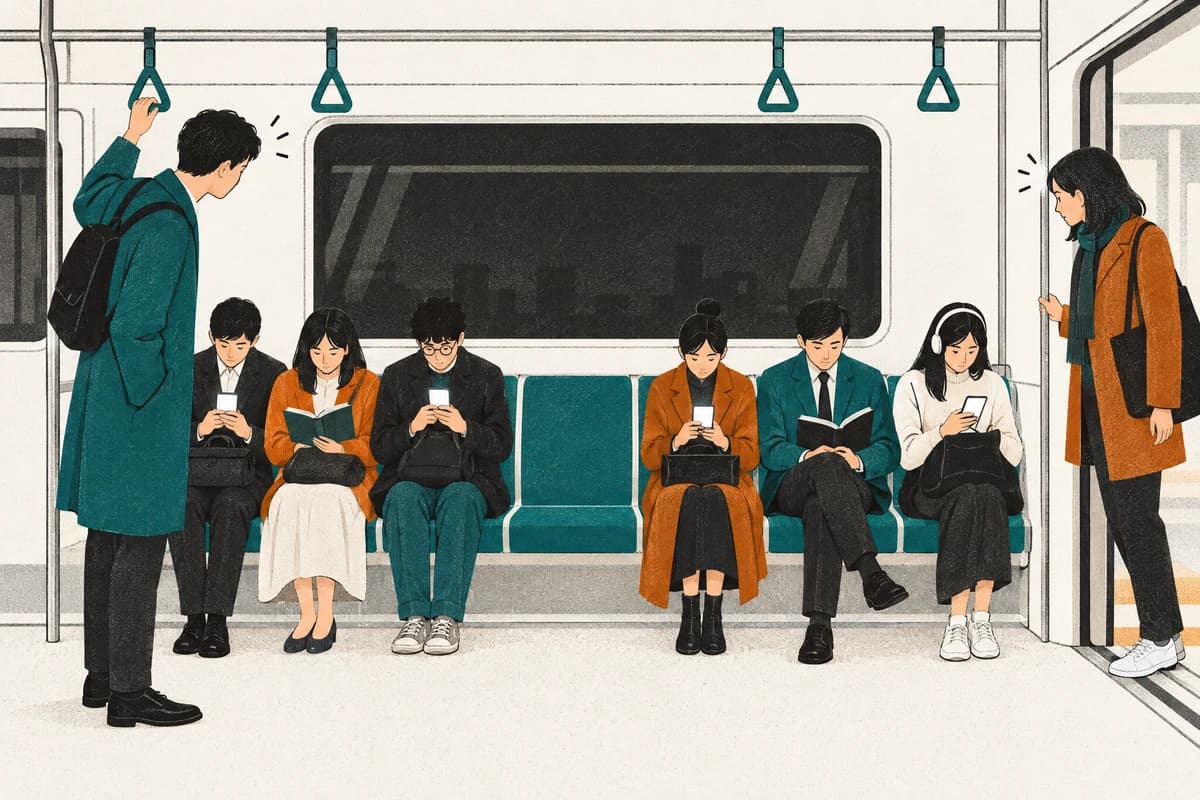
Koreans Have a Word for a Rule Everyone Follows. It Only Ever Gets Used for Rules Not Everyone Follows.
국룰 — gungnul — is Korean internet slang for an unwritten national consensus: the thing everybody does that nobody ever agreed to. It comes from a 2007 shooting game whose players had to invent their own duelling rules because the game had none. And the tell is in which things get called it. Nobody says murder is against 국룰. People say it about which sauce goes with pork belly, and then argue.
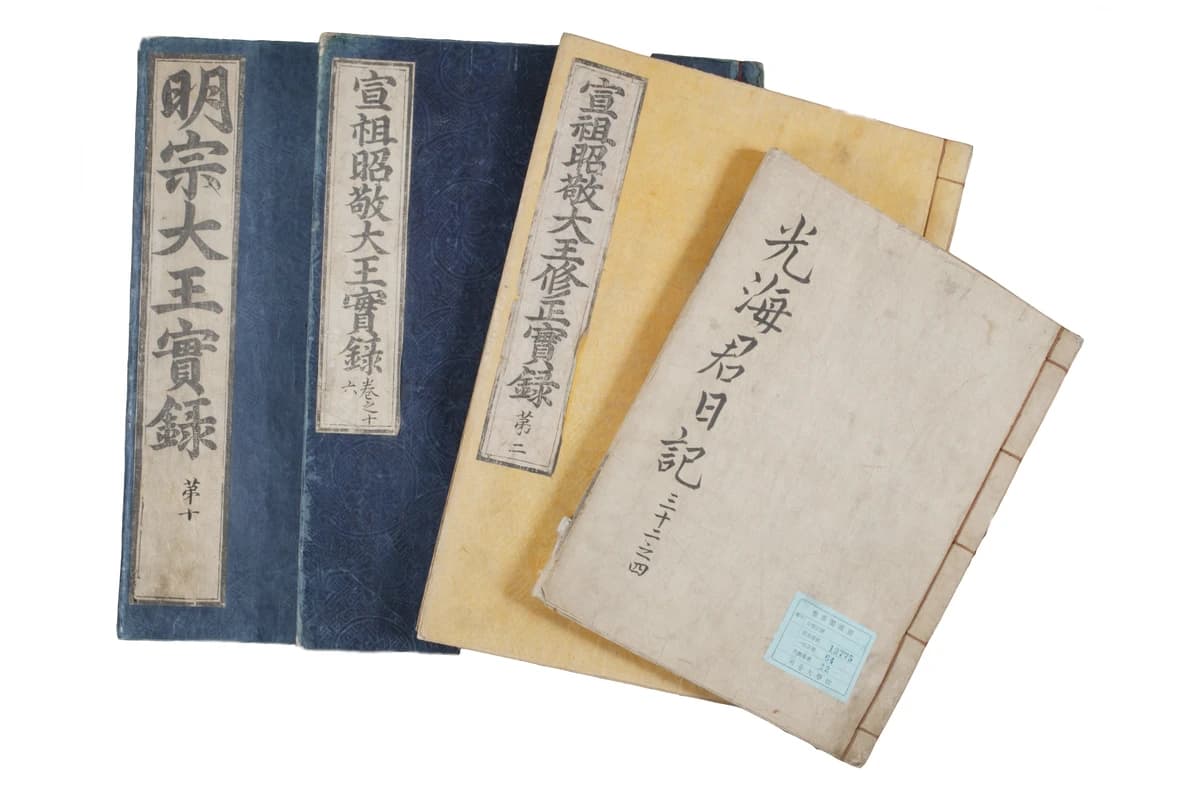
Hangul Day Exists Because a Book Turned Up in 1940. Nobody Can Find the Other Copy.
The date of Korea's alphabet holiday moved four times before a single physical book settled it — and that book arrived missing its first four pages, including King Sejong's own preface, which a calligrapher reconstructed by hand with a typo still in it. A second copy has been in a private house since 2008. The prosecution's own appraisers valued it at over a trillion won. Nobody has seen it since a fire in 2015.
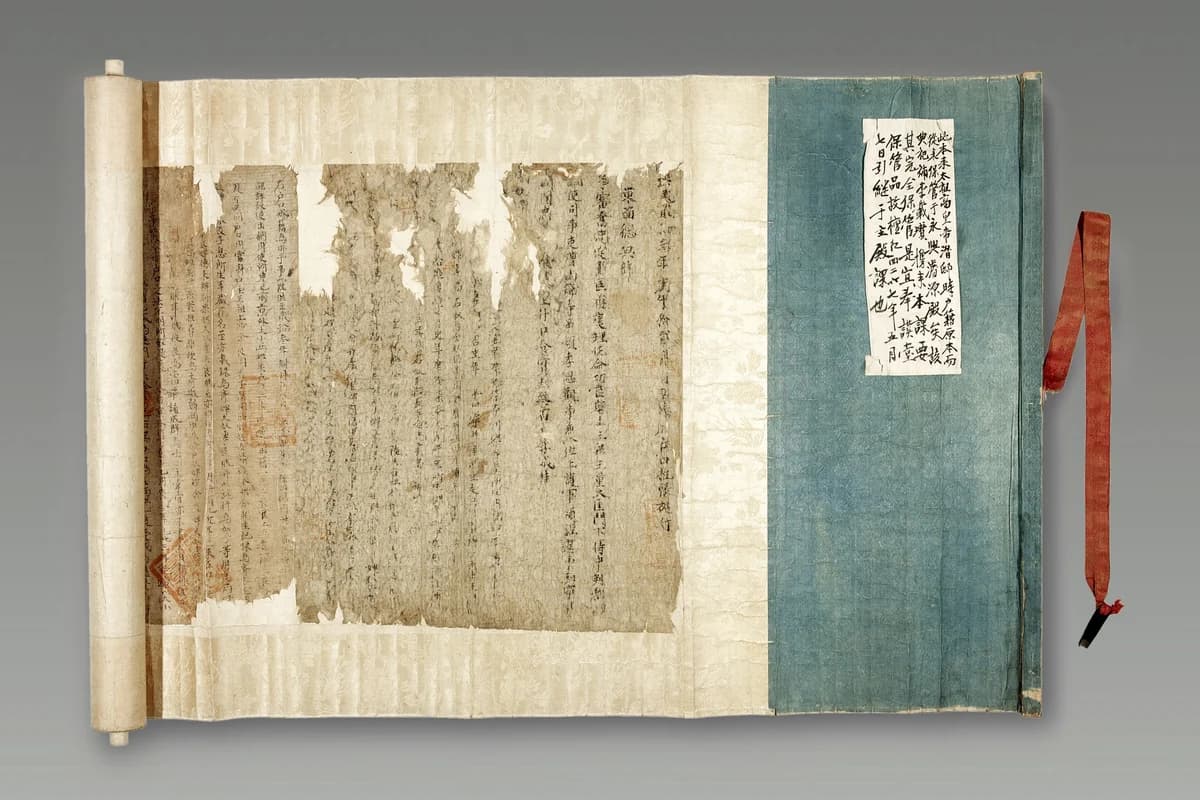
Who Decides What You Can Name Your Baby in Korea? The Supreme Court
A mother chose a character meaning 'beautiful' for her daughter. The clerk registered the child's name in hangul and left the character out — which is not a refusal but the legally correct outcome. Korea permits 9,389 Chinese characters in given names, more than China or Japan, and the list grows because parents get turned down. In April 2026 the Constitutional Court upheld the whole arrangement by a single vote.
The Weekly Dispatch
Korea, curated. Every week.
The best of K-culture, straight from Seoul. Written by people who actually live here.
Free, no spam, unsubscribe whenever.