Koreans Have a Word for a Rule Everyone Follows. It Only Ever Gets Used for Rules Not Everyone Follows.
국룰 — gungnul — is Korean internet slang for an unwritten national consensus: the thing everybody does that nobody ever agreed to. It comes from a 2007 shooting game whose players had to invent their own duelling rules because the game had none. And the tell is in which things get called it. Nobody says murder is against 국룰. People say it about which sauce goes with pork belly, and then argue.
Someone on a Korean forum wants to know who gets the subway seat.
Not legally — socially. A seat opens up. Is it for the person standing directly in front of it, or for whoever reaches it first? The thread runs long. Multiple people settle it the same way, with the same word: 국룰. That's the 국룰. Position, not speed.
Other people disagree. Which is the whole point.
What it means, and how to say it
국룰 is a contraction of 국민룰 — "the people's rule" — bolted to the English word rule. It means an unwritten consensus. The thing everyone does. The way it's done.
It has made it into 우리말샘, the National Institute of Korean Language's open dictionary, which glosses it as "국민 대다수가 널리 받아들이는 규칙" — a rule widely accepted by the great majority of the nation's people. It is not in 표준국어대사전, the formal standard dictionary, which is the usual arrangement: the living-language tier admits a word years before the official one does, if the official one ever does.
The Institute has, however, been asked about it — and answered a different question. A student wrote in during May 2025 wanting to know how to parse it morphologically, and the Institute classified 국룰 as a 혼종어, a hybrid word: Sino-Korean 國 welded to an English loan. It declined to settle whether that also makes it a compound and told the student to follow their textbook.
Now, pronunciation, because this is where people go wrong. 국룰 is not said the way it is spelled.
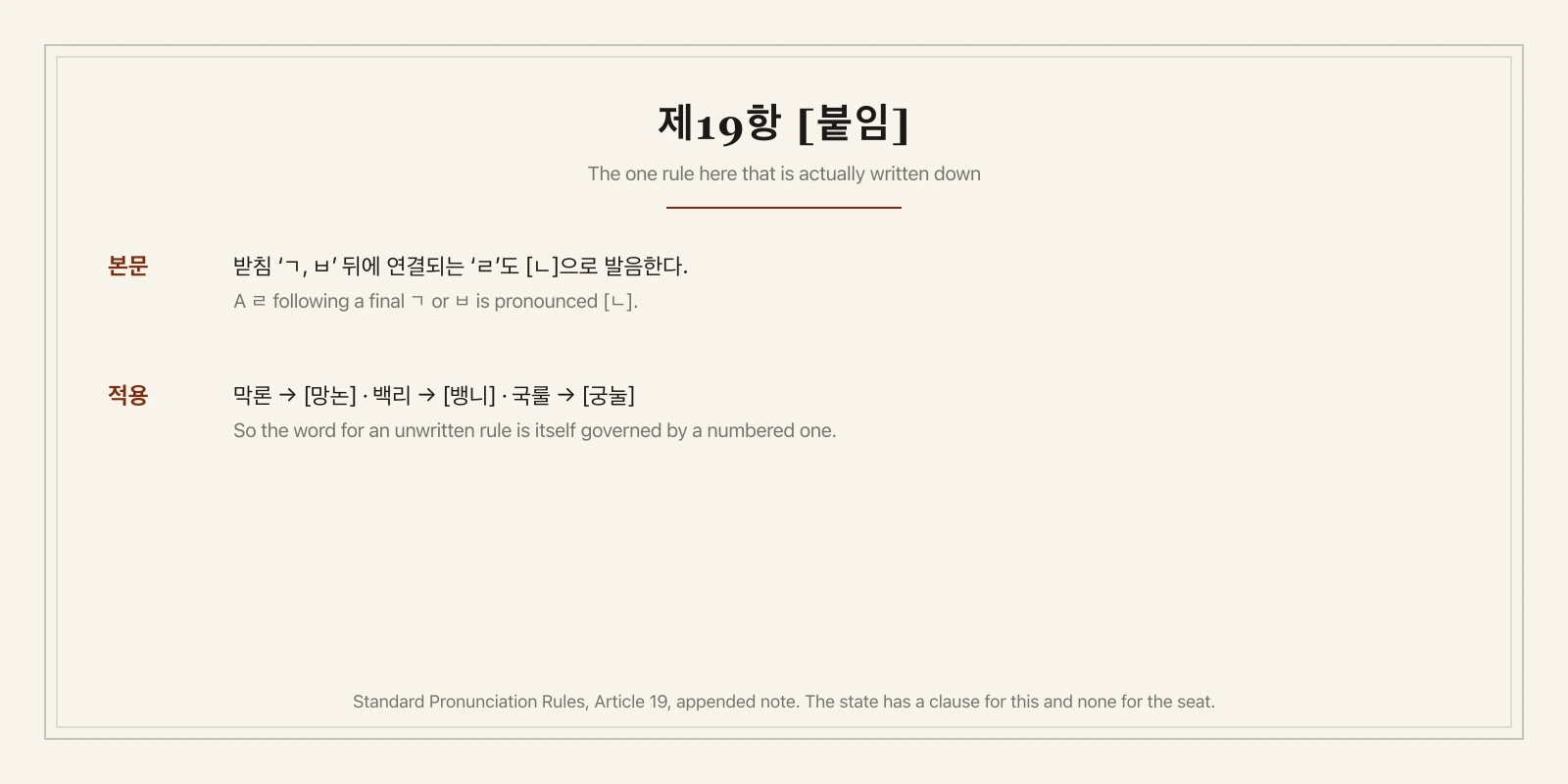
Korean has a rule for this — the [붙임], the appended note to 표준 발음법 제19항 — which says that ㄹ following a final ㄱ or ㅂ is pronounced [ㄴ]. It is why 막론 comes out as [망논] and 백리 as [뱅니]. Apply it here and you get two steps: the ㄹ becomes ㄴ, and then the ㄱ in front of that new ㄴ softens to ㅇ.
국룰 → [궁눌]. Gungnul.
We are being specific about this because the romanisation matters. Transliterate the spelling and you get things like "gug-rur," which is both wrong and — for an English-speaking reader — uncomfortably close to a slur. Transliterate the sound and the problem disappears on its own. gungnul is the phonologically correct answer and the decent one, which is a rare and welcome alignment.
For the avoidance of doubt: the Institute has issued no ruling on this word's pronunciation. It doesn't need to. The rule already existed.
It comes from a game that forgot to include a feature
The origin story is good, and we are going to tell it with the caveats attached, because it rests on community memory rather than documents.
The most-repeated account starts in 2007, with a Korean online shooter called 아바 온라인 (Aba Online). The game had no official system for sword duels — 칼전 — so players who wanted a fair one-on-one had to invent the terms themselves: which weapons were allowed, what counted as cheating. Those negotiated house rules were called 국룰. Break one and you were treated as a cheat, even though the game itself had no opinion on the matter.
That is the perfect origin for this word, if it is true. A rule that governs absolutely, that everyone enforces, and that literally does not exist in the system it purports to govern.
Then 2017, and this is the best-attested link in the chain: Twitch streamers playing a StarCraft custom map called 경매 디펜스, auction defence, declaring that the opening bid is fixed at one won — that's 국룰 — partly as a joke and partly to bait other players into believing it. From there it left gaming.
By 2019 it was ordinary. Though not later than that: there is a thread on the community site 더쿠 dated 24 November 2018 in which somebody asks, plaintively, "근데 여기서 국룰국룰거리는데 국룰이 뭐야..?" — everyone here keeps saying 국룰, what is 국룰? Which is what the arrival of a word actually looks like from inside.
Two honesty notes. All of this rests on Namu Wiki plus a couple of news write-ups that appear to share the same community sourcing; we found no 2007-era forum post or patch note. And there is an earlier claimed prequel — a 2003 Warcraft III custom map where the term supposedly appeared with a negative sense, meaning an unfair rule, before dying out. That one rests on a wiki and a single blog, and we mention it only so you know it is out there.
The things Koreans call 국룰
Here is a sample, with the sourcing quality noted, because some of these are attested everywhere and some we found exactly once.
Widely attested:
- 치킨엔 맥주 — chicken goes with beer. This is the canonical example, in every single source we touched. If 국룰 has a flag, this is it.
- 치킨 옆 치즈볼 — and cheese balls are the side.
- 개강 첫날은 오티만 하고 끝 — the first day of a university semester is orientation and nothing else. Everyone goes home.
- 경매 첫 입찰은 1원 — the original joke, still cited.
Attested once, and telling:
- 한강에선 라면 — instant noodles at the Han River. Not a rule. Obviously a rule.
- 현관문 앞에 놓인 택배는 손대지 않는다 — you don't touch a parcel left outside a neighbour's door.
- 처음 만난 사람에게는 어려 보여도 존댓말 — formal speech with a stranger, however young they look.
- 연장자에게 자리 양보 — give up your seat for someone clearly older.
- 연봉 6천만 원이면 그랜저 — earn sixty million won a year and you drive a Grandeur.
- 결혼 적령기는 30대 초반 — the right age to marry is your early thirties.
- 모기는 얼굴은 피해서 문다 — mosquitoes avoid biting your face. Offered, in both sources that carry it, as an obvious joke.
And a set specifically for instant noodles, offered as a top five: ramyeon tastes better after 11pm; you do not begin without kimchi beside you; the firm-noodle-versus-soft-noodle argument will happen; you tip rice into the leftover broth at the end; it is better cooked and eaten with other people.
Read that list again and notice what is on it. Marrying age. What car your salary entitles you to. Whether you top off a stranger's formality. These are not rules. They are pressures, wearing the word "rule" as a costume.
The word only appears where the consensus is fake
Here is the thing that makes 국룰 worth an article rather than a glossary entry.
Nobody says murder is against 국룰. Nobody invokes it for stopping at a red light, or not stealing, or any of the ten thousand norms that genuinely are universal. The word is never reached for when a rule is actually settled.
It is reached for at precisely the boundary where somebody wants a preference to have the authority of a consensus it does not have.
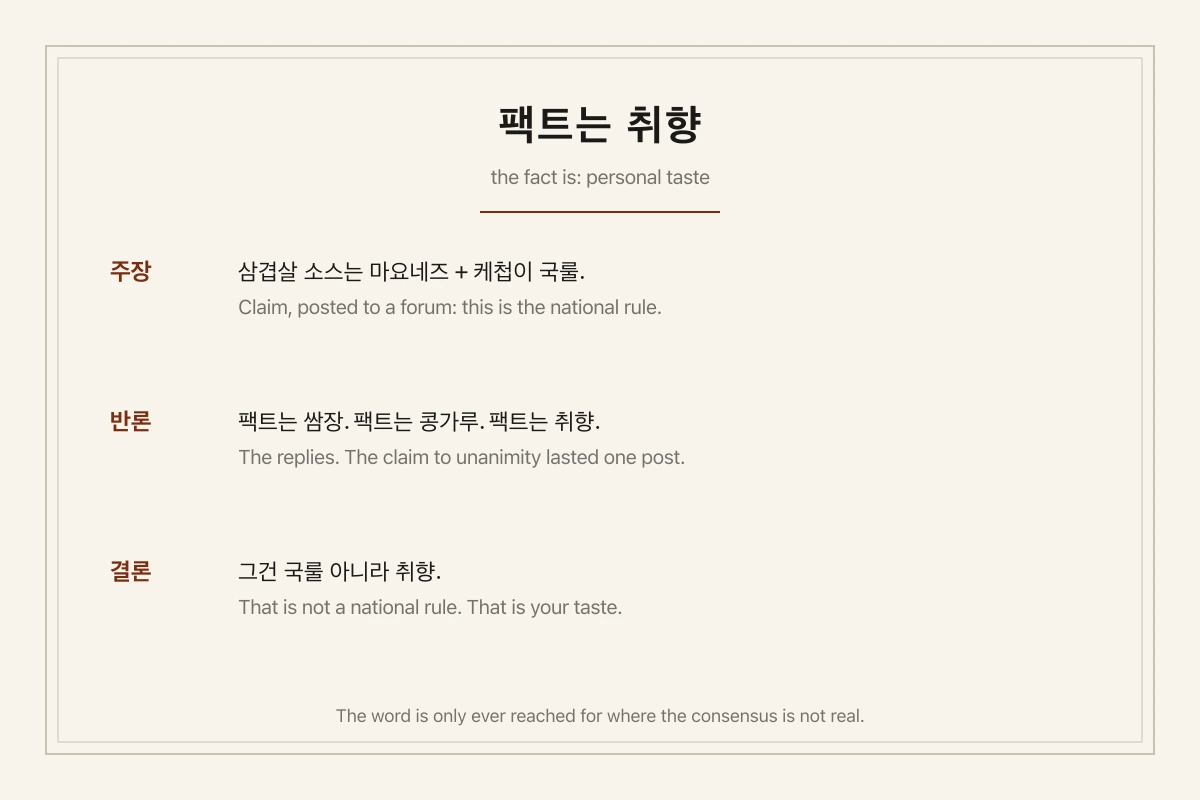
Watch it fail in public. On the forum Ruliweb, someone posts that the sauce for grilled pork belly is mayonnaise and ketchup — 국룰. The top replies: "팩트는 쌈장" — the fact is ssamjang. "팩트는 콩가루." "팩트는 취향." The fact is: personal taste. The claim to national unanimity gets refused in three words.
And that is the ordinary case. Korean speakers push back on 국룰 claims constantly, with a standard move — "그건 국룰 아니라 취향", that's not 국룰, that's your taste. Which tells you the authority the word claims is asserted rather than possessed.
An essayist writing about the word in Korean puts the objection at its sharpest:
"당신이 말하는 국룰은 그저, 당신의 취향일 뿐이다."
"What you call the national rule is just your taste."
Her complaint is that 국룰 works as a conversation-ending device. Dress your preference as unanimous and your friend's disagreement stops being an alternative and starts being awkwardness.
Which is what the little syllable is actually doing. English has "unwritten rule" and "the done thing," and neither of them names the entire population as co-signatories. 국(민) does. It hands you, free, a claim that everybody already agrees — for a proposition about pork belly.
Where it is drifting
The word is already moving. Wiktionary's entry — the most rigorous English-language treatment of 국룰 that exists, which is itself worth noting — records two senses: the original unwritten-rule meaning, and a weaker extended one, closer to the obvious choice. A no-brainer. In that second sense the consensus claim has worn away and what's left is emphasis.
The samgyeopsal sauce post is really sense two. The subway-seat thread is sense one, and it is a genuine disagreement about a genuine norm, argued in public, using a word whose entire function is to pretend the argument has already happened.
Korea has a rule for how ㄹ behaves after ㄱ, written down in an article with a number. It has no rule about the subway seat. So somebody invented a word that sounds like there is one.
For the other Korean internet-language game we have taken seriously — writing words so they look like different words — see 야민정음, explained. And for words that came into Korean from English and did not come back out the same shape, Konglish, explained.
Images. The cover, the lead image and the panel in the article are things we made — a mock rulebook and its companions, typeset in the numbered-article style of Korea's actual pronunciation regulations, because the joke is structural: the state really does have a numbered clause governing how 국룰 is pronounced, and no clause whatever governing the subway seat. Every "article" in it is one of the sourced examples above. The listing thumbnail is an AI illustration (generated with Higgsfield, GPT Image 2.5) of the subway-seat standoff; it depicts no real person. There are no photographs; this is a word, and there is nothing honest to photograph.
Reported from 우리말샘, from 국립국어원's own reply to a morphology question in May 2025, from 표준 발음법 제19항, from Korean coverage of the word's origins, and from community threads on 더쿠, 루리웹 and Blind which we read directly rather than through summaries.
On the examples, and a failure worth naming. Two customs we expected to include are not above. 첨잔 — never topping up a glass that is not empty — and the 3:7 soju-to-beer ratio are both real, well documented and famous. They came back to us attached to the word 국룰; when we opened the actual pages cited, the word was not there. They are real customs that our sources do not attest under this particular word, so they are out. Similarly, the 부먹/찍먹 dipping argument is always described in Korean as an unresolved 논쟁, a dispute — which is arguably better evidence for this article's thesis than any example: there is a whole class of things Koreans argue about permanently and pointedly never call 국룰.
Also stated rather than smoothed: the 2007 and 2017 origin points rest on community memory relayed by two outlets that appear to share sourcing, not on documents from the time; the 2003 prequel is weaker still and is flagged as such in the text; and the National Institute of Korean Language has made no ruling on how this word is pronounced — the pronunciation follows from a general rule that already existed, which is a different and less authoritative thing. A rival spelling, 궁뉼, circulates online; we could find no source that argues for it on phonological grounds, and the vowel change it implies is not something nasalisation does.
Keep Reading
More Stories
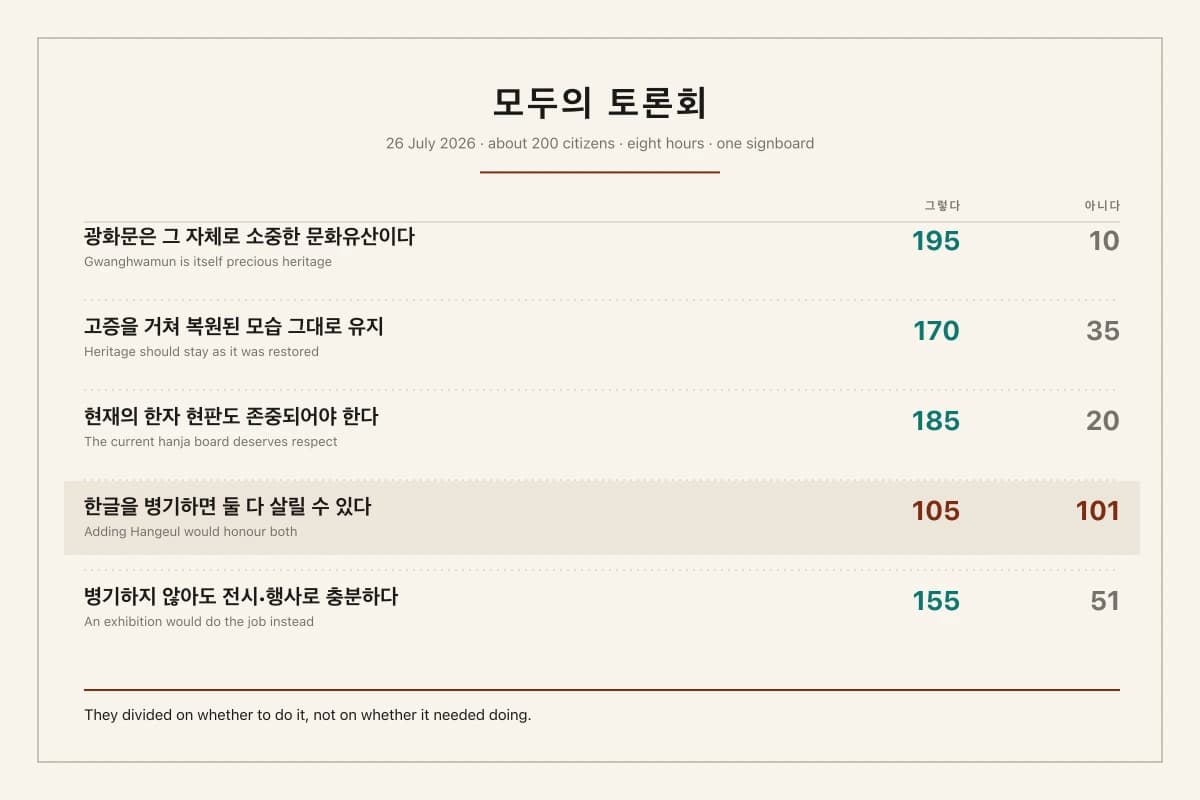
Korea Asked 200 Citizens Whether to Put a Hangeul Sign on Gwanghwamun. They Split 105–101, Then Voted 155–51 That It Is Not Needed.
The government convened its first-ever citizens' deliberation and spent eight hours on a signboard. The panel divided almost exactly in half on whether adding a Hangeul plaque would honour both the heritage and the alphabet — and then, overwhelmingly, said an exhibition would do the job instead. Both answers are coherent, which is the interesting part. The plaque they were arguing about is three years old, and the one before the one before it was in Park Chung-hee's handwriting.
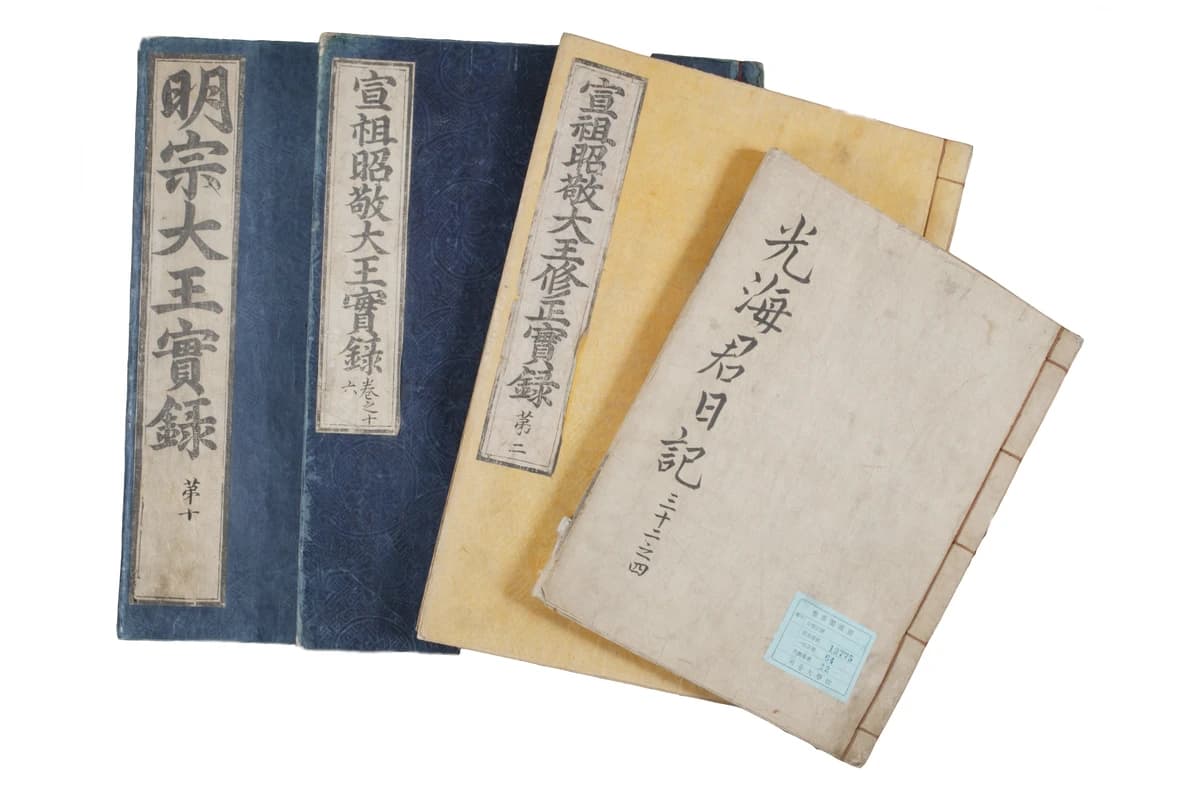
Hangul Day Exists Because a Book Turned Up in 1940. Nobody Can Find the Other Copy.
The date of Korea's alphabet holiday moved four times before a single physical book settled it — and that book arrived missing its first four pages, including King Sejong's own preface, which a calligrapher reconstructed by hand with a typo still in it. A second copy has been in a private house since 2008. The prosecution's own appraisers valued it at over a trillion won. Nobody has seen it since a fire in 2015.
Who Decides What You Can Name Your Baby in Korea? The Supreme Court
A mother chose a character meaning 'beautiful' for her daughter. The clerk registered the child's name in hangul and left the character out — which is not a refusal but the legally correct outcome. Korea permits 9,389 Chinese characters in given names, more than China or Japan, and the list grows because parents get turned down. In April 2026 the Constitutional Court upheld the whole arrangement by a single vote.
The Weekly Dispatch
Korea, curated. Every week.
The best of K-culture, straight from Seoul. Written by people who actually live here.
Free, no spam, unsubscribe whenever.