The Joke Spelling That Became a Real Product: 야민정음, Explained
Korean internet users spent years swapping hangul characters for ones that merely look similar — 멍멍이 into 댕댕이, 귀엽다 into 커엽다. Then a noodle company printed the joke on an actual packet, sold seventy-five thousand of them in twenty-three hours, and got told to apologise to the nation. Three years later the government's own language institute tried the same gag and deleted it within two hours.
On 19 February 2019, you could buy a box of instant noodles on the Korean shopping site 11번가 whose name was not a word. It was a misspelling — deliberate, elaborate, and printed on the packaging by the manufacturer.
The product was called 괄도네넴띤. By four o'clock that afternoon it was moving at roughly a hundred packets a minute. Twenty-three hours after going on sale, the first run was gone: fifteen thousand boxes, seventy-five thousand individual packets.
The noodles inside were 팔도비빔면 — Paldo's cold spicy mixed noodles, a supermarket fixture since 1984. 괄도네넴띤 is what 팔도비빔면 looks like if you stop reading it and start looking at it.
That distinction is the whole subject of this article, and it has a name.
What 야민정음 Actually Is
야민정음 is the practice of replacing a hangul syllable with a different syllable that resembles it visually. Not phonetically — visually. The sound changes completely. The shape barely does.
The canonical examples, each attested in Korean sources:
- 멍멍이 ("doggy") becomes 댕댕이, because 머 and 대 look alike at a glance
- 귀엽다 ("cute") becomes 커엽다, because 귀 and 커 do
- 명곡 ("a great song") becomes 띵곡, because 명 and 띵 do
- 대박 ("jackpot") becomes 머박
- and, inevitably, 세종대왕 — King Sejong, who gave Korea the alphabet — becomes 세종머왕
The name is a portmanteau. 야갤 is 디시인사이드's domestic baseball gallery, a forum where the practice consolidated around 2015 and 2016. 훈민정음 is the 1446 document that promulgated King Sejong's alphabet — created three years earlier, in 1443 — and whose name means the correct sounds for the instruction of the people. Splice them and you get 야민정음.
There is a tidier story, and it is worth knowing that it is false. The tale goes that it began when the baseball gallery misread the player 강귀태's name as 강커태. Korean sources treat this as folk etymology; Namu Wiki argues the real lineage runs back to the 통신체 — the deliberately deformed spellings of Korean dial-up and early internet culture in the 1990s and early 2000s. The practice is older than the name.
You will also see 야민정음 written in Chinese characters as 野民正音 — "the correct sounds for the wild people," one character away from 훈민정음's 訓民正音, teaching the people. It is a good pun. It is also retrofitted: the 야 comes from baseball, not from 野. The joke was made after the fact, by people pleased with themselves.
Why It Works, and When It Stops Working
This is not a code. There is no rule you could write down and apply. It works on the eye, and the eye is unreliable in specific, describable ways.
Korean type designers know the confusable pairs well, because they have to draw them: ㅗ and ㅜ, ㄹ and ㅌ, ㅒ and ㅓ, 대 and 머, 의 and 익. Confusion strengthens at small sizes, at low resolution, in compressed geometric sans faces, and — most of all — in handwriting. Namu Wiki's entry on lookalike letters notes drily that this is a genuine headache in hangul typeface design.
Which brings us back to the noodles, and to the detail that makes the Paldo story more than a marketing stunt.
괄도네넴띤 was not invented. It was read. Korean coverage described it as a transcription of 팔도비빔면 as the packaging's own lettering appears — the company's logotype, rendered at speed by an eye that wasn't concentrating. The internet did not make up a joke about Paldo. It reported what Paldo's own type design looked like. Paldo then printed the report and sold it.
One more mechanic deserves mention, because it is the most elaborate thing anyone has done with this. 폭풍눈물 — "a storm of tears" — becomes 롬곡옾눞. That is the entire phrase rotated a hundred and eighty degrees. The word order reverses and every syllable block turns over: 물 becomes 롬, 눈 becomes 곡, 풍 becomes 옾, 폭 becomes 눞. Turn this page upside down and check.
(One Korean outlet printed it as 롬곡웊눞. That is wrong, and you can prove it from the rotation itself: ㅜ turns into ㅗ.)
A clarification, since English writing on Korean internet language routinely gets this wrong: 야민정음 is not the same thing as 초성체, the initial-consonant shorthand where ㅇㄱㄹㅇㅂㅂ stands in for a whole sentence. Nor is it 급식체, the schoolkid register. 야민정음 is purely orthographic — it changes how a word is drawn, not how the language is built. Keep them separate.
The Row
Eight days after launch, on 27 February 2019, the 사단법인 한글문화연대 — a hangul advocacy society — published a statement demanding that Paldo apologise. It was timed to land just before 삼일절, the 1 March holiday commemorating the 1919 independence movement, and the statement made the connection explicit: this was the alphabet that the 조선어학회 had protected under Japanese colonial rule at the cost of their lives, and two of its scholars, 이윤재 and 한징, had died in prison.
The charge was not that people were playing. It was that a company was selling the play. The statement's own subheading called it a commercial impulse that had gone past a culture of games.
Paldo did not apologise. Its response was that it had considered the concerns and concluded the phenomenon was best received as culture, and that the point was to reach the target demographic in the target demographic's own language. The limited run of five million packets sold out on 8 April 2019.
And here is the part of the row that nobody outside Korea has written down. The statement demanding accuracy from a food company named the wrong food company. It attributed 괄도네넴띤 to 한국야쿠르트, having failed to establish that 한국야쿠르트 and 팔도 had been separate legal entities since 2012. A correction now sits at the foot of the page, explaining the error and setting it right.
That is not a cheap shot at the 한글문화연대, whose statement is otherwise carefully argued. It is the article's first honest complication: the people arguing that carelessness with Korean has consequences were careless, in public, in the document making the argument.
The Charge Is Probably Misfiled — And the Defence Is Not Clean Either
The complaint against 야민정음 is usually phrased as 한글 파괴, "destruction of hangul." On the evidence, that is the wrong charge.
Namu Wiki puts the counter-argument in one line: the letters are substituted while keeping their forms entirely intact, so nothing is destroyed. 김하수 of the 한겨레말글연구소 was blunter — hangul, he wrote, is not something that collapses or breaks under a prank of that size.
The precise version is that 야민정음 does not touch hangul at all. Every stroke is a legal, standard letter. What it does is spell Korean words wrongly on purpose, which makes the accurate charge 한국어 파괴 rather than 한글 파괴 — and arguably not even that, since the phonology and grammar of the language are untouched. It is graffiti on the surface of writing. Notably, this distinction was raised inside the 한글문화연대's own publication, against its own framing.
So: harmless fun, and the objectors are fussing?
Not quite, and this is where the story stops being cute. A 2015 student newspaper investigation at the University of Seoul documented that the practice grew partly as a way to evade keyword filters — respelling words so that posts could not be found by search, and so that outsiders could not read them. The early payloads were political and often cruel. Presidents' names were deformed into insults. The word for the bereaved families of the 세월호 ferry disaster was respelled into a form engineered to sound unpleasant.
Cultural commentators quoted in that investigation made the obvious point: a spelling that implies a politician is mentally deficient is not a typography experiment. In-group jargon builds cohesion, and this in-group knew exactly what its cohesion was for.
Both things are true. 야민정음 is a genuinely inventive piece of visual wordplay that produced 댕댕이, which is delightful. It is also a technology for saying things you don't want indexed. The same mechanism serves both, which is why arguments about it never resolve: people are describing different halves of it.
The Two-Hour Retreat
Korea's 국립국어원 — the National Institute of Korean Language, the state body that arbitrates the standard — has held both positions.
In 2017, a researcher at the institute's public language division offered studied neutrality: 야민정음 could be neither condemned outright as linguistic destruction nor endorsed, and the sensible course was to guide young people toward standard forms.
In mid-September 2022, ahead of 한글날 — Hangul Day, 9 October, the holiday celebrating the alphabet — the institute ran a social media engagement post. It explained that internet users sometimes swap syllables for similar-looking ones, called the practice 야민정음, offered 멍멍이→댕댕이, 광역시→팡역시 and 귀여워→커여워 as examples, and asked the public what they thought of it.
The reaction was immediate enough that the post came down in a little over two hours. 야민정음 was purged from the institute's open dictionary. The institute's explanation was that it had not known where the word came from, learned from users' objections, and judged that stopping was correct.
What it had not known was the baseball gallery's politics — the specific history in the section above. The state's language authority had picked up a piece of internet vocabulary without checking what the internet had used it for.
What the Dictionary Says Today
Here is the state of the record, checked at the time of writing.
우리말샘, the institute's open dictionary, does not contain 야민정음. Search it and you are told the word is not registered. The 2022 deletion was never reversed.
It does contain 댕댕이, as a noun, defined as a word used on internet forums to mean 멍멍이.
It also contains 커엽다, as an adjective — with a pronunciation guide and a full conjugation, 커엽다 [커엽따], 커여워, 커여우니 — defined as an internet-forum word for 귀엽다, and noting that it arose from playfully writing a word whose letter shapes are similar. It is marked as having completed expert review.
So the state deleted the word for the joke and kept the jokes.
There is a final accident in this. 댕댕이 was already a Korean word. 우리말샘 carries it as the name of a perennial vine, the 댕댕이덩굴, and — in North Korean usage — as a cloth for binding an aching head. The internet's word for doggo landed squarely on top of a plant.
The Label Did Not Survive
괄도네넴띤 worked. Five million packets, a second sale of twelve thousand boxes six days after the first, and a demonstrated appetite for a product whose name you could not pronounce.
On 15 July 2019, Paldo made it permanent — and renamed it 팔도 비빔면 매운맛. Paldo Bibim Myeon, Spicy.
The joke won the sales and lost the label. The noodles are still on the shelf under a name that means exactly what it says, spelled exactly as it should be, next to a dictionary that will define 커엽다 for you but no longer admits the word for why.
If you want to see why any of these swaps work in the first place, the shapes themselves are the answer — and they take about an afternoon to learn: how to read hangul in one sitting. Once you can read the blocks, you can see them collide.
And 훈민정음, the document this joke is named after, has a stranger afterlife than the joke does: the copy that fixed the date of Hangul Day turned up in 1940 with four pages missing, and the second copy has been missing since a fire in 2015.
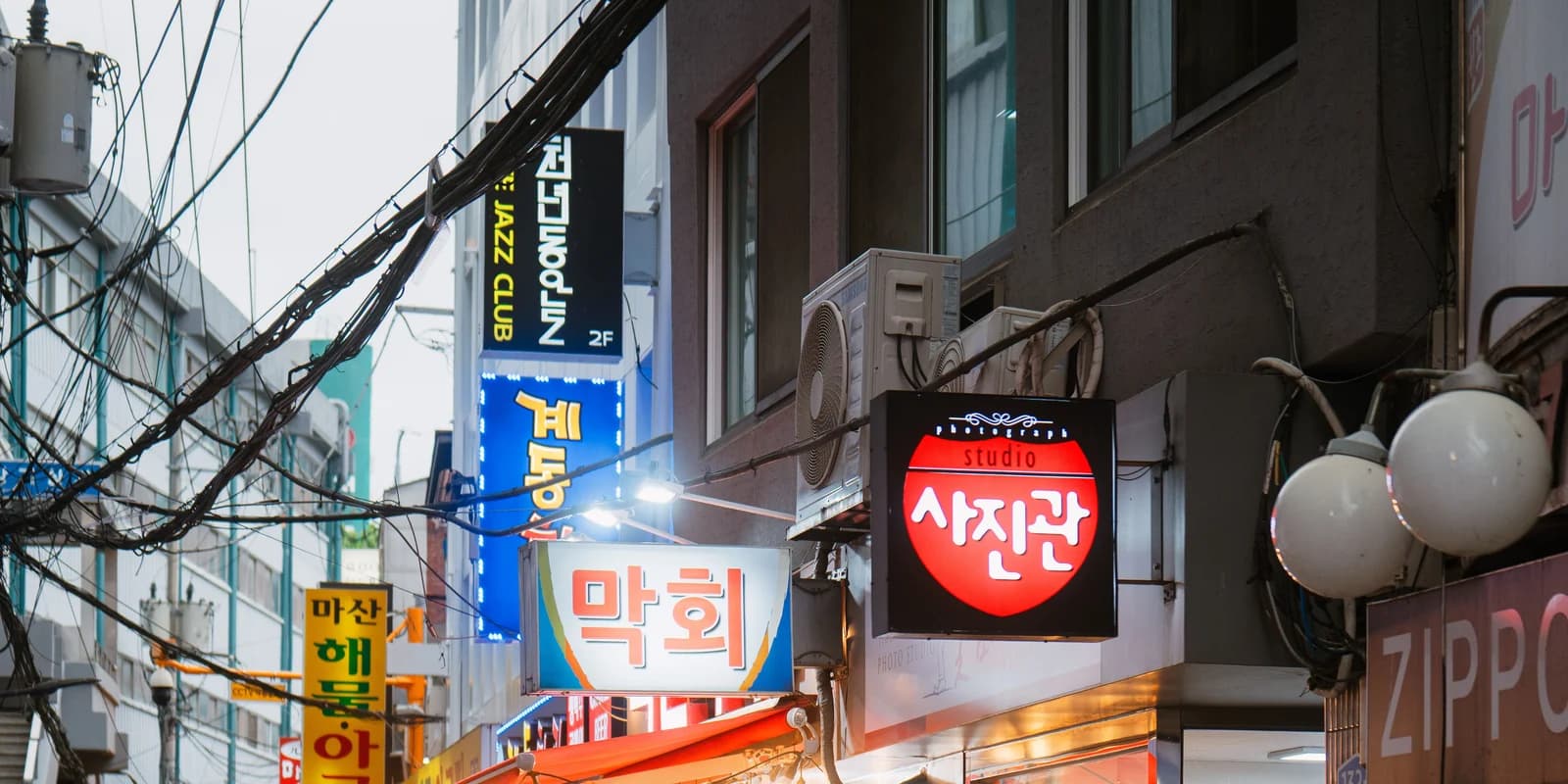
Images, cropped by us. Listing card — a 1946 facsimile of the 훈민정음 해례본, published by the 조선어학회 on Hangul Day that year for the 500th anniversary of the alphabet's promulgation, open at the 예의 section where each letter is given its own column, with ㅗ and ㅏ and ㅜ a few columns apart on the same page. Public domain, via Wikimedia Commons. This is the document 야민정음 is named after and has nothing to do with the modern joke. One caution we owe the reader: the 간송본 this facsimile derives from surfaced in 1940 missing its first two leaves — four pages containing Sejong's own preface — and those pages were reconstructed by hand, in imitation of an earlier calligrapher, from a source that carried errors of its own. The file's Commons metadata gives no leaf number and is internally inconsistent about its own edition, so we cannot say whether this particular page is 1446 printing or 1940 reconstruction, and we do not claim it is either. Cover — shop signs stacked at six sizes and weights in 낙원동, Jongno, by Sergiy Galyonkin, CC BY-SA 4.0 via Wikimedia Commons; not decoration but the mechanism itself, since 야민정음 depends on hangul taken in at a glance rather than read letter by letter. None of these signs is a 야민정음 spelling. Hero — cup ramyeon shelving in a Wonju 7-Eleven, by 최광모, CC0. 팔도비빔면 is not on those shelves: this is the aisle, not the product. We did not go looking for photographs of 괄도네넴띤 itself, because the packaging is copyrighted and no licence-clean image of it exists. We also rejected a promising 훈민정음 exhibition photograph after the display card beside it turned out to read 복제 — replica.
Verified against Korean-language sources. The etymology (야갤 + 훈민정음), the folk-etymology debunk, and the substitution examples are from 한국어 위키백과, 나무위키 and 서울경제's neologism dictionary; we present 野民正音 as a retrofitted pun rather than a derivation, because the 야 is from 야구. Launch details, the 2,652 SHU figure and the five-million-packet run are from Paldo's own press release; the sell-out figure is 11번가's own statement as carried by 국민일보 — fifteen thousand sets, seventy-five thousand packets, twenty-three hours. A second series exists (시사저널e: twenty thousand sets, one hundred thousand units, same day) which no source reconciles with the first; we use the retailer's figure and flag the conflict rather than averaging them. The 한글문화연대 statement, its subheading and its published correction are quoted from the society's own site. 국립국어원's 2017 position, the mid-September 2022 post and its removal are from 한글문화연대's newsletter and from 매일신문 and 카뉴스 coverage dated 6 October 2022; the exact post date is not given in that coverage, so we say mid-September. The 우리말샘 entries for 댕댕이 and 커엽다, and the absence of 야민정음, were checked directly. Deliberately omitted: a widely circulated opinion poll on attitudes to 야민정음, which names no pollster, sample or date; a revenue figure attributed to the product, which we could source only once; a claim that Google Translate once rendered 머통령 as "President," which we could not test; and reported adoption by two other food companies, named in a general reference but tied to no specific product.
Keep Reading
More Stories
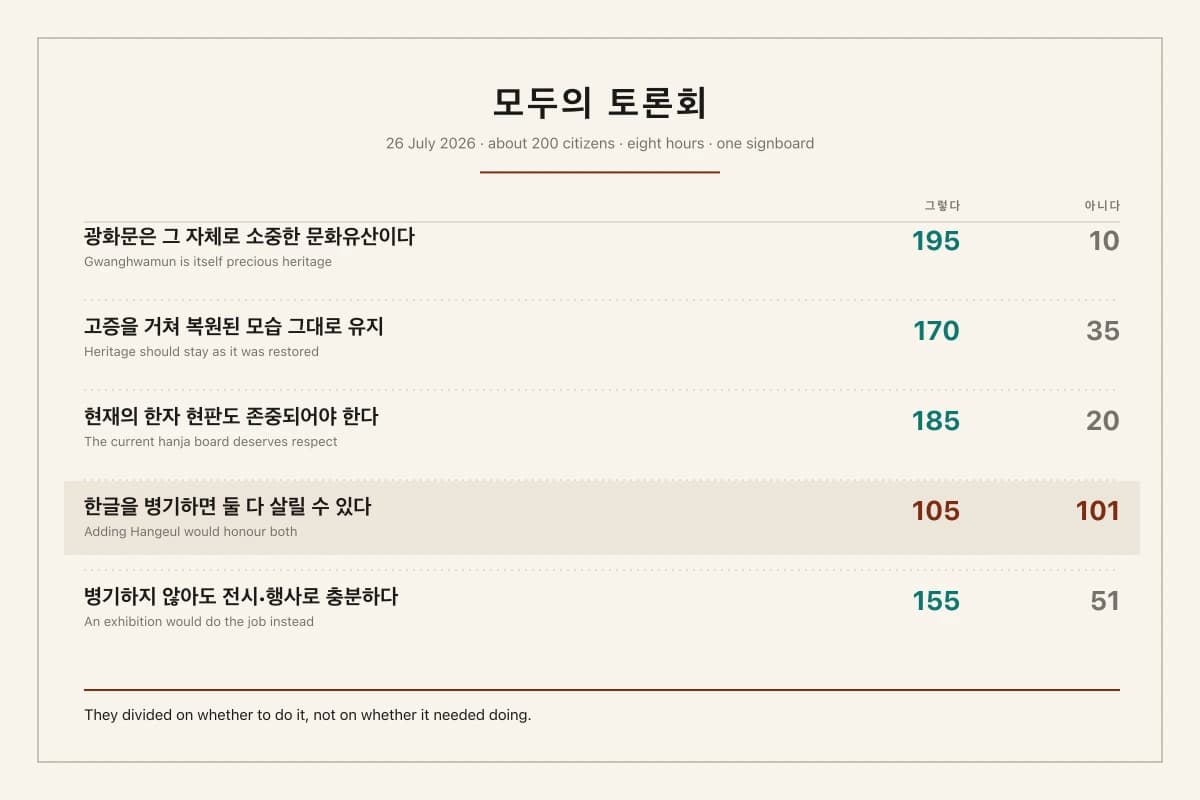
Korea Asked 200 Citizens Whether to Put a Hangeul Sign on Gwanghwamun. They Split 105–101, Then Voted 155–51 That It Is Not Needed.
The government convened its first-ever citizens' deliberation and spent eight hours on a signboard. The panel divided almost exactly in half on whether adding a Hangeul plaque would honour both the heritage and the alphabet — and then, overwhelmingly, said an exhibition would do the job instead. Both answers are coherent, which is the interesting part. The plaque they were arguing about is three years old, and the one before the one before it was in Park Chung-hee's handwriting.
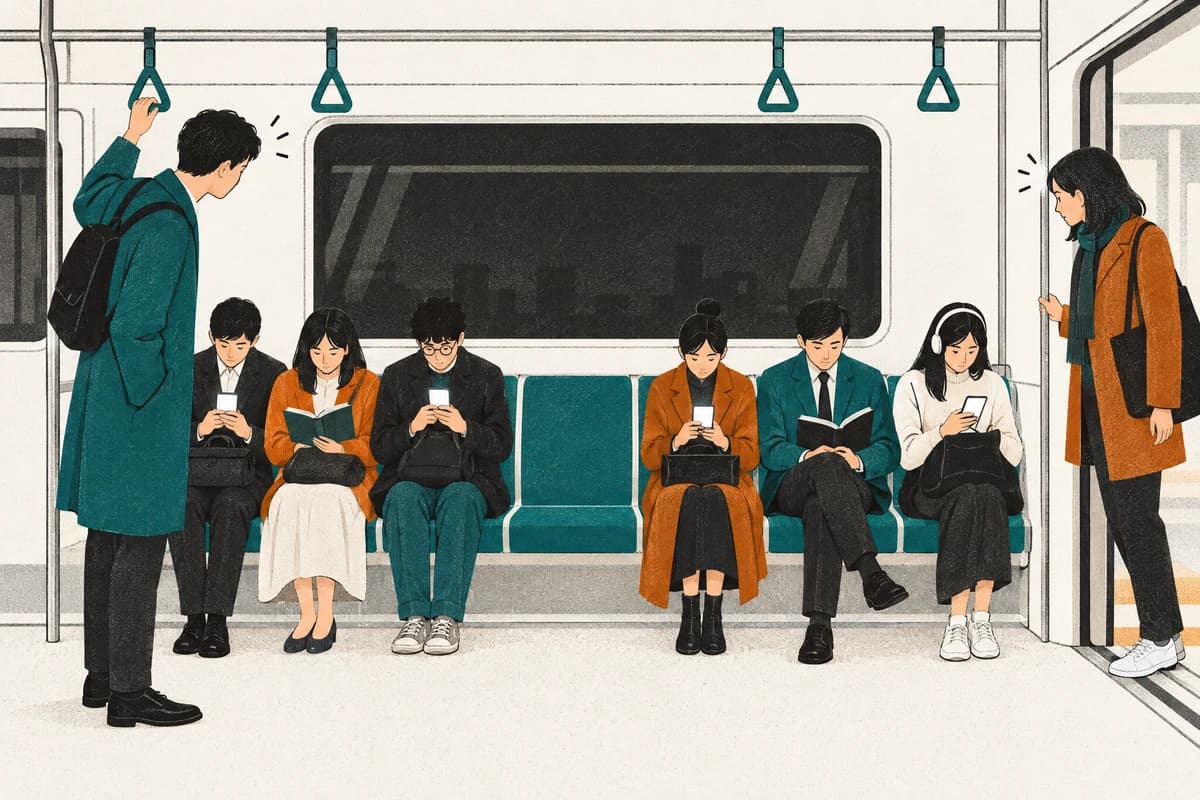
Koreans Have a Word for a Rule Everyone Follows. It Only Ever Gets Used for Rules Not Everyone Follows.
국룰 — gungnul — is Korean internet slang for an unwritten national consensus: the thing everybody does that nobody ever agreed to. It comes from a 2007 shooting game whose players had to invent their own duelling rules because the game had none. And the tell is in which things get called it. Nobody says murder is against 국룰. People say it about which sauce goes with pork belly, and then argue.
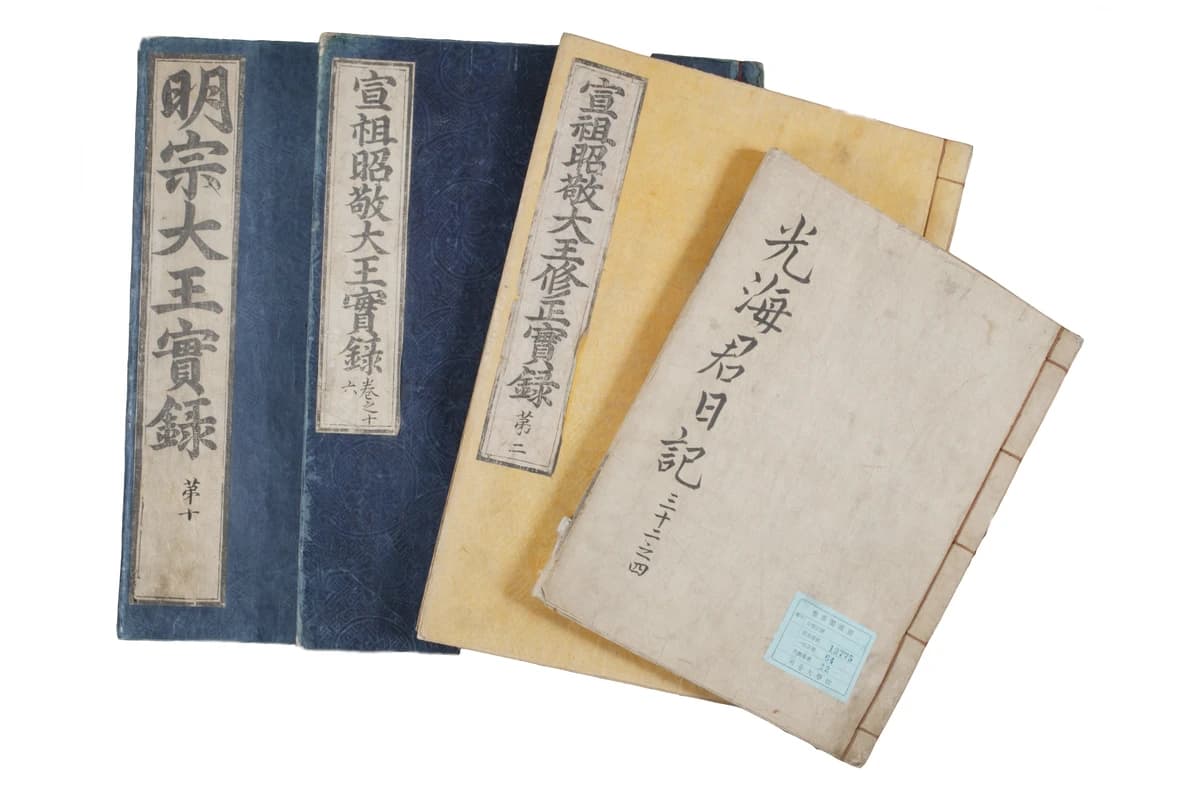
Hangul Day Exists Because a Book Turned Up in 1940. Nobody Can Find the Other Copy.
The date of Korea's alphabet holiday moved four times before a single physical book settled it — and that book arrived missing its first four pages, including King Sejong's own preface, which a calligrapher reconstructed by hand with a typo still in it. A second copy has been in a private house since 2008. The prosecution's own appraisers valued it at over a trillion won. Nobody has seen it since a fire in 2015.
The Weekly Dispatch
Korea, curated. Every week.
The best of K-culture, straight from Seoul. Written by people who actually live here.
Free, no spam, unsubscribe whenever.