Hangul Day Exists Because a Book Turned Up in 1940. Nobody Can Find the Other Copy.
The date of Korea's alphabet holiday moved four times before a single physical book settled it — and that book arrived missing its first four pages, including King Sejong's own preface, which a calligrapher reconstructed by hand with a typo still in it. A second copy has been in a private house since 2008. The prosecution's own appraisers valued it at over a trillion won. Nobody has seen it since a fire in 2015.
In September 2024, a man in 낙동면, on the edge of 상주, moved a statue of King Sejong from a shuttered local school to the entrance of his own house.
He gave the installation a name: 흠정대 (欽定臺) — roughly, the imperially-decreed platform. He has stopped speaking to the roughly thirty households in his village, and to the state agency that has written to him about twenty times since 2017.
We will come back to why. It requires explaining what he has, and that requires explaining why Korea celebrates its alphabet on 9 October — a date that was arrived at, after four attempts, by reading the colophon of a book.
The Holiday's Date Is Set by a Physical Object
Korea's alphabet was created in 1443 and promulgated in 1446. Everyone knew that. What nobody knew, for most of the twentieth century, was when in 1446 — and a commemoration needs a day.
So the day moved.
- 1926. Korean language scholars mark the alphabet's 480th anniversary — eight sixty-year cycles — on the last day of the ninth lunar month, because that was the date on the entry in the 조선왕조실록. They called it 가갸날, since the alphabet was then called 가갸글.
- 1928. Renamed 한글날, adopting a word that the linguist 주시경 is generally credited with coining.
- 1931. Moved to 29 October.
- 1934. Moved again to 28 October, after agreement that the retrospective conversion from the lunar calendar had been done wrong.
Then, in 1940, a copy of the 훈민정음 해례본 turned up. Its colophon dated publication to 음력 9월 상순 — the first ten days of the ninth lunar month. Convert the last day of that period, in 1446, to the Gregorian calendar, and you get 9 October.
The date has not moved since. A national holiday, observed by fifty-one million people, is pegged to a printer's note in a book that was missing for four and a half centuries.
What UNESCO Actually Inscribed
In 1997, UNESCO added the Hunminjeongum Manuscript to its Memory of the World International Register, alongside the Annals of the Joseon Dynasty. They were Korea's first two documentary-heritage inscriptions; there are twenty now.
Two clarifications, briefly, because they matter for what follows. Memory of the World is a register of documents — it is not the World Heritage List, and it is not the intangible-heritage list that 김장 and 씨름 are on. And what was inscribed is not "hangul." It is one printed book, in a private museum in Seoul.
We'd flag that we went looking for the popular error here and mostly didn't find it. UNESCO's own record is precise, English Wikipedia is precise, university library guides are precise. The places that claim Korea's alphabet is a World Heritage Site are search-optimised content farms, and correcting those is not journalism.
The interesting slippage is the other one, and even careful sources commit it: they say UNESCO recognised the value of the alphabet. What UNESCO put on the register is a specific object with a specific condition — and its condition is the story.
The Difference Between the Two Books Everyone Confuses
Three names get mashed together in English writing, and untangling them takes one paragraph.
훈민정음 is the name of both the alphabet and the book. The 해례본 is the 1446 woodblock edition: one volume, 33 leaves, 66 pages, written in Chinese. It has three parts — 예의, containing Sejong's own preface and the letters with their uses; 해례, in which the 집현전 scholars explain the reasoning behind the letters' shapes; and a postface by 정인지. The 언해본 is something else entirely: a Korean translation of the 예의 only, the oldest surviving version of which opens the first volume of the 월인석보 in 1459.
So: the 예의 tells you what the letters are. The 해례 tells you why they look the way they do. And no 언해본 translates the 해례.
Which means the design logic of the Korean alphabet — the thing every explainer now recites, including ours — survived in exactly one book, and that book was lost for centuries. That hangul's principles are documented is a fact about the twentieth century, not the fifteenth.
The Most Quoted Page in Korean History Is a Forgery With a Typo
The copy that surfaced in 1940 — the 간송본, now the inscribed one — arrived missing its first two leaves. Four pages. Containing Sejong's preface, which is the single most quoted passage in the Korean language.
이용준, a trained calligrapher, reconstructed them by hand, in imitation of the style of 안평대군, rebuilding the text from the 조선왕조실록 and the 언해본. The Annals copy he worked from was one hastily reproduced after the Japanese invasions of the 1590s, and it is riddled with errors — and the reconstruction inherited them.
The most notorious: the final character of Sejong's preface should be 耳, a particle meaning roughly and that is all. The reconstruction has 矣. There are wrong punctuation marks and missing tone dots as well. The reconstructed leaves have consequently never been accepted as the authoritative text, and Korea's heritage agency announced in 2017 that it intended to restore them properly. We could not establish whether that was ever completed.
So the object on the Memory of the World register opens with four pages of 1940 pastiche containing a known error, and the sentence Korean children memorise is transmitted through it.
Fight One: What It Cost, and What Happened to the Broker
The seller wanted 1,000 won.
전형필 — the collector whose museum still holds the book — paid 10,000, the price of ten tiled houses, without haggling, and added another 1,000 as a fee for the man who brought it to him.
That man was 김태준 (1905–1949), and he is the detail nobody in English writes about. He was the first Korean ever to hold a teaching post in Korean literature at 경성제대, the colonial imperial university. He was also, secretly, a communist — a member of the 경성콤그룹, later a Central Committee member and cultural chief of 박헌영's party. He was arrested in 종로 on 26 July 1949, sentenced to death on 30 September, and shot at the army execution ground at 수색 in November 1949.
The man who brokered the surfacing of the founding document of the Korean alphabet was executed by the South Korean state within nine years of doing it.
The discovery itself was announced in 조선일보 across five instalments, from 30 July to 4 August 1940, under the headline 「원본 훈민정음의 발견」. Note that sources disagree on when 전형필 actually bought it — some say 1940, the National Hangeul Museum says 1943 — and we have not resolved that.
And two families are still arguing about where it came from, by name and on the record. Descendants of the 광산김씨 긍구당 line say the book was in their head house until the 1940s, and that 이용준 — who had married into the family in 1933, at seventeen — removed it from his father-in-law's house without permission. The 진성이씨 대종회 says the original holding was elsewhere entirely, and calls the in-law version a distortion of their clan's history.
There is also the wartime survival story: that 전형필 carried the book against his body by day and slept with it in a wooden box under his head by night. It is a good story. It is sourced to a memoir written by his son, fifty years after the fact, and we would only ever print it as that.
Fight Two: The Copy Nobody Can Find
In July 2008, a bookseller named 배익기 made public a second copy of the 해례본, reporting it to a regional broadcaster. Same edition as the 간송본. He concealed it immediately afterwards.
What was seen of it, then, by the researcher 임노직: 18 of its 66 pages were missing — eight from the preface and 예의, eight from the 해례, two from 정인지's postface. A scholar who examined it, 이상규, described more than a third of the front faces as corroded. Not a single page of Sejong's own preface survives in it.
The chronology since then is a legal knot, and it is worth following precisely because the popular version is wrong.
The civil courts decided ownership in May 2011: the Supreme Court held that title belonged to an antique dealer named 조용훈, who said the book had come from his shop, and ordered it handed over. In May 2012, 조용훈 donated his ownership in full to the state — title with no object attached. He died later that year.
The criminal courts went the other way. Prosecutors sought fifteen years; the trial court sentenced 배익기 to ten years' imprisonment in February 2012 and detained him. The appellate court acquitted him for insufficient evidence later that year, and in May 2014 the Supreme Court dismissed the prosecution's appeal. The acquittal is final. He is, in law, innocent of theft.
Those two outcomes look contradictory, and in July 2019 the Supreme Court explained in one sentence why they are not — in a judgment refusing his attempt to block enforcement:
"형사사건 무죄판결은 법관으로 하여금 합리적 의심을 배제할 정도의 확신을 갖게 하는 증명이 없다는 의미일 뿐, 공소사실이 존재하지 않다는 게 증명됐다는 의미는 아니다." An acquittal in a criminal case means only that there was no proof sufficient to convince a judge beyond reasonable doubt. It does not mean the alleged facts have been proven not to have occurred.
Then the fire. On 26 March 2015 the main house at his home burned, along with antiques and old books. He said he ran in and pulled the 해례본 out. His accounts of what happened to it have not been consistent: he first indicated that only a small part he hadn't hidden deeply was in that room, and later said "나도 잘 모른다. 불에 타버렸으니 지금은 없을 수도 있다" — I don't really know myself; it burned, so it may not exist now.
In May 2022 investigators executed a forced search of three locations — his house, his office, and a safe belonging to an acquaintance. They found nothing. The book is classified as 도난 문화재, stolen cultural property. Its condition has not been independently verified by anyone since 2015.
The Trillion Won Was the State's Own Number
The figure attached to this book in every retelling is one trillion won. It is worth knowing exactly where it came from, because it does not mean what it is used to mean.
In September 2011, during the criminal case, prosecutors commissioned an appraisal. Four bibliographers returned it as 무가지보 (無價之寶) — a treasure beyond price — adding that if you insist on a number, over a trillion won. Their reference point was a figure of roughly 800 billion circulating for another Korean national treasure.
So: a prosecution-commissioned valuation, produced adversarially, explicitly framed as a refusal to value, benchmarked against another untraceable number. The state put that figure into the record. From 2015 the man holding the book began quoting a price of his own — at first not less than a hundred billion won, later a trillion.
The state priced it, and thereby armed the person holding it. No independent appraisal is possible now, for the straightforward reason that nobody has seen the object in eleven years.
Fight Three: The Holiday Itself
Which brings us to the thing being celebrated on 9 October, and the fact that for twenty-two years Koreans worked through it.
한글날 was a public holiday from 1949, by presidential decree. In November 1990 the cabinet removed it, effective from 1991. The stated reason was that business organisations had represented that 공휴일이 많아서 나라 경제가 어렵다 — there are too many public holidays and it is hurting the economy.
In December 2005 the National Assembly amended the 국경일에 관한 법률 and elevated 한글날 to a 국경일, a national day, in the same legal class as the March First Movement and Liberation Day.
It stayed a working day for seven more years.
That gap is not an oversight, it is a filing quirk with real consequences: national-day status lives in a statute, and the day off lives in a presidential decree. Amending the first does nothing to the second. So from 2006 to 2012, Korea had a national day celebrating its alphabet that nobody was given off.
Breaking the deadlock took a coalition, nine street petition drives at 광화문 through 2012, and — on 23 October 2012 — one of the organisers, 이건범, staging a 도끼 상소: an axe petition, the Joseon-era form in which the petitioner brings an axe and invites the sovereign to use it on him if the request is refused.
The employers' federation argued, on the record, that Korea already had 134 days off or more counting annual leave. The campaigners' answer was that Korean annual working hours then ran to roughly 2,200 against an OECD average nearer 1,800.
The resolution passed the National Assembly on 1 November 2012 by 189 votes to 4. The decree was amended on 28 December. The holiday returned in 2013.
It had been taken away over a business-federation productivity argument, and given back over one.
Back to the Statue
So: the alphabet's holiday is dated by a colophon. The book carrying that colophon is missing its opening leaves, which were forged in 1940 with an error still in them. The man who brokered its surfacing was shot by the state in 1949, and two clans are still arguing over whose house it left. A second copy has been in a private house since 2008, priced at a trillion won by the prosecution's own appraisers, and unseen since a fire in 2015.
And in September 2024 the man who has it moved a statue of King Sejong from a closed school to his own gate and called the spot the imperially-decreed platform.
We report the act and the name. We do not interpret them, and we note that the courts have held he is innocent of theft and that title is the state's, and that the Supreme Court has explained why both are true at once.
One last thing, because it is the genuine UNESCO story and almost nobody tells it. Since 1989, UNESCO has awarded the King Sejong Literacy Prize, funded by the South Korean government — three prizes a year, announced on International Literacy Day, and alone among UNESCO's literacy prizes in giving special weight to education in a learner's mother tongue. Korea endowed a permanent international prize named after Sejong, aimed at precisely the problem he said he was solving.
It is a more fitting monument than a statue at a private gate. It is also, unlike the second 해례본, findable.
If you want the alphabet itself rather than the paperwork around it, hangul takes about an afternoon. And for what Korean internet culture has since done to those letterforms — including a joke spelling built on the name 훈민정음 — see 야민정음.
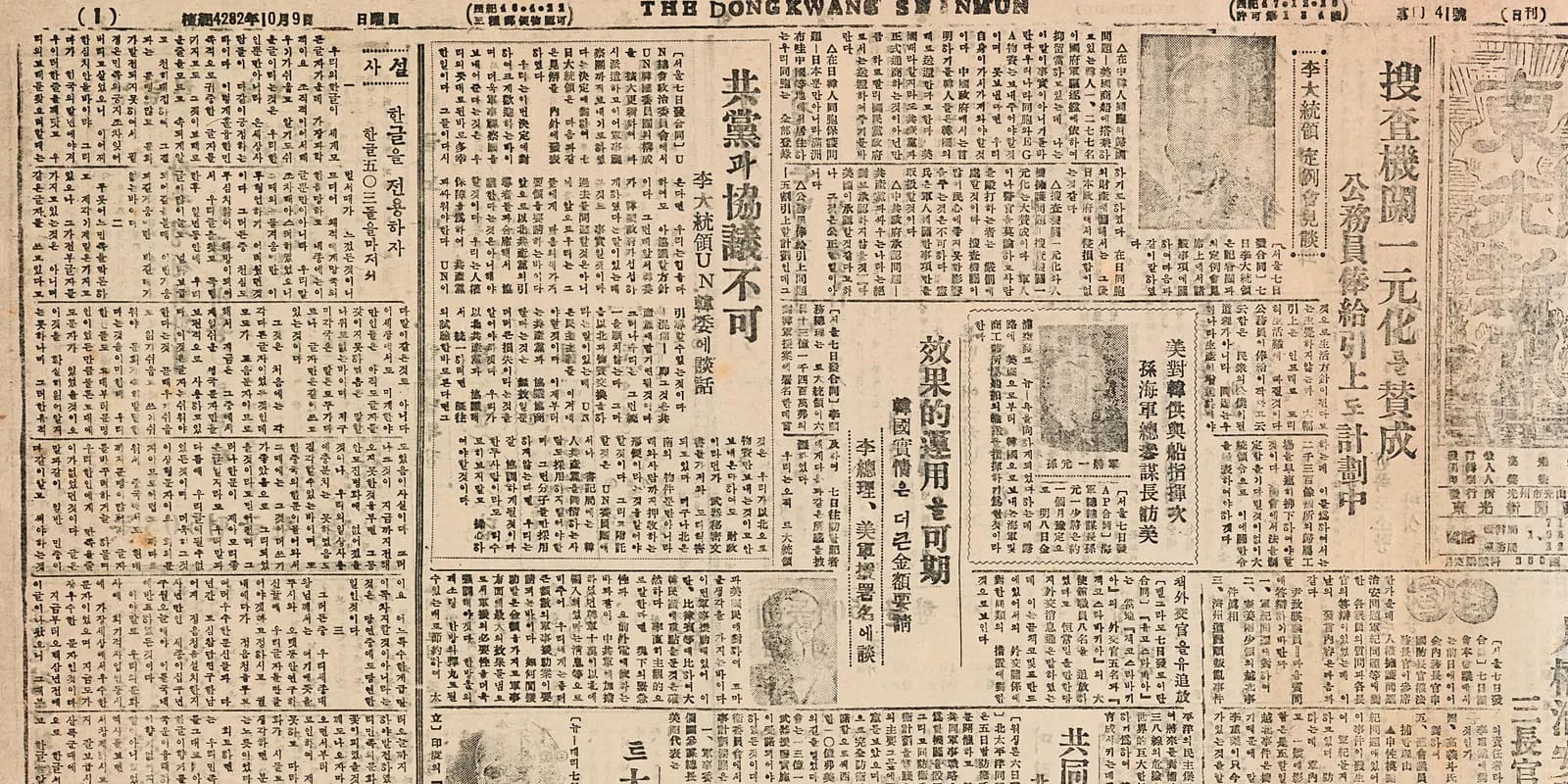
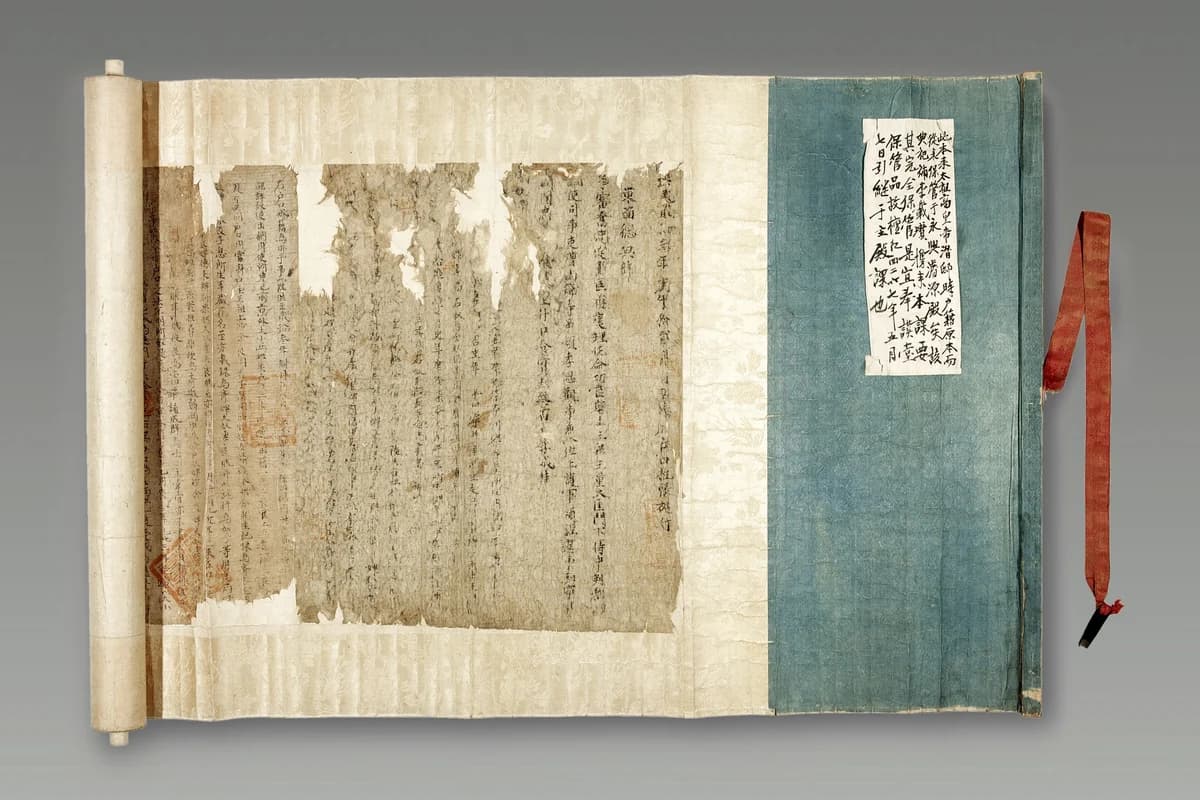
Images, cropped by us — chosen so that none of them is the 해례본, because a book missing from this article is the point of it. Listing card — bound volumes of the 조선왕조실록, the companion inscription on the same UNESCO register in the same year, catalogued by the heritage agency as the 태백산사고본; photograph Korea Heritage Service (국가유산청, formerly 문화재청), KOGL Type 1. One honest wrinkle: the accession label visible on the 광해군일기 volume reads 奎章閣圖書 / 서울大學校, which we could not reconcile with the agency's own designation, so we credit the designation and make no claim about custody. Cover — the front page of 『東光新聞』 for 9 October 1949, carrying at top left the editorial 「한글을 전용하자」, let us use hangul exclusively, marked as the alphabet's 503rd anniversary. Look at the typography rather than the words: the editorial is set almost entirely in hangul and every news column beside it is dense hanja. 1949 is the year 한글날 first became a public holiday — and the year 김태준 was shot. Public domain, scanned by the 국립중앙도서관. Hero — a physical 월인석보 dated by the National Museum of Korea to 1568, open at the 훈민정음 언해본: Sejong's preface in Korean translation, hanja carrying small hangul glosses and tone dots. Photograph Jocelyndurrey, CC BY-SA 4.0, so this crop carries the same share-alike terms.
Two notes on how those were checked. The museum's own display card for the 월인석보 was photographed in the adjacent upload and reads 「조선 1568년」 with no 복제 marker — which is how we know it is the object and not a reproduction, a check we now run after nearly publishing a replica last batch. And a fourth candidate was rejected for licence laundering of an unusually well-disguised kind: a photograph claimed as CC BY-SA "own work" by an individual, whose camera body and exposure settings are byte-identical to a confirmed heritage-agency studio file from the same August 2005 shoot. It was the best image of the four and we dropped it. We also cropped the newspaper short of the album's next sheet, where the scan catches a sliver of an unrelated Japanese-language page, and we widened the card by extending its plain studio background rather than cutting into the books.
Verified against primary and Korean-language sources. The UNESCO facts — the Memory of the World International Register, the 1997 inscription of the Hunminjeongum Manuscript, its custody at the Kansong Art Museum, and the Annals of the Joseon Dynasty as its companion — are from UNESCO's own register record, which also states the 1443 creation and 1446 publication. The 1997 register entry uses UNESCO's romanisation, which drops a letter from the now-standard one. The 상주본 chronology is from the court records and contemporaneous Korean reporting; the July 2019 Supreme Court passage is quoted from the judgment. We state plainly that the criminal acquittal is final and that the civil courts held title to be the state's, because these are both true and are routinely reported as though one cancels the other. The trillion-won figure is traced to a prosecution-commissioned appraisal of September 2011 by four bibliographers who expressly declined to value the book; it is not a market valuation and we do not present it as one. Prices stated by the holder are attributed to the outlets that printed them, and we do not characterise his motives. The holiday's legal history distinguishes throughout between the statute that confers 국경일 status and the presidential decree that confers a day off, because conflating them is what makes the 2006–2012 gap look like an error rather than a filing consequence. Deliberately omitted: the widely repeated claim that hangul itself is UNESCO World Heritage, which credible sources do not in fact make; a counter-valuation putting the 상주본 under ten billion won, which names no appraiser; an asset-declaration figure reported by a single outlet; North Korea's equivalent holiday and its different date, attested to us only by one wiki; and the 간송본's wartime survival story, which appears here explicitly as its owner's son's recollection rather than as record. The purchase year is left unresolved because two credible sources give 1940 and 1943.
Keep Reading
More Stories
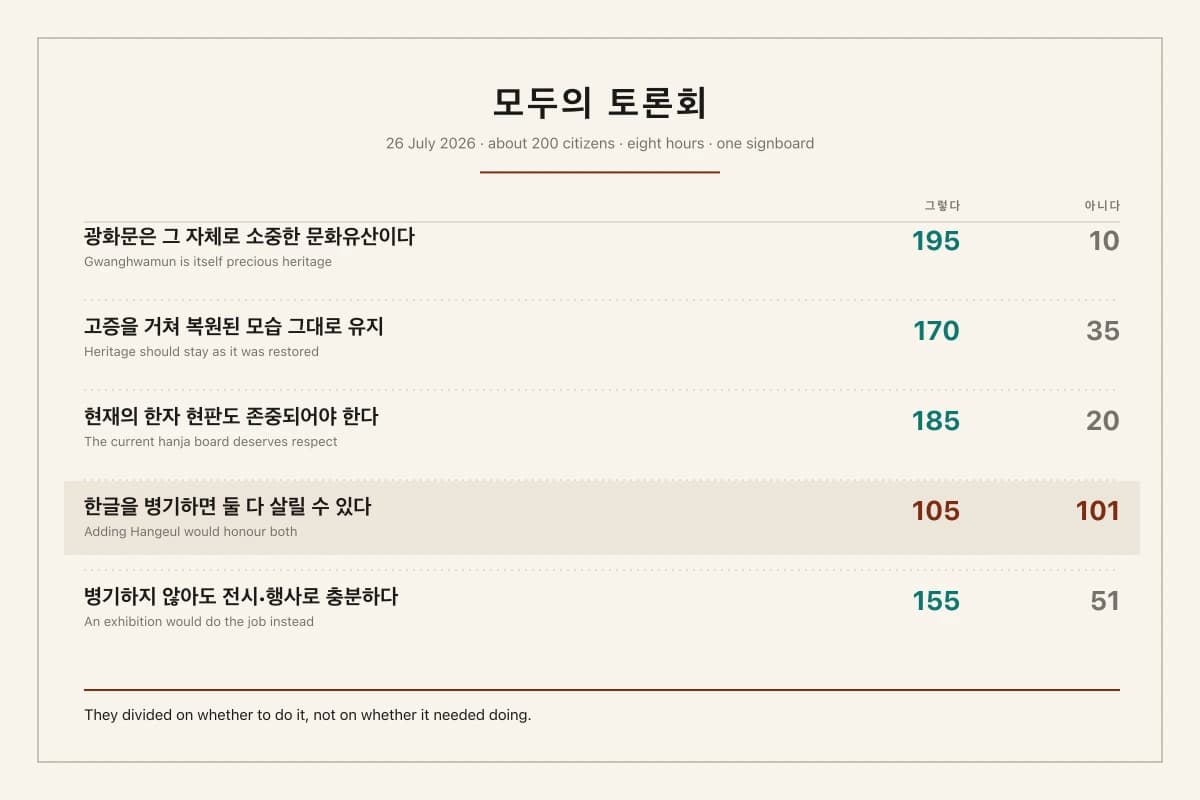
Korea Asked 200 Citizens Whether to Put a Hangeul Sign on Gwanghwamun. They Split 105–101, Then Voted 155–51 That It Is Not Needed.
The government convened its first-ever citizens' deliberation and spent eight hours on a signboard. The panel divided almost exactly in half on whether adding a Hangeul plaque would honour both the heritage and the alphabet — and then, overwhelmingly, said an exhibition would do the job instead. Both answers are coherent, which is the interesting part. The plaque they were arguing about is three years old, and the one before the one before it was in Park Chung-hee's handwriting.
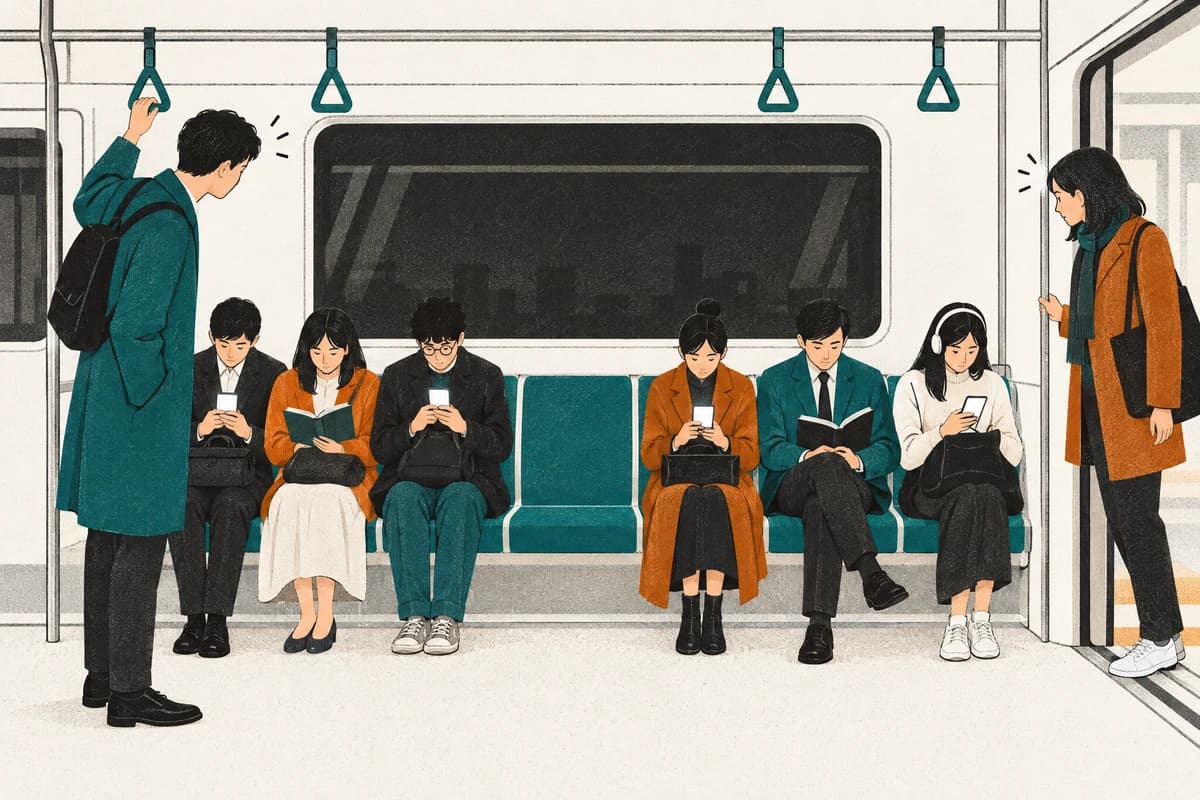
Koreans Have a Word for a Rule Everyone Follows. It Only Ever Gets Used for Rules Not Everyone Follows.
국룰 — gungnul — is Korean internet slang for an unwritten national consensus: the thing everybody does that nobody ever agreed to. It comes from a 2007 shooting game whose players had to invent their own duelling rules because the game had none. And the tell is in which things get called it. Nobody says murder is against 국룰. People say it about which sauce goes with pork belly, and then argue.
Who Decides What You Can Name Your Baby in Korea? The Supreme Court
A mother chose a character meaning 'beautiful' for her daughter. The clerk registered the child's name in hangul and left the character out — which is not a refusal but the legally correct outcome. Korea permits 9,389 Chinese characters in given names, more than China or Japan, and the list grows because parents get turned down. In April 2026 the Constitutional Court upheld the whole arrangement by a single vote.
The Weekly Dispatch
Korea, curated. Every week.
The best of K-culture, straight from Seoul. Written by people who actually live here.
Free, no spam, unsubscribe whenever.