Who Decides What You Can Name Your Baby in Korea? The Supreme Court
A mother chose a character meaning 'beautiful' for her daughter. The clerk registered the child's name in hangul and left the character out — which is not a refusal but the legally correct outcome. Korea permits 9,389 Chinese characters in given names, more than China or Japan, and the list grows because parents get turned down. In April 2026 the Constitutional Court upheld the whole arrangement by a single vote.
In February 2023, at a neighbourhood administration office in South Korea, a woman registered the birth of her daughter. She had chosen a two-syllable given name whose first syllable was to be written with the Chinese character 婡 — glossed in Korean as 예쁠 래, roughly beautiful.
The clerk did not refuse the name. The clerk did not send her away, or ask her to choose again, or tell her the name was illegal.
The clerk registered the child's name in hangul, as 래, and did not write the character down.
That is the correct legal outcome, and understanding why is the fastest route into one of the odder pieces of Korean administrative machinery: a country where the body deciding which characters may appear in your child's name is not a ministry, not a language academy, but the Supreme Court.
The First Surprise Is Who Owns the Register
In most countries, civil registration belongs to the executive. Births, deaths and marriages are a ministry's business.
In Korea they belong to the judiciary. The 법원행정처 — the National Court Administration, the Supreme Court's own administrative arm — runs the family relations register. It also runs the property register, through a national network of registry offices. Land and babies, filed by the same branch of government.
Japan is the instructive contrast, because the concept is nearly identical and the ownership is not: the Japanese 戸籍 family register runs through the Ministry of Justice's legal affairs bureaux. Japan has no court registry offices at all.
Korea very nearly went the same way, in public and with some heat. In 2002, while the country was arguing over whether family registration should be transferred to national administration, the Ministry of Justice argued that registration was state business, belonged to the ministry, and that having the Chief Justice run it offended the separation of powers. The Supreme Court replied that registration work is strongly judicial-administrative in character.
The judiciary won. When the old 호적 household-register system was abolished and rebuilt as 가족관계등록 in 2008, it stayed with the courts. Name changes, registry corrections and the rest are formally non-contentious judicial proceedings — which is the doctrinal reason the courts get to keep them.
We should be honest about the limits of that account: it explains the fight and the outcome, not the original intent. The reasoning behind the 1960 decision to hand this to the judiciary in the first place is not something we could establish from the record.
What You Are Actually Allowed to Use
Here the tiers matter enormously, because English writing on this subject collapses four different kinds of rule into the phrase "Korean law says." They are not the same, and the differences are the story.
The statute. 가족관계등록법 제44조 제3항 says a child's name shall use hangul or commonly used hanja, and that the scope of "commonly used hanja" is to be set by Supreme Court rule. That is an Act of the National Assembly, and all it really does is delegate.
The court rule. 가족관계의 등록 등에 관한 규칙 제37조 — headed 인명용 한자의 범위, the scope of characters for personal names — does the delegated work. And it does it in two halves. The permitted range is the 한문교육용 기초한자, the 1,800 basic teaching characters set by the Ministry of Education, plus the characters in the rule's own annex. A second annex separately whitelists variant and abbreviated forms.
So the list is not the court's alone. The education ministry owns the base layer and the court owns the extension, and two branches of government are stapled together inside a Korean child's name.
The total, today: 9,389 characters.
That number is worth setting against the Constitutional Court's own comparisons, because they are the strongest argument the system has. Japan permits 2,998 characters in names. China's general-use table runs to 8,105. Unicode's CJK block contains 98,682 characters — but only around 8,760 have a Korean reading assigned at all. Korea permits more name-characters than either neighbour, and more than any standard that has settled how the characters are pronounced in Korean.
And the fallback. 규칙 제37조 제3항: where a name uses a character outside the permitted range, the register records the child's name in hangul.
Not "the registration is rejected." The Constitutional Court has spelled this out itself: using an unlisted character does not cause the birth registration or the name to be refused. The child is registered. Only the characters are left off. And nothing prevents the family using those characters in private life — on a name card, in a diary, at a school, anywhere outside the register and the official documents chained to it.
Which means a hangul-only name is completely, unambiguously legal. It is the state's own default. Whatever else this system is, it is not a system that stops you naming your child.
The registrar's script follows from that. The office is directed to urge the parent to switch to a listed character; if the parent declines, the office must record the name in hangul. If an unlisted character slips through, an official corrects it on their own authority and must notify the family without delay.
The Machine Runs on Rejection
This is the part we find genuinely elegant, and it is invisible from outside.
When a local office records a name in hangul because the character wasn't listed, it does not simply move on. It writes down the character and how it is pronounced, and reports it upward to the supervising court by the tenth of the following month. Supervising courts compile these quarterly and report to the National Court Administration by the twentieth.
Rejected characters are the raw material of the permitted list.
Every few years the accumulated pile becomes an amendment. The Council of Supreme Court Justices votes; the Chief Justice promulgates. The 2024 amendment — promulgated 30 May, effective 11 June 2024 — added 1,070 characters and brought the list to 9,389. Its entire operative text is one sentence instructing that the two annexes be replaced.
Where did 1,070 characters come from? Commissioned research into characters that were already sitting in the name fields of the family register, from the era before any restriction existed. Among them: 㖀, 疋, 䬈, 汩. The court legalised names Koreans already had.
And if your character is one that gets added later, you do not need a court case to claim it. A single supplementary filing upgrades your hangul-only entry to hangul-plus-character. The state keeps a door open behind you.
The Rule With No Law Behind It
Now the rule everyone repeats, and the one nobody checks.
A Korean given name may not exceed five characters. The surname does not count — so 남궁 plus five syllables is seven and perfectly legal.
You will read that this is Korean law. It is not. It is not a statute, and it is not even a court rule. It lives in 「이름의 기재문자와 관련된 가족관계등록사무」, a 가족관계등록예규 — an internal administrative directive the Supreme Court issues to its own registrars. Its text simply instructs offices not to accept a birth registration whose given name exceeds five characters, on the reasoning that a name is a public designation with consequences for others, so names that are hard to understand or conspicuously inconvenient to use cannot be used.
Binding on every registrar in the country. Never voted by the legislature. The government's own plain-language legal portal cites the directive, not an act, as the source.
The rule dates from 1993, when its predecessor directive was issued in response to names running past ten characters. And it has consequences that outlive it, because it does not reach backwards.
박하늘별님구름햇님보다사랑스러우리 was born on 28 May 1985. Seventeen syllables including the surname; a given name of sixteen. Her father, told of her birth, looked up at the night sky, found the stars and the sky lovely, and named her after being more lovely than them.
It is a legal name. She was registered eight years before the cap existed, and the cap was never applied retroactively.
She goes by 박하우리 — the first two syllables and the last two — because her real name does not fit inside the country's own text boxes. It has failed real-name verification on websites and phone contracts. A bank field that stopped at ten characters forced the short form. A phone signup in December 2009 needed a manager to override the system.
(A 22-syllable name is often attributed to her older sister. It was never registered; the sister's registered name is 박하예진. The long version is a story about a name, not a name.)
So the state's stated reason for the cap — that unmanageable names cause real inconvenience — is demonstrated by the one person the cap does not apply to.
The Father Who Cut a Syllable Off His Son
The cap produced a second case, and this one changed the rule.
A Korean father, surname 김, and a Portuguese mother, surname 피레스, had a son registered in Portugal as 크리스티아누 피레스 김. Filing in Korea, they wanted 김 크리스티아누.
크리스티아누 is six syllables. One too many.
They registered the child as 김 크리스티아. They cut a letter off their son's name at the counter and then applied to the courts to get it back.
An exception for mixed-nationality families did exist. It ran in exactly one direction: it covered a foreign father and a Korean mother, permitting the name as recorded in the father's country. A Korean father and a foreign mother got nothing. The family fell into the gap precisely because the Korean parent was the father.
The route out was not litigation. A public-interest legal centre published the argument that a directive capping name length lacked statutory basis, and petitioned for amendment. On 20 June 2025 the Supreme Court amended its own directive, adding the mirror case: Korean father, foreign mother, name as recorded in the mother's country. Promulgated and effective the same day.
It was not, as often reported, a relaxation of the cap for mixed-nationality parents. The exception already existed. What changed was that it stopped running only through fathers.
And it applies backwards. Families who had already registered a truncated name can fix it with a supplementary filing — no name-change petition required. Names like 김 아름다운지수 and 알렉산드리나 became registrable with a Korean surname.
Four Rules You Would Not Guess
Register your child about fifteen years late and the character list stops applying. Bring a diploma, a licence or an insurance certificate showing the name is genuinely in use in society, and the directive lets it through. Proof of use beats the whitelist.
You may not name a baby after a family member. A birth registration bearing the same name as someone already appearing on the parents' own family relations certificate must not be accepted — the register refuses ambiguity, not sentiment.
You may mix scripts inside one name. Hangul and permitted hanja together in the same name field is registrable.
And if you end up disliking your name, the bar is low. Changing it requires family court permission, and since a 2005 Supreme Court decision the standard has been to grant it unless the application is an abuse — dodging a crime or a legal restriction. In 2009 the Supreme Court overturned a refusal for a man who wanted a change because his name was, in his words, common, characterless and out of date. A lower court had suspected he was evading bankruptcy restrictions. The Supreme Court held that using a name of one's own choosing is an ordinary part of the right of personality, and that even a name your parents gave you is not something the law can compel you to keep. It also noted — closing the circle — that his own character was not among the commonly used ones, so his name could not be properly read or typed.
One Vote
On 29 April 2026, the Constitutional Court decided the case of the mother and the character 婡. She had filed in February 2023, sixteen days after the clerk left it out.
The Court upheld the restriction. Five to four.
The majority's position is that a register has to hold characters that the members of a society actually read and use. The dissenters — four of nine — held that a name is the concentrated expression of individual identity, and that this is not the state's call.
The Court had reached the same conclusion once before, in 2016, rejecting a father's complaint over a different character when the list stood at 8,142. That time three justices dissented. Eight years and 1,247 characters later, the dissent had grown to four.
The most interesting exchange is about hanja itself. The dissent leans on the fact that Chinese characters have receded enormously from Korean written life. The majority answers that directly and refuses the inference: a decline in the weight and importance of hanja in national literacy is not a reason to conclude that the need to restrict has shrunk or disappeared.
That is where this rests. Not resolved, not reformed — upheld by one vote, four months ago, with four justices on record that it should not have been.
Meanwhile the machine keeps running. Somewhere this month, a local office is writing down a character it would not accept, and its pronunciation, to be reported upward by the tenth of next month.
For the other half of the Korean naming story — why a fifth of the country is called Kim, and what happens to a surname at a passport desk — see why so many Koreans are named Kim. And if you're wondering what happened when Korea last overhauled a naming-adjacent rule that everyone had learned to live with, the age system is the counter-example: that one actually got settled.
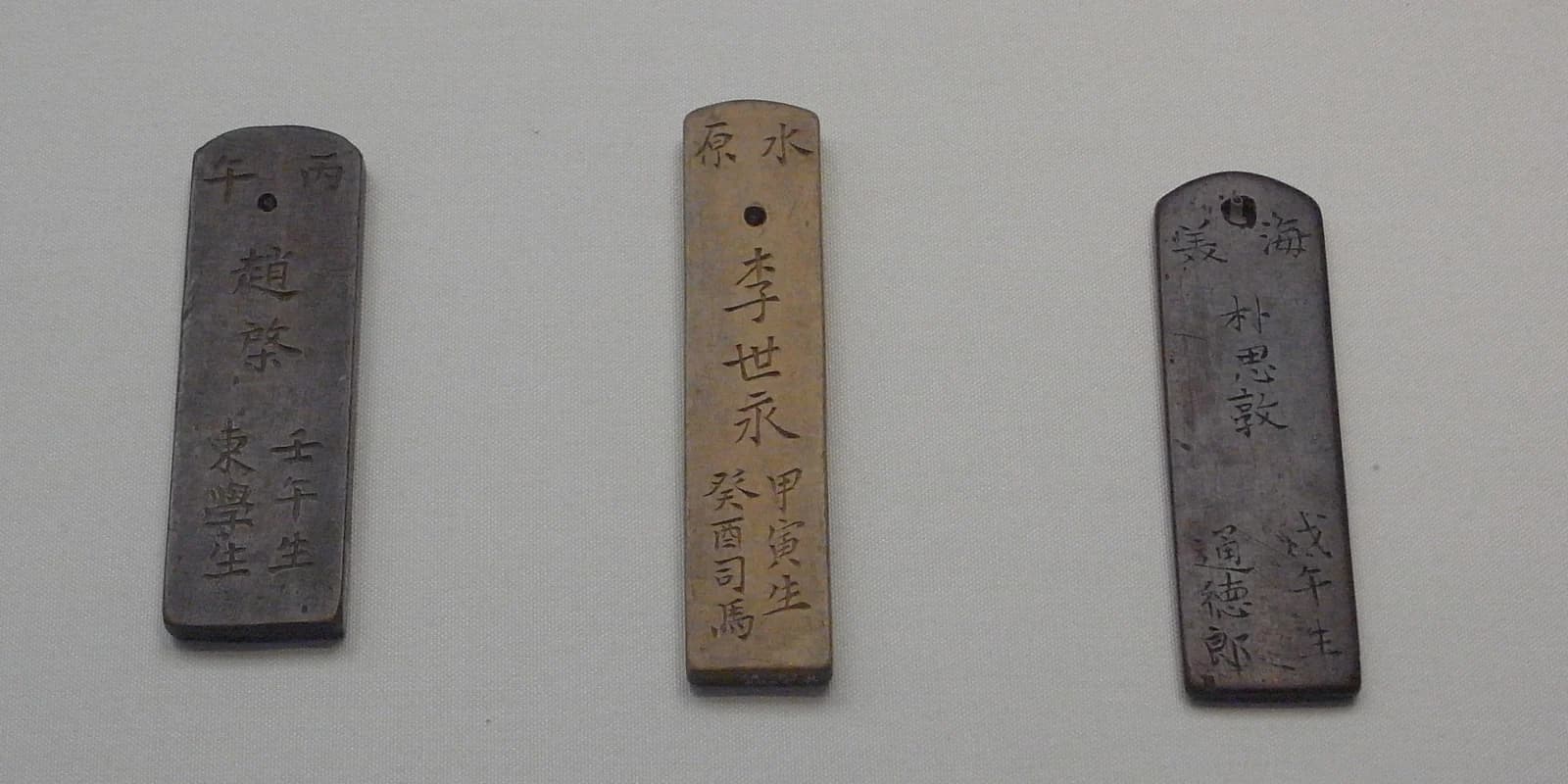
Images, cropped by us — all three pre-modern objects, with no identifiable person in any frame. Hero — 어정규장전운 (1796), the rhyme dictionary of Chinese characters commissioned by King Jeongjo, open at the index; the page tallies its own contents at 13,345 characters, which is a Korean court counting its characters two centuries before this article's 9,389. Photograph 국립중앙박물관, KOGL Type 1. It is not the modern 인명용 한자 list. Cover — three Joseon 호패 identity tags, each carved with one man's name, birth year and rank: the state cutting a name in hanja onto an official tag tied to the household register. Photograph Eggmoon, CC BY-SA 3.0 via Wikimedia Commons. Listing card — a household register from Hwaryeong-bu written in the late Goryeo dynasty, National Treasure No. 131, the distant ancestor of the register the Supreme Court runs today and not a modern family relations certificate. Photograph 국립중앙박물관, KOGL Type 1. We deliberately used no photograph of a baby: this article is about a legal dispute, and attaching an identifiable infant to a piece about state restriction fails our dignity standard regardless of licence. Every document shown predates 1900, so no living person's registration data appears; a museum accession label was cropped out of the hero. One dead end: we found no licence-clean specimen of a blank modern 가족관계증명서 and substituted nothing for it.
Verified against primary Korean legal sources. 규칙 제37조 and the full text of 가족관계등록예규 제638호 were read directly on 국가법령정보센터 (law.go.kr), as was the Supreme Court rule amendment history; 가족관계등록법 제44조 제3항 is quoted from the Constitutional Court's own statement of the provision under review, a primary source at one remove. We distinguish throughout between statute, court rule, administrative directive and case law, because the five-character cap is a directive and is very widely misreported as law. The 2026 decision (5–4, 29 April 2026), the 2016 decision, the comparative character counts and the Court's quoted reasoning are from the decision texts. The 1,070-character 2024 expansion and its origin in pre-restriction register entries are from the 대법원 press release of 23 May 2024. The five-character cap's 1993 origin is attested by Korean reporting but the pre-2008 directive series is not in the current public database, so we date it to 1993 without a document number. Deliberately omitted: the initial 1991 designation figure, where a contemporaneous 국립국어원 account and secondary tables disagree by two characters over what was actually enacted; annual name-change volumes, where at least four mutually incompatible series circulate and none could be tied to 사법연감; any percentage for hanja-free registrations, for which we found no defensible figure; a reported refusal of a hangul syllable, which we could not corroborate and which would matter a great deal if true; and the claim that the sixteen-syllable name appears in short form on a passport, which conflicts with how passport names are derived. The 22-syllable "sister's name" is explicitly identified as unregistered.
Keep Reading
More Stories
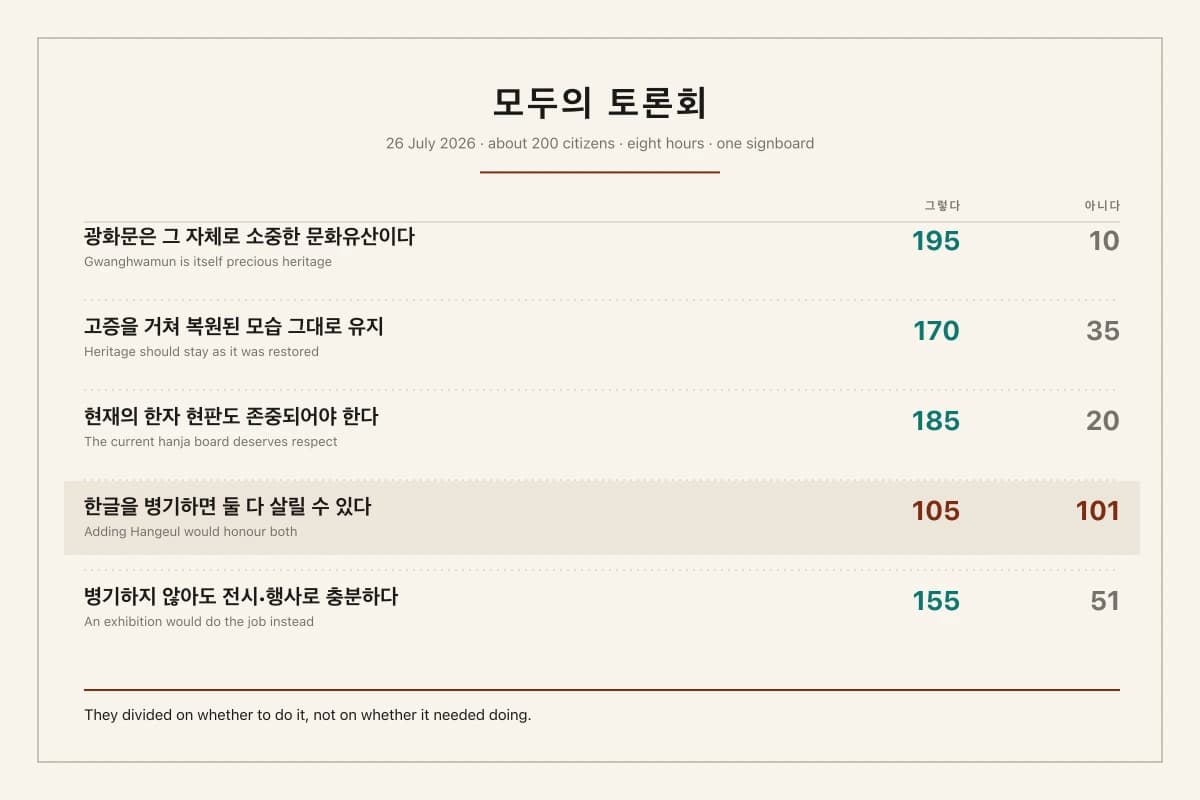
Korea Asked 200 Citizens Whether to Put a Hangeul Sign on Gwanghwamun. They Split 105–101, Then Voted 155–51 That It Is Not Needed.
The government convened its first-ever citizens' deliberation and spent eight hours on a signboard. The panel divided almost exactly in half on whether adding a Hangeul plaque would honour both the heritage and the alphabet — and then, overwhelmingly, said an exhibition would do the job instead. Both answers are coherent, which is the interesting part. The plaque they were arguing about is three years old, and the one before the one before it was in Park Chung-hee's handwriting.
Koreans Have a Word for a Rule Everyone Follows. It Only Ever Gets Used for Rules Not Everyone Follows.
국룰 — gungnul — is Korean internet slang for an unwritten national consensus: the thing everybody does that nobody ever agreed to. It comes from a 2007 shooting game whose players had to invent their own duelling rules because the game had none. And the tell is in which things get called it. Nobody says murder is against 국룰. People say it about which sauce goes with pork belly, and then argue.
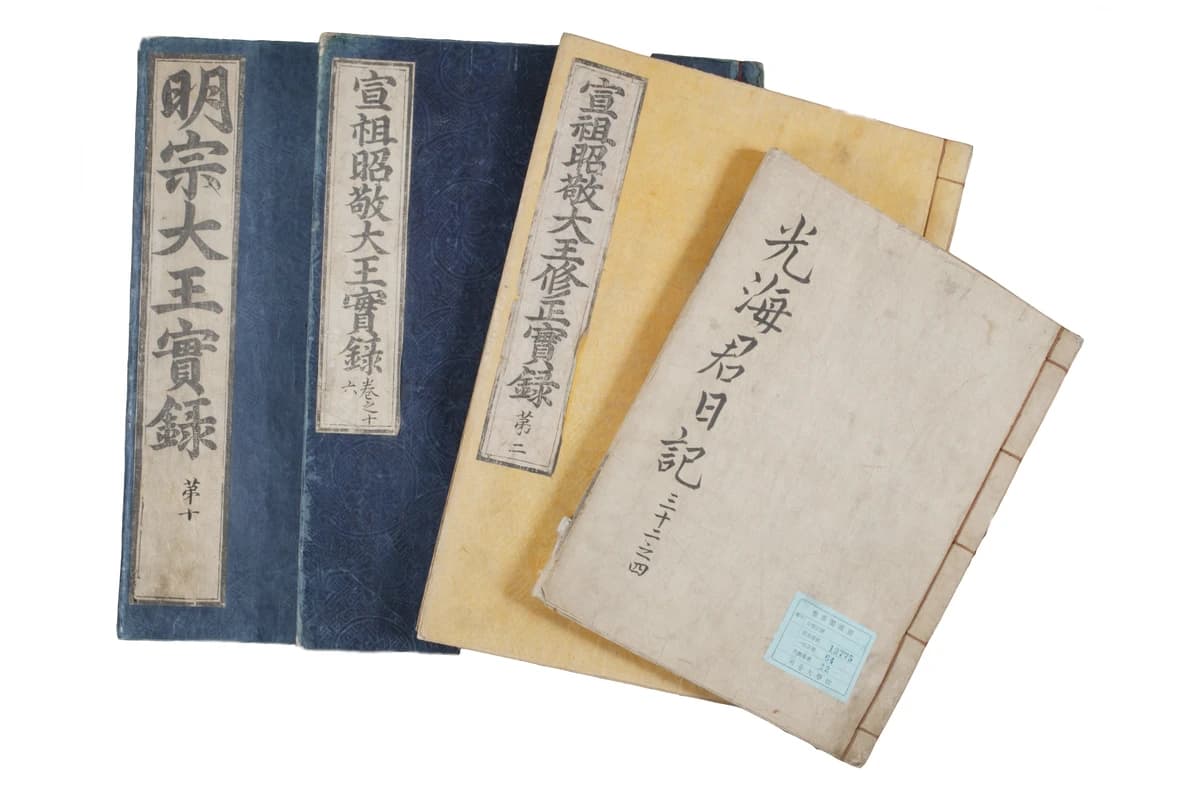
Hangul Day Exists Because a Book Turned Up in 1940. Nobody Can Find the Other Copy.
The date of Korea's alphabet holiday moved four times before a single physical book settled it — and that book arrived missing its first four pages, including King Sejong's own preface, which a calligrapher reconstructed by hand with a typo still in it. A second copy has been in a private house since 2008. The prosecution's own appraisers valued it at over a trillion won. Nobody has seen it since a fire in 2015.
The Weekly Dispatch
Korea, curated. Every week.
The best of K-culture, straight from Seoul. Written by people who actually live here.
Free, no spam, unsubscribe whenever.